A French Word to Live By
Translate Esclave to English
/ɛs.klav/
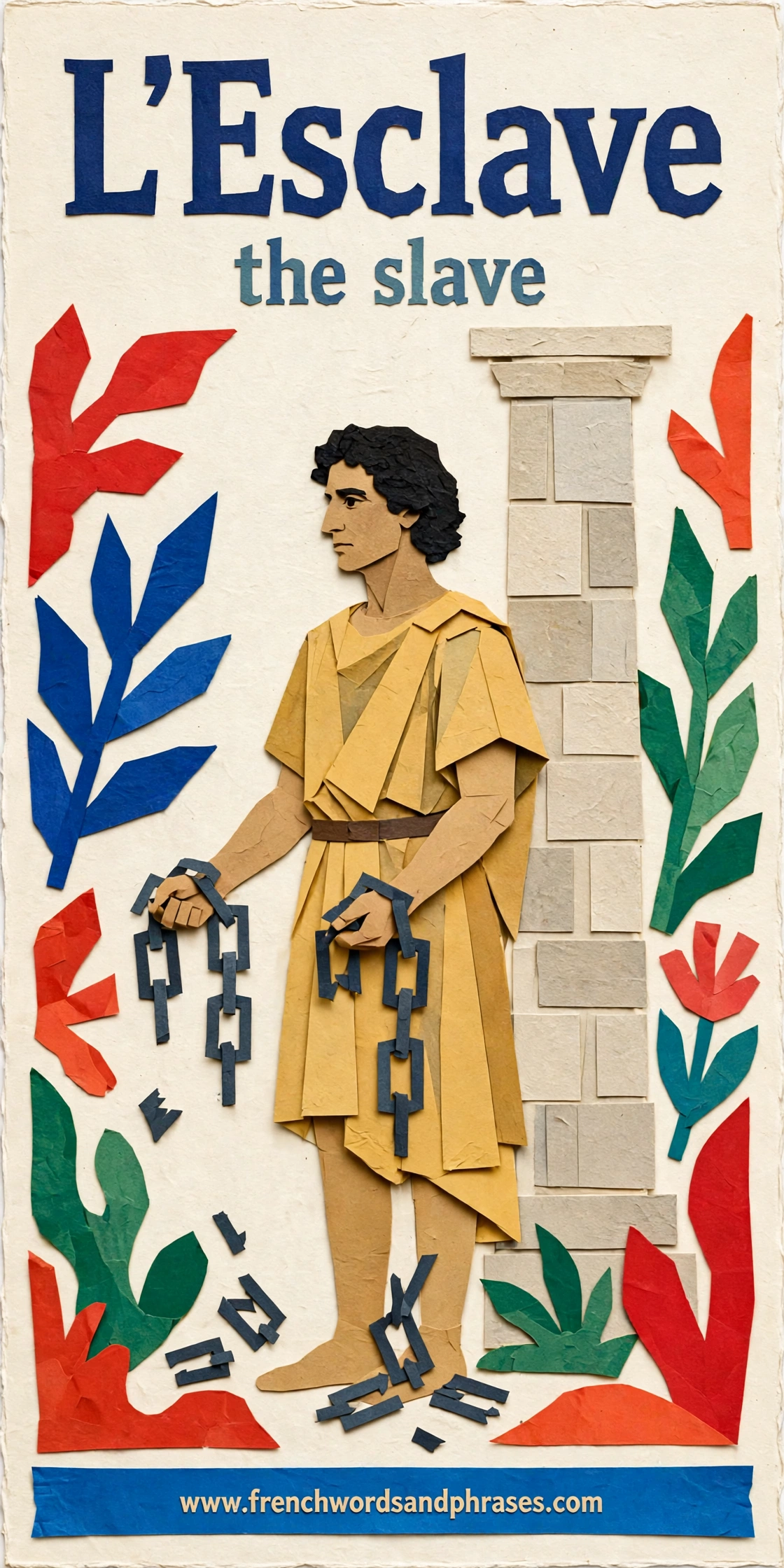
L’Esclave means the slave.
It is the heaviest word in this run: the human being owned by another, in the holds of ships and the pages of history books: l’esclave, the slave — a word French keeps for history, for memory, and for the metaphors of everything that enslaves us still.
In this guide, you’ll learn what esclave means in English, how to use it with its articles, how to form its plural, and how it appears in everyday French. Explore French examples, English translations, and practice quizzes.
Understanding the French Noun Esclave
Esclave is a French noun that works for both genders — un esclave for a man, une esclave for a woman; it is an epicene noun, its article following the person. It begins with a vowel, so the definite article melts: l’esclave. Its origin is a whole history lesson: medieval Latin sclavus, from the Slavs, so many of whom were enslaved in the early Middle Ages that their name became the word itself.
Its literal sense belongs to history: a person owned as property, deprived of freedom — les esclaves des plantations, the slaves of the plantations, la traite des esclaves, the slave trade, abolir l’esclavage, to abolish slavery (France did so finally in 1848). Its living sense is figurative: être l’esclave de son travail, to be a slave to one’s work, esclave de ses habitudes, a slave to one’s habits — the word survives wherever freedom is lost to a master, a screen or a routine.
Gender: Epicene — un esclave (a man), une esclave (a woman)
Definite article: l’ — l’esclave (the slave), melted before the vowel
Indefinite article: un / une — according to the person
Plural: les esclaves — regular, with a simple -s
Spelling note: from sclavus, the Slav — a people’s name that became the word for slave
Key noun: l’esclavage — slavery; abolition in France: 1848
English equivalents: The slave.
Because esclave begins with a vowel, the possessives for a woman still use the masculine-looking forms in the singular: son esclave for his or her (female) slave is written with son to avoid the clash of vowels — exactly like son amie. The figurative use is the everyday one: je ne suis pas ton esclave !, I am not your slave, and the thoughtful esclave de la mode, a slave to fashion.
Experience the Word
Esclave is the word of freedom’s opposite — the person treated as a thing, whose name history must not lose.
Imagine the memorial at Nantes, the great slave-trading port, where the names of ships are set into the quay stone by stone — each one carried des esclaves whose own names were never written down.
You have not just named a victim of history. You have named the condition freedom defines itself against — l’esclave, and the long road to l’abolition.
How to Use Esclave in French: Complete Guide
Let’s explore how esclave works in French, beginning with its articles — l’esclave, un esclave, une esclave.
Esclave with the Definite Article (L’, Les)
The article melts before the vowel: l’esclave, for a man or a woman.
| Form | French |
|---|---|
| Singular (man or woman) | l’esclave |
| Plural | les esclaves |
Example
L’esclave affranchi a fondé un village libre.
The freed slave founded a free village.
Esclave with the Indefinite Article (Un, Une)
The indefinite article follows the person: un esclave for a man, une esclave for a woman.
| Form | French |
|---|---|
| A man | un esclave |
| A woman | une esclave |
| Plural | des esclaves |
Example
Une esclave de la plantation a raconté son histoire.
A woman slave from the plantation told her story.
Esclave in History (La traite, L’abolition…)
The vocabulary of the history books — the words this noun keeps company with.
| Expression | French |
|---|---|
| the slave trade | la traite des esclaves |
| slavery | l’esclavage |
| to abolish slavery | abolir l’esclavage |
| a freed slave | un esclave affranchi |
| a slave ship | un navire négrier |
Example
La France a aboli l’esclavage en 1848.
France abolished slavery in 1848.
Quick Quiz 1
Complete the sentence:
______ esclave a été libéré en 1848. (the)
Reveal the answer
L’
L’esclave a été libéré en 1848.
The slave was freed in 1848 — le melts into l’ before the vowel.
The Plural of Esclave
Esclave takes a regular plural in -s — the plural of the history books and the memorials.
| Number | French |
|---|---|
| Singular | l’esclave |
| Plural | les esclaves |
Example
Les esclaves travaillaient dans les plantations de canne à sucre.
The slaves worked in the sugar-cane plantations.
Esclave with Possessive Adjectives (Mon, Ton, Son…)
Before a vowel, the feminine possessives ma, ta, sa become mon, ton, son — even for a woman.
| Owner | French |
|---|---|
| my | mon esclave |
| your (tu) | ton esclave |
| his / her | son esclave |
| our | notre esclave |
| your (vous) | votre esclave |
| their | leur esclave |
Example
Je ne suis pas ton esclave, fais-le toi-même !
I am not your slave, do it yourself!
Quick Quiz 2
How do you say a woman slave — un esclave or une esclave?
Reveal the answer
une esclave
Esclave is epicene: the article follows the person — un esclave for a man, une esclave for a woman.
A woman slave.
Esclave with Demonstrative Adjectives (Cet, Ces)
Used to point: cet esclave, cette esclave — cet before the vowel for a man, cette for a woman.
| Form | French |
|---|---|
| A man | cet esclave |
| A woman | cette esclave |
| Plural | ces esclaves |
Example
Cette esclave a gagné sa liberté et celle de ses enfants.
This slave woman won her freedom and her children’s.
Esclave in the Figurative Sense (Esclave de…)
The living use of the word: a slave to work, to habits, to fashion — always with de.
| Expression | French |
|---|---|
| a slave to one’s work | l’esclave de son travail |
| a slave to fashion | un esclave de la mode |
| a slave to one’s habits | esclave de ses habitudes |
| a slave to one’s phone | esclave de son téléphone |
| to be a slave to | être l’esclave de |
Example
Il est l’esclave de son téléphone, il le regarde cent fois par jour.
He is a slave to his phone, he looks at it a hundred times a day.
Quick Quiz 3
Complete the sentence:
Elle est ______ de ses habitudes. (a slave)
Reveal the answer
esclave
Elle est esclave de ses habitudes.
She is a slave to her habits — the figurative phrase takes de.
Everyday Expressions with Esclave
History lessons and modern metaphors — the esclave phrases of daily life.
| Expression | In English |
|---|---|
| la traite des esclaves | the slave trade |
| abolir l’esclavage | to abolish slavery |
| être l’esclave de | to be a slave to |
| je ne suis pas ton esclave | I am not your slave |
| un esclave affranchi | a freed slave |
Example
Le musée raconte l’histoire des esclaves de l’île.
The museum tells the story of the island’s slaves.
Words from the Same Family as Esclave
Slavery and freedom — the words that travel with esclave.
| French | In English |
|---|---|
| l’esclavage | slavery |
| affranchir | to free (a slave), to emancipate |
| la liberté | freedom, liberty |
| un maître | a master |
| l’abolition | the abolition |
Example
L’abolition de l’esclavage est célébrée chaque année.
The abolition of slavery is commemorated every year.
Quick Quiz 4
What is l’esclavage?
Reveal the answer
Slavery — the system itself, where esclave is the person.
L’esclavage a été aboli en 1848.
Slavery was abolished in 1848.
Esclave in Everyday French: Real-Life Examples
Now that you know the word, let’s see how esclave appears in everyday French.
Example 1 — History
Les esclaves ont construit ces murs il y a deux siècles.
The slaves built these walls two centuries ago.
Example 2 — The museum
Ce musée raconte la vie des esclaves.
This museum tells the story of the slaves’ lives.
Example 3 — A protest
Je ne suis pas ton esclave !
I am not your slave!
Example 4 — Work
Il est l’esclave de son travail, il ne s’arrête jamais.
He is a slave to his work, he never stops.
Example 5 — Fashion
Esclave de la mode, elle achète tout ce qui paraît.
A slave to fashion, she buys everything that comes out.
Example 6 — Freedom
L’esclave affranchi a écrit ses mémoires.
The freed slave wrote his memoirs.
Beyond Translation: The Meaning of Esclave
Few French words carry so much history in so few letters. Esclave descends from the name of the Slavs, enslaved in such numbers in the early Middle Ages that their people’s name became Europe’s word for a human being owned. French history wrote the word large — the Code Noir, the plantations of the Caribbean, the abolition of 1794, its restoration, and the final abolition of 1848 driven by Victor Schœlcher. Today the literal sense belongs to memorials and museums; the figurative one — esclave de son travail, de son téléphone — keeps the word’s warning alive in everyday speech.
To say esclave is to name what freedom is not — and to remember those who were denied it.
It evokes memorial stones, sugar plantations and the modern joke that is only half a joke: esclave de son téléphone.
How to Remember the French Noun Esclave
Remember it this way: Esclave is epicene — un esclave, une esclave — with l’ before the vowel; its noun is l’esclavage, slavery.
- Both genders — un esclave, une esclave; the article melts: l’esclave.
- The history pair — la traite des esclaves, the slave trade; abolir l’esclavage, 1848.
- The living metaphor — être l’esclave de son travail, to be a slave to one’s work.
The key idea is l’esclave — the slave, un/une by person; l’esclavage = slavery.
Test Your Knowledge of Esclave
Let’s see how much you’ve learned. Try answering these questions before revealing the answers.
Question 1
How do you say a woman slave?
Reveal the answer
Une esclave — the noun is epicene; the article follows the person.
Question 2
What is the French for slavery?
Reveal the answer
L’esclavage.
Question 3
Translate: I am not your slave!
Reveal the answer
Je ne suis pas ton esclave !
Question 4
When did France finally abolish slavery?
Reveal the answer
In 1848 — la France a aboli l’esclavage en 1848.
Question 5
Complete the sentence:
______ esclaves travaillaient dans les plantations. (the)
Reveal the answer
Les
Les esclaves travaillaient dans les plantations.
The slaves worked in the plantations.
Your Final Challenge
Can You Use It?
How would you say this in French?
“France abolished slavery in 1848.”
Reveal the answer
La France a aboli l’esclavage en 1848.
France abolished slavery in 1848.
A little French. A little curiosity. A richer everyday life.
LEARN FRENCH ONE WORD AT A TIME