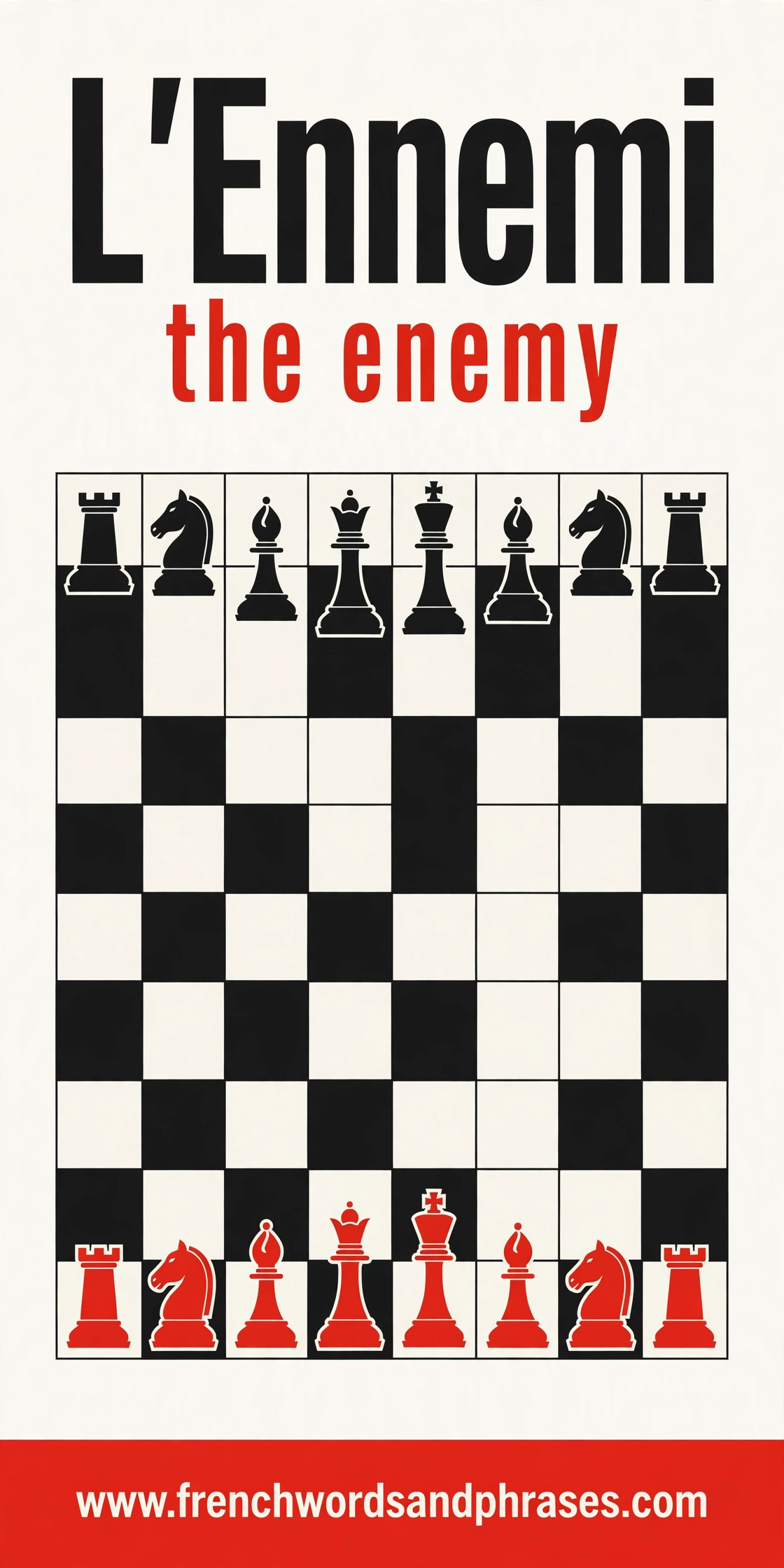
A French Word to Live By
Translate Ennemi to English
/ɛn.mi/
L’Ennemi means the enemy.
Two flags face each other across a battlefield map; two chess players lean over the same board; a voice on the radio speaks of l’ennemi public numéro un: l’ennemi, the enemy — the one who wishes you harm and works for your defeat, in war, in games and in the proverbs of everyday life.
In this guide, you’ll learn what ennemi means in English, how to use it with its articles, how to form its plural, and how it appears in everyday French. Explore French examples, English translations, and practice quizzes.
Understanding the French Noun Ennemi
Ennemi is a masculine French noun, learned with its article: l’ennemi, un ennemi — with une ennemie for a woman. It begins with a vowel, so the definite article melts into it: l’ennemi. Its Latin ancestor is a small tragedy: inimicus — in-, not, plus amicus, a friend: the enemy is, word for word, the not-friend.
It means an enemy — a person, army or country opposed to you: l’ennemi attaque à l’aube, the enemy attacks at dawn, un ennemi juré, a sworn enemy, se faire des ennemis, to make enemies. Beyond the battlefield it names anything hostile to a cause: l’ennemi du progrès, the enemy of progress, and the proverb’s wisdom: le meilleur est l’ennemi du bien — the best is the enemy of the good, France’s beloved warning against perfectionism.
Gender: Masculine — l’ennemi (feminine: une ennemie)
Definite article: l’ — l’ennemi (the enemy), melted before the vowel
Indefinite article: un — un ennemi (an enemy); une ennemie for a woman
Plural: les ennemis — regular, with a simple -s
Spelling note: from Latin inimicus — in- (not) + amicus (friend): the not-friend
Key proverb: le meilleur est l’ennemi du bien — the best is the enemy of the good
English equivalents: The enemy, the foe.
Ennemi works as an adjective too: un pays ennemi, an enemy country, des troupes ennemies, enemy troops — it agrees like any adjective. The feminine noun une ennemie exists and is used. In games and sport the word stays gallant: your opponent at chess is un adversaire; ennemi is heavier, reserved for real hostility — or for the mock-heroic language of playgrounds and politics.
Experience the Word
Ennemi is the mirror word of ami: the same Latin friend, negated — the person who stands exactly where the friend would have stood, facing the other way.
Imagine the chess club on a wet evening: two old friends hunched over the board, and for one hour, by agreement and with delight, chacun devient l’ennemi de l’autre — then they shake hands and the friendship resumes.
You have not just named an opponent. You have named the not-friend — l’ennemi, hostility with a face.
How to Use Ennemi in French: Complete Guide
Let’s explore how ennemi works in French, beginning with its articles — l’ennemi, un ennemi, se faire des ennemis.
Ennemi with the Definite Article (L’, Les)
The article melts before the vowel: l’ennemi, the enemy in question.
| Form | French |
|---|---|
| Masculine singular | l’ennemi |
| Plural | les ennemis |
Example
L’ennemi a reculé pendant la nuit.
The enemy withdrew during the night.
Ennemi with the Indefinite Article (Un, Des)
Used for an enemy in general — one foe among possible foes; une ennemie for a woman.
| Form | French |
|---|---|
| Masculine singular | un ennemi |
| Feminine singular | une ennemie |
| Plural | des ennemis |
Example
Elle s’est fait une ennemie en disant la vérité.
She made an enemy (a woman) by telling the truth.
Ennemi with Its Verbs (Combattre, Se faire…)
Enemies are fought, made and faced — the verbs of hostility.
| Verb | French |
|---|---|
| to fight the enemy | combattre l’ennemi |
| to make enemies | se faire des ennemis |
| to face the enemy | faire face à l’ennemi |
| to defeat the enemy | vaincre l’ennemi |
| to have enemies | avoir des ennemis |
Example
En parlant trop franchement, il s’est fait des ennemis.
By speaking too frankly, he made enemies.
Quick Quiz 1
Complete the sentence:
______ ennemi principal du jardinier, c’est la limace. (the)
Reveal the answer
L’
L’ennemi principal du jardinier, c’est la limace.
The gardener’s main enemy is the slug — le melts into l’ before the vowel.
The Plural of Ennemi
Ennemi takes a regular plural in -s — enemies rarely travel alone.
| Number | French |
|---|---|
| Singular | l’ennemi |
| Plural | les ennemis |
Example
Les ennemis de la réforme sont nombreux.
The enemies of the reform are numerous.
Ennemi with Possessive Adjectives (Mon, Ton, Son…)
Possessives agree with the noun: ennemi is masculine, so mon, ton, son in the singular.
| Owner | French |
|---|---|
| my | mon ennemi |
| your (tu) | ton ennemi |
| his / her | son ennemi |
| our | notre ennemi |
| your (vous) | votre ennemi |
| their | leur ennemi |
Example
Son ennemi juré habite le même village.
His sworn enemy lives in the same village.
Quick Quiz 2
Complete the sentence:
Au jeu d’échecs, chacun est ______ ennemi pendant une heure. (the other’s / each other’s)
Reveal the answer
l’ennemi de l’autre
Au jeu d’échecs, chacun est l’ennemi de l’autre pendant une heure.
At chess, each is the other’s enemy for an hour — l’ennemi, with the melted article.
Ennemi with Demonstrative Adjectives (Cet, Ces)
Used to point: cet ennemi, this enemy — cet, because the noun begins with a vowel.
| Form | French |
|---|---|
| Masculine singular | cet ennemi |
| Plural | ces ennemis |
Example
Cet ennemi-là est plus dangereux qu’il n’en a l’air.
That enemy is more dangerous than he looks.
Ennemi with Adjectives
Adjectives agree with ennemi — and ennemi itself can be the adjective: des troupes ennemies.
| Adjective | With Ennemi |
|---|---|
| juré (sworn) | un ennemi juré |
| principal (main) | l’ennemi principal |
| public (public) | l’ennemi public numéro un |
| mortel (mortal) | un ennemi mortel |
| as adjective (enemy) | des troupes ennemies |
Example
Les troupes ennemies ont quitté la plaine.
The enemy troops left the plain.
Quick Quiz 3
Complete the sentence:
C’est un ennemi ______, il ne pardonnera jamais. (sworn)
Reveal the answer
juré
C’est un ennemi juré, il ne pardonnera jamais.
He is a sworn enemy, he will never forgive — juré, masculine, to agree with ennemi.
Everyday Expressions with Ennemi
Battlefields, proverbs and playgrounds — the ennemi phrases of daily life.
| Expression | In English |
|---|---|
| un ennemi juré | a sworn enemy |
| se faire des ennemis | to make enemies |
| l’ennemi public numéro un | public enemy number one |
| le meilleur est l’ennemi du bien | the best is the enemy of the good (proverb) |
| passer à l’ennemi | to go over to the enemy |
Example
Le meilleur est l’ennemi du bien : publie ton livre au lieu de le corriger sans fin.
The best is the enemy of the good: publish your book instead of correcting it endlessly.
Words from the Same Family as Ennemi
Hostility and its opposites — the words that travel with ennemi.
| French | In English |
|---|---|
| un ami | a friend — the Latin twin, amicus |
| un adversaire | an opponent, an adversary |
| hostile | hostile (adjective) |
| la guerre | war |
| un allié | an ally — the opposite |
Example
Hier ennemis, aujourd’hui alliés : l’histoire tourne vite.
Enemies yesterday, allies today: history turns fast.
Quick Quiz 4
What does the proverb « le meilleur est l’ennemi du bien » teach?
Reveal the answer
That perfectionism spoils good work — the best is the enemy of the good.
Finis ton tableau, le meilleur est l’ennemi du bien.
Finish your painting, the best is the enemy of the good.
Ennemi in Everyday French: Real-Life Examples
Now that you know the word, let’s see how ennemi appears in everyday French.
Example 1 — History
L’ennemi a attaqué la ville à l’aube.
The enemy attacked the town at dawn.
Example 2 — Politics
Les ennemis de la loi manifestent devant l’Assemblée.
The enemies of the law are demonstrating outside the Assembly.
Example 3 — Frankness
À force de tout dire, elle s’est fait des ennemis.
By saying everything, she made enemies.
Example 4 — The garden
L’ennemi du potager, ce sont les limaces.
The vegetable garden’s enemy is slugs.
Example 5 — A proverb
Le meilleur est l’ennemi du bien, souviens-t’en.
The best is the enemy of the good, remember it.
Example 6 — Games
Aux échecs, mon ennemi est aussi mon meilleur ami.
At chess, my enemy is also my best friend.
Beyond Translation: The Meaning of Ennemi
Ennemi is ami read in a mirror: Latin amicus, the friend, with the little prefix in- that negates everything it touches — inimicus, the not-friend. French kept the word heavy: lighter contests get adversaire or rival, but ennemi is for real hostility, declared or sworn — un ennemi juré. And then the proverb turns the word inward: le meilleur est l’ennemi du bien, where the enemy is not a person at all but a temptation — perfection itself, besieging every good piece of work.
To say ennemi is to draw the line where friendship ends — the not-friend, facing you.
It evokes battlefield maps, chess clocks and the slug in the lettuce patch.
How to Remember the French Noun Ennemi
Remember it this way: Ennemi is masculine with a melted article — l’ennemi — literally the not-friend; the feminine is une ennemie.
- Masculine, vowel first — l’ennemi, un ennemi, cet ennemi; feminine une ennemie.
- The Latin mirror — inimicus = in- + amicus: the not-friend.
- The proverb — le meilleur est l’ennemi du bien.
The key idea is l’ennemi — the enemy, masculine; literally the not-friend.
Test Your Knowledge of Ennemi
Let’s see how much you’ve learned. Try answering these questions before revealing the answers.
Question 1
Is ennemi masculine or feminine?
Reveal the answer
Masculine — l’ennemi, un ennemi; a woman is une ennemie.
Question 2
How do you say a sworn enemy?
Reveal the answer
Un ennemi juré.
Question 3
Translate: By speaking frankly, he made enemies.
Reveal the answer
En parlant franchement, il s’est fait des ennemis.
Question 4
What Latin word hides inside ennemi?
Reveal the answer
Amicus, the friend — inimicus is the not-friend.
Question 5
Complete the sentence:
______ ennemis de la réforme sont nombreux. (the)
Reveal the answer
Les
Les ennemis de la réforme sont nombreux.
The enemies of the reform are numerous.
Your Final Challenge
Can You Use It?
How would you say this in French?
“The best is the enemy of the good.”
Reveal the answer
Le meilleur est l’ennemi du bien.
The best is the enemy of the good.
A little French. A little curiosity. A richer everyday life.
LEARN FRENCH ONE WORD AT A TIME