A French Word to Live By
Translate Canard to English
/ka.naʁ/
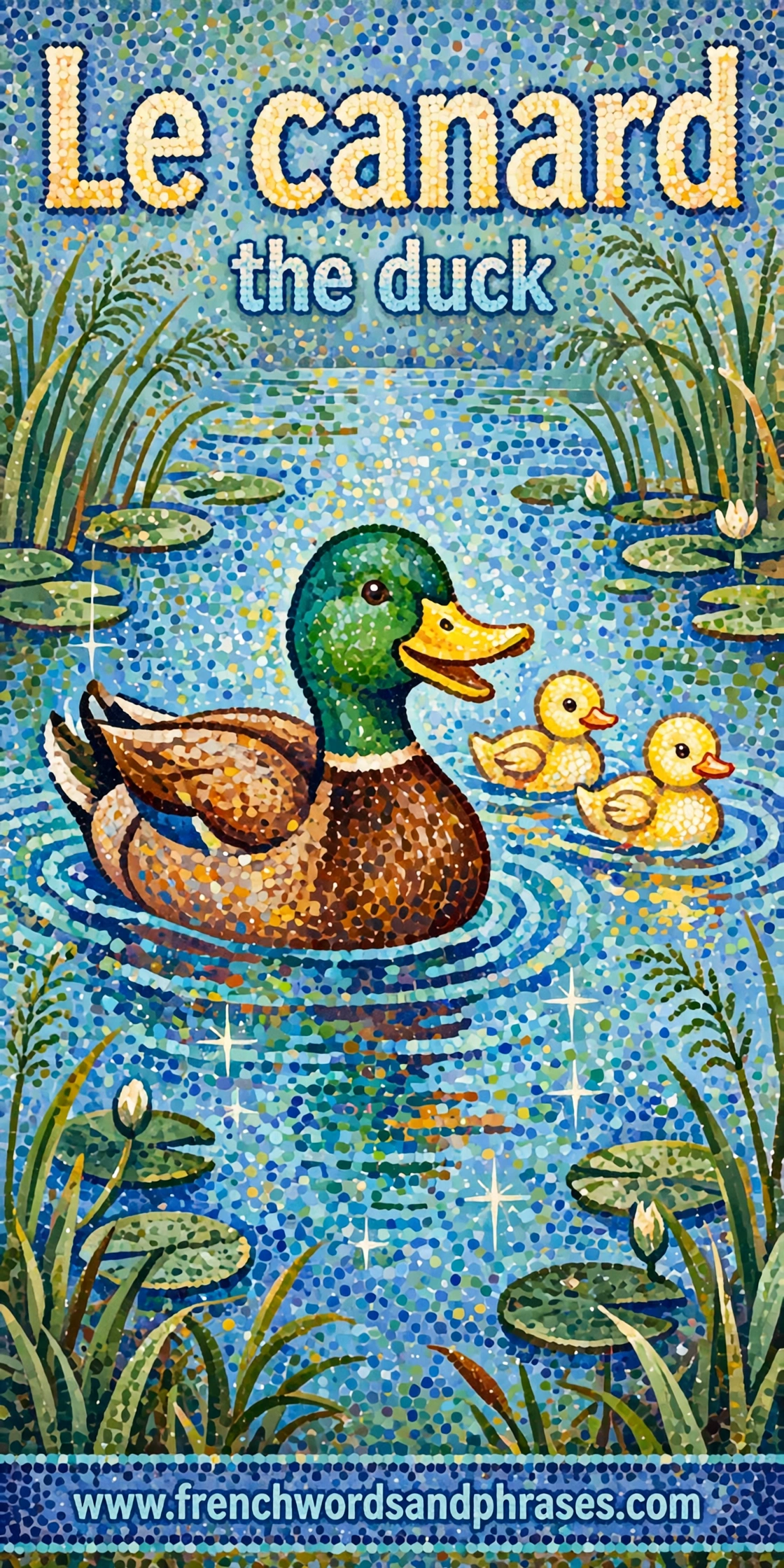
Le canard means the duck.
It waddles to the pond at dawn, it glistens lacquered on the restaurant plate, it gives its name to France’s most famous satirical newspaper: le canard, the duck — farmyard bird, culinary star and journalistic joker in one feathered word.
In this guide, you’ll learn what canard means in English, how to use it with its articles, how to form its plural, and how it appears in everyday French. Explore French examples, English translations, and practice quizzes.
Understanding the French Noun Canard
Canard is a masculine French noun, learned with its article: le canard, un canard. The female duck is une cane, the duckling un caneton. The word’s second career is famous: in familiar French, un canard is a newspaper — and un faux canard gave English the word canard, a false rumour. A lump of sugar dipped in coffee or alcohol is also un canard.
First, the bird: un canard sauvage, a wild duck, les canards du lac, the ducks on the lake. Then the plate: le canard laqué, lacquered duck, le magret de canard, duck breast — the beloved dish of the South-West — and le confit de canard, duck confit. Then the jokes: Le Canard enchaîné, France’s great satirical weekly, wears the bird as its name, and a hoax story is un canard in the newsroom sense.
Gender: Masculine — le canard
Definite article: le — le canard (the duck)
Indefinite article: un — un canard (a duck)
Plural: les canards — regular, with a simple -s
The family: la cane — the female duck; le caneton — the duckling
Second lives: a newspaper (familiar); a false rumour; a sugar lump dipped in coffee
English equivalents: The duck.
On menus, canard is a noble bird: order un magret de canard and you get the breast fillet, served rosé. In the press sense, un canard is familiar, never official — journalists themselves use it of their own papers with a grin. And the dipped sugar lump: faire un canard, to dip a sugar cube in coffee or eau-de-vie and eat it, a grandfather’s ritual.
Experience the Word
Canard is the bird that conquered both the farmyard and the front page — dinner and satire in a single word.
Imagine the market in Sarlat on a Saturday: stalls of confit, magrets and foie gras, every one of them beginning with the same placid bird now waddling, untroubled, around the village pond behind the square.
You have not just named a duck. You have named a French institution — le canard, from the pond to the plate to the newspaper.
How to Use Canard in French: Complete Guide
Let’s explore how canard works in French, beginning with its articles — le canard, un canard, le magret de canard.
Canard with the Definite Article (Le, Les)
Used for a specific duck — the one on the pond, the one on the menu.
| Form | French |
|---|---|
| Masculine singular | le canard |
| Plural | les canards |
Example
Le canard traverse l’étang vers les roseaux.
The duck is crossing the pond towards the reeds.
Canard with the Indefinite Article (Un, Des)
Used for a duck in general — any duck, wild or farmyard.
| Form | French |
|---|---|
| Masculine singular | un canard |
| Plural | des canards |
Example
Un canard sauvage survole le lac.
A wild duck flies over the lake.
Canard with Quantities and Company
Ducks are counted in ponds and plates — some numbers and company for the word.
| Quantity | French |
|---|---|
| two ducks | deux canards |
| many ducks | beaucoup de canards |
| a flock of ducks | un groupe de canards |
| a duck and her ducklings | une cane et ses canetons |
| duck for dinner | du canard au dîner |
Example
Beaucoup de canards vivent sur cet étang.
Many ducks live on this pond.
Quick Quiz 1
Complete the sentence:
______ canard nage vers nous. (the)
Reveal the answer
Le
Le canard nage vers nous.
The duck is swimming towards us — canard is masculine, so le.
The Plural of Canard
Canard takes a regular plural in -s — ponds and menus are full of them.
| Number | French |
|---|---|
| Singular | le canard |
| Plural | les canards |
Example
Les canards dorment la tête sous l’aile.
The ducks sleep with their heads under their wings.
Canard with Possessive Adjectives (Mon, Ton, Son…)
Possessives agree with the noun: canard is masculine, so mon, ton, son in the singular.
| Owner | French |
|---|---|
| my | mon canard |
| your (tu) | ton canard |
| his / her | son canard |
| our | notre canard |
| your (vous) | votre canard |
| their | leur canard |
Example
Le fermier nourrit son canard préféré à la main.
The farmer feeds his favourite duck by hand.
Quick Quiz 2
Complete the sentence:
Les enfants regardent ______ canards de l’étang. (the)
Reveal the answer
les
Les enfants regardent les canards de l’étang.
The children watch the ducks of the pond — les, the plural article.
Canard with Demonstrative Adjectives (Ce, Ces)
Used to point: ce canard, this duck — the bold one coming for the bread.
| Form | French |
|---|---|
| Masculine singular | ce canard |
| Plural | ces canards |
Example
Ce canard vient toujours manger dans ma main.
This duck always comes to eat from my hand.
Canard with Adjectives
Adjectives agree with canard — masculine singular: un canard sauvage, un canard rôti.
| Adjective | With Canard |
|---|---|
| sauvage (wild) | un canard sauvage |
| rôti (roast) | un canard rôti |
| laqué (lacquered) | un canard laqué |
| gras (fat) | un canard gras |
| jeune (young) | un jeune canard |
Example
Le canard laqué est la spécialité de la maison.
The lacquered duck is the house speciality.
Quick Quiz 3
Complete the sentence:
Nous avons commandé un canard ______. (roast)
Reveal the answer
rôti
Nous avons commandé un canard rôti.
We ordered a roast duck — rôti, masculine, to agree with canard.
Everyday Expressions with Canard
Ponds, plates and press rooms — the canard phrases of daily life.
| Expression | In English |
|---|---|
| le magret de canard | duck breast (fillet) |
| le confit de canard | duck confit |
| un canard (familiar) | a newspaper |
| faire un canard | to dip a sugar lump in coffee or spirits |
| le Canard enchaîné | France’s famous satirical weekly |
Example
Le magret de canard se sert rosé.
Duck breast is served pink.
Words from the Same Family as Canard
The farmyard — the words that travel with canard.
| French | In English |
|---|---|
| la cane | the female duck |
| le caneton | the duckling |
| une oie | a goose |
| une poule | a hen |
| l’étang | the pond |
Example
La cane traverse la cour, suivie de ses canetons.
The duck crosses the yard, followed by her ducklings.
Quick Quiz 4
In familiar French, what is un canard, besides the bird?
Reveal the answer
A newspaper — journalists’ slang, worn proudly by Le Canard enchaîné.
Il achète son canard tous les matins.
He buys his paper every morning.
Canard in Everyday French: Real-Life Examples
Now that you know the word, let’s see how canard appears in everyday French.
Example 1 — The pond
Les canards attendent du pain près de la berge.
The ducks wait for bread near the bank.
Example 2 — At the restaurant
Je prends le magret de canard, s’il vous plaît.
I’ll have the duck breast, please.
Example 3 — The market
Le confit de canard est en promotion cette semaine.
Duck confit is on offer this week.
Example 4 — The press
Tu as lu le canard de ce matin ?
Did you read this morning’s paper?
Example 5 — A ritual
Grand-père fait un canard dans son café.
Grandfather dips a sugar lump in his coffee.
Example 6 — Nature
Un canard sauvage survole les roseaux.
A wild duck flies over the reeds.
Beyond Translation: The Meaning of Canard
Canard is the happiest double agent in French vocabulary. On the pond it is a placid bird; on the plate, a prince of the South-West — magret, confit, foie gras; in the press room, a newspaper, and in English mouths, via French, a lying rumour: a canard. The satirical weekly Le Canard enchaîné has worn the bird on its masthead since 1915, quacking at the powerful every Wednesday. Few words can be ordered for dinner and read with breakfast.
To say canard is to hold the farmyard, the feast and the front page in one word.
It evokes village ponds, Sarlat markets and Wednesday’s satire.
How to Remember the French Noun Canard
Remember it this way: Canard is masculine — le canard — the duck, the newspaper, and the sugar lump dipped in coffee.
- Always masculine — le canard, un canard, mon canard; the female is la cane.
- The plate phrases — le magret de canard, le confit de canard.
- The press joke — un canard is also a newspaper.
The key idea is le canard — the duck, masculine; also a newspaper (familiar).
Test Your Knowledge of Canard
Let’s see how much you’ve learned. Try answering these questions before revealing the answers.
Question 1
Is canard masculine or feminine?
Reveal the answer
Masculine — le canard, un canard.
Question 2
What is the female duck called?
Reveal the answer
La cane — and the duckling is le caneton.
Question 3
Translate: I’ll have the duck breast, please.
Reveal the answer
Je prends le magret de canard, s’il vous plaît.
Question 4
What does faire un canard mean at the coffee cup?
Reveal the answer
To dip a sugar lump in coffee or spirits and eat it.
Question 5
Complete the sentence:
______ canards dorment au bord de l’étang. (the)
Reveal the answer
Les
Les canards dorment au bord de l’étang.
The ducks are sleeping at the edge of the pond.
Your Final Challenge
Can You Use It?
How would you say this in French?
“The ducks wait for bread near the bank.”
Reveal the answer
Les canards attendent du pain près de la berge.
The ducks wait for bread near the bank.
A little French. A little curiosity. A richer everyday life.
LEARN FRENCH ONE WORD AT A TIME