A French Word to Live By
How to Conjugate Éloigner in French
/e.lwa.ɲe/
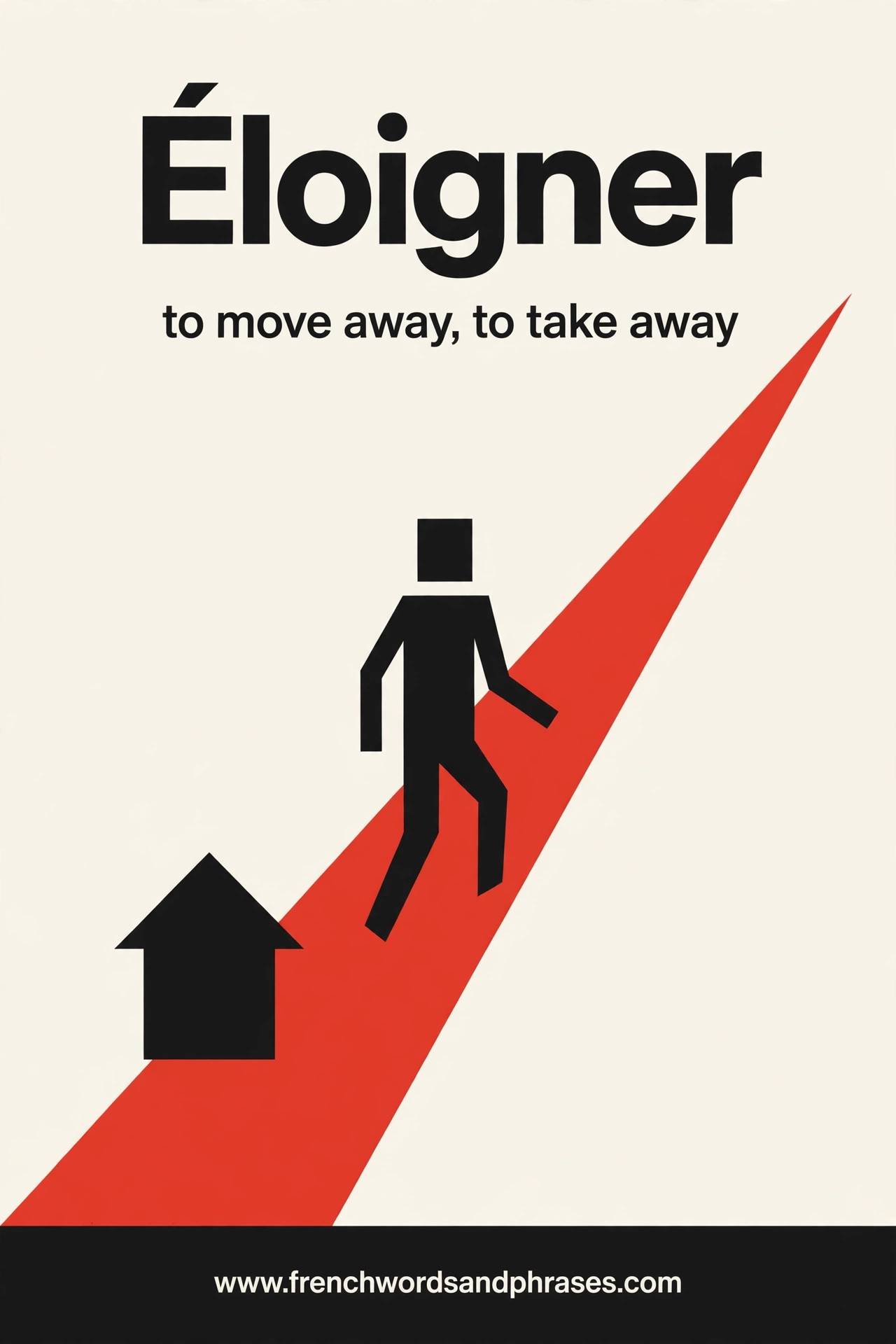
Éloigner means to move away, to take away — to put distance between a thing and where it was, or between a person and what threatens or tempts them.
A mother drawing the matches away from small hands, a gardener moving the ladder back from the wall, a diplomat quietly transferring a troublesome official to a distant post — éloigner is the verb of creating distance on purpose: something is taken, or kept, away.
In this guide, you’ll learn how to conjugate éloigner in all the major French tenses and moods. Explore complete conjugation tables, French examples, English translations, and practice quizzes.
Understanding the French Verb Éloigner
Éloigner is a regular French verb belonging to the first group of verbs, those ending in-er.
It means to move away, to take away. It is commonly used for moving objects out of reach or out of harm’s way, for keeping people away from danger, temptation or bad company, and, in offices and politics, for discreetly removing a person — éloigner un fonctionnaire is to post him far away, out of trouble.
Verb classification: First group (-er)
Auxiliary verb: Avoir
Past participle: éloigné
Present participle: éloignant
English equivalents: To move away, to take away, to keep away; éloigner quelque chose de — to move something away from; éloigner les enfants du feu — to keep the children away from the fire; éloigner un danger — to ward off a danger; éloigner quelqu’un — to send someone away, to remove someone.
One important detail: éloigner is transitive — it always moves something or someone — and it is built with de: éloigner la chaise du mur, to move the chair away from the wall; éloigner un enfant du danger. The gn is one soft sound, as in agneau: j’éloigne, nous éloignons. For the movement itself — going away under your own power — French switches to the reflexive twin, s’éloigner: elle éloigne la lampe (she moves the lamp away), but elle s’éloigne (she walks away).
Experience the Word
Éloigner is the verb of the protective hand — it does not destroy the danger, it simply puts space between the danger and what you love.
Imagine a grandmother at a farmhouse table. Without a word, without breaking her story, her hand slides the knife, the matches and the bottle of eau-de-vie to the far end of the table, away from the grandchildren. Elle éloigne — quietly, completely, in advance.
Nothing was snatched or scolded. She has moved it away — éloigné — and the afternoon is safe.
How to Conjugate Éloigner: Complete French Conjugation Guide
Let’s explore every major conjugation of éloigner, beginning with the indicative mood.
How to Conjugate Éloigner in the Indicative Mood
The indicative mood is used to express facts, observations, actions, and events.
How to Conjugate Éloigner in the Present Tense (Présent)
Used for actions happening now, habitual actions, and general truths.
| Subject | Conjugation |
|---|---|
| je | éloigne |
| tu | éloignes |
| il / elle | éloigne |
| nous | éloignons |
| vous | éloignez |
| ils / elles | éloignent |
Example
Elle éloigne les allumettes des petites mains.
She moves the matches away from the little hands.
Quick Quiz 1
Complete the sentence:
Nous ______ les chaises du mur.
Reveal the answer
éloignons
Nous éloignons les chaises du mur.
We are moving the chairs away from the wall.
How to Conjugate Éloigner in the Passé Composé
Used for completed actions in the past. Éloigner takes the auxiliary verb avoir.
| Subject | Conjugation |
|---|---|
| j’ | ai éloigné |
| tu | as éloigné |
| il / elle | a éloigné |
| nous | avons éloigné |
| vous | avez éloigné |
| ils / elles | ont éloigné |
Example
Il a éloigné la lampe du rideau.
He moved the lamp away from the curtain.
How to Conjugate Éloigner in the Imparfait (Imperfect Tense)
Used for habitual past actions, descriptions, and ongoing situations in the past.
| Subject | Conjugation |
|---|---|
| je | éloignais |
| tu | éloignais |
| il / elle | éloignait |
| nous | éloignions |
| vous | éloigniez |
| ils / elles | éloignaient |
Example
Le berger éloignait les brebis de la route.
The shepherd used to keep the sheep away from the road.
Quick Quiz 2
Choose the correct form:
He moved the lamp away from the curtain.
Il ______ la lampe du rideau. (a éloigné / est éloigné)
Reveal the answer
a éloigné
Il a éloigné la lampe du rideau.
Éloigner takes avoir.
How to Conjugate Éloigner in the Plus-que-parfait
Used to describe an action that had already been completed before another past event.
| Subject | Conjugation |
|---|---|
| j’ | avais éloigné |
| tu | avais éloigné |
| il / elle | avait éloigné |
| nous | avions éloigné |
| vous | aviez éloigné |
| ils / elles | avaient éloigné |
Example
Nous avions éloigné les enfants avant les travaux.
We had moved the children away before the work began.
How to Conjugate Éloigner in the Passé Simple
Primarily used in formal writing, literature, and historical narratives. It is rarely used in everyday conversation.
| Subject | Conjugation |
|---|---|
| je | éloignai |
| tu | éloignas |
| il / elle | éloigna |
| nous | éloignâmes |
| vous | éloignâtes |
| ils / elles | éloignèrent |
Example
Le garde éloigna la foule de la porte.
The guard moved the crowd away from the gate.
How to Conjugate Éloigner in the Passé Antérieur
A literary tense used to express an action completed immediately before another past action, generally in the passé simple.
| Subject | Conjugation |
|---|---|
| j’ | eus éloigné |
| tu | eus éloigné |
| il / elle | eut éloigné |
| nous | eûmes éloigné |
| vous | eûtes éloigné |
| ils / elles | eurent éloigné |
Example
Quand elle eut éloigné le chien, les enfants sortirent.
When she had taken the dog away, the children came out.
How to Conjugate Éloigner in the Future Tense (Futur Simple)
Used to describe actions that will take place in the future.
| Subject | Conjugation |
|---|---|
| je | éloignerai |
| tu | éloigneras |
| il / elle | éloignera |
| nous | éloignerons |
| vous | éloignerez |
| ils / elles | éloigneront |
Example
Demain, on éloignera les voitures de la place.
Tomorrow, the cars will be moved away from the square.
How to Conjugate Éloigner in the Futur Antérieur (Future Perfect)
Used for an action that will have been completed before a particular point in the future.
| Subject | Conjugation |
|---|---|
| j’ | aurai éloigné |
| tu | auras éloigné |
| il / elle | aura éloigné |
| nous | aurons éloigné |
| vous | aurez éloigné |
| ils / elles | auront éloigné |
Example
À midi, ils auront éloigné toutes les chaises.
By noon, they will have moved all the chairs away.
How to Conjugate Éloigner in the Near Future (Futur Proche)
Used to describe something that is going to happen soon. Formed with aller + infinitive.
| Subject | Conjugation |
|---|---|
| je | vais éloigner |
| tu | vas éloigner |
| il / elle | va éloigner |
| nous | allons éloigner |
| vous | allez éloigner |
| ils / elles | vont éloigner |
Example
Je vais éloigner cette plante du radiateur.
I am going to move this plant away from the radiator.
How to Conjugate Éloigner in the Conditional Mood
The conditional mood expresses what would happen under certain circumstances. It is also frequently used to make polite requests or express wishes.
How to Conjugate Éloigner in the Present Conditional
| Subject | Conjugation |
|---|---|
| je | éloignerais |
| tu | éloignerais |
| il / elle | éloignerait |
| nous | éloignerions |
| vous | éloigneriez |
| ils / elles | éloigneraient |
Example
Un grillage éloignerait les renards du poulailler.
A fence would keep the foxes away from the henhouse.
How to Conjugate Éloigner in the Past Conditional
| Subject | Conjugation |
|---|---|
| j’ | aurais éloigné |
| tu | aurais éloigné |
| il / elle | aurait éloigné |
| nous | aurions éloigné |
| vous | auriez éloigné |
| ils / elles | auraient éloigné |
Example
Elle aurait éloigné les enfants si elle avait vu le danger.
She would have moved the children away if she had seen the danger.
Éloigner in the Literary Past Conditional Form
This less common literary form uses the imperfect subjunctive of avoir.
| Subject | Conjugation |
|---|---|
| j’ | eusse éloigné |
| tu | eusses éloigné |
| il / elle | eût éloigné |
| nous | eussions éloigné |
| vous | eussiez éloigné |
| ils / elles | eussent éloigné |
Example
Il eût éloigné la foule sans l’arrivée de la police.
He would have moved the crowd away without the arrival of the police.
How to Conjugate Éloigner in the Subjunctive Mood
The subjunctive is used to express wishes, emotions, doubts, necessity, and uncertainty. It frequently follows expressions such as il faut que (it is necessary that) or bien que (although).
How to Conjugate Éloigner in the Present Subjunctive
| Subject | Conjugation |
|---|---|
| que je | éloigne |
| que tu | éloignes |
| qu’il / qu’elle | éloigne |
| que nous | éloignions |
| que vous | éloigniez |
| qu’ils / qu’elles | éloignent |
Example
Il faut que tu éloignes les médicaments des enfants.
You must keep the medicines away from the children.
Quick Quiz 3
Complete the sentence using the subjunctive:
Il faut que vous ______ les enfants du bord.
Reveal the answer
éloigniez
Il faut que vous éloigniez les enfants du bord.
You must keep the children away from the edge.
How to Conjugate Éloigner in the Imperfect Subjunctive
A literary tense, rarely encountered in modern spoken French.
| Subject | Conjugation |
|---|---|
| que je | éloignasse |
| que tu | éloignasses |
| qu’il / qu’elle | éloignât |
| que nous | éloignassions |
| que vous | éloignassiez |
| qu’ils / qu’elles | éloignassent |
Example
Elle veillait à ce qu’on éloignât les badauds.
She made sure the onlookers were kept away.
How to Conjugate Éloigner in the Pluperfect Subjunctive
A literary construction used to express an action completed before another past action.
| Subject | Conjugation |
|---|---|
| que j’ | eusse éloigné |
| que tu | eusses éloigné |
| qu’il / qu’elle | eût éloigné |
| que nous | eussions éloigné |
| que vous | eussiez éloigné |
| qu’ils / qu’elles | eussent éloigné |
Example
On racontait qu’il eût éloigné tous les témoins gênants.
People said he had removed all the awkward witnesses.
How to Conjugate Éloigner in the Past Subjunctive
| Subject | Conjugation |
|---|---|
| que j’ | aie éloigné |
| que tu | aies éloigné |
| qu’il / qu’elle | ait éloigné |
| que nous | ayons éloigné |
| que vous | ayez éloigné |
| qu’ils / qu’elles | aient éloigné |
Example
Je suis content que vous ayez éloigné ce vase de la fenêtre.
I am glad you moved that vase away from the window.
How to Conjugate Éloigner in the Imperative
The imperative is used to give commands, instructions, invitations, or suggestions. Subject pronouns are omitted.
How to Conjugate Éloigner in the Present Imperative
| Person | Conjugation |
|---|---|
| (tu) | éloigne |
| (nous) | éloignons |
| (vous) | éloignez |
Example
Éloignez les enfants du bord !
Keep the children away from the edge!
Quick Quiz 4
How would you say Keep the medicines away from the children (tu form)?
Reveal the answer
Éloigne les médicaments des enfants !
French Participles of Éloigner
Participles are verb forms that can be used in compound tenses and other grammatical constructions.
Present Participle of Éloigner
éloignant
En éloignant les voitures, la police a dégagé la place.
By moving the cars away, the police cleared the square.
Past Participle of Éloigner
éloigné
Éloignée du feu, la bonbonne de gaz ne risquait plus rien.
Moved away from the fire, the gas bottle was no longer at risk.
Éloigner in Everyday French: Real-Life Examples
Now that you know the conjugations, let’s see how éloigner appears in everyday French.
Example 1 — Present
Elle éloigne les allumettes des enfants.
She moves the matches away from the children.
Example 2 — Passé composé
Il a éloigné la lampe du rideau.
He moved the lamp away from the curtain.
Example 3 — Imparfait
Le berger éloignait les brebis de la route.
The shepherd used to keep the sheep away from the road.
Example 4 — Future
On éloignera les voitures de la place.
The cars will be moved away from the square.
Example 5 — Conditional
Un grillage éloignerait les renards.
A fence would keep the foxes away.
Example 6 — Imperative
Éloigne les médicaments des enfants !
Keep the medicines away from the children!
Beyond Translation: The Meaning of Éloigner
Éloigner is built on loin, far — its whole meaning is in its root: to make something loin, farther.
Distance, used as a tool.
French reaches for éloigner whenever space itself is the solution — a hot lamp from a curtain, a child from a fire, a scandal from a minister. Its opposite is approcher, and the pair runs French daily life: approche la chaise, éloigne la lampe — bring the chair closer, move the lamp away.
How to Remember the French Verb Éloigner
Remember it this way: Éloigner is about the grandmother’s hand sliding the matches to the far end of the table.
- Transitive twin: éloigner moves something or someone — éloigner la lampe du rideau.
- Always with de: éloigner quelque chose de quelque chose — away FROM the wall, the fire, the edge.
- Regular -er, gn as one soft sound: j’éloigne, nous éloignons, past participle éloigné.
The key idea is the grandmother’s hand sliding the matches to the far end of the table.
Test Your Knowledge of Éloigner
Let’s see how much you’ve learned. Try answering these questions before revealing the answers.
Question 1
What preposition does éloigner take, and what does it mean?
Reveal the answer
De — éloigner quelque chose de… is to move it away FROM something.
Question 2
How do you say He moved the lamp away from the curtain in French?
Reveal the answer
Il a éloigné la lampe du rideau.
Question 3
Translate: She moves the matches away from the little hands.
Reveal the answer
Elle éloigne les allumettes des petites mains.
Question 4
What is the past participle of éloigner?
Reveal the answer
Éloigné.
Question 5
Complete the sentence:
Il faut que tu ______ les médicaments des enfants.
Reveal the answer
éloignes
Il faut que tu éloignes les médicaments des enfants.
You must keep the medicines away from the children.
Your Final Challenge
Can You Use It?
How would you say this in French?
She moves the matches away from the little hands, and the kitchen becomes a safe place again.
Reveal the answer
Elle éloigne les allumettes des petites mains, et la cuisine redevient un endroit sûr.
She moves the matches away from the little hands, and the kitchen becomes a safe place again.
A little French. A little curiosity. A richer everyday life.
LEARN FRENCH ONE WORD AT A TIME