A French Word to Live By
How to Conjugate Se éloigner in French
/sə e.lwa.ɲe/
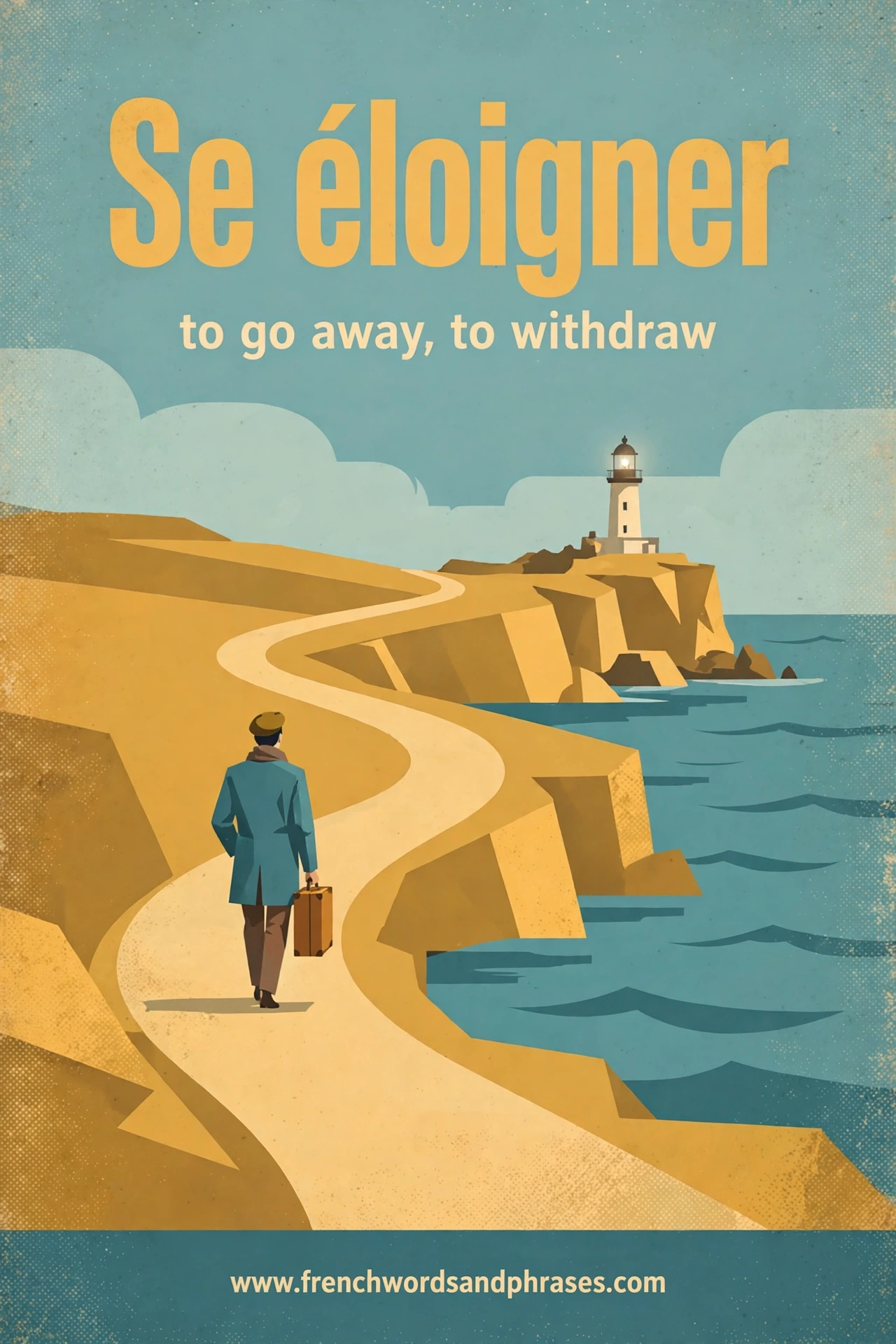
Se éloigner means to go away, to withdraw — to move off under your own power, putting distance between yourself and a place, a person or a subject.
A walker drifting away from the group along a cliff path, a guest quietly withdrawing from a noisy room, a conversation sliding away from its subject — s’éloigner is the reflexive verb of departure by degrees: nobody is sent away; you simply go.
In this guide, you’ll learn how to conjugate se éloigner in all the major French tenses and moods. Explore complete conjugation tables, French examples, English translations, and practice quizzes.
Understanding the French Verb Se éloigner
Se éloigner is a regular French verb belonging to the first group of verbs, those ending in-er.
It means to go away, to withdraw. It is commonly used for people and boats moving away from a place, for topics and conversations drifting off course — s’éloigner du sujet — and figuratively for growing distant from people, ideas or one’s own past: s’éloigner de ses amis, s’éloigner de la vérité.
Verb classification: First group (-er), reflexive
Auxiliary verb: Être
Past participle: éloigné
Present participle: éloignant
English equivalents: To go away, to move away, to withdraw, to stray; s’éloigner de — to move away from; s’éloigner du sujet — to stray from the subject; s’éloigner de la côte — to move away from the coast; ne t’éloigne pas ! — don’t go far! don’t wander off!
One important detail: s’éloigner is the reflexive twin of éloigner, and the difference is who moves: elle éloigne la lampe — she moves the lamp away; elle s’éloigne — she herself goes away. Being reflexive, it takes être in every compound tense and the participle agrees: elle s’est éloignée, ils se sont éloignés. It keeps the family preposition de: s’éloigner de la côte, s’éloigner du sujet. And its tu imperative is a parent’s classic: ne t’éloigne pas ! — don’t wander off!
Experience the Word
S’éloigner is the verb of the widening gap — no slam of a door, just steps, and the shore getting smaller.
Imagine a small sailing boat leaving a Breton harbour at dawn. Nobody waves for long; the town simply shrinks — the church, the quay, the lights — while the boat s’éloigne, metre by metre, until the coast is a grey line and then a memory.
Nothing was cut or closed. She has moved away — éloignée — and distance has done the rest.
How to Conjugate Se éloigner: Complete French Conjugation Guide
Let’s explore every major conjugation of se éloigner, beginning with the indicative mood.
How to Conjugate Se éloigner in the Indicative Mood
The indicative mood is used to express facts, observations, actions, and events.
How to Conjugate Se éloigner in the Present Tense (Présent)
Used for actions happening now, habitual actions, and general truths.
| Subject | Conjugation |
|---|---|
| je | m’éloigne |
| tu | t’éloignes |
| il / elle | s’éloigne |
| nous | nous éloignons |
| vous | vous éloignez |
| ils / elles | s’éloignent |
Example
Le bateau s’éloigne lentement de la côte.
The boat is slowly moving away from the coast.
Quick Quiz 1
Complete the sentence:
Nous nous ______ lentement de la côte.
Reveal the answer
éloignons
Nous nous éloignons lentement de la côte.
We are slowly moving away from the coast.
How to Conjugate Se éloigner in the Passé Composé
Used for completed actions in the past. Se éloigner takes the auxiliary verb être.
| Subject | Conjugation |
|---|---|
| je | me suis éloigné / me suis éloignée |
| tu | t’es éloigné / t’es éloignée |
| il / elle | s’est éloigné / s’est éloignée |
| nous | nous sommes éloignés / nous sommes éloignées |
| vous | vous êtes éloignés / vous êtes éloignées / vous êtes éloigné / vous êtes éloignée |
| ils / elles | se sont éloignés / se sont éloignées |
Example
Elle s’est éloignée sans dire un mot.
She went away without saying a word.
How to Conjugate Se éloigner in the Imparfait (Imperfect Tense)
Used for habitual past actions, descriptions, and ongoing situations in the past.
| Subject | Conjugation |
|---|---|
| je | m’éloignais |
| tu | t’éloignais |
| il / elle | s’éloignait |
| nous | nous éloignions |
| vous | vous éloigniez |
| ils / elles | s’éloignaient |
Example
Nous nous éloignions du village quand la nuit est tombée.
We were moving away from the village when night fell.
Quick Quiz 2
Choose the correct form:
She went away without a word.
Elle ______ sans un mot. (s’est éloignée / a éloigné)
Reveal the answer
s’est éloignée
Elle s’est éloignée sans un mot.
S’éloigner is reflexive, takes être, and the participle agrees: éloignée.
How to Conjugate Se éloigner in the Plus-que-parfait
Used to describe an action that had already been completed before another past event.
| Subject | Conjugation |
|---|---|
| je | m’étais éloigné / m’étais éloignée |
| tu | t’étais éloigné / t’étais éloignée |
| il / elle | s’était éloigné / s’était éloignée |
| nous | nous étions éloignés / nous étions éloignées |
| vous | vous étiez éloignés / vous étiez éloignées / vous étiez éloigné / vous étiez éloignée |
| ils / elles | s’étaient éloignés / s’étaient éloignées |
Example
Il s’était éloigné de ses amis depuis des années.
He had grown distant from his friends for years.
How to Conjugate Se éloigner in the Passé Simple
Primarily used in formal writing, literature, and historical narratives. It is rarely used in everyday conversation.
| Subject | Conjugation |
|---|---|
| je | m’éloignai |
| tu | t’éloignas |
| il / elle | s’éloigna |
| nous | nous éloignâmes |
| vous | vous éloignâtes |
| ils / elles | s’éloignèrent |
Example
Le promeneur s’éloigna du groupe et disparut dans la brume.
The walker moved away from the group and disappeared into the mist.
How to Conjugate Se éloigner in the Passé Antérieur
A literary tense used to express an action completed immediately before another past action, generally in the passé simple.
| Subject | Conjugation |
|---|---|
| je | me fus éloigné / me fus éloignée |
| tu | te fus éloigné / te fus éloignée |
| il / elle | se fut éloigné / se fut éloignée |
| nous | nous fûmes éloignés / nous fûmes éloignées |
| vous | vous fûtes éloignés / vous fûtes éloignées / vous fûtes éloigné / vous fûtes éloignée |
| ils / elles | se furent éloignés / se furent éloignées |
Example
Dès qu’elle se fut éloignée, la fête devint plus bruyante.
As soon as she had withdrawn, the party became noisier.
How to Conjugate Se éloigner in the Future Tense (Futur Simple)
Used to describe actions that will take place in the future.
| Subject | Conjugation |
|---|---|
| je | m’éloignerai |
| tu | t’éloigneras |
| il / elle | s’éloignera |
| nous | nous éloignerons |
| vous | vous éloignerez |
| ils / elles | s’éloigneront |
Example
Demain, le bateau s’éloignera de la côte à l’aube.
Tomorrow, the boat will move away from the coast at dawn.
How to Conjugate Se éloigner in the Futur Antérieur (Future Perfect)
Used for an action that will have been completed before a particular point in the future.
| Subject | Conjugation |
|---|---|
| je | me serai éloigné / me serai éloignée |
| tu | te seras éloigné / te seras éloignée |
| il / elle | se sera éloigné / se sera éloignée |
| nous | nous serons éloignés / nous serons éloignées |
| vous | vous serez éloignés / vous serez éloignées / vous serez éloigné / vous serez éloignée |
| ils / elles | se seront éloignés / se seront éloignées |
Example
À midi, nous nous serons éloignés de vingt kilomètres.
By noon, we will have moved twenty kilometres away.
How to Conjugate Se éloigner in the Near Future (Futur Proche)
Used to describe something that is going to happen soon. Formed with aller + infinitive.
| Subject | Conjugation |
|---|---|
| je | vais m’éloigner |
| tu | vas t’éloigner |
| il / elle | va s’éloigner |
| nous | allons nous éloigner |
| vous | allez vous éloigner |
| ils / elles | vont s’éloigner |
Example
Ne restez pas là, le train va s’éloigner du quai.
Do not stay there, the train is going to move away from the platform.
How to Conjugate Se éloigner in the Conditional Mood
The conditional mood expresses what would happen under certain circumstances. It is also frequently used to make polite requests or express wishes.
How to Conjugate Se éloigner in the Present Conditional
| Subject | Conjugation |
|---|---|
| je | m’éloignerais |
| tu | t’éloignerais |
| il / elle | s’éloignerait |
| nous | nous éloignerions |
| vous | vous éloigneriez |
| ils / elles | s’éloigneraient |
Example
Sans ce brouillard, le bateau s’éloignerait plus vite.
Without this fog, the boat would move away faster.
How to Conjugate Se éloigner in the Past Conditional
| Subject | Conjugation |
|---|---|
| je | me serais éloigné / me serais éloignée |
| tu | te serais éloigné / te serais éloignée |
| il / elle | se serait éloigné / se serait éloignée |
| nous | nous serions éloignés / nous serions éloignées |
| vous | vous seriez éloignés / vous seriez éloignées / vous seriez éloigné / vous seriez éloignée |
| ils / elles | se seraient éloignés / se seraient éloignées |
Example
Elle se serait éloignée plus tôt si elle avait pu.
She would have gone away sooner if she had been able to.
Se éloigner in the Literary Past Conditional Form
This less common literary form uses the imperfect subjunctive of être.
| Subject | Conjugation |
|---|---|
| je | me fusse éloigné / me fusse éloignée |
| tu | te fusses éloigné / te fusses éloignée |
| il / elle | se fût éloigné / se fût éloignée |
| nous | nous fussions éloignés / nous fussions éloignées |
| vous | vous fussiez éloignés / vous fussiez éloignées / vous fussiez éloigné / vous fussiez éloignée |
| ils / elles | se fussent éloignés / se fussent éloignées |
Example
Il se fût éloigné de la cour sans l’amitié du roi.
He would have withdrawn from the court without the king’s friendship.
How to Conjugate Se éloigner in the Subjunctive Mood
The subjunctive is used to express wishes, emotions, doubts, necessity, and uncertainty. It frequently follows expressions such as il faut que (it is necessary that) or bien que (although).
How to Conjugate Se éloigner in the Present Subjunctive
| Subject | Conjugation |
|---|---|
| que je | m’éloigne |
| que tu | t’éloignes |
| qu’il / qu’elle | s’éloigne |
| que nous | nous éloignions |
| que vous | vous éloigniez |
| qu’ils / qu’elles | s’éloignent |
Example
Il vaut mieux que les enfants ne s’éloignent pas du groupe.
It is better that the children do not wander away from the group.
Quick Quiz 3
Complete the sentence using the subjunctive:
Il vaut mieux que tu ne ______ pas du groupe.
Reveal the answer
t’éloignes
Il vaut mieux que tu ne t’éloignes pas du groupe.
It is better that you do not wander away from the group.
How to Conjugate Se éloigner in the Imperfect Subjunctive
A literary tense, rarely encountered in modern spoken French.
| Subject | Conjugation |
|---|---|
| que je | m’éloignasse |
| que tu | t’éloignasses |
| qu’il / qu’elle | s’éloignât |
| que nous | nous éloignassions |
| que vous | vous éloignassiez |
| qu’ils / qu’elles | s’éloignassent |
Example
Elle craignait que le bateau ne s’éloignât trop vite.
She feared the boat might move away too quickly.
How to Conjugate Se éloigner in the Pluperfect Subjunctive
A literary construction used to express an action completed before another past action.
| Subject | Conjugation |
|---|---|
| que je | me fusse éloigné / me fusse éloignée |
| que tu | te fusses éloigné / te fusses éloignée |
| qu’il / qu’elle | se fût éloigné / se fût éloignée |
| que nous | nous fussions éloignés / nous fussions éloignées |
| que vous | vous fussiez éloignés / vous fussiez éloignées / vous fussiez éloigné / vous fussiez éloignée |
| qu’ils / qu’elles | se fussent éloignés / se fussent éloignées |
Example
On racontait qu’ils se fussent éloignés de la vérité.
People said they had strayed from the truth.
How to Conjugate Se éloigner in the Past Subjunctive
| Subject | Conjugation |
|---|---|
| que je | me sois éloigné / me sois éloignée |
| que tu | te sois éloigné / te sois éloignée |
| qu’il / qu’elle | se soit éloigné / se soit éloignée |
| que nous | nous soyons éloignés / nous soyons éloignées |
| que vous | vous soyez éloignés / vous soyez éloignées / vous soyez éloigné / vous soyez éloignée |
| qu’ils / qu’elles | se soient éloignés / se soient éloignées |
Example
Je suis surpris qu’elle se soit éloignée si vite.
I am surprised she went away so quickly.
How to Conjugate Se éloigner in the Imperative
The imperative is used to give commands, instructions, invitations, or suggestions. Subject pronouns are omitted.
How to Conjugate Se éloigner in the Present Imperative
| Person | Conjugation |
|---|---|
| (tu) | éloigne-toi |
| (nous) | éloignons-nous |
| (vous) | éloignez-vous |
Example
Ne t’éloigne pas du groupe, petit !
Do not wander away from the group, little one!
Quick Quiz 4
How would you say Do not wander off (tu form)?
Reveal the answer
Ne t’éloigne pas !
French Participles of Se éloigner
Participles are verb forms that can be used in compound tenses and other grammatical constructions.
Present Participle of Se éloigner
éloignant
En s’éloignant de la côte, le marin regarda une dernière fois le phare.
As he moved away from the coast, the sailor looked at the lighthouse one last time.
Past Participle of Se éloigner
éloigné
Éloignée de la côte, la barque dansait sur les vagues.
Away from the coast, the little boat danced on the waves.
Se éloigner in Everyday French: Real-Life Examples
Now that you know the conjugations, let’s see how se éloigner appears in everyday French.
Example 1 — Present
Le bateau s’éloigne de la côte.
The boat is moving away from the coast.
Example 2 — Passé composé
Elle s’est éloignée sans dire un mot.
She went away without saying a word.
Example 3 — Imparfait
Nous nous éloignions du village.
We were moving away from the village.
Example 4 — Future
Le bateau s’éloignera à l’aube.
The boat will move away at dawn.
Example 5 — Conditional
Elle se serait éloignée plus tôt si elle avait pu.
She would have gone away sooner if she had been able to.
Example 6 — Imperative
Ne t’éloigne pas du groupe !
Do not wander away from the group!
Beyond Translation: The Meaning of Se éloigner
S’éloigner is éloigner turned homeward — the same loin, far, but this time you are the thing that gets farther.
French splits departure in two.
Éloigner sends something away; s’éloigner takes yourself away — and because it is reflexive, it covers everything from a boat leaving the coast to a friend slowly drifting out of your life: ils se sont éloignés can simply mean they grew apart.
How to Remember the French Verb Se éloigner
Remember it this way: Se éloigner is about the little boat watching the coast shrink at dawn.
- Reflexive twin: s’éloigner is you going away; éloigner is you moving something else away.
- Être in compound tenses, participle agreeing: elle s’est éloignée, ils se sont éloignés.
- Keeps de: s’éloigner de la côte, du sujet, de ses amis — and ne t’éloigne pas ! is don’t wander off!
The key idea is the little boat watching the coast shrink at dawn.
Test Your Knowledge of Se éloigner
Let’s see how much you’ve learned. Try answering these questions before revealing the answers.
Question 1
Which auxiliary does s’éloigner use, and why?
Reveal the answer
Être — it is a reflexive verb: elle s’est éloignée sans un mot.
Question 2
How do you say The boat is moving away from the coast in French?
Reveal the answer
Le bateau s’éloigne de la côte.
Question 3
Translate: She went away without saying a word.
Reveal the answer
Elle s’est éloignée sans dire un mot.
Question 4
What is the past participle of s’éloigner?
Reveal the answer
Éloigné — agreeing: éloignée, éloignés, éloignées.
Question 5
Complete the sentence:
Il vaut mieux que les enfants ne ______ pas du groupe.
Reveal the answer
s’éloignent
Il vaut mieux que les enfants ne s’éloignent pas du groupe.
It is better that the children do not wander away from the group.
Your Final Challenge
Can You Use It?
How would you say this in French?
The boat moves away from the coast, and the village becomes a grey line on the horizon.
Reveal the answer
Le bateau s’éloigne de la côte, et le village devient une ligne grise à l’horizon.
The boat moves away from the coast, and the village becomes a grey line on the horizon.
A little French. A little curiosity. A richer everyday life.
LEARN FRENCH ONE WORD AT A TIME