A French Word to Live By
How to Conjugate Élinguer in French
/e.lɛ̃.ɡe/
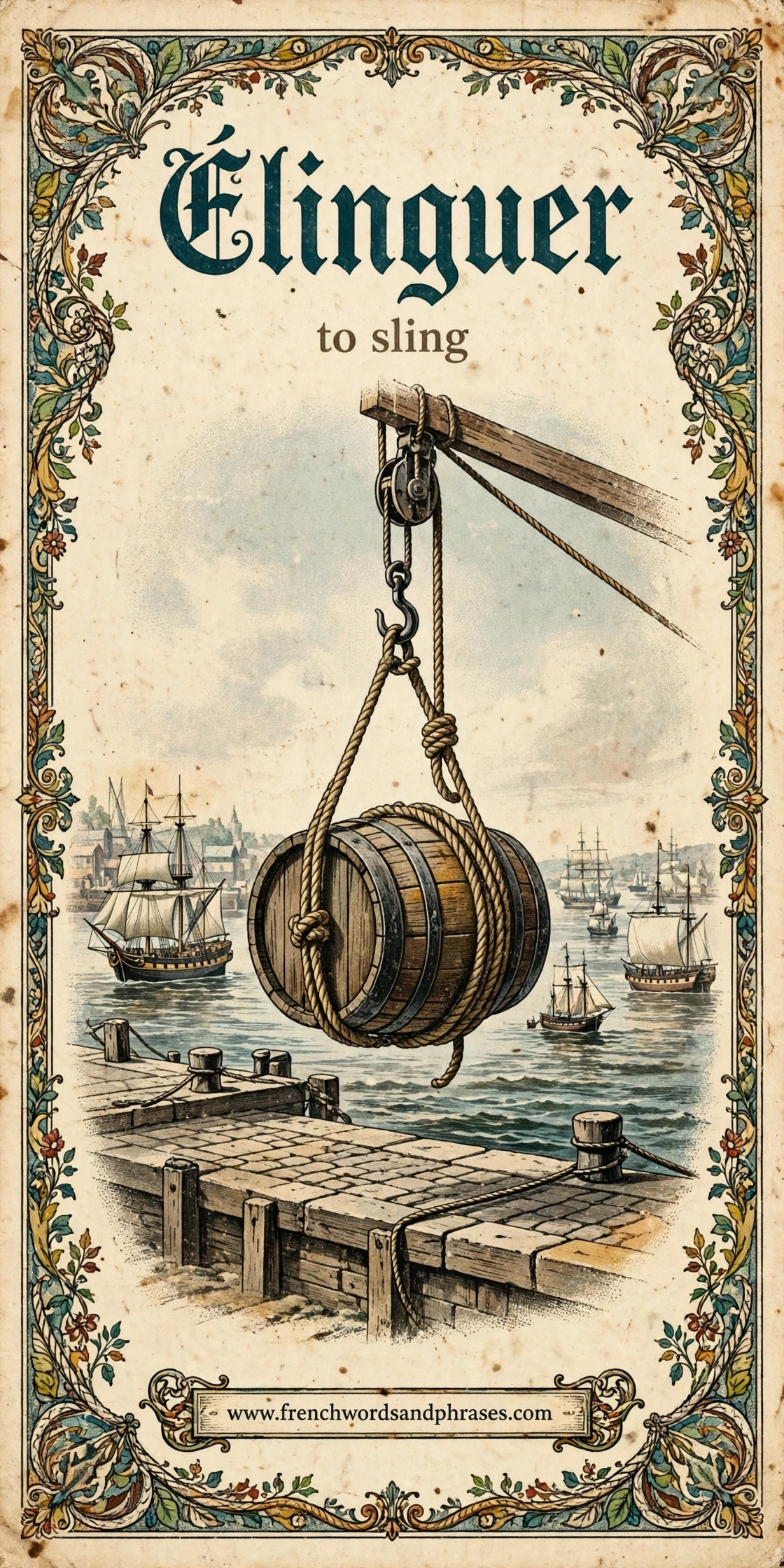
Élinguer means to sling — to pass a strong rope sling around a heavy load and make it fast, so that a crane can lift it safely.
On a dock at dawn, two dockers loop a thick rope sling under a crate the size of a small car, check every knot, and step well back as the crane takes the strain — élinguer is the rigger’s verb: the skilled moment before a load leaves the ground.
In this guide, you’ll learn how to conjugate élinguer in all the major French tenses and moods. Explore complete conjugation tables, French examples, English translations, and practice quizzes.
Understanding the French Verb Élinguer
Élinguer is a regular French verb belonging to the first group of verbs, those ending in-er.
It means to sling. It belongs to the world of lifting: ports, building sites, theatres and removal vans, anywhere a crane, a hoist or a derrick raises something too heavy for hands. Outside that world it is rarely heard, but inside it, élinguer is a safety word — a badly slung load can swing, slip or fall.
Verb classification: First group (-er)
Auxiliary verb: Avoir
Past participle: élingué
Present participle: élinguant
English equivalents: To sling, to make fast in a sling; élinguer une charge — to sling a load; élinguer un conteneur — to sling a container; une élingue — a sling, a lifting strop; un élingueur — a rigger, a slinger.
One important detail: the -gu- of élinguer never changes — the u is there to keep the g hard, and it stays in every form: j’élingue, nous élinguons, ils élinguaient, en élinguant. It is a dockside and building-site word, a technical verb of ports, warehouses and cranes; the family is small and concrete: une élingue is the sling itself, the loop of rope or webbing that goes round the load, and un élingueur is the worker whose judgement the whole lift depends on.
Experience the Word
Élinguer is the verb of trust in a rope — a few loops, a checked knot, and ten tonnes leave the ground.
Imagine the port of Marseille at six in the morning. An old rigger walks round a marble block, passes his sling beneath it, adjusts it twice by a hand’s breadth, and only then raises his thumb to the crane driver. Il a élingué — and everyone on the quay relaxes.
The crane does the lifting. But the slinging — élingué, checked, judged by eye — was the real work.
How to Conjugate Élinguer: Complete French Conjugation Guide
Let’s explore every major conjugation of élinguer, beginning with the indicative mood.
How to Conjugate Élinguer in the Indicative Mood
The indicative mood is used to express facts, observations, actions, and events.
How to Conjugate Élinguer in the Present Tense (Présent)
Used for actions happening now, habitual actions, and general truths.
| Subject | Conjugation |
|---|---|
| je | élingue |
| tu | élingues |
| il / elle | élingue |
| nous | élinguons |
| vous | élinguez |
| ils / elles | élinguent |
Example
Les dockers élinguent les caisses avant l’arrivée de la grue.
The dockers sling the crates before the crane arrives.
Quick Quiz 1
Complete the sentence:
Nous ______ les tuyaux un par un.
Reveal the answer
élinguons
Nous élinguons les tuyaux un par un.
We are slinging the pipes one by one.
How to Conjugate Élinguer in the Passé Composé
Used for completed actions in the past. Élinguer takes the auxiliary verb avoir.
| Subject | Conjugation |
|---|---|
| j’ | ai élingué |
| tu | as élingué |
| il / elle | a élingué |
| nous | avons élingué |
| vous | avez élingué |
| ils / elles | ont élingué |
Example
Il a élingué le conteneur en quelques minutes.
He slung the container in a few minutes.
How to Conjugate Élinguer in the Imparfait (Imperfect Tense)
Used for habitual past actions, descriptions, and ongoing situations in the past.
| Subject | Conjugation |
|---|---|
| je | élinguais |
| tu | élinguais |
| il / elle | élinguait |
| nous | élinguions |
| vous | élinguiez |
| ils / elles | élinguaient |
Example
Chaque matin, on élinguait les ballots sur le quai.
Every morning, the bales were slung on the quay.
Quick Quiz 2
Choose the correct form:
He slung the container.
Il ______ le conteneur. (a élingué / est élingué)
Reveal the answer
a élingué
Il a élingué le conteneur.
Élinguer takes avoir.
How to Conjugate Élinguer in the Plus-que-parfait
Used to describe an action that had already been completed before another past event.
| Subject | Conjugation |
|---|---|
| j’ | avais élingué |
| tu | avais élingué |
| il / elle | avait élingué |
| nous | avions élingué |
| vous | aviez élingué |
| ils / elles | avaient élingué |
Example
Ils avaient élingué la machine avant la tempête.
They had slung the machine before the storm.
How to Conjugate Élinguer in the Passé Simple
Primarily used in formal writing, literature, and historical narratives. It is rarely used in everyday conversation.
| Subject | Conjugation |
|---|---|
| je | élinguai |
| tu | élinguas |
| il / elle | élingua |
| nous | élinguâmes |
| vous | élinguâtes |
| ils / elles | élinguèrent |
Example
Le grutier attendit, puis l’ouvrier élingua la poutre.
The crane driver waited, then the worker slung the beam.
How to Conjugate Élinguer in the Passé Antérieur
A literary tense used to express an action completed immediately before another past action, generally in the passé simple.
| Subject | Conjugation |
|---|---|
| j’ | eus élingué |
| tu | eus élingué |
| il / elle | eut élingué |
| nous | eûmes élingué |
| vous | eûtes élingué |
| ils / elles | eurent élingué |
Example
Dès qu’il eut élingué la charge, il fit signe au grutier.
As soon as he had slung the load, he signalled to the crane driver.
How to Conjugate Élinguer in the Future Tense (Futur Simple)
Used to describe actions that will take place in the future.
| Subject | Conjugation |
|---|---|
| je | élinguerai |
| tu | élingueras |
| il / elle | élinguera |
| nous | élinguerons |
| vous | élinguerez |
| ils / elles | élingueront |
Example
Demain, nous élinguerons les tuyaux un par un.
Tomorrow, we will sling the pipes one by one.
How to Conjugate Élinguer in the Futur Antérieur (Future Perfect)
Used for an action that will have been completed before a particular point in the future.
| Subject | Conjugation |
|---|---|
| j’ | aurai élingué |
| tu | auras élingué |
| il / elle | aura élingué |
| nous | aurons élingué |
| vous | aurez élingué |
| ils / elles | auront élingué |
Example
À midi, l’équipe aura élingué toutes les caisses.
By noon, the team will have slung all the crates.
How to Conjugate Élinguer in the Near Future (Futur Proche)
Used to describe something that is going to happen soon. Formed with aller + infinitive.
| Subject | Conjugation |
|---|---|
| je | vais élinguer |
| tu | vas élinguer |
| il / elle | va élinguer |
| nous | allons élinguer |
| vous | allez élinguer |
| ils / elles | vont élinguer |
Example
Attention, il va élinguer la charge, écartez-vous !
Careful, he is going to sling the load, stand clear!
How to Conjugate Élinguer in the Conditional Mood
The conditional mood expresses what would happen under certain circumstances. It is also frequently used to make polite requests or express wishes.
How to Conjugate Élinguer in the Present Conditional
| Subject | Conjugation |
|---|---|
| je | élinguerais |
| tu | élinguerais |
| il / elle | élinguerait |
| nous | élinguerions |
| vous | élingueriez |
| ils / elles | élingueraient |
Example
Avec une élingue plus longue, on élinguerait ce bloc facilement.
With a longer sling, we could sling this block easily.
How to Conjugate Élinguer in the Past Conditional
| Subject | Conjugation |
|---|---|
| j’ | aurais élingué |
| tu | aurais élingué |
| il / elle | aurait élingué |
| nous | aurions élingué |
| vous | auriez élingué |
| ils / elles | auraient élingué |
Example
Ils auraient élingué la caisse plus tôt avec une deuxième grue.
They would have slung the crate earlier with a second crane.
Élinguer in the Literary Past Conditional Form
This less common literary form uses the imperfect subjunctive of avoir.
| Subject | Conjugation |
|---|---|
| j’ | eusse élingué |
| tu | eusses élingué |
| il / elle | eût élingué |
| nous | eussions élingué |
| vous | eussiez élingué |
| ils / elles | eussent élingué |
Example
Il eût élingué la charge sans l’aide du contremaître.
He would have slung the load without the foreman’s help.
How to Conjugate Élinguer in the Subjunctive Mood
The subjunctive is used to express wishes, emotions, doubts, necessity, and uncertainty. It frequently follows expressions such as il faut que (it is necessary that) or bien que (although).
How to Conjugate Élinguer in the Present Subjunctive
| Subject | Conjugation |
|---|---|
| que je | élingue |
| que tu | élingues |
| qu’il / qu’elle | élingue |
| que nous | élinguions |
| que vous | élinguiez |
| qu’ils / qu’elles | élinguent |
Example
Il faut que vous élinguiez la charge correctement.
You must sling the load correctly.
Quick Quiz 3
Complete the sentence using the subjunctive:
Il faut que tu ______ la charge correctement.
Reveal the answer
élingues
Il faut que tu élingues la charge correctement.
You must sling the load correctly.
How to Conjugate Élinguer in the Imperfect Subjunctive
A literary tense, rarely encountered in modern spoken French.
| Subject | Conjugation |
|---|---|
| que je | élinguasse |
| que tu | élinguasses |
| qu’il / qu’elle | élinguât |
| que nous | élinguassions |
| que vous | élinguassiez |
| qu’ils / qu’elles | élinguassent |
Example
Le contremaître exigeait que l’apprenti élinguât la caisse sous surveillance.
The foreman required the apprentice to sling the crate under supervision.
How to Conjugate Élinguer in the Pluperfect Subjunctive
A literary construction used to express an action completed before another past action.
| Subject | Conjugation |
|---|---|
| que j’ | eusse élingué |
| que tu | eusses élingué |
| qu’il / qu’elle | eût élingué |
| que nous | eussions élingué |
| que vous | eussiez élingué |
| qu’ils / qu’elles | eussent élingué |
Example
On racontait qu’il eût élingué des charges de dix tonnes.
People said he had slung ten-ton loads.
How to Conjugate Élinguer in the Past Subjunctive
| Subject | Conjugation |
|---|---|
| que j’ | aie élingué |
| que tu | aies élingué |
| qu’il / qu’elle | ait élingué |
| que nous | ayons élingué |
| que vous | ayez élingué |
| qu’ils / qu’elles | aient élingué |
Example
Je suis content que tu aies élingué la poutre à temps.
I am glad you slung the beam in time.
How to Conjugate Élinguer in the Imperative
The imperative is used to give commands, instructions, invitations, or suggestions. Subject pronouns are omitted.
How to Conjugate Élinguer in the Present Imperative
| Person | Conjugation |
|---|---|
| (tu) | élingue |
| (nous) | élinguons |
| (vous) | élinguez |
Example
Élinguez la charge et reculez !
Sling the load and step back!
Quick Quiz 4
How would you say Sling the load (tu form)?
Reveal the answer
Élingue la charge !
French Participles of Élinguer
Participles are verb forms that can be used in compound tenses and other grammatical constructions.
Present Participle of Élinguer
élinguant
En élinguant ce bloc, il faut vérifier chaque nœud.
When slinging this block, every knot must be checked.
Past Participle of Élinguer
élingué
Élinguée avec soin, la caisse s’est élevée sans un bruit.
Made fast in its sling with care, the crate rose without a sound.
Élinguer in Everyday French: Real-Life Examples
Now that you know the conjugations, let’s see how élinguer appears in everyday French.
Example 1 — Present
Les dockers élinguent les caisses sur le quai.
The dockers sling the crates on the quay.
Example 2 — Passé composé
Il a élingué le conteneur en cinq minutes.
He slung the container in five minutes.
Example 3 — Imparfait
On élinguait les ballots chaque matin.
The bales were slung every morning.
Example 4 — Future
Nous élinguerons les tuyaux un par un.
We will sling the pipes one by one.
Example 5 — Conditional
Avec une plus longue élingue, on élinguerait ce bloc facilement.
With a longer sling, we could sling this block easily.
Example 6 — Imperative
Élingue la charge et recule !
Sling the load and step back!
Beyond Translation: The Meaning of Élinguer
English sling is the exact cousin — and French élinguer is what a sling does for a living on the docks.
Every lift begins on the ground.
Before the crane, before the height and the swing, there is a person with a rope, judging weight and balance by eye. Une élingue also names the sling that supports a broken arm — the same idea: a loop that carries what cannot carry itself.
How to Remember the French Verb Élinguer
Remember it this way: Élinguer is about the docker’s rope sling round the crate, just before the crane lifts.
- A dockside word: élinguer une charge is to pass the sling round a load before the crane lifts.
- The -gu- never changes: j’élingue, nous élinguons — the u keeps the g hard everywhere.
- Family: une élingue (the sling), un élingueur (the rigger), élinguer (to sling).
The key idea is the docker’s rope sling round the crate, just before the crane lifts.
Test Your Knowledge of Élinguer
Let’s see how much you’ve learned. Try answering these questions before revealing the answers.
Question 1
What is une élingue?
Reveal the answer
A sling — the loop of rope or webbing passed round a load so a crane can lift it.
Question 2
How do you say The dockers sling the crates in French?
Reveal the answer
Les dockers élinguent les caisses.
Question 3
Translate: He slung the container in a few minutes.
Reveal the answer
Il a élingué le conteneur en quelques minutes.
Question 4
What is the past participle of élinguer?
Reveal the answer
Élingué.
Question 5
Complete the sentence:
Il faut que vous ______ la charge correctement.
Reveal the answer
élinguiez
Il faut que vous élinguiez la charge correctement.
You must sling the load correctly.
Your Final Challenge
Can You Use It?
How would you say this in French?
The old rigger slung the block of marble, and the crane lifted it like a feather.
Reveal the answer
Le vieil élingueur a élingué le bloc de marbre, et la grue l’a soulevé comme une plume.
The old rigger slung the block of marble, and the crane lifted it like a feather.
A little French. A little curiosity. A richer everyday life.
LEARN FRENCH ONE WORD AT A TIME