A French Word to Live By
How to Conjugate Écurer in French
/e.ky.ʁe/
Écurer means to scour.
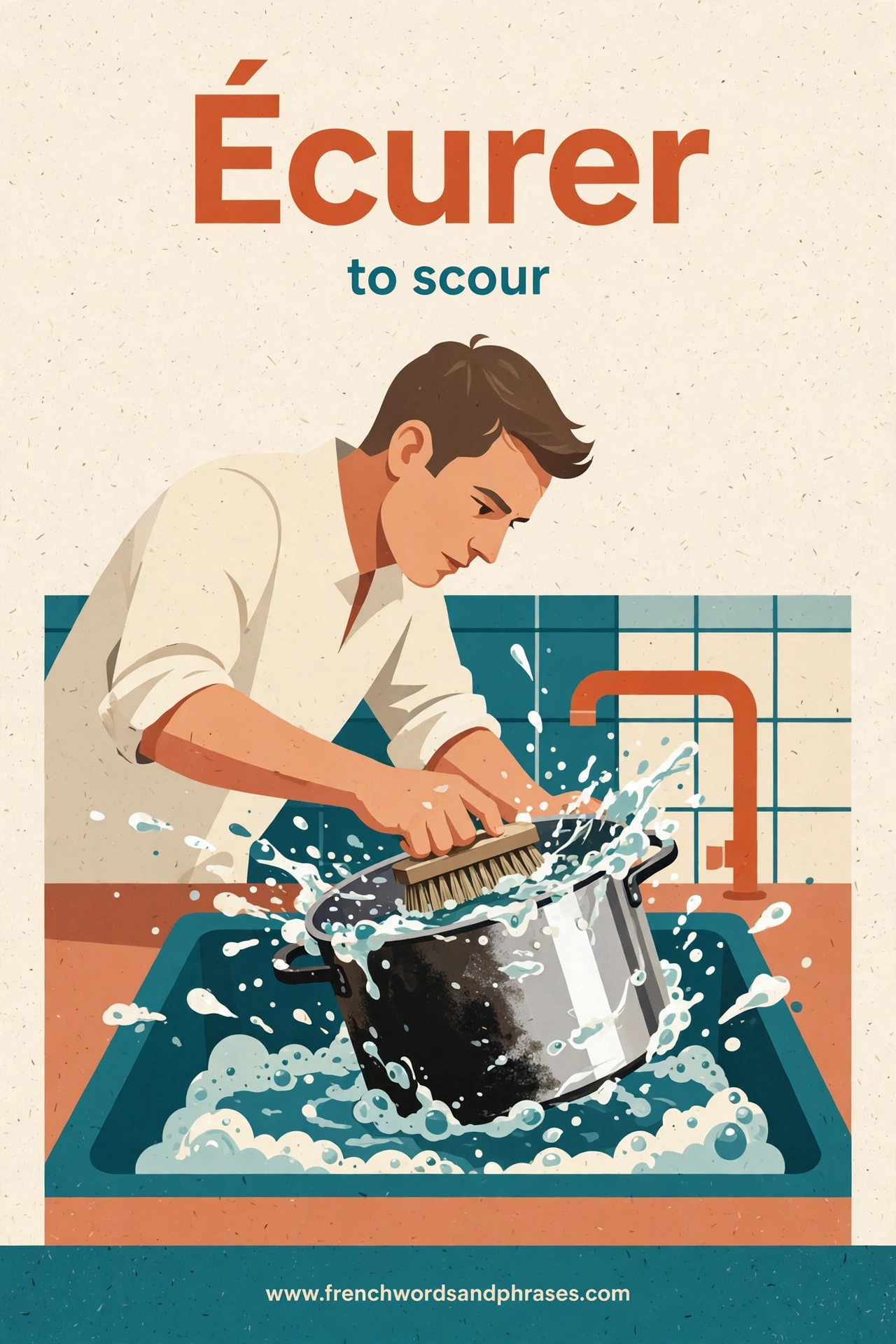
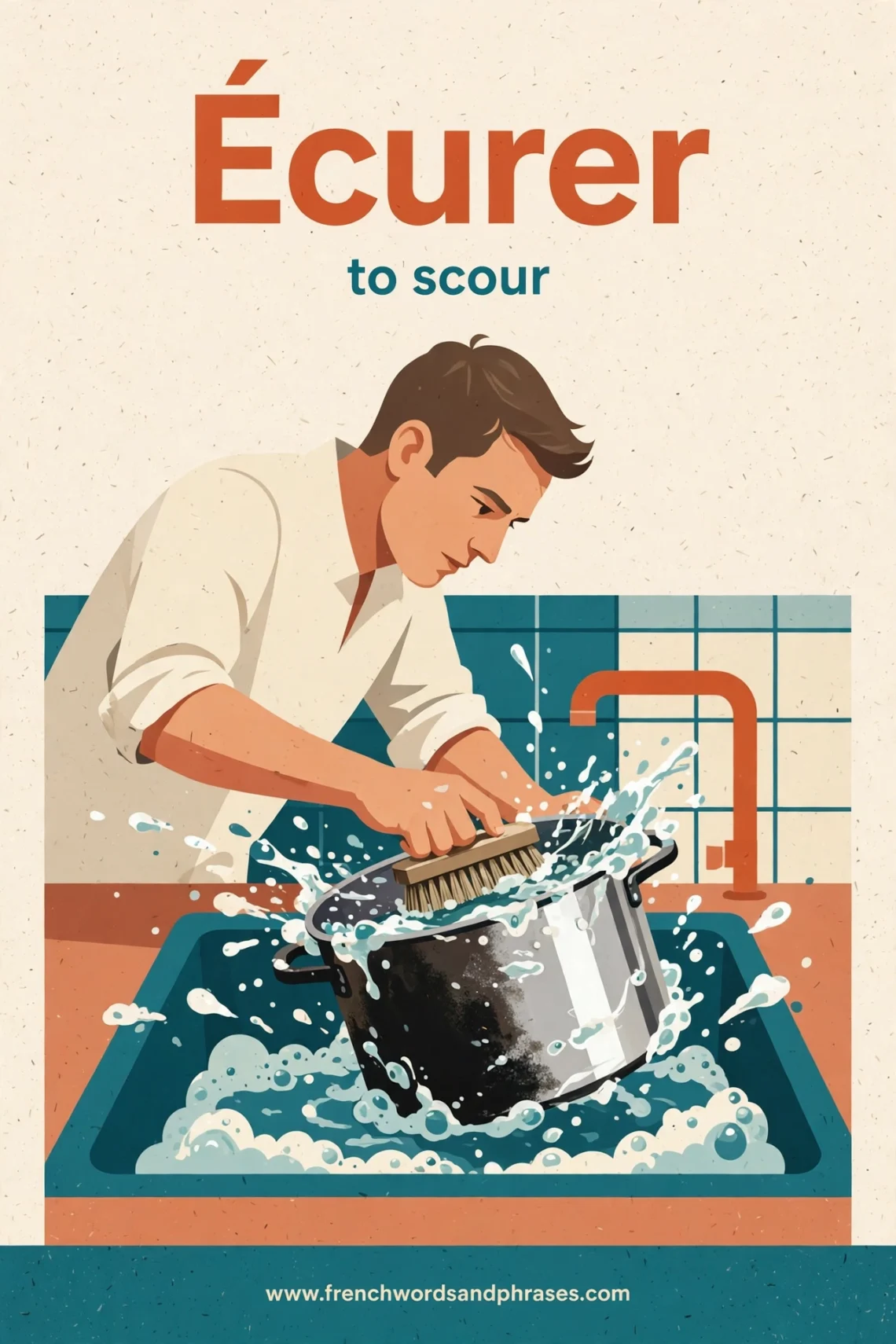
A burnt pan soaking in the sink, a farmyard trough green with algae, elbow grease and a stiff brush — écurer is the old, thorough verb of scouring things clean down to their true surface.
In this guide, you’ll learn how to conjugate écurer in all the major French tenses and moods. Explore complete conjugation tables, French examples, English translations, and practice quizzes.
Understanding the French Verb Écurer
Écurer is a regular French verb belonging to the first group of verbs, those ending in -er.
It means to scour. It is commonly used for scouring burnt pans and sinks in older and rural French, for cleaning out stables, troughs and farm equipment, and in literature wherever a cleaning is so thorough that it amounts to a small restoration.
Verb classification: First group (-er)
Auxiliary verb: Avoir
Past participle: écuré
Present participle: écurant
English equivalents: To scour, to scrub thoroughly clean; récurer — the everyday modern synonym, as in poudre à récurer, scouring powder.
One important detail: écurer has largely handed its job to its younger brother récurer — today you will buy de la poudre à récurer and récurer une casserole in everyday French. Écurer survives in older texts, in farming language — écurer une étable, un abreuvoir, to muck out and scour a stable or a trough — and in the speech of grandparents, for whom it still means the deepest kind of clean.
Experience the Word
Écurer is the verb of the deep clean — not a wipe, not a rinse, but a scouring that brings back the original surface.
Imagine a farm kitchen on a Saturday morning. The big pot from yesterday’s stew sits blackened in the sink, and the grandmother, sleeves rolled, écure it with sand and patience until the iron shines like new.
The pot has not merely been washed. It has been écured — scoured back to brightness.
How to Conjugate Écurer: Complete French Conjugation Guide
Let’s explore every major conjugation of écurer, beginning with the indicative mood.
How to Conjugate Écurer in the Indicative Mood
The indicative mood is used to express facts, observations, actions, and events.
How to Conjugate Écurer in the Present Tense (Présent)
Used for actions happening now, habitual actions, and general truths.
| Subject | Conjugation |
|---|---|
| je | écure |
| tu | écures |
| il / elle | écure |
| nous | écurons |
| vous | écurez |
| ils / elles | écurent |
Example
Elle écure la marmite avec une brosse dure.
She scours the pot with a stiff brush.
Quick Quiz 1
Complete the sentence:
Nous ______ l’étable avant l’hiver.
Reveal the answer
écurons
Nous écurons l’étable avant l’hiver.
We scour out the stable before winter.
How to Conjugate Écurer in the Passé Composé
Used for completed actions in the past. Écurer takes the auxiliary verb avoir.
| Subject | Conjugation |
|---|---|
| j’ | ai écuré |
| tu | as écuré |
| il / elle | a écuré |
| nous | avons écuré |
| vous | avez écuré |
| ils / elles | ont écuré |
Example
Nous avons écuré l’étable avant l’hiver.
We scoured out the stable before winter.
How to Conjugate Écurer in the Imparfait (Imperfect Tense)
Used for habitual past actions, descriptions, and ongoing situations in the past.
| Subject | Conjugation |
|---|---|
| je | écurais |
| tu | écurais |
| il / elle | écurait |
| nous | écurions |
| vous | écuriez |
| ils / elles | écuraient |
Example
Autrefois, on écurait les casseroles avec du sable.
In the old days, people used to scour pans with sand.
Quick Quiz 2
Choose the correct form:
I scoured the burnt pan.
J’______ la poêle brûlée. (ai écuré / suis écuré)
Reveal the answer
ai écuré
J’ai écuré la poêle brûlée.
Écurer takes avoir.
How to Conjugate Écurer in the Plus-que-parfait
Used to describe an action that had already been completed before another past event.
| Subject | Conjugation |
|---|---|
| j’ | avais écuré |
| tu | avais écuré |
| il / elle | avait écuré |
| nous | avions écuré |
| vous | aviez écuré |
| ils / elles | avaient écuré |
Example
Il avait écuré l’abreuvoir avant d’y mettre l’eau fraîche.
He had scoured the trough before putting fresh water in it.
How to Conjugate Écurer in the Passé Simple
Primarily used in formal writing, literature, and historical narratives. It is rarely used in everyday conversation.
| Subject | Conjugation |
|---|---|
| je | écurai |
| tu | écuras |
| il / elle | écura |
| nous | écurâmes |
| vous | écurâtes |
| ils / elles | écurèrent |
Example
La fermière écura le chaudron jusqu’à le faire briller.
The farmer’s wife scoured the cauldron until it shone.
How to Conjugate Écurer in the Passé Antérieur
A literary tense used to express an action completed immediately before another past action, generally in the passé simple.
| Subject | Conjugation |
|---|---|
| j’ | eus écuré |
| tu | eus écuré |
| il / elle | eut écuré |
| nous | eûmes écuré |
| vous | eûtes écuré |
| ils / elles | eurent écuré |
Example
Quand ils eurent écuré la cour, les poules revinrent.
When they had scoured the yard, the hens came back.
How to Conjugate Écurer in the Future Tense (Futur Simple)
Used to describe actions that will take place in the future.
| Subject | Conjugation |
|---|---|
| je | écurerai |
| tu | écureras |
| il / elle | écurera |
| nous | écurerons |
| vous | écurerez |
| ils / elles | écureront |
Example
Demain, nous écurerons les gamelles des chiens.
Tomorrow, we will scour the dogs’ bowls.
How to Conjugate Écurer in the Futur Antérieur (Future Perfect)
Used for an action that will have been completed before a particular point in the future.
| Subject | Conjugation |
|---|---|
| j’ | aurai écuré |
| tu | auras écuré |
| il / elle | aura écuré |
| nous | aurons écuré |
| vous | aurez écuré |
| ils / elles | auront écuré |
Example
À la fin de la journée, elle aura écuré toute la batterie de cuisine.
By the end of the day, she will have scoured all the kitchen pots and pans.
How to Conjugate Écurer in the Near Future (Futur Proche)
Used to describe something that is going to happen soon. Formed with aller + infinitive.
| Subject | Conjugation |
|---|---|
| je | vais écurer |
| tu | vas écurer |
| il / elle | va écurer |
| nous | allons écurer |
| vous | allez écurer |
| ils / elles | vont écurer |
Example
Je vais écurer cette poêle brûlée, donne-moi la brosse.
I am going to scour this burnt frying pan, hand me the brush.
How to Conjugate Écurer in the Conditional Mood
The conditional mood expresses what would happen under certain circumstances. It is also frequently used to make polite requests or express wishes.
How to Conjugate Écurer in the Present Conditional
| Subject | Conjugation |
|---|---|
| je | écurerais |
| tu | écurerais |
| il / elle | écurerait |
| nous | écurerions |
| vous | écureriez |
| ils / elles | écureraient |
Example
Avec un bon produit, on écurerait ce four en dix minutes.
With a good product, we would scour this oven in ten minutes.
How to Conjugate Écurer in the Past Conditional
| Subject | Conjugation |
|---|---|
| j’ | aurais écuré |
| tu | aurais écuré |
| il / elle | aurait écuré |
| nous | aurions écuré |
| vous | auriez écuré |
| ils / elles | auraient écuré |
Example
Tu aurais écuré l’évier si tu avais vu son état.
You would have scoured the sink if you had seen its state.
Écurer in the Literary Past Conditional Form
This less common literary form uses the imperfect subjunctive of avoir.
| Subject | Conjugation |
|---|---|
| j’ | eusse écuré |
| tu | eusses écuré |
| il / elle | eût écuré |
| nous | eussions écuré |
| vous | eussiez écuré |
| ils / elles | eussent écuré |
Example
Les servantes eussent écuré les chaudrons avant la fête.
The maids would have scoured the cauldrons before the feast.
How to Conjugate Écurer in the Subjunctive Mood
The subjunctive is used to express wishes, emotions, doubts, necessity, and uncertainty. It frequently follows expressions such as il faut que (it is necessary that) or bien que (although).
How to Conjugate Écurer in the Present Subjunctive
| Subject | Conjugation |
|---|---|
| que je | écure |
| que tu | écures |
| qu’il / qu’elle | écure |
| que nous | écurions |
| que vous | écuriez |
| qu’ils / qu’elles | écurent |
Example
Il faut que tu écures la marmite avant ce soir.
You must scour the pot before this evening.
Quick Quiz 3
Complete the sentence using the subjunctive:
Il faut que vous ______ la cuisine.
Reveal the answer
écuriez
Il faut que vous écuriez la cuisine.
You must scour the kitchen.
How to Conjugate Écurer in the Imperfect Subjunctive
A literary tense, rarely encountered in modern spoken French.
| Subject | Conjugation |
|---|---|
| que je | écurasse |
| que tu | écurasses |
| qu’il / qu’elle | écurât |
| que nous | écurassions |
| que vous | écurassiez |
| qu’ils / qu’elles | écurassent |
Example
Ma grand-mère voulait que j’écure l’abreuvoir chaque semaine.
My grandmother wanted me to scour the trough every week.
How to Conjugate Écurer in the Pluperfect Subjunctive
A literary construction used to express an action completed before another past action.
| Subject | Conjugation |
|---|---|
| que j’ | eusse écuré |
| que tu | eusses écuré |
| qu’il / qu’elle | eût écuré |
| que nous | eussions écuré |
| que vous | eussiez écuré |
| qu’ils / qu’elles | eussent écuré |
Example
On voyait qu’ils eussent écuré l’étable à fond.
You could see they had scoured the stable thoroughly.
How to Conjugate Écurer in the Past Subjunctive
| Subject | Conjugation |
|---|---|
| que j’ | aie écuré |
| que tu | aies écuré |
| qu’il / qu’elle | ait écuré |
| que nous | ayons écuré |
| que vous | ayez écuré |
| qu’ils / qu’elles | aient écuré |
Example
Je suis content que vous ayez écuré la cuisine avant la visite.
I am glad you scoured the kitchen before the visit.
How to Conjugate Écurer in the Imperative
The imperative is used to give commands, instructions, invitations, or suggestions. Subject pronouns are omitted.
How to Conjugate Écurer in the Present Imperative
| Person | Conjugation |
|---|---|
| (tu) | écure |
| (nous) | écurons |
| (vous) | écurez |
Example
Écure cette casserole, elle en a bien besoin !
Scour this pan, it badly needs it!
Quick Quiz 4
How would you say Scour this pan (tu form)?
Reveal the answer
Écure cette casserole !
French Participles of Écurer
Participles are verb forms that can be used in compound tenses and other grammatical constructions.
Present Participle of Écurer
écurant
En écurant le chaudron, il chantait de vieilles chansons.
While scouring the cauldron, he was singing old songs.
Past Participle of Écurer
écuré
Écurée à fond, la marmite brillait comme au premier jour.
Scoured thoroughly, the pot shone as on the first day.
Écurer in Everyday French: Real-Life Examples
Now that you know the conjugations, let’s see how écurer appears in everyday French.
Example 1 — Present
Elle écure l’évier tous les samedis.
She scours the sink every Saturday.
Example 2 — Passé composé
J’ai écuré la poêle brûlée pendant une heure.
I scoured the burnt frying pan for an hour.
Example 3 — Imparfait
On écurait les abreuvoirs avant de remplir l’eau.
We used to scour the troughs before refilling the water.
Example 4 — Future
Nous écurerons la cuisine de fond en comble.
We will scour the kitchen from top to bottom.
Example 5 — Conditional
Tu écurerais le four si je te le demandais ?
Would you scour the oven if I asked you?
Example 6 — Imperative
Écurez les gamelles avant de nourrir les bêtes !
Scour the bowls before feeding the animals!
Beyond Translation: The Meaning of Écurer
English scour does this work alone; French splits it between écurer and récurer, and the split tells a story.
Récurer won the supermarket; écurer kept the farm and the classics.
Meet écurer in a novel or from a grandmother’s mouth and you are hearing the older, deeper word — the scouring of stables, troughs and iron pots, done properly or not at all.
How to Remember the French Verb Écurer
Remember it this way: Écurer is about the deep clean — pans, stables and troughs scoured bright.
- Écurer — the older word; récurer — its modern everyday synonym (poudre à récurer).
- Écurer une casserole, une étable, un abreuvoir — a pan, a stable, a trough.
- Regular -er: j’écure, nous écurons, past participle écuré.
The key idea is the deep clean — pans, stables and troughs scoured bright.
Test Your Knowledge of Écurer
Let’s see how much you’ve learned. Try answering these questions before revealing the answers.
Question 1
What is the modern everyday synonym of écurer?
Reveal the answer
Récurer — as in poudre à récurer, scouring powder.
Question 2
How do you say She scours the pot in French?
Reveal the answer
Elle écure la marmite.
Question 3
Translate: We scoured out the stable before winter.
Reveal the answer
Nous avons écuré l’étable avant l’hiver.
Question 4
What is the past participle of écurer?
Reveal the answer
Écuré.
Question 5
Complete the sentence:
Il faut que tu ______ la marmite avant ce soir.
Reveal the answer
écures
Il faut que tu écures la marmite avant ce soir.
You must scour the pot before this evening.
Your Final Challenge
Can You Use It?
How would you say this in French?
She scours the old pot patiently, and the iron finds its shine of long ago again.
Reveal the answer
Elle écure la vieille marmite avec patience, et le fer retrouve son éclat d’autrefois.
She scours the old pot patiently, and the iron finds its shine of long ago again.
A little French. A little curiosity. A richer everyday life.
LEARN FRENCH ONE WORD AT A TIME