A French Word to Live By
Translate École to English
/e.kɔl/
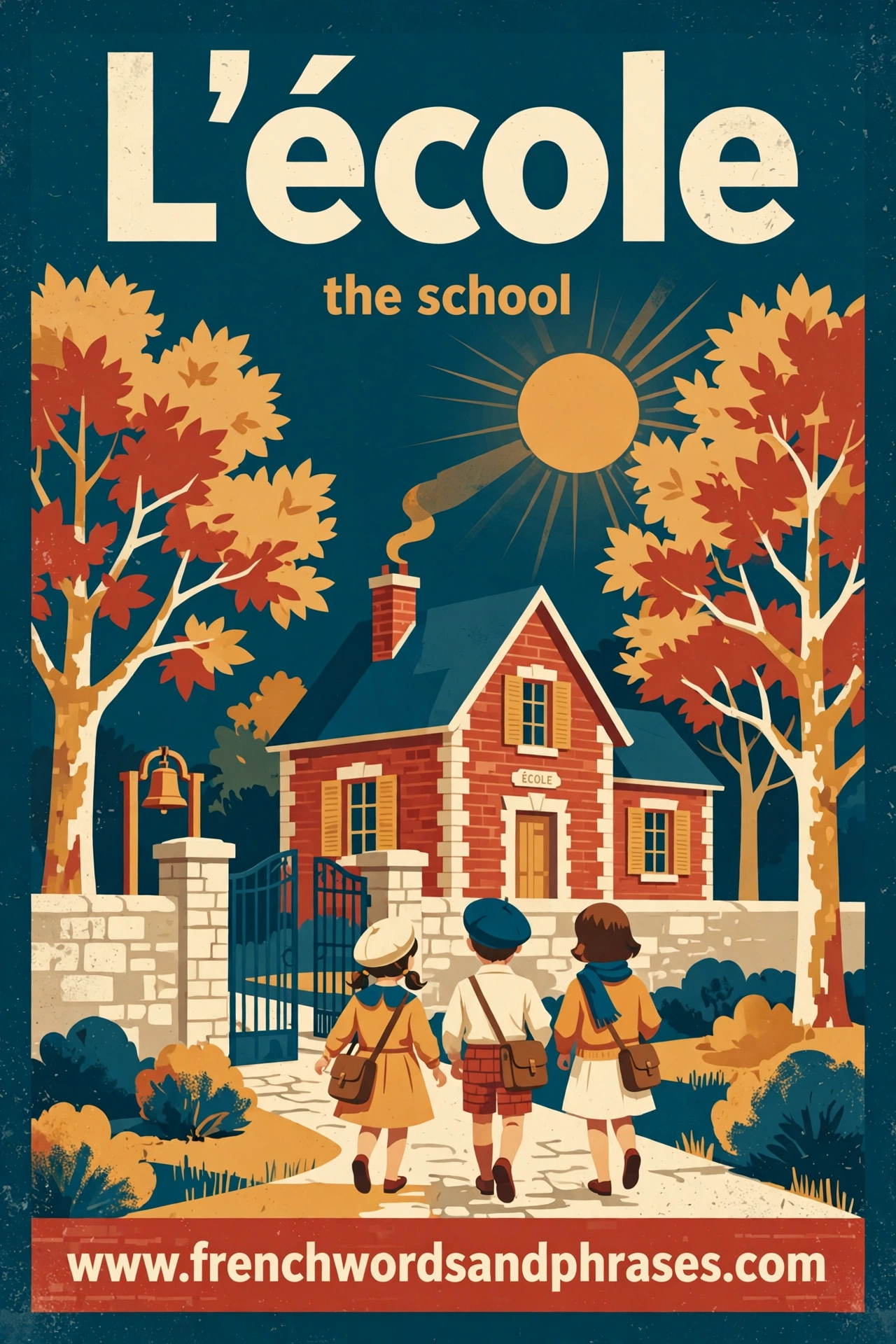
L’école means a school.
Eight o’clock on a September morning: satchels bounce, gates swing wide, and a hundred voices rise in the courtyard before the bell. That is l’école.
In this guide, you’ll learn what école means in English, how to use it with its articles, how to form its plural, and how it appears in everyday French. Explore French examples, English translations, and practice quizzes.
Understanding the French Noun École
École is a feminine French noun. Like every French noun, it has a gender, and it is learned together with its article: l’école — the l’ hides the la, because école begins with a vowel.
It means a school — the building, the institution, and the whole world of lessons, classmates and courtyards. Children in France start at l’école maternelle (nursery school) around the age of three, then move on to l’école primaire (primary school).
Gender: Feminine
Definite article: l’ — l’école (the school)
Indefinite article: une — une école (a school)
Plural: les écoles (the schools)
English equivalents: A school.
One important detail: école begins with a vowel, so its possessives borrow the masculine forms — mon école, ton école, son école, never ma école. And for the daily routine, learn the address by heart: aller à l’école, to go to school.
Experience the Word
École is more than a building. It is where the world first opens: first friends, first books, first triumphs in the courtyard.
Imagine the smell of chalk and new notebooks, your name called from a list, and a satchel almost as big as you are, waiting by the door.
You have not just gone to class. You have started the great adventure.
How to Use École in French: Complete Guide
Let’s explore how école works in French, beginning with its articles.
École and Its Articles
French nouns are almost never used alone. The small word in front of the noun — the article — does a great deal of work.
École with the Definite Article (L’, Les)
Used for a particular school, or school in general. Because école begins with a vowel, la becomes l’.
| Number | French |
|---|---|
| Singular | l’école |
| Plural | les écoles |
Example
L’école commence à huit heures et demie.
School starts at half past eight.
École with the Indefinite Article (Une, Des)
Used for one school among others, or schools in general.
| Number | French |
|---|---|
| Singular | une école |
| Plural | des écoles |
Example
Il y a une école au bout de la rue.
There is a school at the end of the street.
École with Small Words (À l’école)
École is a count noun with no partitive article — instead, it lives inside set phrases with à, de and après. Learn these as blocks.
| Meaning | French |
|---|---|
| at school / to school | à l’école |
| the children’s school | l’école des enfants |
| after school | après l’école |
| in front of the school | devant l’école |
Example
Les enfants sont à l’école jusqu’à seize heures.
The children are at school until four o’clock.
Quick Quiz 1
Complete the sentence:
Les enfants vont ______ à pied.
Reveal the answer
à l’école
Les enfants vont à l’école à pied.
The children walk to school.
The Plural of École
Like most French nouns, école simply adds an -s in the plural — a letter you see but do not hear.
| Number | French |
|---|---|
| Singular | l’école |
| Plural | les écoles |
Example
Les écoles du village sont fermées en août.
The village schools are closed in August.
École with Possessive Adjectives (Mon, Ton, Son…)
Possessives agree with the noun — and école, although feminine, takes mon, ton, son because it begins with a vowel sound.
| Owner | French |
|---|---|
| my | mon école |
| your (tu) | ton école |
| his / her | son école |
| our | notre école |
| your (vous) | votre école |
| their | leur école |
Example
Mon école est à dix minutes à pied.
My school is ten minutes away on foot.
Quick Quiz 2
How do you say my school in French?
Reveal the answer
mon école
Mon école est grande.
My school is big. (École takes mon, not ma, because it begins with a vowel.)
École with Demonstrative Adjectives (Cette, Ces)
Used to point: this school here, those schools there.
| Number | French |
|---|---|
| Singular | cette école |
| Plural | ces écoles |
Example
Cette école a une belle cour.
This school has a lovely courtyard.
École with Adjectives
Adjectives agree with école — feminine forms — and most come after the noun, while short common ones like grande and petite come before it.
| Adjective | With École |
|---|---|
| grande (big) | une grande école |
| petite (small) | une petite école |
| nouvelle (new) | une nouvelle école |
| primaire (primary) | une école primaire |
| maternelle (nursery) | une école maternelle |
| publique (state, public) | une école publique |
Example
Ma fille va dans une petite école de village.
My daughter goes to a small village school.
Quick Quiz 3
Complete the sentence:
C’est une ______ école, avec seulement trois classes.
Reveal the answer
petite
C’est une petite école, avec seulement trois classes.
It is a small school, with only three classes.
Everyday Expressions with École
École appears in expressions every French adult remembers from childhood.
| Expression | In English |
|---|---|
| faire l’école buissonnière | to play truant, to skip school |
| l’école de la vie | the school of life (learning from experience) |
| le chemin de l’école | the way to school |
| la rentrée des classes | the start of the school year (September) |
| un ancien de l’école | a former pupil |
Example
Autrefois, il faisait l’école buissonnière le vendredi.
In the old days, he used to skip school on Fridays.
Words from the Same Family as École
Learn these together and the whole school day falls into place.
| French | In English |
|---|---|
| un élève | a pupil |
| un professeur | a teacher |
| une classe | a class, a classroom |
| un cartable | a school bag |
| un cahier | a notebook |
| la récréation | break time, playtime |
Example
L’élève pose son cartable sous son bureau.
The pupil puts his school bag under his desk.
Quick Quiz 4
What does faire l’école buissonnière mean?
Reveal the answer
To play truant — to skip school
Il a fait l’école buissonnière hier.
He skipped school yesterday.
École in Everyday French: Real-Life Examples
Now that you know the word, let’s see how école appears in everyday French.
Example 1 — The school run
Le matin, elle accompagne sa fille jusqu’à la porte de l’école.
In the morning, she walks her daughter to the school gate.
Example 2 — School hours
L’école commence à huit heures et demie le matin.
School starts at half past eight in the morning.
Example 3 — A new school
Ils ont construit une nouvelle école dans le quartier.
They have built a new school in the neighbourhood.
Example 4 — After school
Après l’école, les enfants jouent dans le parc.
After school, the children play in the park.
Example 5 — Remembering
Mon ancienne école était petite mais chaleureuse.
My old school was small but friendly.
Example 6 — An expression in real life
Pas d’école buissonnière aujourd’hui: il y a un contrôle!
No skipping school today: there is a test!
Beyond Translation: The Meaning of École
English says school for the meaning of école — but in France the word opens the door of the Republic itself: free, secular and compulsory, the école is where every citizen begins.
To say école is to say childhood, and the promise that everyone starts equal.
It evokes the September rentrée, the courtyard bell, the satchel by the door — and the grown-up joke that the deepest lessons came from l’école de la vie, the school of life.
How to Remember the French Noun École
Remember it this way: École begins with a vowel, so it hides behind l’ — and it steals mon for its possessive.
- You do the morning run — tu emmènes les enfants à l’école.
- You show a visitor the building — c’est mon école.
- You remember September — la rentrée à l’école.
The key idea is l’école, à l’école, mon école.
Test Your Knowledge of École
Let’s see how much you’ve learned. Try answering these questions before revealing the answers.
Question 1
Is école masculine or feminine?
Reveal the answer
Feminine — l’école (la becomes l’ before a vowel).
Question 2
How do you say to go to school in French?
Reveal the answer
Aller à l’école.
Question 3
Translate: She is a pupil at the village school.
Reveal the answer
Elle est élève à l’école du village.
Question 4
What is un cartable?
Reveal the answer
A school bag.
Question 5
Complete the sentence:
______ école est à dix minutes d’ici. (my)
Reveal the answer
Mon
Mon école est à dix minutes d’ici.
My school is ten minutes from here.
Your Final Challenge
Can You Use It?
How would you say this in French?
“Next year, our son will start nursery school.”
Reveal the answer
L’année prochaine, notre fils commencera l’école maternelle.
Next year, our son will start nursery school.
A little French. A little curiosity. A richer everyday life.
LEARN FRENCH ONE WORD AT A TIME