A French Word to Live By
Translate Eau to English
/o/
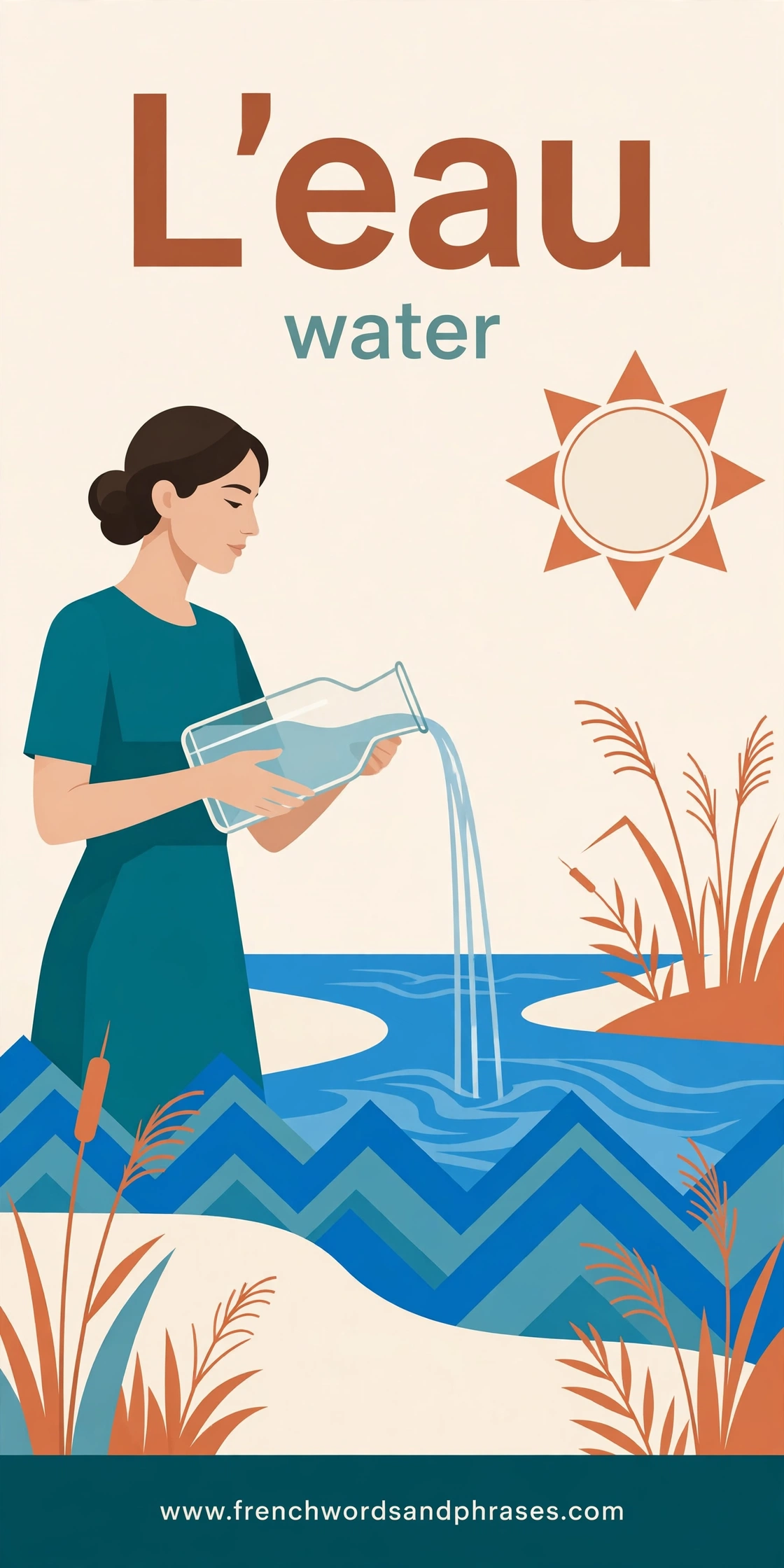
L’eau means water.
A village fountain in August, a queue of bicycles and grandmothers with bottles, and the sound before anything else — cold, clear, endless. That is l’eau.
In this guide, you’ll learn what eau means in English, how to use it with its articles, how to form its plural, and how it appears in everyday French. Explore French examples, English translations, and practice quizzes.
Understanding the French Noun Eau
Eau is a feminine French noun — one of the famous traps, because its article hides the gender completely: it is learned as l’eau.
It means water: the water you drink, the water of rivers and rain, the water of the sea. Because eau begins with a vowel sound, French melts the article into it — l’eau — and only the words around it reveal that eau is feminine: l’eau froide, the cold water.
Gender: Feminine
Definite article: l’ — l’eau (the water); les eaux (the waters)
Indefinite article: Measured, not counted — un verre d’eau (a glass of water); see below
Partitive article: de l’ — de l’eau (some water)
Plural: les eaux (waters — seas, springs, whole regions; rare in the kitchen)
English equivalents: Water.
One important detail: you never ask for une eau at a café table. Water comes by the glass, the bottle or the carafe — un verre d’eau, une bouteille d’eau — and for some water, in general, French uses the partitive: je bois de l’eau, I drink water. The feminine gender hides until an adjective betrays it: l’eau froide.
Experience the Word
Eau is more than a drink. It is the first landscape of France: the Loire sliding past its châteaux, Norman rain, Alpine torrents, and the carafe that arrives on every café table without being asked for.
Imagine the market gardener at dawn, hose in hand, giving the young lettuce its drink before the sun is properly up — the whole garden breathing easier.
You have not just opened a tap. You have touched the element that decides gardens, harvests and summers.
How to Use Eau in French: Complete Guide
Let’s explore how eau works in French, beginning with its articles.
Eau and Its Articles
French nouns are almost never used alone. The small word in front of the noun — the article — does a great deal of work.
Eau with the Definite Article (L’, Les)
Used for water in general, or for the particular water both speakers know about.
| Number | French |
|---|---|
| Singular | l’eau |
| Plural | les eaux |
Example
L’eau du robinet est très froide.
The tap water is very cold.
Eau Measured, Not Counted (Un Verre d’Eau)
Water itself is never counted in French — its containers are. This is how one eau becomes one, two, three.
| Meaning | French |
|---|---|
| a glass of water | un verre d’eau |
| a bottle of water | une bouteille d’eau |
| a carafe of water | une carafe d’eau |
| a litre of water | un litre d’eau |
Example
Je voudrais un verre d’eau, s’il vous plaît.
I would like a glass of water, please.
Eau with the Partitive Article (De l’Eau — Some Water)
Used for an amount of water you do not measure: some water, water in general at the table.
| Meaning | French |
|---|---|
| some water | de l’eau |
| no water | pas d’eau |
| a lot of water | beaucoup d’eau |
| a little water | un peu d’eau |
Example
Elle verse de l’eau dans le vase.
She pours some water into the vase.
Quick Quiz 1
How do you say some water in French?
Reveal the answer
de l’eau
Tu veux de l’eau?
Do you want some water?
The Plural of Eau
The plural les eaux leaves the kitchen behind: it belongs to seas, spa towns and map-makers.
| Number | French |
|---|---|
| Singular | l’eau |
| Plural | les eaux |
Example
Les eaux de la Méditerranée sont chaudes en août.
The waters of the Mediterranean are warm in August.
Eau with Possessive Adjectives (Mon, Ton, Son…)
Before a vowel sound, French uses mon, ton, son even for a feminine noun — mon eau sounds smoother than ma eau would.
| Owner | French |
|---|---|
| my | mon eau |
| your (tu) | ton eau |
| his / her | son eau |
| our | notre eau |
| your (vous) | votre eau |
| their | leur eau |
Example
N’oublie pas ton eau pour la randonnée.
Do not forget your water for the hike.
Quick Quiz 2
Complete the sentence:
Nous buvons ______ après le sport. (some water)
Reveal the answer
de l’eau
Nous buvons de l’eau après le sport.
We drink water after sport.
Eau with Demonstrative Adjectives (Cette, Ces)
Used to point: this water here. For a feminine noun, the demonstrative is cette — one more witness that eau is feminine.
| Number | French |
|---|---|
| Singular | cette eau |
| Plural | ces eaux |
Example
Cette eau de source est délicieuse.
This spring water is delicious.
Eau with Adjectives
Adjectives agree with eau and prove its gender — and at a café, two of them do the daily ordering: plate for still, gazeuse for sparkling.
| Adjective | With Eau |
|---|---|
| froide (cold) | l’eau froide |
| chaude (hot) | l’eau chaude |
| minérale (mineral) | l’eau minérale |
| gazeuse (sparkling) | l’eau gazeuse |
| plate (still) | l’eau plate |
| douce (fresh, soft) | l’eau douce |
Example
Je préfère l’eau plate à l’eau gazeuse.
I prefer still water to sparkling water.
Quick Quiz 3
Complete the sentence:
Je voudrais une eau ______. (sparkling)
Reveal the answer
gazeuse
Je voudrais une eau gazeuse.
I would like a sparkling water. (At a café, une eau gazeuse is exactly how you order it.)
Everyday Expressions with Eau
Eau fills French idioms — plans fall into it, trouble brews in it, and tempers are watered down with it.
| Expression | In English |
|---|---|
| l’eau potable | drinking water |
| tomber à l’eau | to fall through (of a plan) |
| mettre de l’eau dans son vin | to calm down, to compromise (to put water in one’s wine) |
| l’eau de source | spring water |
| il y a de l’eau dans le gaz | there is trouble brewing (water in the gas) |
| se noyer dans un verre d’eau | to get overwhelmed by nothing (to drown in a glass of water) |
Example
Leur projet est tombé à l’eau.
Their plan fell through.
Words from the Same Family as Eau
Learn these together and the whole landscape is watered.
| French | In English |
|---|---|
| une rivière | a river |
| la pluie | rain |
| la mer | the sea |
| un robinet | a tap |
| arroser | to water (plants) |
| un arrosoir | a watering can |
Example
Il arrose les fleurs avec l’arrosoir.
He waters the flowers with the watering can.
Quick Quiz 4
What does tomber à l’eau mean for a plan?
Reveal the answer
To fall through
Notre voyage est tombé à l’eau.
Our trip fell through.
Eau in Everyday French: Real-Life Examples
Now that you know the word, let’s see how eau appears in everyday French.
Example 1 — All day long
Il faut boire de l’eau toute la journée.
You need to drink water all day long.
Example 2 — At the café
Un verre d’eau avec le café, s’il vous plaît.
A glass of water with the coffee, please.
Example 3 — Sparkling or still
Vous voulez de l’eau plate ou gazeuse?
Would you like still or sparkling water?
Example 4 — In the garden
Les plantes ont besoin d’eau tous les jours.
The plants need water every day.
Example 5 — By the sea
L’eau est froide ce matin.
The water is cold this morning.
Example 6 — An expression in real life
Après l’orage, le pique-nique est tombé à l’eau.
After the storm, the picnic fell through.
Beyond Translation: The Meaning of Eau
English says water for the meaning of eau — three letters in French that make a single sound, /o/: a word that is almost all vowel, as fluid as its meaning.
To say l’eau is to hear the word flow.
It evokes fountains in village squares, spa towns built on springs, and the French certainty that a meal without a carafe of water is not yet a meal.
How to Remember the French Noun Eau
Remember it this way: Eau is feminine but hides behind l’ — remember it with its partitive, de l’eau, and its café partners, plate and gazeuse.
- You fill a glass — tu verses de l’eau.
- You order at the café — un verre d’eau, s’il vous plaît.
- You choose sparkling — une eau gazeuse.
The key idea is de l’eau for some water, l’eau froide to prove it is feminine.
Test Your Knowledge of Eau
Let’s see how much you’ve learned. Try answering these questions before revealing the answers.
Question 1
Is eau masculine or feminine?
Reveal the answer
Feminine — l’eau froide, with a feminine adjective.
Question 2
How do you say some water in French?
Reveal the answer
De l’eau.
Question 3
Translate: She pours some water into the vase.
Reveal the answer
Elle verse de l’eau dans le vase.
Question 4
What happens to a plan that tombe à l’eau?
Reveal the answer
It falls through.
Question 5
Complete the sentence:
Je voudrais un verre ______ , s’il vous plaît. (of water)
Reveal the answer
d’eau
Je voudrais un verre d’eau, s’il vous plaît.
I would like a glass of water, please.
Your Final Challenge
Can You Use It?
How would you say this in French?
“I would like a glass of water, please.”
Reveal the answer
Je voudrais un verre d’eau, s’il vous plaît.
I would like a glass of water, please.
A little French. A little curiosity. A richer everyday life.
LEARN FRENCH ONE WORD AT A TIME