A French Word to Live By
How to Conjugate Ébraser in French
/e.bʁa.ze/
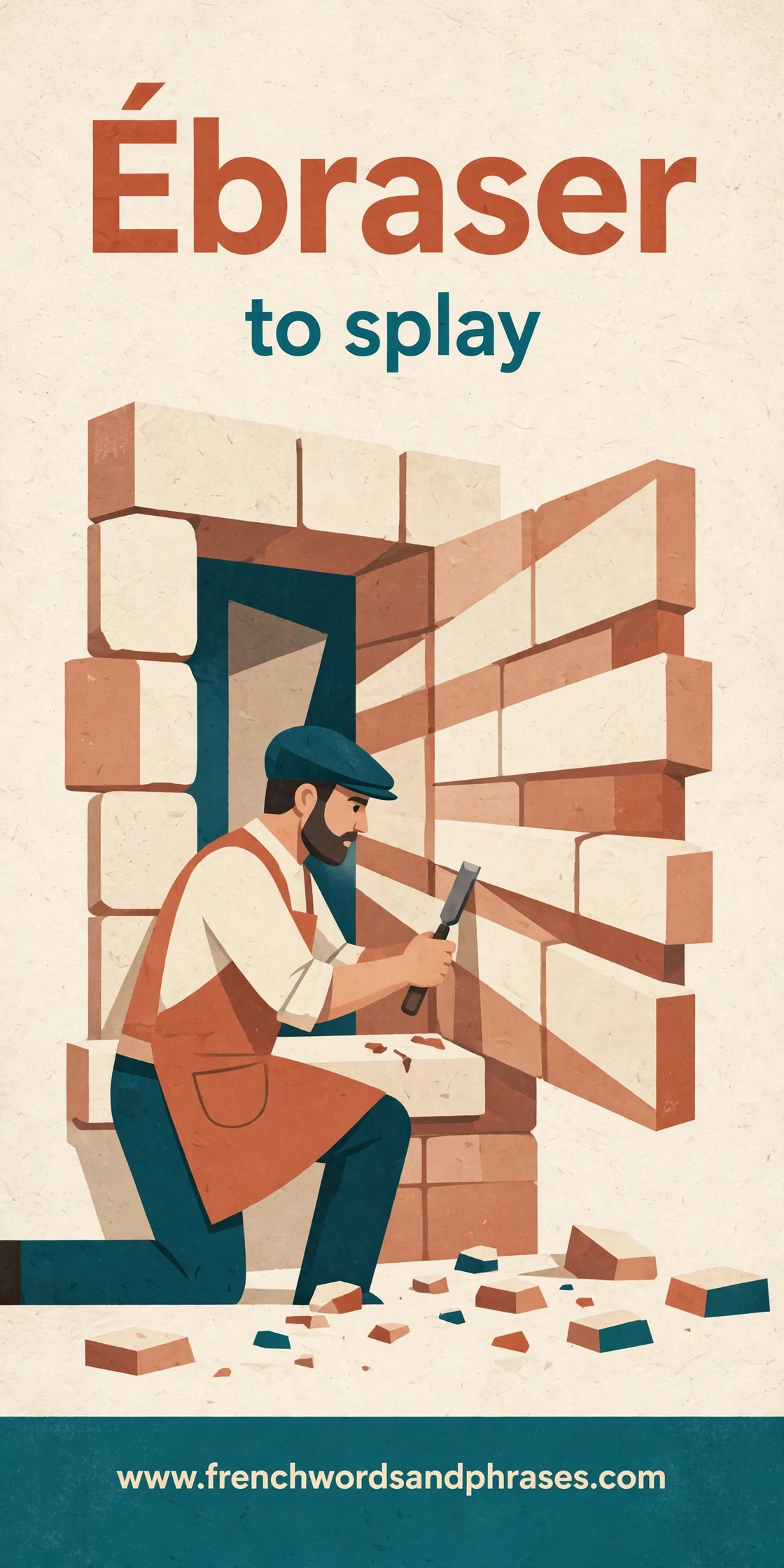
Ébraser means to splay — to widen an opening by cutting its sides at a slant.
A narrow window cut through a thick castle wall, its sides slanted wide so one slit of glass can light a whole room — ébraser is the craftsman’s verb for that slant: splaying the sides of an opening so light, air or a screw can get in.
In this guide, you’ll learn how to conjugate ébraser in all the major French tenses and moods. Explore complete conjugation tables, French examples, English translations, and practice quizzes.
Understanding the French Verb Ébraser
Ébraser is a regular French verb belonging to the first group of verbs, those ending in -er.
It means to splay. It is commonly used by masons and architects for splaying window and door openings in thick walls, by joiners for widening the mouth of a hole, and in metalwork for flaring or countersinking a hole so a screw head sits flush.
Verb classification: First group (-er)
Auxiliary verb: Avoir
Past participle: ébrasé
Present participle: ébrasant
English equivalents: To splay, to flare out the sides of an opening; un ébrasement — the splay of a doorway or window (also called une embrasure).
One important detail: ébraser is a workshop word — masonry, joinery and metalwork. The result of the work is un ébrasement, the splayed reveal of a door or window, the slanted cheeks you see inside every thick-walled old church. Medieval builders ébrasaient their tiny windows for a practical reason: a narrow opening in a two-metre wall lets in almost no light unless its sides are splayed wide toward the inside.
Experience the Word
Ébraser is the verb of the generous opening — the wall stays thick, but the light is invited in at an angle.
Imagine a Romanesque chapel at noon. Outside, the window is a mere slit; inside, its splayed sides open like a funnel, and a blade of sunlight widens across the whole floor. Someone, nine centuries ago, ébrasa that window by hand.
The opening has not simply been cut. It has been splayed — widened with intent, so the inside receives more than the outside promises.
How to Conjugate Ébraser: Complete French Conjugation Guide
Let’s explore every major conjugation of ébraser, beginning with the indicative mood.
How to Conjugate Ébraser in the Indicative Mood
The indicative mood is used to express facts, observations, actions, and events.
How to Conjugate Ébraser in the Present Tense (Présent)
Used for actions happening now, habitual actions, and general truths.
| Subject | Conjugation |
|---|---|
| je | ébrase |
| tu | ébrases |
| il / elle | ébrase |
| nous | ébrasons |
| vous | ébrasez |
| ils / elles | ébrasent |
Example
Le maçon ébrase l’ouverture pour laisser entrer plus de lumière.
The mason splays the opening to let in more light.
Quick Quiz 1
Complete the sentence:
Nous ______ la fenêtre vers l’intérieur.
Reveal the answer
ébrasons
Nous ébrasons la fenêtre vers l’intérieur.
We splay the window towards the inside.
How to Conjugate Ébraser in the Passé Composé
Used for completed actions in the past. Ébraser takes the auxiliary verb avoir.
| Subject | Conjugation |
|---|---|
| j’ | ai ébrasé |
| tu | as ébrasé |
| il / elle | a ébrasé |
| nous | avons ébrasé |
| vous | avez ébrasé |
| ils / elles | ont ébrasé |
Example
Ils ont ébrasé les bords de la fenêtre côté cour.
They splayed the edges of the window on the courtyard side.
How to Conjugate Ébraser in the Imparfait (Imperfect Tense)
Used for habitual past actions, descriptions, and ongoing situations in the past.
| Subject | Conjugation |
|---|---|
| je | ébrasais |
| tu | ébrasais |
| il / elle | ébrasait |
| nous | ébrasions |
| vous | ébrasiez |
| ils / elles | ébrasaient |
Example
Les bâtisseurs ébrasaient toujours les embrasures vers l’intérieur.
The builders always used to splay the window reveals towards the inside.
Quick Quiz 2
Choose the correct form:
They splayed the entrance.
Ils ______ l’entrée. (ont ébrasé / sont ébrasés)
Reveal the answer
ont ébrasé
Ils ont ébrasé l’entrée.
Ébraser takes avoir.
How to Conjugate Ébraser in the Plus-que-parfait
Used to describe an action that had already been completed before another past event.
| Subject | Conjugation |
|---|---|
| j’ | avais ébrasé |
| tu | avais ébrasé |
| il / elle | avait ébrasé |
| nous | avions ébrasé |
| vous | aviez ébrasé |
| ils / elles | avaient ébrasé |
Example
L’architecte avait ébrasé la porte pour agrandir le passage.
The architect had splayed the doorway to widen the passage.
How to Conjugate Ébraser in the Passé Simple
Primarily used in formal writing, literature, and historical narratives. It is rarely used in everyday conversation.
| Subject | Conjugation |
|---|---|
| je | ébrasai |
| tu | ébrasas |
| il / elle | ébrasa |
| nous | ébrasâmes |
| vous | ébrasâtes |
| ils / elles | ébrasèrent |
Example
Le tailleur de pierre ébrasa le seuil avec une précision admirable.
The stonecutter splayed the threshold with admirable precision.
How to Conjugate Ébraser in the Passé Antérieur
A literary tense used to express an action completed immediately before another past action, generally in the passé simple.
| Subject | Conjugation |
|---|---|
| j’ | eus ébrasé |
| tu | eus ébrasé |
| il / elle | eut ébrasé |
| nous | eûmes ébrasé |
| vous | eûtes ébrasé |
| ils / elles | eurent ébrasé |
Example
Quand il eut ébrasé le trou, la vis entra sans forcer.
When he had flared the hole, the screw went in without forcing.
How to Conjugate Ébraser in the Future Tense (Futur Simple)
Used to describe actions that will take place in the future.
| Subject | Conjugation |
|---|---|
| je | ébraserai |
| tu | ébraseras |
| il / elle | ébrasera |
| nous | ébraserons |
| vous | ébraserez |
| ils / elles | ébraseront |
Example
Nous ébraserons l’entrée de la cave au printemps.
We will splay the entrance to the cellar in spring.
How to Conjugate Ébraser in the Futur Antérieur (Future Perfect)
Used for an action that will have been completed before a particular point in the future.
| Subject | Conjugation |
|---|---|
| j’ | aurai ébrasé |
| tu | auras ébrasé |
| il / elle | aura ébrasé |
| nous | aurons ébrasé |
| vous | aurez ébrasé |
| ils / elles | auront ébrasé |
Example
À la fin du chantier, ils auront ébrasé toutes les ouvertures.
By the end of the building work, they will have splayed all the openings.
How to Conjugate Ébraser in the Near Future (Futur Proche)
Used to describe something that is going to happen soon. Formed with aller + infinitive.
| Subject | Conjugation |
|---|---|
| je | vais ébraser |
| tu | vas ébraser |
| il / elle | va ébraser |
| nous | allons ébraser |
| vous | allez ébraser |
| ils / elles | vont ébraser |
Example
Je vais ébraser ce trou pour y passer le tuyau.
I am going to flare this hole to pass the pipe through it.
How to Conjugate Ébraser in the Conditional Mood
The conditional mood expresses what would happen under certain circumstances. It is also frequently used to make polite requests or express wishes.
How to Conjugate Ébraser in the Present Conditional
| Subject | Conjugation |
|---|---|
| je | ébraserais |
| tu | ébraserais |
| il / elle | ébraserait |
| nous | ébraserions |
| vous | ébraseriez |
| ils / elles | ébraseraient |
Example
Un bon outil ébraserait ce bord en une minute.
A good tool would splay this edge in a minute.
How to Conjugate Ébraser in the Past Conditional
| Subject | Conjugation |
|---|---|
| j’ | aurais ébrasé |
| tu | aurais ébrasé |
| il / elle | aurait ébrasé |
| nous | aurions ébrasé |
| vous | auriez ébrasé |
| ils / elles | auraient ébrasé |
Example
Sans la perceuse, il n’aurait pas ébrasé la plaque.
Without the drill, he would not have flared the plate.
Ébraser in the Literary Past Conditional Form
This less common literary form uses the imperfect subjunctive of avoir.
| Subject | Conjugation |
|---|---|
| j’ | eusse ébrasé |
| tu | eusses ébrasé |
| il / elle | eût ébrasé |
| nous | eussions ébrasé |
| vous | eussiez ébrasé |
| ils / elles | eussent ébrasé |
Example
Le maçon eût ébrasé la fenêtre vers la cour.
The mason would have splayed the window towards the courtyard.
How to Conjugate Ébraser in the Subjunctive Mood
The subjunctive is used to express wishes, emotions, doubts, necessity, and uncertainty. It frequently follows expressions such as il faut que (it is necessary that) or bien que (although).
How to Conjugate Ébraser in the Present Subjunctive
| Subject | Conjugation |
|---|---|
| que je | ébrase |
| que tu | ébrases |
| qu’il / qu’elle | ébrase |
| que nous | ébrasions |
| que vous | ébrasiez |
| qu’ils / qu’elles | ébrasent |
Example
Il faut que tu ébrases l’ouverture en biais.
You must splay the opening at a slant.
Quick Quiz 3
Complete the sentence using the subjunctive:
Il faut que vous ______ l’ouverture en biais.
Reveal the answer
ébrasiez
Il faut que vous ébrasiez l’ouverture en biais.
You must splay the opening at a slant.
How to Conjugate Ébraser in the Imperfect Subjunctive
A literary tense, rarely encountered in modern spoken French.
| Subject | Conjugation |
|---|---|
| que je | ébrasasse |
| que tu | ébrasasses |
| qu’il / qu’elle | ébrasât |
| que nous | ébrasassions |
| que vous | ébrasassiez |
| qu’ils / qu’elles | ébrasassent |
Example
L’architecte voulait que l’on ébrasât les embrasures.
The architect wanted the reveals to be splayed.
How to Conjugate Ébraser in the Pluperfect Subjunctive
A literary construction used to express an action completed before another past action.
| Subject | Conjugation |
|---|---|
| que j’ | eusse ébrasé |
| que tu | eusses ébrasé |
| qu’il / qu’elle | eût ébrasé |
| que nous | eussions ébrasé |
| que vous | eussiez ébrasé |
| qu’ils / qu’elles | eussent ébrasé |
Example
On craignait qu’il eût ébrasé le mur trop largement.
People feared he had splayed the wall too widely.
How to Conjugate Ébraser in the Past Subjunctive
| Subject | Conjugation |
|---|---|
| que j’ | aie ébrasé |
| que tu | aies ébrasé |
| qu’il / qu’elle | ait ébrasé |
| que nous | ayons ébrasé |
| que vous | ayez ébrasé |
| qu’ils / qu’elles | aient ébrasé |
Example
Je suis content que vous ayez ébrasé l’entrée.
I am glad you splayed the entrance.
How to Conjugate Ébraser in the Imperative
The imperative is used to give commands, instructions, invitations, or suggestions. Subject pronouns are omitted.
How to Conjugate Ébraser in the Present Imperative
| Person | Conjugation |
|---|---|
| (tu) | ébrase |
| (nous) | ébrasons |
| (vous) | ébrasez |
Example
Ébrase le trou avant de visser !
Flare the hole before screwing!
Quick Quiz 4
How would you say Flare the hole before screwing (tu form)?
Reveal the answer
Ébrase le trou avant de visser !
French Participles of Ébraser
Participles are verb forms that can be used in compound tenses and other grammatical constructions.
Present Participle of Ébraser
ébrasant
En ébrasant la fenêtre, il a doublé la lumière de la pièce.
By splaying the window, he doubled the light in the room.
Past Participle of Ébraser
ébrasé
Ébrasée vers l’intérieur, la fenêtre éclaire toute la cuisine.
Splayed towards the inside, the window lights the whole kitchen.
Ébraser in Everyday French: Real-Life Examples
Now that you know the conjugations, let’s see how ébraser appears in everyday French.
Example 1 — Present
Le maçon ébrase la fenêtre pour gagner de la lumière.
The mason splays the window to gain light.
Example 2 — Passé composé
Ils ont ébrasé l’entrée de la cave.
They splayed the entrance to the cellar.
Example 3 — Imparfait
On ébrasait les fenêtres des églises vers l’intérieur.
Church windows used to be splayed towards the inside.
Example 4 — Future
Nous ébraserons la porte du grenier.
We will splay the attic door.
Example 5 — Conditional
Tu ébraserais ce trou avec une fraise ?
Would you flare this hole with a countersink bit?
Example 6 — Imperative
Ébrase le bord, mais sans forcer !
Splay the edge, but without forcing!
Beyond Translation: The Meaning of Ébraser
English splay is a word of fingers and legs; French ébraser belongs to walls.
It is the slant that turns a slit into a source of light.
Every old French church demonstrates it: stand inside at noon and watch a window no wider than a hand pour light across a whole chapel — that is an ébrasement at work.
How to Remember the French Verb Ébraser
Remember it this way: Ébraser is about the craftsman’s slant — splayed openings that invite the light in.
- Un ébrasement — the splay itself: the slanted sides of a door or window opening.
- Ébraser une fenêtre — to splay a window so a thick wall admits more light.
- Regular -er: j’ébrase, nous ébrasons, past participle ébrasé.
The key idea is the craftsman’s slant — splayed openings that invite the light in.
Test Your Knowledge of Ébraser
Let’s see how much you’ve learned. Try answering these questions before revealing the answers.
Question 1
What is un ébrasement?
Reveal the answer
The splay of an opening — the slanted sides of a doorway or window in a thick wall.
Question 2
How do you say The mason splays the opening in French?
Reveal the answer
Le maçon ébrase l’ouverture.
Question 3
Translate: They splayed the entrance to the cellar.
Reveal the answer
Ils ont ébrasé l’entrée de la cave.
Question 4
What is the past participle of ébraser?
Reveal the answer
Ébrasé.
Question 5
Complete the sentence:
Il faut que tu ______ l’ouverture en biais.
Reveal the answer
ébrases
Il faut que tu ébrases l’ouverture en biais.
You must splay the opening at a slant.
Your Final Challenge
Can You Use It?
How would you say this in French?
The mason splays the little window, and suddenly the whole chapel breathes light.
Reveal the answer
Le maçon ébrase la petite fenêtre, et soudain la chapelle entière respire la lumière.
The mason splays the little window, and suddenly the whole chapel breathes light.
A little French. A little curiosity. A richer everyday life.
LEARN FRENCH ONE WORD AT A TIME