A French Word to Live By
How to Conjugate Ébourrer in French
/e.bu.ʁe/
Ébourrer means to remove stuffing — to empty a cushion, a mattress or a chair of its old padding before it is made new.
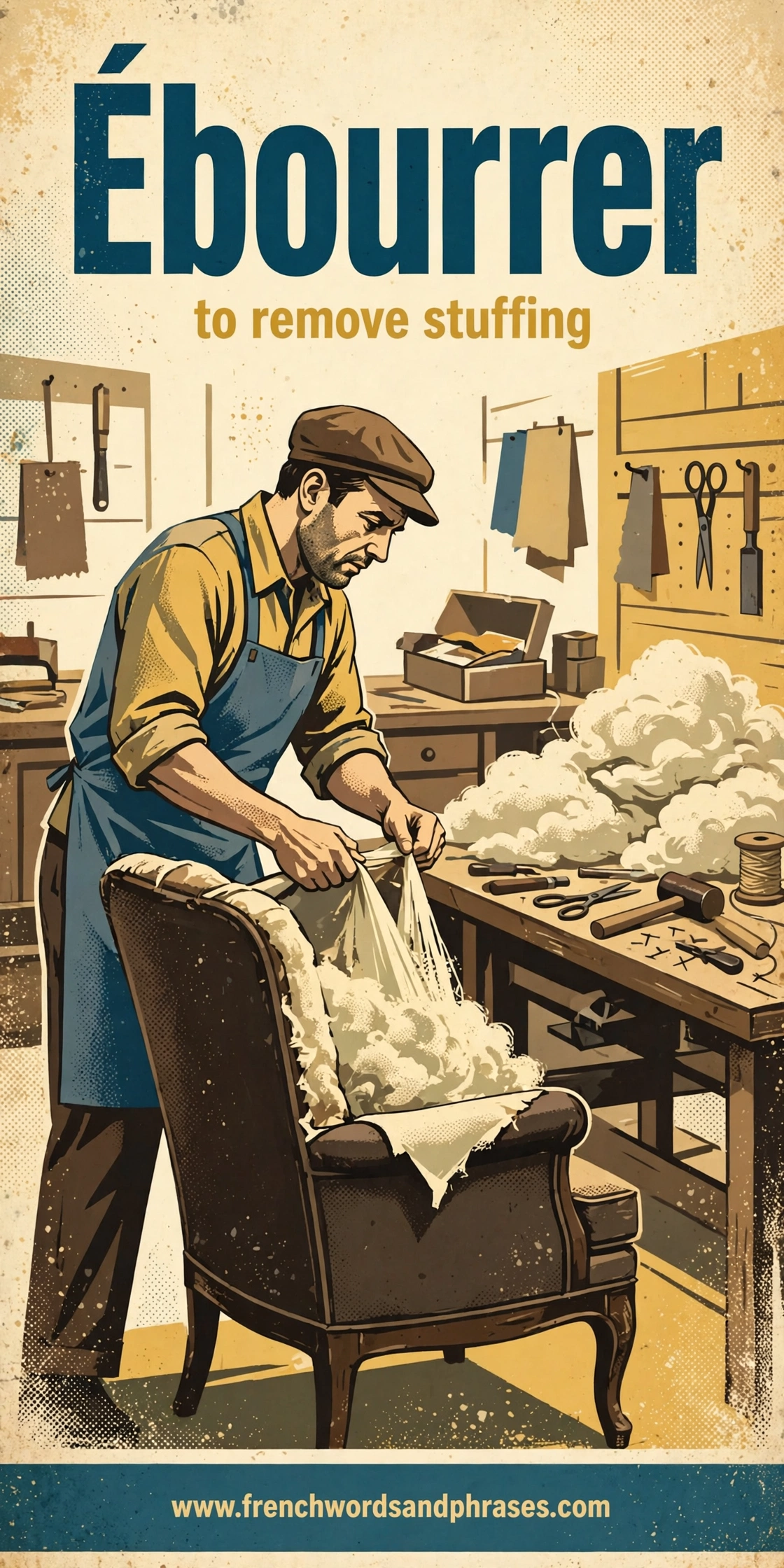
An old armchair opened like a book, clouds of grey flock drifting in a sunlit workshop, a mattress emptied onto the floor — ébourrer is the upholsterer’s verb of emptying, the necessary destruction before every restoration.
In this guide, you’ll learn how to conjugate ébourrer in all the major French tenses and moods. Explore complete conjugation tables, French examples, English translations, and practice quizzes.
Understanding the French Verb Ébourrer
Ébourrer is a regular French verb belonging to the first group of verbs, those ending in -er.
It means to remove stuffing. It is commonly used by upholsterers emptying armchairs and sofas before re-covering them, by mattress makers stripping old bedding down to the ticking, and by saddlers taking the padding out of saddles — wherever something soft must be emptied before it can be made good again.
Verb classification: First group (-er)
Auxiliary verb: Avoir
Past participle: ébourré
Present participle: ébourrant
English equivalents: To remove the stuffing, to unstuff; la bourre — stuffing, padding, flock; rembourrer — to re-stuff, to pad again.
One important detail: ébourrer is built on la bourre, the coarse fibrous stuffing — flock, tow, horsehair waste — that filled the cushions and mattresses of the old world. The prefix é- takes it out; its partner rembourrer puts fresh stuffing back, and the tradesman is le tapissier, the upholsterer. Keep the double r everywhere: j’ébourre, nous ébourrons. Not to be confused with its neighbour ébouriffer, which ruffles hair — the workshop and the hairdresser are only one syllable apart.
Experience the Word
Ébourrer is the verb of the workshop’s dusty hour — everything soft is opened, emptied, and judged.
Imagine a tapissier’s workshop in Lyon. A Louis-Philippe armchair stands upside down, its underside cut open, and the upholsterer pulls out handful after handful of century-old bourre while the new horsehair waits in a clean pile — first ébourrer, then rembourrer, then the chair lives another hundred years.
The chair has not been destroyed. It has been ébourré — emptied of its tired stuffing, ready to be reborn.
How to Conjugate Ébourrer: Complete French Conjugation Guide
Let’s explore every major conjugation of ébourrer, beginning with the indicative mood.
How to Conjugate Ébourrer in the Indicative Mood
The indicative mood is used to express facts, observations, actions, and events.
How to Conjugate Ébourrer in the Present Tense (Présent)
Used for actions happening now, habitual actions, and general truths.
| Subject | Conjugation |
|---|---|
| je | ébourre |
| tu | ébourres |
| il / elle | ébourre |
| nous | ébourrons |
| vous | ébourrez |
| ils / elles | ébourrent |
Example
Le tapissier ébourre le fauteuil avant de le retapisser.
The upholsterer removes the stuffing from the armchair before re-covering it.
Quick Quiz 1
Complete the sentence:
Nous ______ les matelas au printemps.
Reveal the answer
ébourrons
Nous ébourrons les matelas au printemps.
We unstuff the mattresses in spring.
How to Conjugate Ébourrer in the Passé Composé
Used for completed actions in the past. Ébourrer takes the auxiliary verb avoir.
| Subject | Conjugation |
|---|---|
| j’ | ai ébourré |
| tu | as ébourré |
| il / elle | a ébourré |
| nous | avons ébourré |
| vous | avez ébourré |
| ils / elles | ont ébourré |
Example
Nous avons ébourré deux matelas ce matin.
We removed the stuffing from two mattresses this morning.
How to Conjugate Ébourrer in the Imparfait (Imperfect Tense)
Used for habitual past actions, descriptions, and ongoing situations in the past.
| Subject | Conjugation |
|---|---|
| je | ébourrais |
| tu | ébourrais |
| il / elle | ébourrait |
| nous | ébourrions |
| vous | ébourriez |
| ils / elles | ébourraient |
Example
Autrefois, on ébourrait les paillasses chaque printemps.
In the old days, people used to unstuff the straw mattresses every spring.
Quick Quiz 2
Choose the correct form:
They unstuffed the sofa.
Ils ______ le canapé. (ont ébourré / sont ébourrés)
Reveal the answer
ont ébourré
Ils ont ébourré le canapé.
Ébourrer takes avoir.
How to Conjugate Ébourrer in the Plus-que-parfait
Used to describe an action that had already been completed before another past event.
| Subject | Conjugation |
|---|---|
| j’ | avais ébourré |
| tu | avais ébourré |
| il / elle | avait ébourré |
| nous | avions ébourré |
| vous | aviez ébourré |
| ils / elles | avaient ébourré |
Example
Elle avait ébourré le coussin avant de le laver.
She had removed the stuffing from the cushion before washing it.
How to Conjugate Ébourrer in the Passé Simple
Primarily used in formal writing, literature, and historical narratives. It is rarely used in everyday conversation.
| Subject | Conjugation |
|---|---|
| je | ébourrai |
| tu | ébourras |
| il / elle | ébourra |
| nous | ébourrâmes |
| vous | ébourrâtes |
| ils / elles | ébourrèrent |
Example
L’atelier ébourra cent chaises pour l’hôtel.
The workshop unstuffed a hundred chairs for the hotel.
How to Conjugate Ébourrer in the Passé Antérieur
A literary tense used to express an action completed immediately before another past action, generally in the passé simple.
| Subject | Conjugation |
|---|---|
| j’ | eus ébourré |
| tu | eus ébourré |
| il / elle | eut ébourré |
| nous | eûmes ébourré |
| vous | eûtes ébourré |
| ils / elles | eurent ébourré |
Example
Quand ils eurent ébourré la selle, ils examinèrent le cuir.
When they had removed the stuffing from the saddle, they examined the leather.
How to Conjugate Ébourrer in the Future Tense (Futur Simple)
Used to describe actions that will take place in the future.
| Subject | Conjugation |
|---|---|
| je | ébourrerai |
| tu | ébourreras |
| il / elle | ébourrera |
| nous | ébourrerons |
| vous | ébourrerez |
| ils / elles | ébourreront |
Example
Demain, j’ébourrerai ce vieux canapé.
Tomorrow, I will remove the stuffing from this old sofa.
How to Conjugate Ébourrer in the Futur Antérieur (Future Perfect)
Used for an action that will have been completed before a particular point in the future.
| Subject | Conjugation |
|---|---|
| j’ | aurai ébourré |
| tu | auras ébourré |
| il / elle | aura ébourré |
| nous | aurons ébourré |
| vous | aurez ébourré |
| ils / elles | auront ébourré |
Example
À midi, l’équipe aura ébourré tous les fauteuils du salon.
By noon, the team will have unstuffed all the armchairs in the showroom.
How to Conjugate Ébourrer in the Near Future (Futur Proche)
Used to describe something that is going to happen soon. Formed with aller + infinitive.
| Subject | Conjugation |
|---|---|
| je | vais ébourrer |
| tu | vas ébourrer |
| il / elle | va ébourrer |
| nous | allons ébourrer |
| vous | allez ébourrer |
| ils / elles | vont ébourrer |
Example
Je vais ébourrer ce coussin, la bourre est toute tassée.
I am going to unstuff this cushion, the stuffing is all packed down.
How to Conjugate Ébourrer in the Conditional Mood
The conditional mood expresses what would happen under certain circumstances. It is also frequently used to make polite requests or express wishes.
How to Conjugate Ébourrer in the Present Conditional
| Subject | Conjugation |
|---|---|
| je | ébourrerais |
| tu | ébourrerais |
| il / elle | ébourrerait |
| nous | ébourrerions |
| vous | ébourreriez |
| ils / elles | ébourreraient |
Example
Avec un bon couteau, on ébourrerait ce matelas en dix minutes.
With a good knife, we would unstuff this mattress in ten minutes.
How to Conjugate Ébourrer in the Past Conditional
| Subject | Conjugation |
|---|---|
| j’ | aurais ébourré |
| tu | aurais ébourré |
| il / elle | aurait ébourré |
| nous | aurions ébourré |
| vous | auriez ébourré |
| ils / elles | auraient ébourré |
Example
Ils auraient ébourré les chaises si le tissu neuf était arrivé.
They would have unstuffed the chairs if the new fabric had arrived.
Ébourrer in the Literary Past Conditional Form
This less common literary form uses the imperfect subjunctive of avoir.
| Subject | Conjugation |
|---|---|
| j’ | eusse ébourré |
| tu | eusses ébourré |
| il / elle | eût ébourré |
| nous | eussions ébourré |
| vous | eussiez ébourré |
| ils / elles | eussent ébourré |
Example
Le tapissier eût ébourré le trône lui-même.
The upholsterer would have unstuffed the throne itself.
How to Conjugate Ébourrer in the Subjunctive Mood
The subjunctive is used to express wishes, emotions, doubts, necessity, and uncertainty. It frequently follows expressions such as il faut que (it is necessary that) or bien que (although).
How to Conjugate Ébourrer in the Present Subjunctive
| Subject | Conjugation |
|---|---|
| que je | ébourre |
| que tu | ébourres |
| qu’il / qu’elle | ébourre |
| que nous | ébourrions |
| que vous | ébourriez |
| qu’ils / qu’elles | ébourrent |
Example
Il faut que tu ébourres ce coussin avant de le recoudre.
You must remove the stuffing from this cushion before sewing it up again.
Quick Quiz 3
Complete the sentence using the subjunctive:
Il faut que vous ______ la selle.
Reveal the answer
ébourriez
Il faut que vous ébourriez la selle.
You must remove the stuffing from the saddle.
How to Conjugate Ébourrer in the Imperfect Subjunctive
A literary tense, rarely encountered in modern spoken French.
| Subject | Conjugation |
|---|---|
| que je | ébourrasse |
| que tu | ébourrasses |
| qu’il / qu’elle | ébourrât |
| que nous | ébourrassions |
| que vous | ébourrassiez |
| qu’ils / qu’elles | ébourrassent |
Example
Le client voulait que l’atelier ébourrât la banquette le jour même.
The client wanted the workshop to unstuff the bench seat the same day.
How to Conjugate Ébourrer in the Pluperfect Subjunctive
A literary construction used to express an action completed before another past action.
| Subject | Conjugation |
|---|---|
| que j’ | eusse ébourré |
| que tu | eusses ébourré |
| qu’il / qu’elle | eût ébourré |
| que nous | eussions ébourré |
| que vous | eussiez ébourré |
| qu’ils / qu’elles | eussent ébourré |
Example
On voyait qu’ils eussent ébourré les matelas à la hâte.
You could see they had unstuffed the mattresses in a hurry.
How to Conjugate Ébourrer in the Past Subjunctive
| Subject | Conjugation |
|---|---|
| que j’ | aie ébourré |
| que tu | aies ébourré |
| qu’il / qu’elle | ait ébourré |
| que nous | ayons ébourré |
| que vous | ayez ébourré |
| qu’ils / qu’elles | aient ébourré |
Example
Je suis content que vous ayez ébourré la selle avant l’hiver.
I am glad you removed the stuffing from the saddle before winter.
How to Conjugate Ébourrer in the Imperative
The imperative is used to give commands, instructions, invitations, or suggestions. Subject pronouns are omitted.
How to Conjugate Ébourrer in the Present Imperative
| Person | Conjugation |
|---|---|
| (tu) | ébourre |
| (nous) | ébourrons |
| (vous) | ébourrez |
Example
Ébourre ce fauteuil, puis apporte la bourre neuve !
Unstuff this armchair, then bring the new stuffing!
Quick Quiz 4
How would you say Unstuff this armchair (tu form)?
Reveal the answer
Ébourre ce fauteuil !
French Participles of Ébourrer
Participles are verb forms that can be used in compound tenses and other grammatical constructions.
Present Participle of Ébourrer
ébourrant
En ébourrant le matelas, elle a trouvé une pièce ancienne.
While removing the stuffing from the mattress, she found an old coin.
Past Participle of Ébourrer
ébourré
Ébourrés puis rembourrés, les fauteuils semblent neufs.
Unstuffed then re-stuffed, the armchairs look new.
Ébourrer in Everyday French: Real-Life Examples
Now that you know the conjugations, let’s see how ébourrer appears in everyday French.
Example 1 — Present
Le tapissier ébourre les chaises avant de les retapisser.
The upholsterer unstuffs the chairs before re-covering them.
Example 2 — Passé composé
Elle a ébourré le coussin pour le laver.
She removed the stuffing from the cushion to wash it.
Example 3 — Imparfait
On ébourrait les paillasses au printemps.
People used to unstuff the straw mattresses in spring.
Example 4 — Future
Nous ébourrerons le canapé demain.
We will unstuff the sofa tomorrow.
Example 5 — Conditional
Tu ébourrerais ce matelas tout seul ?
Would you unstuff this mattress on your own?
Example 6 — Imperative
Ébourrez le fauteuil, mais gardez la bourre propre de côté !
Unstuff the armchair, but keep the clean stuffing aside!
Beyond Translation: The Meaning of Ébourrer
English must unpack this idea into remove the stuffing; French ébourrer names the act with the material itself — bourre out, by the handful.
It is the first half of every restoration.
No chair is rembourré before it is ébourré: French upholstery keeps the honest sequence in two verbs, emptying before filling, judgement before renewal.
How to Remember the French Verb Ébourrer
Remember it this way: Ébourrer is about the upholsterer’s emptying — old stuffing out, by the handful.
- La bourre — the stuffing; é- takes it out: ébourrer empties, rembourrer refills.
- The tapissier’s pair: ébourrer first, rembourrer second, retapisser last.
- Regular -er with double r: j’ébourre, nous ébourrons, past participle ébourré.
The key idea is the upholsterer’s emptying — old stuffing out, by the handful.
Test Your Knowledge of Ébourrer
Let’s see how much you’ve learned. Try answering these questions before revealing the answers.
Question 1
What is la bourre?
Reveal the answer
The stuffing — the padding ébourrer removes.
Question 2
How do you say The upholsterer unstuffs the chairs in French?
Reveal the answer
Le tapissier ébourre les chaises.
Question 3
Translate: She removed the stuffing from the cushion to wash it.
Reveal the answer
Elle a ébourré le coussin pour le laver.
Question 4
What is the past participle of ébourrer?
Reveal the answer
Ébourré.
Question 5
Complete the sentence:
Il faut que tu ______ ce coussin avant de le recoudre.
Reveal the answer
ébourres
Il faut que tu ébourres ce coussin avant de le recoudre.
You must remove the stuffing from this cushion before sewing it up again.
Your Final Challenge
Can You Use It?
How would you say this in French?
The upholsterer removes the stuffing from the old armchair, and already its second life begins.
Reveal the answer
Le tapissier ébourre le vieux fauteuil, et déjà sa seconde vie commence.
The upholsterer removes the stuffing from the old armchair, and already its second life begins.
A little French. A little curiosity. A richer everyday life.
LEARN FRENCH ONE WORD AT A TIME