A French Word to Live By
Translate Dimanche to English
/di.mɑ̃ʃ/
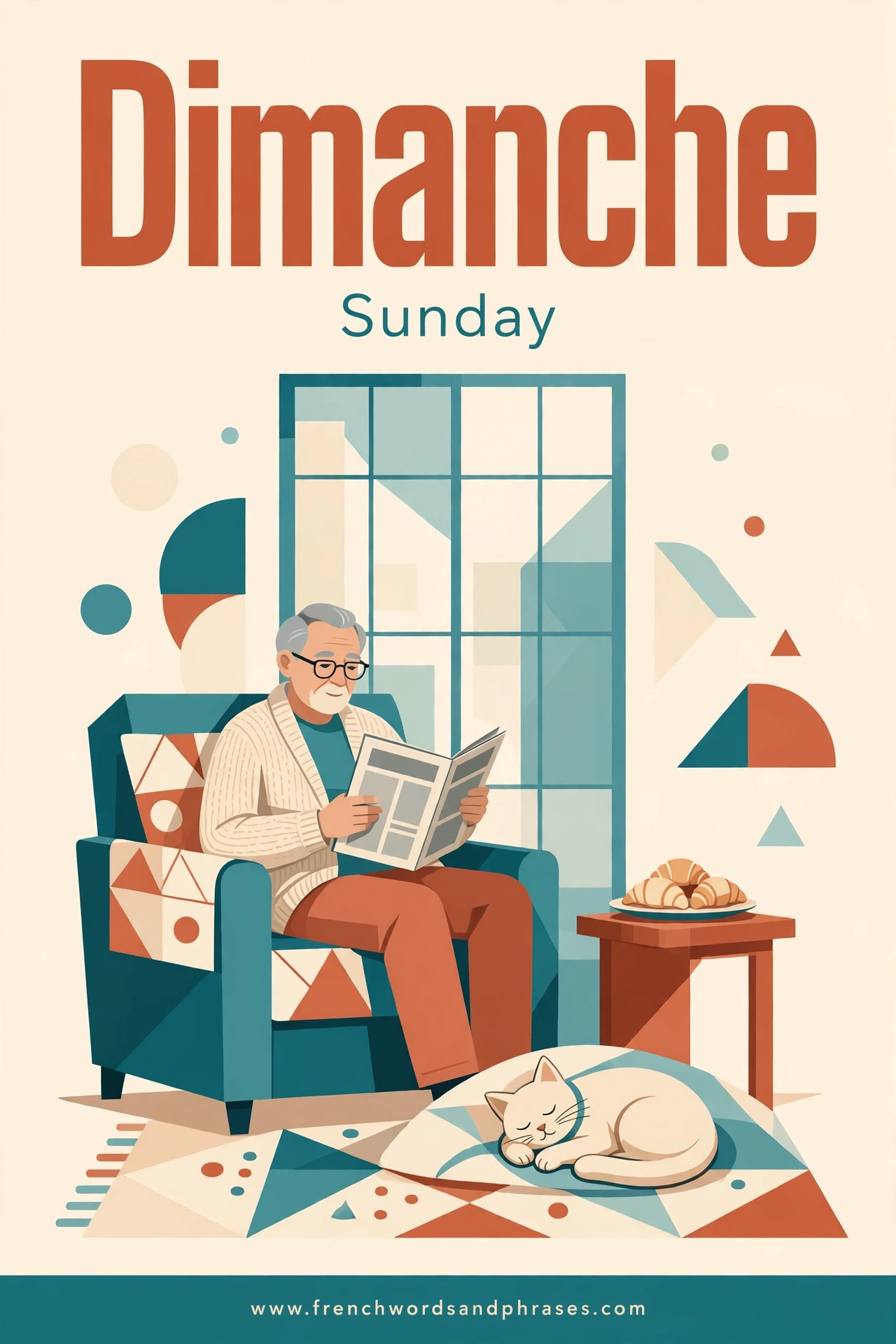
Le dimanche means Sunday.
No alarm, no hurry: the smell of coffee drifts through a quiet house, the church bells ring far off, and the day belongs to the family. It is dimanche — Sunday, the day of rest.
In this guide, you’ll learn what dimanche means in English, how to use it with its articles, how to form its plural, and how it appears in everyday French. Explore French examples, English translations, and practice quizzes.
Understanding the French Noun Dimanche
Dimanche is a masculine French noun, learned with its article: le dimanche. Like every French day it takes no capital letter, and it follows the great day rule: on its own — dimanche prochain — it names one specific Sunday; with le — le dimanche — it means every Sunday, Sundays as a habit.
It means Sunday — the day of rest, whose name tells its story: dimanche comes from the Latin for the Lord’s day, le jour du Seigneur. In France it is protected by custom and by law: most shops stay closed, the roads empty, and the week’s longest, slowest meal — le déjeuner du dimanche — gathers the family around the table.
Gender: Masculine
Definite article: le — le dimanche (on Sundays, every Sunday); no article for one specific Sunday
Indefinite article: un — un dimanche (one Sunday, a Sunday)
Plural: les dimanches
Capital letter: None — dimanche, with a small d
English equivalents: Sunday.
One important usage detail: dimanche is the week’s closed door — « Le dimanche, les magasins sont fermés. » For the weekly rhythm, say le dimanche; for one date, bare dimanche. And when Sunday evening brings its small sadness before Monday, the French have a name for it too: le blues du dimanche soir.
Experience the Word
Dimanche is more than a day. It is the week’s sanctuary — the one morning the grasse matinée is a right, not a luxury, and lunch can last until four.
Imagine it: croissants still warm from the boulangerie — the one shop open — a roast in the oven, three generations finding their places around the table.
You have not just named a day. You have sat down to the long lunch — le déjeuner du dimanche.
How to Use Dimanche in French: Complete Guide
Let’s explore how dimanche works in French, beginning with its articles — bare dimanche for one Sunday, le dimanche for every Sunday.
Dimanche with the Definite Article (Le, Les)
Bare dimanche names one day, le dimanche names the weekly habit, les dimanches names them all.
| Form | French |
|---|---|
| One specific Sunday | dimanche (no article) |
| Every Sunday, on Sundays | le dimanche |
| Plural | les dimanches |
Example
Le dimanche, les magasins sont fermés.
On Sundays, the shops are closed.
Dimanche with the Indefinite Article (Un, Des)
Un dimanche picks out one Sunday among others — often a slow, sunny one.
| Form | French |
|---|---|
| Masculine singular | un dimanche |
| Plural | des dimanches |
| A Sunday morning | un dimanche matin |
Example
Un dimanche matin, nous avons fait une longue promenade.
One Sunday morning, we went for a long walk.
Dimanche with Quantities (Chaque, Tous les…)
Days have no partitive article — you cannot have « some of Sunday ». French counts Sundays with rhythms and quantities instead.
| Quantity | French |
|---|---|
| every Sunday | chaque dimanche |
| every Sunday (the whole set) | tous les dimanches |
| every other Sunday | un dimanche sur deux |
| several Sundays | plusieurs dimanches |
| the first Sunday of the month | le premier dimanche du mois |
Example
La brocante a lieu le premier dimanche du mois.
The flea market takes place on the first Sunday of the month.
Quick Quiz 1
Your family has lunch together every Sunday. Complete the sentence:
______ nous déjeunons en famille.
Reveal the answer
Le dimanche
Le dimanche, nous déjeunons en famille.
On Sundays, we have lunch as a family — le makes it a weekly habit.
The Plural of Dimanche
Dimanche adds an -s in the plural — les dimanches, all the Sundays on the calendar.
| Number | French |
|---|---|
| Singular | dimanche / le dimanche |
| Plural | les dimanches |
Example
Les dimanches d’hiver, on reste près du feu.
On Sundays in winter, we stay by the fire.
Dimanche with Possessive Adjectives (Mon, Ton, Son…)
In diary talk, the day can belong to you: mon dimanche, my Sunday, as it stands in your agenda.
| Owner | French |
|---|---|
| my | mon dimanche |
| your (tu) | ton dimanche |
| his / her | son dimanche |
| our | notre dimanche |
| your (vous) | votre dimanche |
| their | leur dimanche |
Example
Mon dimanche est sacré : famille et repos, rien d’autre.
My Sunday is sacred: family and rest, nothing else.
Quick Quiz 2
Complete the sentence:
______ dimanche est réservé à la famille. (Our)
Reveal the answer
Notre
Notre dimanche est réservé à la famille.
Our Sunday is set aside for the family — the possessive agrees with dimanche, masculine.
Dimanche with Demonstrative Adjectives (Ce, Ces)
Used to point at the Sunday you mean: ce dimanche, this Sunday in the diary.
| Form | French |
|---|---|
| Masculine singular | ce dimanche |
| Plural | ces dimanches |
Example
Ce dimanche, nous recevons les grands-parents.
This Sunday, we’re having the grandparents over.
Dimanche with Adjectives
Adjectives agree with dimanche — masculine: un dimanche ensoleillé, un dimanche pluvieux.
| Adjective | With Dimanche |
|---|---|
| ensoleillé (sunny) | un dimanche ensoleillé |
| pluvieux (rainy) | un dimanche pluvieux |
| calme (quiet, calm) | un dimanche calme |
| libre (free) | un dimanche libre |
| prochain (next) | dimanche prochain |
| dernier (last) | dimanche dernier |
Example
Un dimanche pluvieux, on regarde des films en famille.
On a rainy Sunday, we watch films as a family.
Quick Quiz 3
Complete the sentence:
On se retrouve ______ prochain chez les cousins. (next Sunday)
Reveal the answer
dimanche
On se retrouve dimanche prochain chez les cousins.
We’ll meet next Sunday at our cousins’ house — a specific day takes no article.
Everyday Expressions with Dimanche
Long lunches, lie-ins and closed shops — the dimanche phrases of daily life.
| Expression | In English |
|---|---|
| le déjeuner du dimanche | the Sunday lunch |
| la grasse matinée | the lie-in, sleeping in late |
| le dimanche matin | on Sunday morning(s) |
| le dimanche soir | on Sunday evening(s) |
| dimanche prochain | next Sunday |
| à dimanche ! | see you on Sunday! |
Example
Le dimanche matin, je fais la grasse matinée.
On Sunday mornings, I have a lie-in.
Words from the Same Family as Dimanche
Rest, family and the long lunch — the words that travel with dimanche.
| French | In English |
|---|---|
| le repos | rest |
| la famille | the family |
| le déjeuner | lunch |
| la messe | Mass (the Sunday service) |
| le week-end | the weekend |
| le jour | the day |
Example
Le repos du dimanche prépare la semaine qui vient.
Sunday’s rest prepares the week to come.
Quick Quiz 4
What is la grasse matinée?
Reveal the answer
The lie-in — literally « the fat morning »: sleeping late, dimanche’s favourite pleasure.
Le dimanche, on fait la grasse matinée.
On Sundays, we have a lie-in.
Dimanche in Everyday French: Real-Life Examples
Now that you know the word, let’s see how dimanche appears in everyday French.
Example 1 — The day of rest
Le dimanche, tout le village se repose.
On Sundays, the whole village rests.
Example 2 — Making a plan
On se voit dimanche prochain pour le déjeuner ?
Shall we see each other next Sunday for lunch?
Example 3 — The long lunch
Le déjeuner du dimanche dure parfois jusqu’à seize heures.
Sunday lunch sometimes lasts until four o’clock.
Example 4 — Saying goodbye
À dimanche ! Repose-toi bien.
See you Sunday! Have a good rest.
Example 5 — Closed shops
Dimanche, presque tous les magasins sont fermés.
On Sunday, almost all the shops are closed.
Example 6 — Sunday evening
Le dimanche soir, on prépare doucement la semaine.
On Sunday evenings, we quietly prepare for the week.
Beyond Translation: The Meaning of Dimanche
Dimanche is defended in France like a small republic of rest. The law keeps most shops closed, and attempts to open Sunday trading spark national debates — because dimanche is not shopping time, it is family time: the long déjeuner, the walk afterwards, the grandparents’ house. Even its sadness is named and shared: le blues du dimanche soir, the Sunday-evening blues, when the weekend folds away and lundi waits at the door.
To say dimanche is to protect one slow day from the whole busy week.
It evokes the Lord’s day it is named for, the bells over the rooftops, the roast at noon — and the quiet house at dusk, resting before the week begins again.
How to Remember the French Noun Dimanche
Remember it this way: Dimanche is Sunday — the Lord’s day, the day of rest, masculine, small letter: no article for one Sunday, le for every Sunday.
- You mean one Sunday — dimanche prochain, no article at all.
- You mean every Sunday — le dimanche, with le, and the shops are closed.
- You enjoy the morning — la grasse matinée, dimanche’s gift.
The key idea is dimanche = one Sunday; le dimanche = every Sunday.
Test Your Knowledge of Dimanche
Let’s see how much you’ve learned. Try answering these questions before revealing the answers.
Question 1
How do you say « on Sundays » (every Sunday)?
Reveal the answer
Le dimanche — the definite article turns the day into a habit.
Question 2
Is dimanche masculine or feminine?
Reveal the answer
Masculine — le dimanche, un dimanche. All seven days are masculine.
Question 3
Translate: See you on Sunday!
Reveal the answer
À dimanche !
Question 4
What is le déjeuner du dimanche?
Reveal the answer
The Sunday lunch — the week’s longest, slowest family meal.
Question 5
Complete the sentence:
______ les magasins sont fermés. (On Sundays)
Reveal the answer
Le dimanche
Le dimanche, les magasins sont fermés.
On Sundays, the shops are closed.
Your Final Challenge
Can You Use It?
How would you say this in French?
“On Sundays, the shops are closed.”
Reveal the answer
Le dimanche, les magasins sont fermés.
On Sundays, the shops are closed.
A little French. A little curiosity. A richer everyday life.
LEARN FRENCH ONE WORD AT A TIME