A French Word to Live By
Translate Diable to English
/djabl/
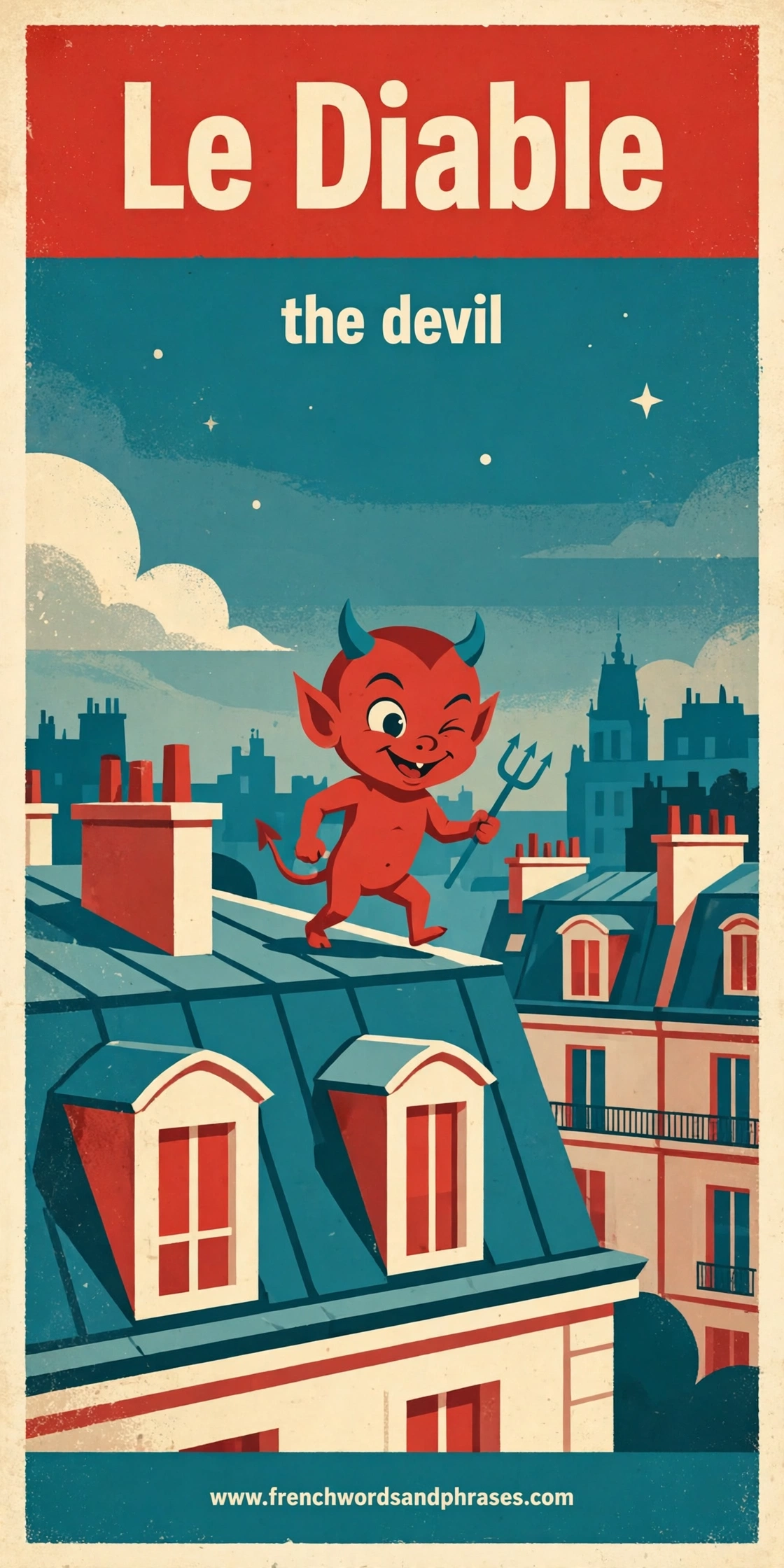
Le Diable means the devil.
The removal men arrive with a strange two-wheeled trolley for the fridge. « Passe-moi le diable », calls the first. No horns, no tail — in French, un diable is also the hand truck that moves heavy boxes. But first, of course, he is someone else entirely: le diable.
In this guide, you’ll learn what diable means in English, how to use it with its articles, how to form its plural, and how it appears in everyday French. Explore French examples, English translations, and practice quizzes.
Understanding the French Noun Diable
Diable is a masculine French noun, learned with its article: le diable, un diable. Its first meaning is the devil, the prince of l’enfer (hell). But French gives the word a second, earthly life: un diable is also the two-wheeled hand truck used to move furniture — named, people say, for its two horn-like handles.
It means the devil — the fallen angel of religion and folklore, tempter and troublemaker. Around that dark centre, French builds softer figures: un pauvre diable is a poor wretch, a luckless fellow; un petit diable is a mischievous child; and un beau diable (a little dated) is a fine, strapping fellow. The word swings between fear and affection, like many old words.
Gender: Masculine — le diable, un diable
Definite article: le — le diable (the devil)
Indefinite article: un — un diable (a devil; a hand truck)
Plural: les diables
Surprise meaning: un diable = a hand truck, a dolly for moving boxes
English equivalents: The devil; (un pauvre diable) a poor wretch
One important usage detail: diable powers a classic exclamation — que diable ! (what the devil!), and its polite cousin diablement means devilishly, extremely: diablement bon (devilishly good). And when a French speaker says a place is au diable vauvert, it is in the middle of nowhere — as far away as the devil’s own village.
Experience the Word
Diable haunts the French imagination with a wink. He signs pacts in old tales, hides in the details (le diable se cache dans les détails), and gets pulled by the tail by the poor — tirer le diable par la queue, to struggle to make ends meet, is one of the great images of French poverty and courage.
Children meet him gently: un petit diable in a carnival costume, horns of cardboard. Workmen meet him daily without thinking: le diable rolls fridges and pianos through the streets of every town.
You have not just learned a demon. You have learned the word French uses for temptation, poverty, mischief and moving day — all at once.
How to Use Diable in French: Complete Guide
Let’s explore how diable works in French, beginning with its articles — from hell to the removal van, this noun travels.
Diable with the Definite Article (Le, Les)
Masculine: le diable for the one and only, les diables in the plural.
| Form | French |
|---|---|
| Singular | le diable |
| Plural | les diables |
Example
Dans le conte, le diable propose un marché au paysan.
In the tale, the devil offers the peasant a bargain.
Diable with the Indefinite Article (Un, Des)
Un diable can be a devil, a wretch — or a trolley. Context is everything.
| Form | French |
|---|---|
| Singular | un diable |
| Plural | des diables |
Example
Charge les cartons sur un diable, ce sera plus facile.
Load the boxes onto a hand truck, it will be easier.
Le Diable in Every Shape
Hell, pity and cardboard horns: the faces of the French diable.
| French | In English |
|---|---|
| le diable | the devil |
| un pauvre diable | a poor wretch, a luckless fellow |
| un diable | a hand truck, a dolly |
| l’enfer | hell |
| un démon | a demon |
| un ange | an angel |
Example
Ce pauvre diable a encore perdu son travail.
That poor wretch has lost his job again.
Quick Quiz 1
A removal man shouts: « Apporte le diable ! » What should you bring?
Reveal the answer
The hand truck — the two-wheeled dolly.
In the world of moving, un diable is the trolley for boxes and fridges, not the prince of darkness.
The Plural of Diable
Regular: add -s — les diables.
| Number | French |
|---|---|
| Singular | le diable |
| Plural | les diables |
Example
Les petits diables du carnaval courent dans la rue.
The little devils of the carnival run through the street.
Diable with Possessive Adjectives (Mon, Ton, Son…)
Masculine noun: mon, ton, son — handy for the trolley you own and the temper you blame.
| Owner | French |
|---|---|
| my | mon diable |
| your (tu) | ton diable |
| his / her | son diable |
| our | notre diable |
| your (vous) | votre diable |
| their | leur diable |
Example
Prête-moi ton diable pour descendre la machine à laver.
Lend me your hand truck to get the washing machine down.
Quick Quiz 2
Complete the expression:
Ils habitent au ______ vauvert. (in the middle of nowhere)
Reveal the answer
diable
Ils habitent au diable vauvert.
They live in the middle of nowhere — au diable vauvert, at the devil’s faraway village.
Diable with Demonstrative Adjectives (Ce, Ces)
Ce diable for this one — devil, wretch or trolley; ces diables in the plural.
| Form | French |
|---|---|
| Masculine singular | ce diable |
| Plural | ces diables |
Example
Ce diable d’homme arrive toujours au mauvais moment.
That devil of a man always arrives at the wrong moment.
Diable with Adjectives
The adjectives soften the devil: pauvre and petit make him almost lovable.
| Adjective | With Diable |
|---|---|
| pauvre (poor, luckless) | un pauvre diable |
| petit (little) | un petit diable |
| grand (big, tall) | un grand diable |
| beau (fine, strapping) | un beau diable |
Example
Un petit diable de cinq ans a caché mes clés.
A little devil of five years old hid my keys.
Quick Quiz 3
« Tirer le diable par la queue » — what does this old expression mean?
Reveal the answer
To struggle to make ends meet.
To pull the devil by the tail: to live in poverty, fighting for every coin — one of the most vivid images in French.
Everyday Expressions with Diable
Distance, poverty, energy and exasperation — the diable expressions are everywhere.
| Expression | In English |
|---|---|
| au diable vauvert | in the middle of nowhere |
| tirer le diable par la queue | to struggle to make ends meet |
| que diable ! | what the devil! |
| avoir le diable au corps | to be full of mischief, bursting with energy |
| le diable se cache dans les détails | the devil is in the details |
| vendre son âme au diable | to sell one’s soul to the devil |
Example
Après la faillite, ils ont tiré le diable par la queue pendant des années.
After the bankruptcy, they struggled to make ends meet for years.
Words from the Same Family as Diable
Devilish adverbs, wild dances and little devils of cardboard and sparks.
| French | In English |
|---|---|
| diablement | devilishly, extremely |
| diabolique | diabolical |
| endiablé | wild, frenzied (une danse endiablée) |
| le diablotin | a little devil; a small firework |
| diaboliser | to demonise |
Example
La soirée s’est terminée par une danse endiablée.
The evening ended with a wild, frenzied dance.
Quick Quiz 4
« Ce gâteau est diablement bon. » How good is the cake?
Reveal the answer
Devilishly good — extremely good.
Diablement is the adverb of the family: diablement bon, diablement difficile.
Diable in Everyday French: Real-Life Examples
Now that you know the word, let’s see how diable appears in everyday French.
Example 1 — Moving day
On charge le frigo sur le diable et on descend doucement.
We load the fridge onto the hand truck and go down slowly.
Example 2 — Far away
Leur maison est au diable vauvert, à dix kilomètres du village.
Their house is in the middle of nowhere, ten kilometres from the village.
Example 3 — Hard times
À l’époque, ils tiraient le diable par la queue.
At that time, they were struggling to make ends meet.
Example 4 — A mischievous child
Ce petit diable a encore dessiné sur le mur.
That little devil has drawn on the wall again.
Example 5 — Exasperation
Que diable fais-tu avec cette échelle ?
What the devil are you doing with that ladder?
Example 6 — Pity
Ce pauvre diable mérite un peu de chance.
That poor wretch deserves a bit of luck.
Beyond Translation: The Meaning of Diable
Diable shows how French domesticates its fears. The devil of the sermons became, over centuries, a figure of fun, pity and everyday work — a trolley, a carnival costume, a word for a hard life pulled by the tail. The expressions keep the old religion alive as pure imagery: you can sell your soul, hide in details, or live au diable vauvert without believing a word of it.
The French diable is less a monster than a neighbour — troublesome, familiar, almost fond.
Learn his expressions and you will hear him everywhere, from the removal van to the carnival.
How to Remember the French Noun Diable
Remember it this way: Diable has two horns and two wheels: the devil of the tales, and the hand truck of moving day, named for its horn-like handles.
- You sign the pact — le diable, horns, tail and bargains.
- You move house — un diable, the trolley that saves your back.
- You drive forever — au diable vauvert, the middle of nowhere.
The key idea is le diable — the devil, and the trolley named after him.
Test Your Knowledge of Diable
Let’s see how much you’ve learned. Try answering these questions before revealing the answers.
Question 1
What does diable mean?
Reveal the answer
The devil — and, in everyday life, a hand truck for moving heavy things.
Question 2
Is diable masculine or feminine?
Reveal the answer
Masculine — le diable, un diable.
Question 3
What is un pauvre diable?
Reveal the answer
A poor wretch — a luckless fellow who deserves pity, not fear.
Question 4
What does « au diable vauvert » mean?
Reveal the answer
In the middle of nowhere — as far away as the devil’s own village.
Question 5
Translate: They live in the middle of nowhere.
Reveal the answer
Ils habitent au diable vauvert.
Your Final Challenge
Can You Use It?
How would you say this in French?
“They live in the middle of nowhere.”
Reveal the answer
Ils habitent au diable vauvert.
They live in the middle of nowhere.
A little French. A little curiosity. A richer everyday life.
LEARN FRENCH ONE WORD AT A TIME