A French Word to Live By
Translate Blé to English
/ble/
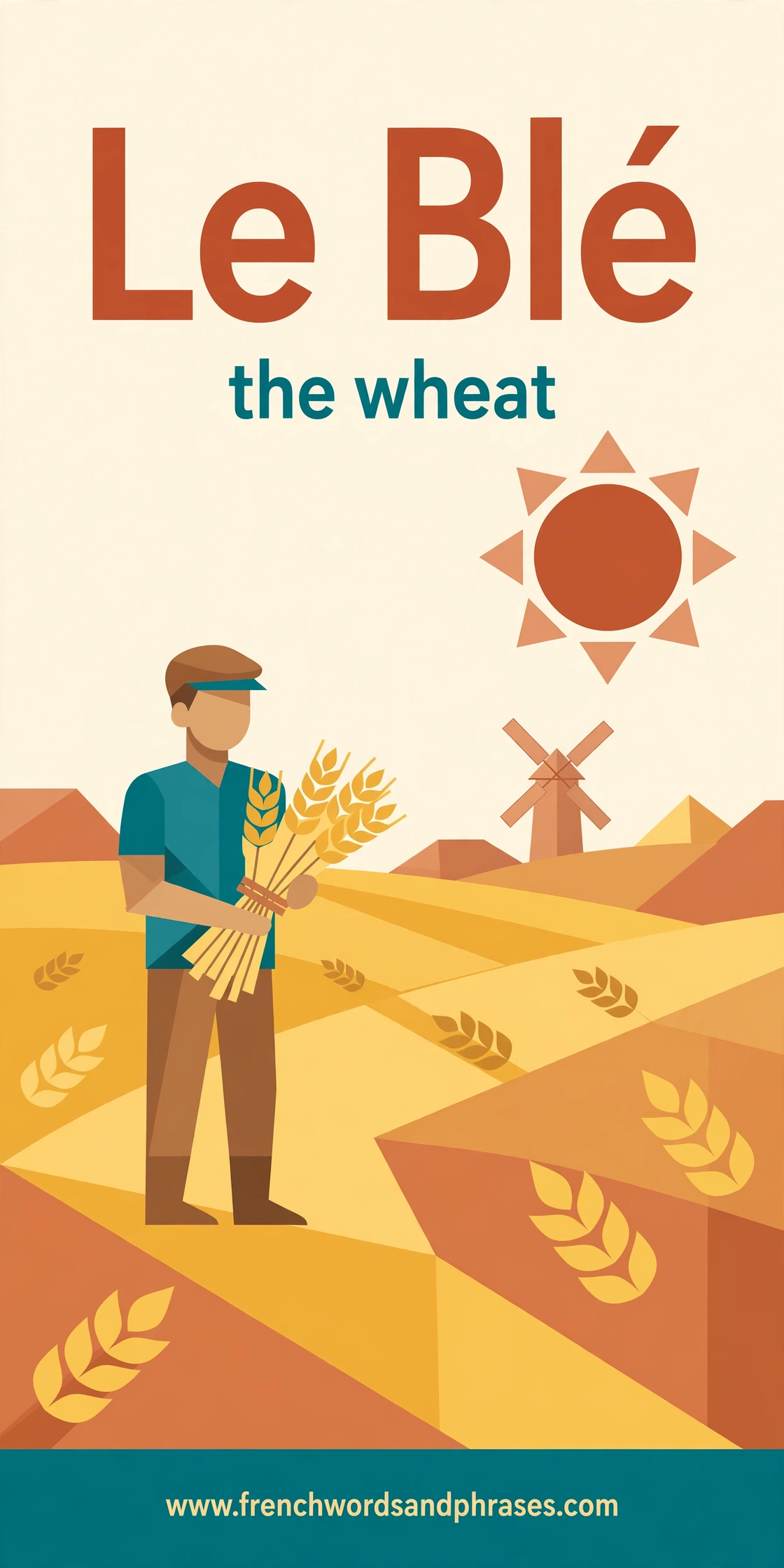
Le Blé means the wheat.
June in the Beauce: the fields have turned to gold as far as the eye can see, and the ears sway in waves under the wind. The farmer rubs a grain between his palms and nods. The harvest is near — le blé, the wheat that built France’s bread, is ripe.
In this guide, you’ll learn what blé means in English, how to use it with its articles, how to form its plural, and how it appears in everyday French. Explore French examples, English translations, and practice quizzes.
Understanding the French Noun Blé
Blé is a masculine French noun, learned with its article: le blé, du blé. It is the wheat plant and its grain — a mass noun, so you mostly meet it with the partitive: du blé (some wheat). The plural les blés exists, but poetically: it means the wheat fields, the standing crops. And in familiar slang, du blé has a second harvest: it means money.
It means wheat — the cereal of bread, flour and a thousand years of French farming: un champ de blé (a wheat field), un épi de blé (an ear of wheat), la farine de blé (wheat flour). Keep it apart from its field neighbours: le maïs is maize (corn), le seigle is rye, l’orge is barley. And when a French friend says il a du blé with a grin, check the context — he may be talking about his bank account, not his farm.
Gender: Masculine — le blé, du blé
Definite article: le — le blé (the wheat)
Partitive: du blé — some wheat
Plural: les blés — the wheat fields, the standing crops
Slang: du blé = money (familiar)
English equivalents: The wheat
One important usage detail: le blé noir is not black wheat at all — it is buckwheat, a different plant, the stuff of Breton galettes. And the money sense of blé is familiar slang: fine between friends (il a du blé, he is loaded), but in a shop or at the bank, the word is l’argent.
Experience the Word
Blé is the gold of the French landscape. Whole regions — the Beauce, the Brie — are seas of it, and the summer moisson (harvest) still sets the rhythm of the countryside: the dust, the combines working into the night, the grain lorries queueing at the silo.
It is also the root of the table: no blé, no farine; no farine, no pain. And its slang second life is pure French humour — the peasant’s treasure became everyone’s word for cash, as if money, like wheat, had to be harvested.
You have not just learned a cereal. You have learned the grain that feeds France — and the joke that turns it into money.
How to Use Blé in French: Complete Guide
Let’s explore how blé works in French, beginning with its articles — the partitive will do most of the work, because wheat is measured, not counted.
Blé with the Definite Article (Le, Les)
Le blé for the wheat in general; les blés, in the plural, paints the fields themselves.
| Form | French |
|---|---|
| Singular | le blé |
| Plural | les blés |
Example
Le blé est presque mûr cette année.
The wheat is almost ripe this year.
Blé with the Indefinite and Partitive Articles (Du, Des)
A mass noun: you take du blé, some wheat. For one grain or one ear, French counts the pieces.
| Form | French |
|---|---|
| Partitive | du blé |
| A grain of wheat | un grain de blé |
| An ear of wheat | un épi de blé |
Example
Le moulin achète du blé aux fermes du village.
The mill buys wheat from the farms of the village.
Blé by the Field and the Sack: Quantities
From the single grain to the whole harvest — how French measures its wheat.
| French | In English |
|---|---|
| du blé | some wheat |
| un grain de blé | a grain of wheat |
| un épi de blé | an ear of wheat |
| un champ de blé | a wheat field |
| un sac de blé | a sack of wheat |
| la farine de blé | wheat flour |
Example
Un épi de blé contient des dizaines de grains.
An ear of wheat contains dozens of grains.
Quick Quiz 1
Complete the sentence:
Le boulanger achète ______ blé au moulin. (some)
Reveal the answer
du
Le boulanger achète du blé au moulin.
Wheat is a mass noun: some wheat is du blé, with the masculine partitive.
The Plural of Blé
Les blés is real but literary — it evokes the fields of standing wheat, not sacks of grain.
| Number | French |
|---|---|
| Singular | le blé |
| Plural | les blés |
Example
Les blés ondulent sous le vent de juin.
The wheat fields ripple under the June wind.
Blé with Possessive Adjectives (Mon, Ton, Son…)
Masculine noun: mon, ton, son — the farmer talking about his crop.
| Owner | French |
|---|---|
| my | mon blé |
| your (tu) | ton blé |
| his / her | son blé |
| our | notre blé |
| your (vous) | votre blé |
| their | leur blé |
Example
Mon blé a souffert de la sécheresse cette année.
My wheat suffered from the drought this year.
Quick Quiz 2
« Depuis son héritage, il a du blé. » Is he a farmer?
Reveal the answer
Not necessarily — he has money.
In familiar slang, avoir du blé means to be well-off, to have cash. The farm sense needs a farm context.
Blé with Demonstrative Adjectives (Ce, Ces)
Ce blé for this wheat; ces blés for these fields of wheat.
| Form | French |
|---|---|
| Masculine singular | ce blé |
| Plural | ces blés |
Example
Ce blé-là donne une farine excellente.
That wheat gives an excellent flour.
Blé with Adjectives
Wheat adjectives are about gold and ripeness.
| Adjective | With Blé |
|---|---|
| doré (golden) | le blé doré |
| mûr (ripe) | le blé mûr |
| jeune (young, green) | le blé jeune |
| haut (tall) | le blé haut |
Example
En juillet, le blé doré couvre la plaine.
In July, the golden wheat covers the plain.
Quick Quiz 3
What is le blé noir?
Reveal the answer
Buckwheat — despite its name.
Le blé noir is a different plant altogether, the grain of Breton galettes. It is « black wheat » in name only.
Everyday Expressions with Blé
Harvests, money and one splendid warning about spending too soon.
| Expression | In English |
|---|---|
| avoir du blé | to be loaded, to have money (slang) |
| un champ de blé | a wheat field |
| les blés d’or | the golden wheat fields |
| faucher le blé | to harvest the wheat |
| le blé noir | buckwheat |
| manger son blé en herbe | to spend one’s money before earning it |
Example
Il a vendu sa récolte avant la moisson : il a mangé son blé en herbe.
He sold his crop before the harvest: he spent his wheat while it was still in the blade.
Words from the Same Family as Blé
From the field to the mill to the loaf.
| French | In English |
|---|---|
| la farine | flour |
| le meunier | the miller |
| le moulin | the mill |
| faucher | to reap, to mow down |
| la moisson | the harvest |
| le blé dur | durum wheat (for pasta) |
Example
La moisson commence la semaine prochaine si le temps le permet.
The harvest begins next week if the weather allows.
Quick Quiz 4
How do you say « a wheat field »?
Reveal the answer
Un champ de blé
Champ de blé is the set phrase — you will see them rolling to the horizon all over the Beauce.
Blé in Everyday French: Real-Life Examples
Now that you know the word, let’s see how blé appears in everyday French.
Example 1 — In the fields
Le blé est doré, la moisson va commencer.
The wheat is golden, the harvest is about to begin.
Example 2 — At the mill
Ce moulin achète le blé de toutes les fermes du canton.
This mill buys the wheat from all the farms in the district.
Example 3 — Slang between friends
Il a gagné au loto, maintenant il a du blé.
He won the lottery, now he is loaded.
Example 4 — Baking
Cette recette demande de la farine de blé complet.
This recipe asks for wholemeal wheat flour.
Example 5 — A walk
Nous traversons un immense champ de blé en fleur.
We cross an immense field of wheat in flower.
Example 6 — A warning
Ne mange pas ton blé en herbe, attends ta paie.
Do not spend your wheat in the blade — wait for your pay.
Beyond Translation: The Meaning of Blé
Blé is the foundation stone of French civilisation: the grain of the daily bread, taxed, fought over and celebrated for two thousand years. Van Gogh painted it writhing under Provençal skies; the poets call the standing fields les blés d’or, the golden wheats. Its slang journey — from harvest to money — says everything about a country that was peasant for most of its history: wealth was wheat before it was ever coins.
Where English says dough for money, French says wheat — the same joke, grown in a field.
Learn blé and you hold the first link of the chain that ends in every baguette.
How to Remember the French Noun Blé
Remember it this way: Blé is the golden field and the full wallet. Masculine, measured not counted — du blé — and in slang, the harvest became money.
- You cross the Beauce — le blé doré jusqu’à l’horizon, wheat to the horizon.
- You fill the sack — du blé, some wheat, by the partitive.
- You hear the joke — il a du blé, he is loaded, harvest in the bank.
The key idea is le blé — the wheat that became money.
Test Your Knowledge of Blé
Let’s see how much you’ve learned. Try answering these questions before revealing the answers.
Question 1
What does blé mean?
Reveal the answer
Wheat — the cereal of bread and flour; in slang, money.
Question 2
Is blé masculine or feminine?
Reveal the answer
Masculine — le blé, du blé.
Question 3
How do you say some wheat?
Reveal the answer
Du blé — wheat is a mass noun and takes the partitive.
Question 4
What does « il a du blé » mean between friends?
Reveal the answer
He has money — he is well-off. It is familiar slang; at the bank, say il a de l’argent.
Question 5
Translate: The wheat is golden in the fields.
Reveal the answer
Le blé est doré dans les champs.
Your Final Challenge
Can You Use It?
How would you say this in French?
“The wheat is golden in the fields.”
Reveal the answer
Le blé est doré dans les champs.
The wheat is golden in the fields.
A little French. A little curiosity. A richer everyday life.
LEARN FRENCH ONE WORD AT A TIME