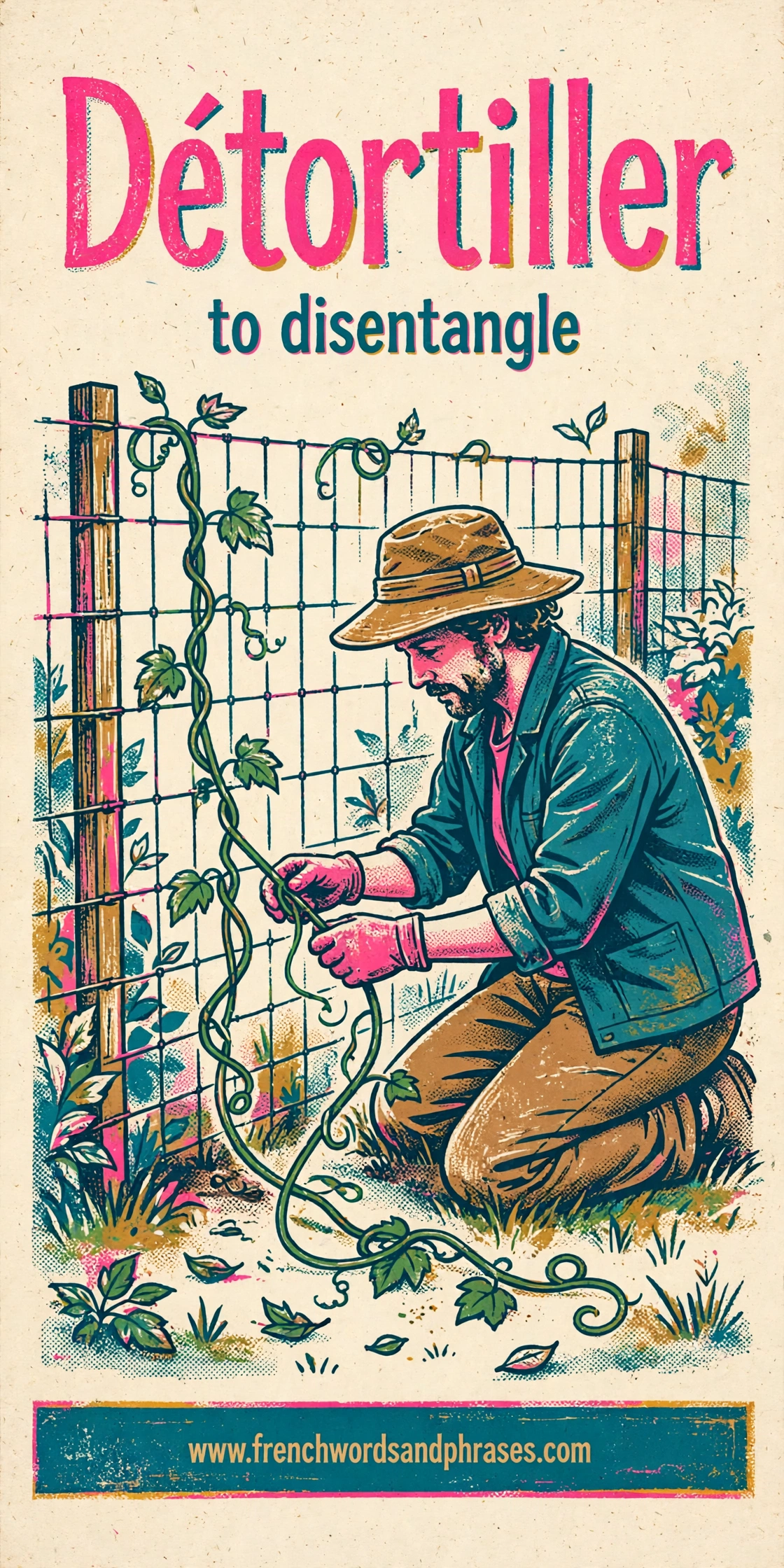
A French Word to Live By
How to Conjugate Détordre in French
/de.tɔʁdʁ/
Détordre means to untwist — to undo the twists in a rope, a wire or a wrung cloth, and bring it back straight.
A sailor coiling a rope that has twisted itself into corkscrews, a laundress un-wringing a sheet, an electrician patiently straightening a kinked cable — détordre is the verb of the un-twist: rotation reversed, tension released, the line lying flat again.
In this guide, you’ll learn how to conjugate détordre in all the major French tenses and moods. Explore complete conjugation tables, French examples, English translations, and practice quizzes.
Understanding the French Verb Détordre
Détordre is a regular French verb belonging to the third group of verbs, those ending in -re.
It means to untwist. It is used for ropes, cables, wires, wool and wrung laundry — anything whose twists are a problem to be patiently reversed. Where détortiller disentangles small tangled things, détordre deals with honest twists along a length: one rotation at a time, all the way down the line.
Verb classification: Third group (-re)
Auxiliary verb: Avoir
Past participle: détordu
Present participle: détordant
English equivalents: To untwist, to uncurl, to straighten out; détordre une corde — to untwist a rope; détordre le linge — to un-wring the washing; détordre un fil — to straighten a wire; tordre / détordre — to twist / to untwist.
One important detail: détordre conjugates exactly like tordre, its base: je détords, tu détords, il détord — note the il form has no ending at all — nous détordons, vous détordez, ils détordent, past participle détordu. The d of the stem is part of the verb and never leaves: je détordais, je détordrai, détordant. Its opposite is tordre, to twist or wring — the laundry pair: on tord le linge to wring it, on le détord to let it fall straight.
Experience the Word
Détordre is the verb of the straightened line — the satisfaction of watching a corkscrew remember it was once a rope.
Imagine a harbour rope that has spent the winter on a wet deck. It comes up stiff, kinked, twisted into spirals that fight the hand. The old sailor walks it out along the quay, end in fist, turning it slowly against its own memory, détordant mètre par mètre — and at the end, the rope lies flat and honest, ready to be coiled like a sleeping snake.
The rope has not been replaced or cut. It has been untwisted — détordu, turned back, twist by twist, into itself.
How to Conjugate Détordre: Complete French Conjugation Guide
Let’s explore every major conjugation of détordre, beginning with the indicative mood.
How to Conjugate Détordre in the Indicative Mood
The indicative mood is used to express facts, observations, actions, and events.
How to Conjugate Détordre in the Present Tense (Présent)
Used for actions happening now, habitual actions, and general truths.
| Subject | Conjugation |
|---|---|
| je | détords |
| tu | détords |
| il / elle | détord |
| nous | détordons |
| vous | détordez |
| ils / elles | détordent |
Example
Je détords la corde avant de l’enrouler.
I untwist the rope before coiling it.
Quick Quiz 1
Complete the sentence:
Nous ______ le linge avant de l’étendre.
Reveal the answer
détordons
Nous détordons le linge avant de l’étendre.
We are un-wringing the washing before hanging it out.
How to Conjugate Détordre in the Passé Composé
Used for completed actions in the past. Détordre takes the auxiliary verb avoir.
| Subject | Conjugation |
|---|---|
| j’ | ai détordu |
| tu | as détordu |
| il / elle | a détordu |
| nous | avons détordu |
| vous | avez détordu |
| ils / elles | ont détordu |
Example
Elle a détordu le fil de fer à la main.
She straightened the iron wire by hand.
How to Conjugate Détordre in the Imparfait (Imperfect Tense)
Used for habitual past actions, descriptions, and ongoing situations in the past.
| Subject | Conjugation |
|---|---|
| je | détordais |
| tu | détordais |
| il / elle | détordait |
| nous | détordions |
| vous | détordiez |
| ils / elles | détordaient |
Example
Le marin détordait les cordages chaque matin sur le pont.
The sailor used to untwist the ropes every morning on deck.
Quick Quiz 2
Choose the correct form:
She straightened the wire.
Elle ______ le fil. (a détordu / est détordue)
Reveal the answer
a détordu
Elle a détordu le fil.
Détordre takes avoir.
How to Conjugate Détordre in the Plus-que-parfait
Used to describe an action that had already been completed before another past event.
| Subject | Conjugation |
|---|---|
| j’ | avais détordu |
| tu | avais détordu |
| il / elle | avait détordu |
| nous | avions détordu |
| vous | aviez détordu |
| ils / elles | avaient détordu |
Example
Nous avions détordu le linge avant de l’étendre.
We had un-wrung the washing before hanging it out.
How to Conjugate Détordre in the Passé Simple
Primarily used in formal writing, literature, and historical narratives. It is rarely used in everyday conversation.
| Subject | Conjugation |
|---|---|
| je | détordis |
| tu | détordis |
| il / elle | détordit |
| nous | détordîmes |
| vous | détordîtes |
| ils / elles | détordirent |
Example
Il détordit le câble d’un geste patient.
He untwisted the cable with a patient gesture.
How to Conjugate Détordre in the Passé Antérieur
A literary tense used to express an action completed immediately before another past action, generally in the passé simple.
| Subject | Conjugation |
|---|---|
| j’ | eus détordu |
| tu | eus détordu |
| il / elle | eut détordu |
| nous | eûmes détordu |
| vous | eûtes détordu |
| ils / elles | eurent détordu |
Example
Quand elle eut détordu la corde, elle la rangea dans le coffre.
When she had untwisted the rope, she put it away in the chest.
How to Conjugate Détordre in the Future Tense (Futur Simple)
Used to describe actions that will take place in the future.
| Subject | Conjugation |
|---|---|
| je | détordrai |
| tu | détordras |
| il / elle | détordra |
| nous | détordrons |
| vous | détordrez |
| ils / elles | détordront |
Example
Demain, nous détordrons tous les fils du chantier.
Tomorrow, we will straighten all the wires on the site.
How to Conjugate Détordre in the Futur Antérieur (Future Perfect)
Used for an action that will have been completed before a particular point in the future.
| Subject | Conjugation |
|---|---|
| j’ | aurai détordu |
| tu | auras détordu |
| il / elle | aura détordu |
| nous | aurons détordu |
| vous | aurez détordu |
| ils / elles | auront détordu |
Example
À midi, il aura détordu les vingt mètres de cordage.
By noon, he will have untwisted the twenty metres of rope.
How to Conjugate Détordre in the Near Future (Futur Proche)
Used to describe something that is going to happen soon. Formed with aller + infinitive.
| Subject | Conjugation |
|---|---|
| je | vais détordre |
| tu | vas détordre |
| il / elle | va détordre |
| nous | allons détordre |
| vous | allez détordre |
| ils / elles | vont détordre |
Example
Je vais détordre ce câble, il est plein de nœuds.
I am going to untwist this cable, it is full of kinks.
How to Conjugate Détordre in the Conditional Mood
The conditional mood expresses what would happen under certain circumstances. It is also frequently used to make polite requests or express wishes.
How to Conjugate Détordre in the Present Conditional
| Subject | Conjugation |
|---|---|
| je | détordrais |
| tu | détordrais |
| il / elle | détordrait |
| nous | détordrions |
| vous | détordriez |
| ils / elles | détordraient |
Example
Avec de la patience, on détordrait même ce vieux cordage.
With patience, we could untwist even this old rope.
How to Conjugate Détordre in the Past Conditional
| Subject | Conjugation |
|---|---|
| j’ | aurais détordu |
| tu | aurais détordu |
| il / elle | aurait détordu |
| nous | aurions détordu |
| vous | auriez détordu |
| ils / elles | auraient détordu |
Example
Tu aurais détordu le fil plus vite avec des pinces.
You would have straightened the wire faster with pliers.
Détordre in the Literary Past Conditional Form
This less common literary form uses the imperfect subjunctive of avoir.
| Subject | Conjugation |
|---|---|
| j’ | eusse détordu |
| tu | eusses détordu |
| il / elle | eût détordu |
| nous | eussions détordu |
| vous | eussiez détordu |
| ils / elles | eussent détordu |
Example
Le marin eût détordu le cordage sans la tempête qui le jeta au travail.
The sailor would have untwisted the rope, if not for the storm that threw him into work.
How to Conjugate Détordre in the Subjunctive Mood
The subjunctive is used to express wishes, emotions, doubts, necessity, and uncertainty. It frequently follows expressions such as il faut que (it is necessary that) or bien que (although).
How to Conjugate Détordre in the Present Subjunctive
| Subject | Conjugation |
|---|---|
| que je | détorde |
| que tu | détordes |
| qu’il / qu’elle | détorde |
| que nous | détordions |
| que vous | détordiez |
| qu’ils / qu’elles | détordent |
Example
Il faut que nous détordions cette corde avant de la ranger.
We must untwist this rope before putting it away.
Quick Quiz 3
Complete the sentence using the subjunctive:
Il faut que vous ______ ce câble sans le casser.
Reveal the answer
détordiez
Il faut que vous détordiez ce câble sans le casser.
You must untwist this cable without breaking it.
How to Conjugate Détordre in the Imperfect Subjunctive
A literary tense, rarely encountered in modern spoken French.
| Subject | Conjugation |
|---|---|
| que je | détordisse |
| que tu | détordisses |
| qu’il / qu’elle | détordît |
| que nous | détordissions |
| que vous | détordissiez |
| qu’ils / qu’elles | détordissent |
Example
Elle voulait qu’il détordît le fil sans le casser.
She wanted him to straighten the wire without breaking it.
How to Conjugate Détordre in the Pluperfect Subjunctive
A literary construction used to express an action completed before another past action.
| Subject | Conjugation |
|---|---|
| que j’ | eusse détordu |
| que tu | eusses détordu |
| qu’il / qu’elle | eût détordu |
| que nous | eussions détordu |
| que vous | eussiez détordu |
| qu’ils / qu’elles | eussent détordu |
Example
On racontait que les marins eussent détordu des kilomètres de cordages.
People said the sailors had untwisted kilometres of rope.
How to Conjugate Détordre in the Past Subjunctive
| Subject | Conjugation |
|---|---|
| que j’ | aie détordu |
| que tu | aies détordu |
| qu’il / qu’elle | ait détordu |
| que nous | ayons détordu |
| que vous | ayez détordu |
| qu’ils / qu’elles | aient détordu |
Example
Je suis content que vous ayez détordu le câble à temps.
I am glad you untwisted the cable in time.
How to Conjugate Détordre in the Imperative
The imperative is used to give commands, instructions, invitations, or suggestions. Subject pronouns are omitted.
How to Conjugate Détordre in the Present Imperative
| Person | Conjugation |
|---|---|
| (tu) | détords |
| (nous) | détordons |
| (vous) | détordez |
Example
Détords ce fil doucement, il casse facilement !
Untwist this wire gently, it breaks easily!
Quick Quiz 4
How would you say Untwist this wire gently (tu form)?
Reveal the answer
Détords ce fil doucement !
French Participles of Détordre
Participles are verb forms that can be used in compound tenses and other grammatical constructions.
Present Participle of Détordre
détordant
En détordant le linge, elle chantait à la fenêtre.
While un-wringing the washing, she sang at the window.
Past Participle of Détordre
détordu
Détordue et rangée, la corde attend le prochain départ.
Untwisted and put away, the rope awaits the next departure.
Détordre in Everyday French: Real-Life Examples
Now that you know the conjugations, let’s see how détordre appears in everyday French.
Example 1 — Present
Je détords la corde avant de l’enrouler.
I untwist the rope before coiling it.
Example 2 — Passé composé
Elle a détordu le fil de fer à la main.
She straightened the iron wire by hand.
Example 3 — Imparfait
Le marin détordait les cordages chaque matin.
The sailor used to untwist the ropes every morning.
Example 4 — Future
Nous détordrons tous les fils du chantier.
We will straighten all the wires on the site.
Example 5 — Conditional
On détordrait ce vieux cordage avec de la patience.
We could untwist this old rope with patience.
Example 6 — Imperative
Détords ce fil doucement !
Untwist this wire gently!
Beyond Translation: The Meaning of Détordre
English untwist is the plain twin; French détordre inherits the long history of tordre — Latin torquere, to twist, the root of torture and torque alike.
Every twist is a small stored anger.
A rope détordue gives its tension back quietly, rotation by rotation. French keeps the pair honest: tordre puts the twist in — the wrung sheet, the twisted ankle — and détordre takes it out.
How to Remember the French Verb Détordre
Remember it this way: Détordre is about the old sailor walking the harbour rope flat, twist by twist, along the quay.
- Like tordre exactly: je détords, il détord (no ending), nous détordons, participle détordu.
- The stem’s d never leaves: détordais, détordrai, détordant.
- The laundry pair: tordre le linge wrings it, détordre le linge lets it fall straight.
The key idea is the old sailor walking the harbour rope flat, twist by twist, along the quay.
Test Your Knowledge of Détordre
Let’s see how much you’ve learned. Try answering these questions before revealing the answers.
Question 1
What is the il form of détordre in the present, and why is it surprising?
Reveal the answer
Il détord — no ending at all: the stem détord- stands alone, exactly as with tordre.
Question 2
How do you say I untwist the rope in French?
Reveal the answer
Je détords la corde.
Question 3
Translate: We must untwist this rope before putting it away.
Reveal the answer
Il faut que nous détordions cette corde avant de la ranger.
Question 4
What is the past participle of détordre?
Reveal the answer
Détordu.
Question 5
Complete the sentence:
Demain, nous ______ tous les fils du chantier.
Reveal the answer
détordrons
Demain, nous détordrons tous les fils du chantier.
Tomorrow, we will straighten all the wires on the site.
Your Final Challenge
Can You Use It?
How would you say this in French?
He untwists the old rope between his palms, and the ship, slowly, prepares to leave.
Reveal the answer
Il détord la vieille corde entre ses paumes, et le navire, lentement, se prépare à partir.
He untwists the old rope between his palms, and the ship, slowly, prepares to leave.
A little French. A little curiosity. A richer everyday life.
LEARN FRENCH ONE WORD AT A TIME