A French Word to Live By
How to Conjugate Détonner in French
/de.tɔ.ne/
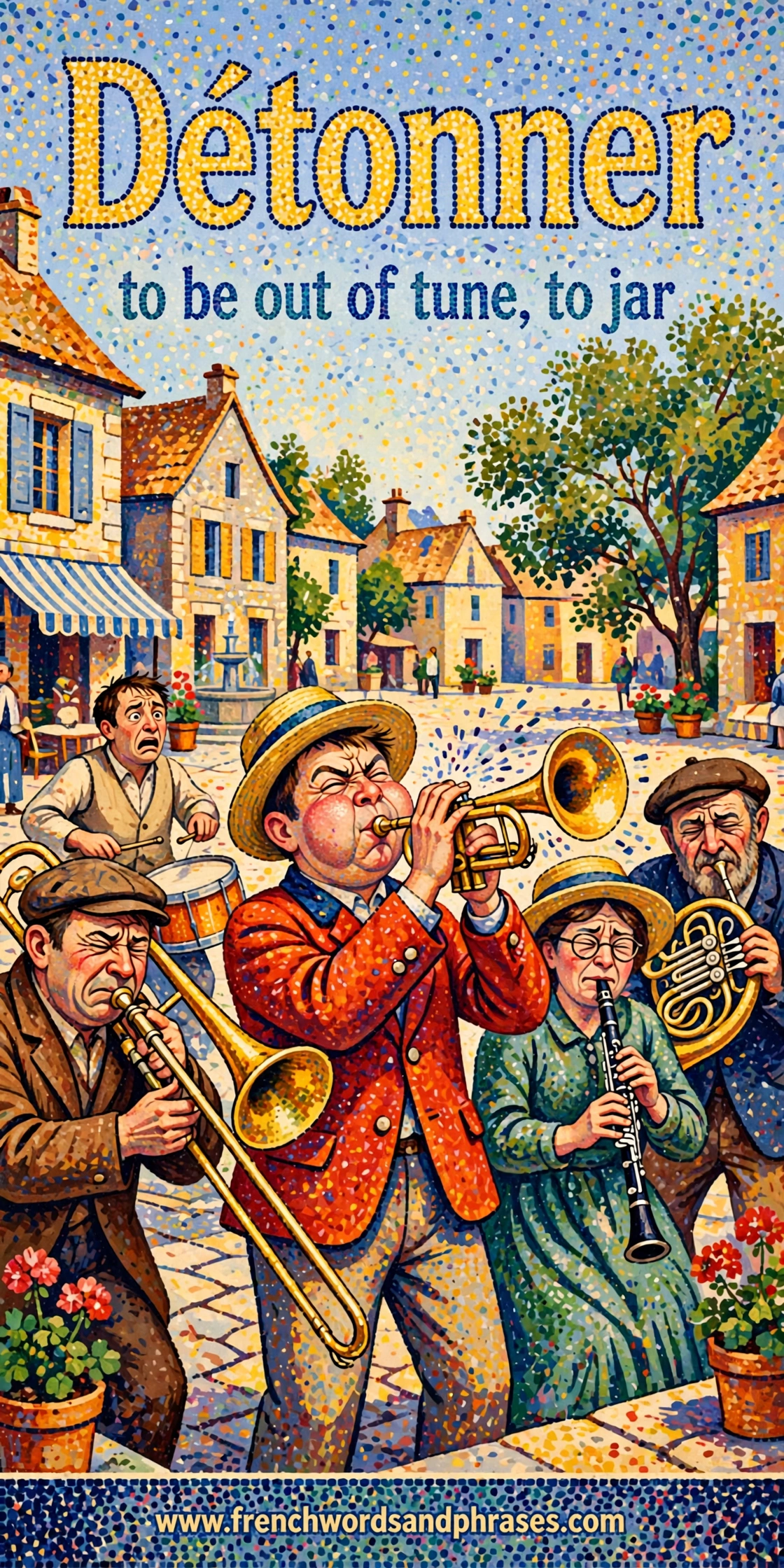
Détonner means to be out of tune, to jar — to strike the one wrong note, in music, in colours, or in company: two n’s, and nothing explodes except the harmony.
A tenor drifting flat at the opera’s climax, a scarlet cushion screaming on a grey sofa, a joke landing wrong at a funeral lunch — détonner is the verb of the discordant note: whatever sticks out, clashes, and makes the room wince.
In this guide, you’ll learn how to conjugate détonner in all the major French tenses and moods. Explore complete conjugation tables, French examples, English translations, and practice quizzes.
Understanding the French Verb Détonner
Détonner is a regular French verb belonging to the first group of verbs, those ending in-er.
It means to be out of tune, to jar. It is the everyday verb for singing or playing out of tune, and just as common in design and fashion criticism: une façade qui détonne dans la rue, un meuble qui détonne avec le reste. Where English needs clash, jar or stick out, détonner covers the whole uncomfortable family.
Verb classification: First group (-er)
Auxiliary verb: Avoir
Past participle: détonné
Present participle: détonnant
English equivalents: To be out of tune, to sing flat, to clash, to jar; détonner dans un chœur — to sing out of tune in a choir; détonner avec — to clash with; une couleur qui détonne — a colour that jars; détonner dans le décor — to stick out in the setting.
One important detail — the mirror of its twin: détonner has TWO n’s and never explodes. Détoner, with one n, detonates. The two verbs are perfect homophones, so only the spelling separates the bomb from the bad note: la charge détone (one n — run), le ténor détonne (two n’s — wince). Détonner works two ways: a voice or instrument that is off the note, and anything — a colour, a building, a remark — that clashes with its surroundings, usually with avec or dans.
Experience the Word
Détonner is the verb of the wrong note — musical, visual or social, it is the one element that does not belong and cannot be ignored.
Imagine a village choir on Christmas Eve, forty voices warm and together — and one enthusiastic baritone a quarter-tone flat, sailing serenely through every carol half a breath behind the note. He détonne magnificently. The children are weeping with laughter; the choir director is praying; the baritone has never been happier.
He is not silent or absent. He is out of tune — détonnant, gloriously, in the middle of the harmony.
How to Conjugate Détonner: Complete French Conjugation Guide
Let’s explore every major conjugation of détonner, beginning with the indicative mood.
How to Conjugate Détonner in the Indicative Mood
The indicative mood is used to express facts, observations, actions, and events.
How to Conjugate Détonner in the Present Tense (Présent)
Used for actions happening now, habitual actions, and general truths.
| Subject | Conjugation |
|---|---|
| je | détonne |
| tu | détonnes |
| il / elle | détonne |
| nous | détonnons |
| vous | détonnez |
| ils / elles | détonnent |
Example
Ce violon détonne dans l’orchestre.
This violin is out of tune in the orchestra.
Quick Quiz 1
Complete the sentence:
Nous ______ toujours au même endroit du chant.
Reveal the answer
détonnons
Nous détonnons toujours au même endroit du chant.
We always sing out of tune at the same place in the song.
How to Conjugate Détonner in the Passé Composé
Used for completed actions in the past. Détonner takes the auxiliary verb avoir.
| Subject | Conjugation |
|---|---|
| j’ | ai détonné |
| tu | as détonné |
| il / elle | a détonné |
| nous | avons détonné |
| vous | avez détonné |
| ils / elles | ont détonné |
Example
Le ténor a détonné sur la note la plus haute.
The tenor sang flat on the highest note.
How to Conjugate Détonner in the Imparfait (Imperfect Tense)
Used for habitual past actions, descriptions, and ongoing situations in the past.
| Subject | Conjugation |
|---|---|
| je | détonnais |
| tu | détonnais |
| il / elle | détonnait |
| nous | détonnions |
| vous | détonniez |
| ils / elles | détonnaient |
Example
Dans le chœur, une voix détonnait toujours au même endroit.
In the choir, one voice was always out of tune at the same place.
Quick Quiz 2
Choose the correct form:
The tenor sang flat.
Le ténor ______ . (a détonné / a détoné)
Reveal the answer
a détonné
Le ténor a détonné.
Out of tune takes détonner, with two n’s.
How to Conjugate Détonner in the Plus-que-parfait
Used to describe an action that had already been completed before another past event.
| Subject | Conjugation |
|---|---|
| j’ | avais détonné |
| tu | avais détonné |
| il / elle | avait détonné |
| nous | avions détonné |
| vous | aviez détonné |
| ils / elles | avaient détonné |
Example
La trompette avait détonné dès le premier morceau.
The trumpet had been off the note from the very first piece.
How to Conjugate Détonner in the Passé Simple
Primarily used in formal writing, literature, and historical narratives. It is rarely used in everyday conversation.
| Subject | Conjugation |
|---|---|
| je | détonnai |
| tu | détonnas |
| il / elle | détonna |
| nous | détonnâmes |
| vous | détonnâtes |
| ils / elles | détonnèrent |
Example
Soudain, le hautbois détonna, et le chef leva les yeux.
Suddenly, the oboe jarred, and the conductor raised his eyes.
How to Conjugate Détonner in the Passé Antérieur
A literary tense used to express an action completed immediately before another past action, generally in the passé simple.
| Subject | Conjugation |
|---|---|
| j’ | eus détonné |
| tu | eus détonné |
| il / elle | eut détonné |
| nous | eûmes détonné |
| vous | eûtes détonné |
| ils / elles | eurent détonné |
Example
Dès que le chœur eut détonné, le public commença à murmurer.
As soon as the choir had sung out of tune, the audience began to murmur.
How to Conjugate Détonner in the Future Tense (Futur Simple)
Used to describe actions that will take place in the future.
| Subject | Conjugation |
|---|---|
| je | détonnerai |
| tu | détonneras |
| il / elle | détonnera |
| nous | détonnerons |
| vous | détonnerez |
| ils / elles | détonneront |
Example
Sans répétition, nous détonnerons tous dimanche.
Without a rehearsal, we will all sing out of tune on Sunday.
How to Conjugate Détonner in the Futur Antérieur (Future Perfect)
Used for an action that will have been completed before a particular point in the future.
| Subject | Conjugation |
|---|---|
| j’ | aurai détonné |
| tu | auras détonné |
| il / elle | aura détonné |
| nous | aurons détonné |
| vous | aurez détonné |
| ils / elles | auront détonné |
Example
À la fin du concert, il aura détonné trois fois.
By the end of the concert, he will have sung flat three times.
How to Conjugate Détonner in the Near Future (Futur Proche)
Used to describe something that is going to happen soon. Formed with aller + infinitive.
| Subject | Conjugation |
|---|---|
| je | vais détonner |
| tu | vas détonner |
| il / elle | va détonner |
| nous | allons détonner |
| vous | allez détonner |
| ils / elles | vont détonner |
Example
Attention, ce piano va détonner, il est désaccordé.
Careful, this piano is going to sound out of tune, it needs tuning.
How to Conjugate Détonner in the Conditional Mood
The conditional mood expresses what would happen under certain circumstances. It is also frequently used to make polite requests or express wishes.
How to Conjugate Détonner in the Present Conditional
| Subject | Conjugation |
|---|---|
| je | détonnerais |
| tu | détonnerais |
| il / elle | détonnerait |
| nous | détonnerions |
| vous | détonneriez |
| ils / elles | détonneraient |
Example
Avec un meilleur oreille, elle ne détonnerait jamais.
With a better ear, she would never sing out of tune.
How to Conjugate Détonner in the Past Conditional
| Subject | Conjugation |
|---|---|
| j’ | aurais détonné |
| tu | aurais détonné |
| il / elle | aurait détonné |
| nous | aurions détonné |
| vous | auriez détonné |
| ils / elles | auraient détonné |
Example
Le chœur aurait détonné sans les répétitions du matin.
The choir would have sung out of tune without the morning rehearsals.
Détonner in the Literary Past Conditional Form
This less common literary form uses the imperfect subjunctive of avoir.
| Subject | Conjugation |
|---|---|
| j’ | eusse détonné |
| tu | eusses détonné |
| il / elle | eût détonné |
| nous | eussions détonné |
| vous | eussiez détonné |
| ils / elles | eussent détonné |
Example
La fanfare eût détonné sans son vieux chef infatigable.
The band would have played out of tune without its tireless old conductor.
How to Conjugate Détonner in the Subjunctive Mood
The subjunctive is used to express wishes, emotions, doubts, necessity, and uncertainty. It frequently follows expressions such as il faut que (it is necessary that) or bien que (although).
How to Conjugate Détonner in the Present Subjunctive
| Subject | Conjugation |
|---|---|
| que je | détonne |
| que tu | détonnes |
| qu’il / qu’elle | détonne |
| que nous | détonnions |
| que vous | détonniez |
| qu’ils / qu’elles | détonnent |
Example
Il est dommage que ce violon détonne dans l’orchestre.
It is a pity this violin is out of tune in the orchestra.
Quick Quiz 3
Complete the sentence using the subjunctive:
Il est dommage que ce violon ______ dans l’orchestre.
Reveal the answer
détonne
Il est dommage que ce violon détonne dans l’orchestre.
It is a pity this violin is out of tune in the orchestra.
How to Conjugate Détonner in the Imperfect Subjunctive
A literary tense, rarely encountered in modern spoken French.
| Subject | Conjugation |
|---|---|
| que je | détonnasse |
| que tu | détonnasses |
| qu’il / qu’elle | détonnât |
| que nous | détonnassions |
| que vous | détonnassiez |
| qu’ils / qu’elles | détonnassent |
Example
Le chef craignait que les cuivres détonnassent au finale.
The conductor feared the brass might jar in the finale.
How to Conjugate Détonner in the Pluperfect Subjunctive
A literary construction used to express an action completed before another past action.
| Subject | Conjugation |
|---|---|
| que j’ | eusse détonné |
| que tu | eusses détonné |
| qu’il / qu’elle | eût détonné |
| que nous | eussions détonné |
| que vous | eussiez détonné |
| qu’ils / qu’elles | eussent détonné |
Example
On riait que le ténor eût détonné précisément sur son grand air.
People laughed that the tenor had sung flat precisely in his great aria.
How to Conjugate Détonner in the Past Subjunctive
| Subject | Conjugation |
|---|---|
| que j’ | aie détonné |
| que tu | aies détonné |
| qu’il / qu’elle | ait détonné |
| que nous | ayons détonné |
| que vous | ayez détonné |
| qu’ils / qu’elles | aient détonné |
Example
Je suis étonné que la chorale ait détonné ce soir.
I am amazed the choir sang out of tune this evening.
How to Conjugate Détonner in the Imperative
The imperative is used to give commands, instructions, invitations, or suggestions. Subject pronouns are omitted.
How to Conjugate Détonner in the Present Imperative
| Person | Conjugation |
|---|---|
| (tu) | détonne |
| (nous) | détonnons |
| (vous) | détonnez |
Example
Ne détonnez pas au refrain, écoutez le piano !
Do not sing out of tune in the chorus, listen to the piano!
Quick Quiz 4
How would you say Do not sing out of tune (tu form)?
Reveal the answer
Ne détonne pas !
French Participles of Détonner
Participles are verb forms that can be used in compound tenses and other grammatical constructions.
Present Participle of Détonner
détonnant
En détonnant ainsi, ce fauteuil rouge gâche tout le salon.
By jarring like that, this red armchair ruins the whole living room.
Past Participle of Détonner
détonné
Détonné au milieu des gris, le coussin écarlate attire tous les regards.
Jarring amid the greys, the scarlet cushion draws every eye.
Détonner in Everyday French: Real-Life Examples
Now that you know the conjugations, let’s see how détonner appears in everyday French.
Example 1 — Present
Ce violon détonne dans l’orchestre.
This violin is out of tune in the orchestra.
Example 2 — Passé composé
Le ténor a détonné sur la note la plus haute.
The tenor sang flat on the highest note.
Example 3 — Imparfait
Une voix détonnait toujours au même endroit.
One voice was always out of tune at the same place.
Example 4 — Future
Sans répétition, nous détonnerons tous dimanche.
Without a rehearsal, we will all sing out of tune on Sunday.
Example 5 — Conditional
Elle ne détonnerait jamais avec une meilleure oreille.
She would never sing out of tune with a better ear.
Example 6 — Imperative
Ne détonnez pas au refrain !
Do not sing out of tune in the chorus!
Beyond Translation: The Meaning of Détonner
English spreads this over out of tune, clash and jar; French détonner holds them all in one word, because all three are the same accident: an element at war with its key.
And its twin is the trap.
Détoner, one n, is thunder and explosives; détonner, two n’s, is the thunder’s poor relation — the note that missed. Same sound, opposite worlds: spelling alone keeps the concert hall from becoming a quarry.
How to Remember the French Verb Détonner
Remember it this way: Détonner is about the village baritone, a quarter-tone flat, sailing happily through the carol.
- Two n’s = the wrong note. One n = the explosion. Your ear hears no difference; your eye must.
- Two territories: voices off the note, and colours or objects that clash — détonner avec, détonner dans.
- Regular -er: je détonne, nous détonnons, past participle détonné.
The key idea is the village baritone, a quarter-tone flat, sailing happily through the carol.
Test Your Knowledge of Détonner
Let’s see how much you’ve learned. Try answering these questions before revealing the answers.
Question 1
Détoner or détonner: which one sings out of tune?
Reveal the answer
Détonner, with two n’s. Détoner, with one, is to detonate.
Question 2
How do you say This violin is out of tune in French?
Reveal the answer
Ce violon détonne.
Question 3
Translate: The tenor sang flat on the highest note.
Reveal the answer
Le ténor a détonné sur la note la plus haute.
Question 4
What is the past participle of détonner?
Reveal the answer
Détonné.
Question 5
Complete the sentence:
Sans répétition, nous ______ tous dimanche.
Reveal the answer
détonnerons
Sans répétition, nous détonnerons tous dimanche.
Without a rehearsal, we will all sing out of tune on Sunday.
Your Final Challenge
Can You Use It?
How would you say this in French?
In the village choir, only one voice is out of tune, and it is the one everyone remembers.
Reveal the answer
Dans le chœur du village, une seule voix détonne, et c’est elle que tout le monde retient.
In the village choir, only one voice is out of tune, and it is the one everyone remembers.
A little French. A little curiosity. A richer everyday life.
LEARN FRENCH ONE WORD AT A TIME