A French Word to Live By
How to Conjugate Désenrhumer in French
/de.zɑ̃.ʁy.me/
Désenrhumer means to relieve a cold — to clear the blocked nose, the heavy head and the sneezes out of someone suffering from un rhume.
A steaming bowl of thyme tea, a grandmother’s syrup, a night of sleep that finally breaks the cold — désenrhumer is the household verb for curing a cold: un rhume goes in with the winter draught, and désenrhumer chases it back out.
In this guide, you’ll learn how to conjugate désenrhumer in all the major French tenses and moods. Explore complete conjugation tables, French examples, English translations, and practice quizzes.
Understanding the French Verb Désenrhumer
Désenrhumer is a regular French verb belonging to the first group of verbs, those ending in-er.
It means to relieve a cold. It belongs to grandmothers, pharmacists and winter evenings — used of syrups, herbal teas, grogs, inhalations and sleep that clear a cold. In everyday speech faire passer le rhume competes with it, but désenrhumer is the precise, cosy household word.
Verb classification: First group (-er)
Auxiliary verb: Avoir
Past participle: désenrhumé
Present participle: désenrhumant
English equivalents: To relieve a cold, to cure of a cold; désenrhumer un enfant — to relieve a child’s cold; un grog qui désenrhume — a hot toddy that relieves a cold; ce sirop désenrhume en deux jours — this syrup clears a cold in two days.
One important detail: désenrhumer is built on un rhume, a cold — enrhumer is to give someone a cold (s’enrhumer is the everyday way to say catching one), and désenrhumer is to get rid of it again, usually with someone or something doing the curing: ce sirop te désenrhume. Mind the h of rhume — it is written but never sounded. Perfectly regular: je désenrhume, nous désenrhumons, past participle désenrhumé.
Experience the Word
Désenrhumer is the verb of the cold defeated — the first morning the nose breathes, the head clears and the tissues go back in the drawer.
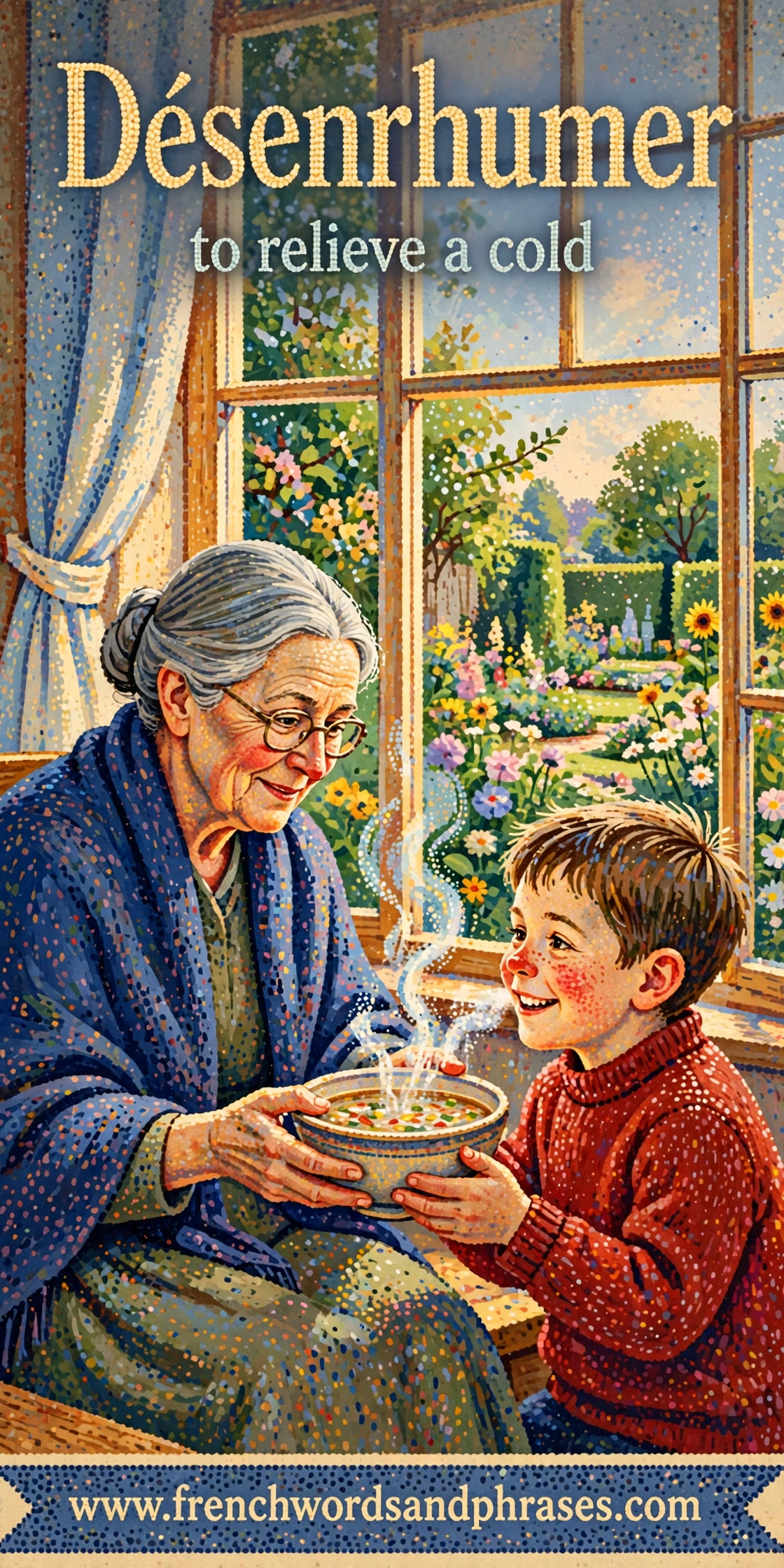
Imagine a small boy home from school with a streaming cold. His grandmother attacks from all sides: thyme tea with honey, a hot water bottle, an early night — et en trois jours, ses remèdes le désenrhument, and he returns to school leaving the cold behind like a bad week.
No doctor was called and no miracle occurred. He was simply cured of his cold — désenrhumé — by tea, honey and sleep.
How to Conjugate Désenrhumer: Complete French Conjugation Guide
Let’s explore every major conjugation of désenrhumer, beginning with the indicative mood.
How to Conjugate Désenrhumer in the Indicative Mood
The indicative mood is used to express facts, observations, actions, and events.
How to Conjugate Désenrhumer in the Present Tense (Présent)
Used for actions happening now, habitual actions, and general truths.
| Subject | Conjugation |
|---|---|
| je | désenrhume |
| tu | désenrhumes |
| il / elle | désenrhume |
| nous | désenrhumons |
| vous | désenrhumez |
| ils / elles | désenrhument |
Example
Cette tisane au thym désenrhume toute la famille.
This thyme tea relieves the whole family’s colds.
Quick Quiz 1
Complete the sentence:
Nous ______ les enfants avec une tisane au thym.
Reveal the answer
désenrhumons
Nous désenrhumons les enfants avec une tisane au thym.
We relieve the children’s colds with a thyme tea.
How to Conjugate Désenrhumer in the Passé Composé
Used for completed actions in the past. Désenrhumer takes the auxiliary verb avoir.
| Subject | Conjugation |
|---|---|
| j’ | ai désenrhumé |
| tu | as désenrhumé |
| il / elle | a désenrhumé |
| nous | avons désenrhumé |
| vous | avez désenrhumé |
| ils / elles | ont désenrhumé |
Example
Le sirop de la pharmacie m’a désenrhumé en deux jours.
The chemist’s syrup cleared my cold in two days.
How to Conjugate Désenrhumer in the Imparfait (Imperfect Tense)
Used for habitual past actions, descriptions, and ongoing situations in the past.
| Subject | Conjugation |
|---|---|
| je | désenrhumais |
| tu | désenrhumais |
| il / elle | désenrhumait |
| nous | désenrhumions |
| vous | désenrhumiez |
| ils / elles | désenrhumaient |
Example
Autrefois, un grog bien chaud désenrhumait les bergers.
In the old days, a good hot toddy used to cure shepherds’ colds.
Quick Quiz 2
Choose the correct form:
The treatment cleared her cold.
Le traitement ______ . (l’a désenrhumée / l’est désenrhumée)
Reveal the answer
l’a désenrhumée
Le traitement l’a désenrhumée.
Désenrhumer takes avoir, and the participle agrees with the preceding direct object.
How to Conjugate Désenrhumer in the Plus-que-parfait
Used to describe an action that had already been completed before another past event.
| Subject | Conjugation |
|---|---|
| j’ | avais désenrhumé |
| tu | avais désenrhumé |
| il / elle | avait désenrhumé |
| nous | avions désenrhumé |
| vous | aviez désenrhumé |
| ils / elles | avaient désenrhumé |
Example
Elle avait désenrhumé les enfants avant les vacances.
She had cured the children’s colds before the holidays.
How to Conjugate Désenrhumer in the Passé Simple
Primarily used in formal writing, literature, and historical narratives. It is rarely used in everyday conversation.
| Subject | Conjugation |
|---|---|
| je | désenrhumai |
| tu | désenrhumas |
| il / elle | désenrhuma |
| nous | désenrhumâmes |
| vous | désenrhumâtes |
| ils / elles | désenrhumèrent |
Example
Le soleil de mars désenrhuma tout le village.
The March sun cured the whole village’s colds.
How to Conjugate Désenrhumer in the Passé Antérieur
A literary tense used to express an action completed immediately before another past action, generally in the passé simple.
| Subject | Conjugation |
|---|---|
| j’ | eus désenrhumé |
| tu | eus désenrhumé |
| il / elle | eut désenrhumé |
| nous | eûmes désenrhumé |
| vous | eûtes désenrhumé |
| ils / elles | eurent désenrhumé |
Example
Quand le remède l’eut désenrhumé, il reprit son travail.
When the remedy had cured his cold, he went back to work.
How to Conjugate Désenrhumer in the Future Tense (Futur Simple)
Used to describe actions that will take place in the future.
| Subject | Conjugation |
|---|---|
| je | désenrhumerai |
| tu | désenrhumeras |
| il / elle | désenrhumera |
| nous | désenrhumerons |
| vous | désenrhumerez |
| ils / elles | désenrhumeront |
Example
Ce traitement te désenrhumera avant le week-end.
This treatment will clear your cold before the weekend.
How to Conjugate Désenrhumer in the Futur Antérieur (Future Perfect)
Used for an action that will have been completed before a particular point in the future.
| Subject | Conjugation |
|---|---|
| j’ | aurai désenrhumé |
| tu | auras désenrhumé |
| il / elle | aura désenrhumé |
| nous | aurons désenrhumé |
| vous | aurez désenrhumé |
| ils / elles | auront désenrhumé |
Example
À lundi, le repos aura désenrhumé tout le bureau.
By Monday, rest will have cured the whole office’s colds.
How to Conjugate Désenrhumer in the Near Future (Futur Proche)
Used to describe something that is going to happen soon. Formed with aller + infinitive.
| Subject | Conjugation |
|---|---|
| je | vais désenrhumer |
| tu | vas désenrhumer |
| il / elle | va désenrhumer |
| nous | allons désenrhumer |
| vous | allez désenrhumer |
| ils / elles | vont désenrhumer |
Example
Bois ça, ça va te désenrhumer.
Drink this, it is going to clear your cold.
How to Conjugate Désenrhumer in the Conditional Mood
The conditional mood expresses what would happen under certain circumstances. It is also frequently used to make polite requests or express wishes.
How to Conjugate Désenrhumer in the Present Conditional
| Subject | Conjugation |
|---|---|
| je | désenrhumerais |
| tu | désenrhumerais |
| il / elle | désenrhumerait |
| nous | désenrhumerions |
| vous | désenrhumeriez |
| ils / elles | désenrhumeraient |
Example
Une bonne nuit de sommeil te désenrhumerait mieux que ces pastilles.
A good night’s sleep would clear your cold better than those lozenges.
How to Conjugate Désenrhumer in the Past Conditional
| Subject | Conjugation |
|---|---|
| j’ | aurais désenrhumé |
| tu | aurais désenrhumé |
| il / elle | aurait désenrhumé |
| nous | aurions désenrhumé |
| vous | auriez désenrhumé |
| ils / elles | auraient désenrhumé |
Example
Le grog l’aurait désenrhumé s’il l’avait bu chaud.
The toddy would have cured his cold if he had drunk it hot.
Désenrhumer in the Literary Past Conditional Form
This less common literary form uses the imperfect subjunctive of avoir.
| Subject | Conjugation |
|---|---|
| j’ | eusse désenrhumé |
| tu | eusses désenrhumé |
| il / elle | eût désenrhumé |
| nous | eussions désenrhumé |
| vous | eussiez désenrhumé |
| ils / elles | eussent désenrhumé |
Example
Le printemps eût désenrhumé la vallée entière.
Spring would have cured the whole valley’s colds.
How to Conjugate Désenrhumer in the Subjunctive Mood
The subjunctive is used to express wishes, emotions, doubts, necessity, and uncertainty. It frequently follows expressions such as il faut que (it is necessary that) or bien que (although).
How to Conjugate Désenrhumer in the Present Subjunctive
| Subject | Conjugation |
|---|---|
| que je | désenrhume |
| que tu | désenrhumes |
| qu’il / qu’elle | désenrhume |
| que nous | désenrhumions |
| que vous | désenrhumiez |
| qu’ils / qu’elles | désenrhument |
Example
Il faut que ce sirop désenrhume les enfants rapidement.
This syrup must clear the children’s colds quickly.
Quick Quiz 3
Complete the sentence using the subjunctive:
Il faut que vous ______ votre fils avant lundi.
Reveal the answer
désenrhumiez
Il faut que vous désenrhumiez votre fils avant lundi.
You must clear your son’s cold before Monday.
How to Conjugate Désenrhumer in the Imperfect Subjunctive
A literary tense, rarely encountered in modern spoken French.
| Subject | Conjugation |
|---|---|
| que je | désenrhumasse |
| que tu | désenrhumasses |
| qu’il / qu’elle | désenrhumât |
| que nous | désenrhumassions |
| que vous | désenrhumassiez |
| qu’ils / qu’elles | désenrhumassent |
Example
Elle préparait la tisane pour qu’elle désenrhumât son mari.
She made the herbal tea so that it would cure her husband’s cold.
How to Conjugate Désenrhumer in the Pluperfect Subjunctive
A literary construction used to express an action completed before another past action.
| Subject | Conjugation |
|---|---|
| que j’ | eusse désenrhumé |
| que tu | eusses désenrhumé |
| qu’il / qu’elle | eût désenrhumé |
| que nous | eussions désenrhumé |
| que vous | eussiez désenrhumé |
| qu’ils / qu’elles | eussent désenrhumé |
Example
On espérait que le soleil eût désenrhumé les voyageurs.
People hoped the sun had cured the travellers’ colds.
How to Conjugate Désenrhumer in the Past Subjunctive
| Subject | Conjugation |
|---|---|
| que j’ | aie désenrhumé |
| que tu | aies désenrhumé |
| qu’il / qu’elle | ait désenrhumé |
| que nous | ayons désenrhumé |
| que vous | ayez désenrhumé |
| qu’ils / qu’elles | aient désenrhumé |
Example
Je suis content que le traitement ait désenrhumé ta fille.
I am glad the treatment cleared your daughter’s cold.
How to Conjugate Désenrhumer in the Imperative
The imperative is used to give commands, instructions, invitations, or suggestions. Subject pronouns are omitted.
How to Conjugate Désenrhumer in the Present Imperative
| Person | Conjugation |
|---|---|
| (tu) | désenrhume |
| (nous) | désenrhumons |
| (vous) | désenrhumez |
Example
Désenrhume les enfants avant l’école lundi !
Get the children’s colds cleared before school on Monday!
Quick Quiz 4
How would you say Get the children’s colds cleared (tu form)?
Reveal the answer
Désenrhume les enfants !
French Participles of Désenrhumer
Participles are verb forms that can be used in compound tenses and other grammatical constructions.
Present Participle of Désenrhumer
désenrhumant
En désenrhumant son fils, elle s’est enrhumée elle-même.
While curing her son’s cold, she caught one herself.
Past Participle of Désenrhumer
désenrhumé
Désenrhumé en trois jours, il a pu chanter au concert.
Cured of his cold in three days, he was able to sing at the concert.
Désenrhumer in Everyday French: Real-Life Examples
Now that you know the conjugations, let’s see how désenrhumer appears in everyday French.
Example 1 — Present
Cette tisane désenrhume toute la famille.
This herbal tea relieves the whole family’s colds.
Example 2 — Passé composé
Le sirop m’a désenrhumé en deux jours.
The syrup cleared my cold in two days.
Example 3 — Imparfait
Un grog désenrhumait les bergers.
A hot toddy used to cure shepherds’ colds.
Example 4 — Future
Le repos te désenrhumera.
Rest will clear your cold.
Example 5 — Conditional
Le soleil désenrhumerait tout le village.
The sun would cure the whole village’s colds.
Example 6 — Imperative
Désenrhumez les enfants avant lundi !
Get the children’s colds cleared before Monday!
Beyond Translation: The Meaning of Désenrhumer
Un rhume descends from Greek rheuma, a flowing — the cold was once imagined as a river running through the head, and the word still flows in un rhume de cerveau, the joking name for a head cold.
Désenrhumer dams the river.
English cures a cold or gets rid of it; French reverses the catching itself — s’enrhumer caught it, désenrhumer un-catches it, and the pair covers the whole biography of a winter cold.
How to Remember the French Verb Désenrhumer
Remember it this way: Désenrhumer is about the grandmother attacking a cold with thyme tea, honey and an early night.
- Un rhume is a cold: s’enrhumer catches it, désenrhumer gets rid of it.
- The h of rhume is written but never sounded: je désenrhume, nous désenrhumons.
- Regular -er, past participle désenrhumé; its remedies: tisanes, sirops, grogs et sommeil.
The key idea is the grandmother attacking a cold with thyme tea, honey and an early night.
Test Your Knowledge of Désenrhumer
Let’s see how much you’ve learned. Try answering these questions before revealing the answers.
Question 1
What is un rhume, and what does désenrhumer do to it?
Reveal the answer
Un rhume is a cold — désenrhumer relieves it and clears it away, the reverse of catching it.
Question 2
How do you say The syrup cleared my cold in two days in French?
Reveal the answer
Le sirop m’a désenrhumé en deux jours.
Question 3
Translate: This thyme tea relieves the whole family’s colds.
Reveal the answer
Cette tisane au thym désenrhume toute la famille.
Question 4
What is the past participle of désenrhumer?
Reveal the answer
Désenrhumé.
Question 5
Complete the sentence:
Il faut que ce traitement ______ les enfants rapidement.
Reveal the answer
désenrhume
Il faut que ce traitement désenrhume les enfants rapidement.
This treatment must clear the children’s colds quickly.
Your Final Challenge
Can You Use It?
How would you say this in French?
Three days of herbal tea and sleep have cured the whole house’s colds.
Reveal the answer
Trois jours de tisane et de sommeil ont désenrhumé toute la maison.
Three days of herbal tea and sleep have cured the whole house’s colds.
A little French. A little curiosity. A richer everyday life.
LEARN FRENCH ONE WORD AT A TIME