A French Word to Live By
How to Conjugate Désensabler in French
/de.zɑ̃.sa.ble/
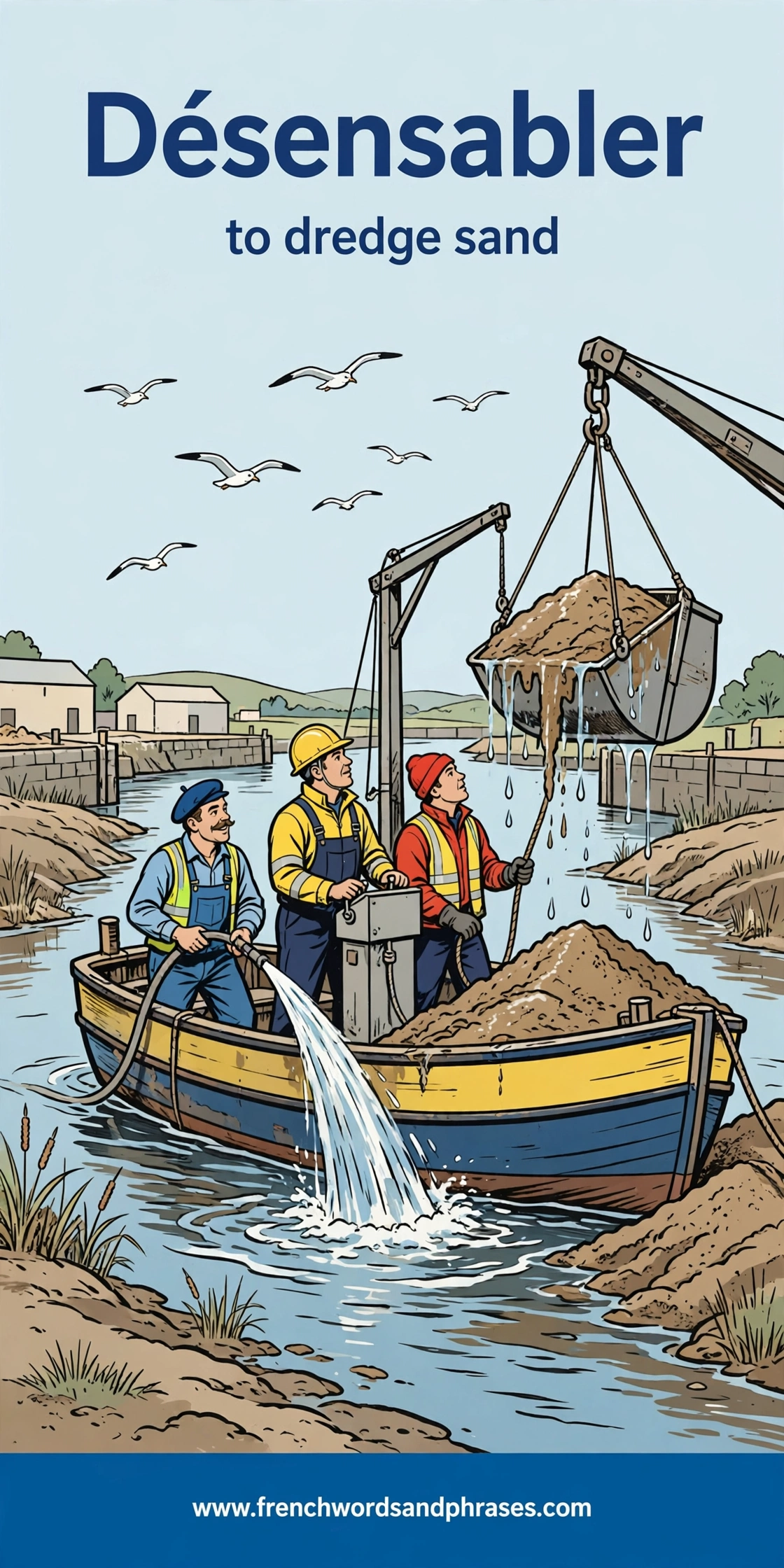
Désensabler means to dredge sand — to clear the sand out of a channel, a harbour or a river mouth so the water runs deep again.
A harbour entrance silting up winter by winter, a channel where ships wait for the dredger before they dare enter — désensabler is the port engineer’s verb: removing the sand that the sea keeps politely returning.
In this guide, you’ll learn how to conjugate désensabler in all the major French tenses and moods. Explore complete conjugation tables, French examples, English translations, and practice quizzes.
Understanding the French Verb Désensabler
Désensabler is a regular French verb belonging to the first group of verbs, those ending in-er.
It means to dredge sand. It is a verb of ports, rivers and canals — used by dredging companies, harbour masters and lock keepers whose whole career is a war against returning sand. A close cousin, le désensablement, is the noun on every port authority’s budget line.
Verb classification: First group (-er)
Auxiliary verb: Avoir
Past participle: désensablé
Present participle: désensablant
English equivalents: To dredge sand, to clear of sand; désensabler un chenal — to dredge a channel clear of sand; désensabler l’entrée d’un port — to clear the sand from a harbour entrance; une drague désensable le fleuve — a dredger clears the river of sand.
One important detail: désensabler is built on le sable, sand, with en- putting it in and dés- taking it out — the exact twin of désenvaser, which does the same for mud (la vase). Its object is the waterway, not the sand: on désensable le chenal, le port, l’estuaire. Perfectly regular: je désensable, nous désensablons, past participle désensablé.
Experience the Word
Désensabler is the verb of the dredger at dawn — the channel deepening bucket by bucket while the town still sleeps.
Imagine a small fishing port after the winter storms. The entrance has silted so badly that the boats can only leave at high tide; one morning the dredger arrives, and semaine après semaine, elle désensable le chenal until the fleet comes and goes as it pleases.
The sea will bring the sand back next winter. For now the channel is cleared — désensablé — and the port is a port again.
How to Conjugate Désensabler: Complete French Conjugation Guide
Let’s explore every major conjugation of désensabler, beginning with the indicative mood.
How to Conjugate Désensabler in the Indicative Mood
The indicative mood is used to express facts, observations, actions, and events.
How to Conjugate Désensabler in the Present Tense (Présent)
Used for actions happening now, habitual actions, and general truths.
| Subject | Conjugation |
|---|---|
| je | désensable |
| tu | désensables |
| il / elle | désensable |
| nous | désensablons |
| vous | désensablez |
| ils / elles | désensablent |
Example
La drague désensable l’entrée du port.
The dredger is clearing the harbour entrance of sand.
Quick Quiz 1
Complete the sentence:
Nous ______ le canal chaque année.
Reveal the answer
désensablons
Nous désensablons le canal chaque année.
We clear the canal of sand every year.
How to Conjugate Désensabler in the Passé Composé
Used for completed actions in the past. Désensabler takes the auxiliary verb avoir.
| Subject | Conjugation |
|---|---|
| j’ | ai désensablé |
| tu | as désensablé |
| il / elle | a désensablé |
| nous | avons désensablé |
| vous | avez désensablé |
| ils / elles | ont désensablé |
Example
Ils ont désensablé le chenal en trois semaines.
They dredged the channel clear of sand in three weeks.
How to Conjugate Désensabler in the Imparfait (Imperfect Tense)
Used for habitual past actions, descriptions, and ongoing situations in the past.
| Subject | Conjugation |
|---|---|
| je | désensablais |
| tu | désensablais |
| il / elle | désensablait |
| nous | désensablions |
| vous | désensabliez |
| ils / elles | désensablaient |
Example
Autrefois, on désensablait le fleuve à la main.
In the old days, people used to clear the river of sand by hand.
Quick Quiz 2
Choose the correct form:
They cleared the channel of sand.
Ils ______ le chenal. (ont désensablé / sont désensablés)
Reveal the answer
ont désensablé
Ils ont désensablé le chenal.
Désensabler takes avoir.
How to Conjugate Désensabler in the Plus-que-parfait
Used to describe an action that had already been completed before another past event.
| Subject | Conjugation |
|---|---|
| j’ | avais désensablé |
| tu | avais désensablé |
| il / elle | avait désensablé |
| nous | avions désensablé |
| vous | aviez désensablé |
| ils / elles | avaient désensablé |
Example
Le port avait désensablé l’estuaire avant l’été.
The port had cleared the estuary of sand before the summer.
How to Conjugate Désensabler in the Passé Simple
Primarily used in formal writing, literature, and historical narratives. It is rarely used in everyday conversation.
| Subject | Conjugation |
|---|---|
| je | désensablai |
| tu | désensablas |
| il / elle | désensabla |
| nous | désensablâmes |
| vous | désensablâtes |
| ils / elles | désensablèrent |
Example
En un mois, la drague désensabla tout le bassin.
In one month, the dredger cleared the whole basin of sand.
How to Conjugate Désensabler in the Passé Antérieur
A literary tense used to express an action completed immediately before another past action, generally in the passé simple.
| Subject | Conjugation |
|---|---|
| j’ | eus désensablé |
| tu | eus désensablé |
| il / elle | eut désensablé |
| nous | eûmes désensablé |
| vous | eûtes désensablé |
| ils / elles | eurent désensablé |
Example
Dès qu’on eut désensablé le canal, les péniches repartirent.
As soon as the canal had been cleared of sand, the barges set off again.
How to Conjugate Désensabler in the Future Tense (Futur Simple)
Used to describe actions that will take place in the future.
| Subject | Conjugation |
|---|---|
| je | désensablerai |
| tu | désensableras |
| il / elle | désensablera |
| nous | désensablerons |
| vous | désensablerez |
| ils / elles | désensableront |
Example
Le nouveau bateau désensablera le port chaque printemps.
The new vessel will clear the harbour of sand every spring.
How to Conjugate Désensabler in the Futur Antérieur (Future Perfect)
Used for an action that will have been completed before a particular point in the future.
| Subject | Conjugation |
|---|---|
| j’ | aurai désensablé |
| tu | auras désensablé |
| il / elle | aura désensablé |
| nous | aurons désensablé |
| vous | aurez désensablé |
| ils / elles | auront désensablé |
Example
À la fin du mois, nous aurons désensablé les deux chenaux.
By the end of the month, we will have cleared both channels of sand.
How to Conjugate Désensabler in the Near Future (Futur Proche)
Used to describe something that is going to happen soon. Formed with aller + infinitive.
| Subject | Conjugation |
|---|---|
| je | vais désensabler |
| tu | vas désensabler |
| il / elle | va désensabler |
| nous | allons désensabler |
| vous | allez désensabler |
| ils / elles | vont désensabler |
Example
La drague va désensabler l’entrée demain matin.
The dredger is going to clear the entrance of sand tomorrow morning.
How to Conjugate Désensabler in the Conditional Mood
The conditional mood expresses what would happen under certain circumstances. It is also frequently used to make polite requests or express wishes.
How to Conjugate Désensabler in the Present Conditional
| Subject | Conjugation |
|---|---|
| je | désensablerais |
| tu | désensablerais |
| il / elle | désensablerait |
| nous | désensablerions |
| vous | désensableriez |
| ils / elles | désensableraient |
Example
Une deuxième drague désensablerait le fleuve deux fois plus vite.
A second dredger would clear the river of sand twice as fast.
How to Conjugate Désensabler in the Past Conditional
| Subject | Conjugation |
|---|---|
| j’ | aurais désensablé |
| tu | aurais désensablé |
| il / elle | aurait désensablé |
| nous | aurions désensablé |
| vous | auriez désensablé |
| ils / elles | auraient désensablé |
Example
On aurait désensablé le port si le budget avait suffi.
They would have cleared the harbour of sand if the budget had stretched.
Désensabler in the Literary Past Conditional Form
This less common literary form uses the imperfect subjunctive of avoir.
| Subject | Conjugation |
|---|---|
| j’ | eusse désensablé |
| tu | eusses désensablé |
| il / elle | eût désensablé |
| nous | eussions désensablé |
| vous | eussiez désensablé |
| ils / elles | eussent désensablé |
Example
La drague eût désensablé l’estuaire avant les tempêtes.
The dredger would have cleared the estuary before the storms.
How to Conjugate Désensabler in the Subjunctive Mood
The subjunctive is used to express wishes, emotions, doubts, necessity, and uncertainty. It frequently follows expressions such as il faut que (it is necessary that) or bien que (although).
How to Conjugate Désensabler in the Present Subjunctive
| Subject | Conjugation |
|---|---|
| que je | désensable |
| que tu | désensables |
| qu’il / qu’elle | désensable |
| que nous | désensablions |
| que vous | désensabliez |
| qu’ils / qu’elles | désensablent |
Example
Il faut que le port désensable le chenal avant la saison.
The port must clear the channel of sand before the season.
Quick Quiz 3
Complete the sentence using the subjunctive:
Il faut que vous ______ la passe avant les marées.
Reveal the answer
désensabliez
Il faut que vous désensabliez la passe avant les marées.
You must clear the pass of sand before the tides.
How to Conjugate Désensabler in the Imperfect Subjunctive
A literary tense, rarely encountered in modern spoken French.
| Subject | Conjugation |
|---|---|
| que je | désensablasse |
| que tu | désensablasses |
| qu’il / qu’elle | désensablât |
| que nous | désensablassions |
| que vous | désensablassiez |
| qu’ils / qu’elles | désensablassent |
Example
Il fallait que la drague désensablât l’entrée avant les grandes marées.
The dredger had to clear the entrance of sand before the spring tides.
How to Conjugate Désensabler in the Pluperfect Subjunctive
A literary construction used to express an action completed before another past action.
| Subject | Conjugation |
|---|---|
| que j’ | eusse désensablé |
| que tu | eusses désensablé |
| qu’il / qu’elle | eût désensablé |
| que nous | eussions désensablé |
| que vous | eussiez désensablé |
| qu’ils / qu’elles | eussent désensablé |
Example
On espérait que les courants eussent désensablé la passe.
People hoped the currents had cleared the pass of sand.
How to Conjugate Désensabler in the Past Subjunctive
| Subject | Conjugation |
|---|---|
| que j’ | aie désensablé |
| que tu | aies désensablé |
| qu’il / qu’elle | ait désensablé |
| que nous | ayons désensablé |
| que vous | ayez désensablé |
| qu’ils / qu’elles | aient désensablé |
Example
Je suis content que vous ayez désensablé le chenal à temps.
I am glad you cleared the channel of sand in time.
How to Conjugate Désensabler in the Imperative
The imperative is used to give commands, instructions, invitations, or suggestions. Subject pronouns are omitted.
How to Conjugate Désensabler in the Present Imperative
| Person | Conjugation |
|---|---|
| (tu) | désensable |
| (nous) | désensablons |
| (vous) | désensablez |
Example
Désensablez la passe avant les grandes marées !
Clear the pass of sand before the spring tides!
Quick Quiz 4
How would you say Clear the channel of sand (tu form)?
Reveal the answer
Désensable le chenal !
French Participles of Désensabler
Participles are verb forms that can be used in compound tenses and other grammatical constructions.
Present Participle of Désensabler
désensablant
En désensablant le fleuve, ils ont découvert une épave ancienne.
While dredging the river clear of sand, they discovered an old wreck.
Past Participle of Désensabler
désensablé
Désensablé chaque printemps, le port accueille les plus gros bateaux.
Cleared of sand every spring, the harbour welcomes the biggest boats.
Désensabler in Everyday French: Real-Life Examples
Now that you know the conjugations, let’s see how désensabler appears in everyday French.
Example 1 — Present
La drague désensable le port.
The dredger clears the harbour of sand.
Example 2 — Passé composé
Ils ont désensablé le chenal.
They cleared the channel of sand.
Example 3 — Imparfait
On désensablait le canal chaque année.
They used to clear the canal of sand every year.
Example 4 — Future
Le bateau désensablera l’estuaire au printemps.
The vessel will clear the estuary of sand in spring.
Example 5 — Conditional
Une deuxième drague désensablerait plus vite.
A second dredger would clear the sand faster.
Example 6 — Imperative
Désensable le chenal avant la saison !
Clear the channel of sand before the season!
Beyond Translation: The Meaning of Désensabler
Le sable is sand, and French ports wage a polite, endless war with it: the sea delivers, the dredger removes, désensabler is the removing.
Its twin works in mud.
Where the bottom is mud (la vase), the verb is désenvaser; where it is sand, désensabler — French hydrography keeps its verbs as precisely sorted as its charts.
How to Remember the French Verb Désensabler
Remember it this way: Désensabler is about the dredger at dawn, deepening the channel bucket by bucket.
- Le sable is sand: désensabler a channel is to take its sand out.
- Its object is the waterway — le chenal, le port, l’estuaire — never the sand itself.
- Regular -er: je désensable, nous désensablons, past participle désensablé.
The key idea is the dredger at dawn, deepening the channel bucket by bucket.
Test Your Knowledge of Désensabler
Let’s see how much you’ve learned. Try answering these questions before revealing the answers.
Question 1
What is the difference between désensabler and désenvaser?
Reveal the answer
The bottom — désensabler clears sand (le sable); désenvaser clears mud (la vase).
Question 2
How do you say The dredger is clearing the harbour entrance of sand in French?
Reveal the answer
La drague désensable l’entrée du port.
Question 3
Translate: They dredged the channel clear of sand in three weeks.
Reveal the answer
Ils ont désensablé le chenal en trois semaines.
Question 4
What is the past participle of désensabler?
Reveal the answer
Désensablé.
Question 5
Complete the sentence:
Il faut que le port ______ le chenal avant la saison.
Reveal the answer
désensable
Il faut que le port désensable le chenal avant la saison.
The port must clear the channel of sand before the season.
Your Final Challenge
Can You Use It?
How would you say this in French?
Every spring, the dredger clears the harbour of sand, and the boats find the sea again.
Reveal the answer
Chaque printemps, la drague désensable le port, et les bateaux retrouvent la mer.
Every spring, the dredger clears the harbour of sand, and the boats find the sea again.
A little French. A little curiosity. A richer everyday life.
LEARN FRENCH ONE WORD AT A TIME