A French Word to Live By
How to Conjugate Douter in French
/du.te/
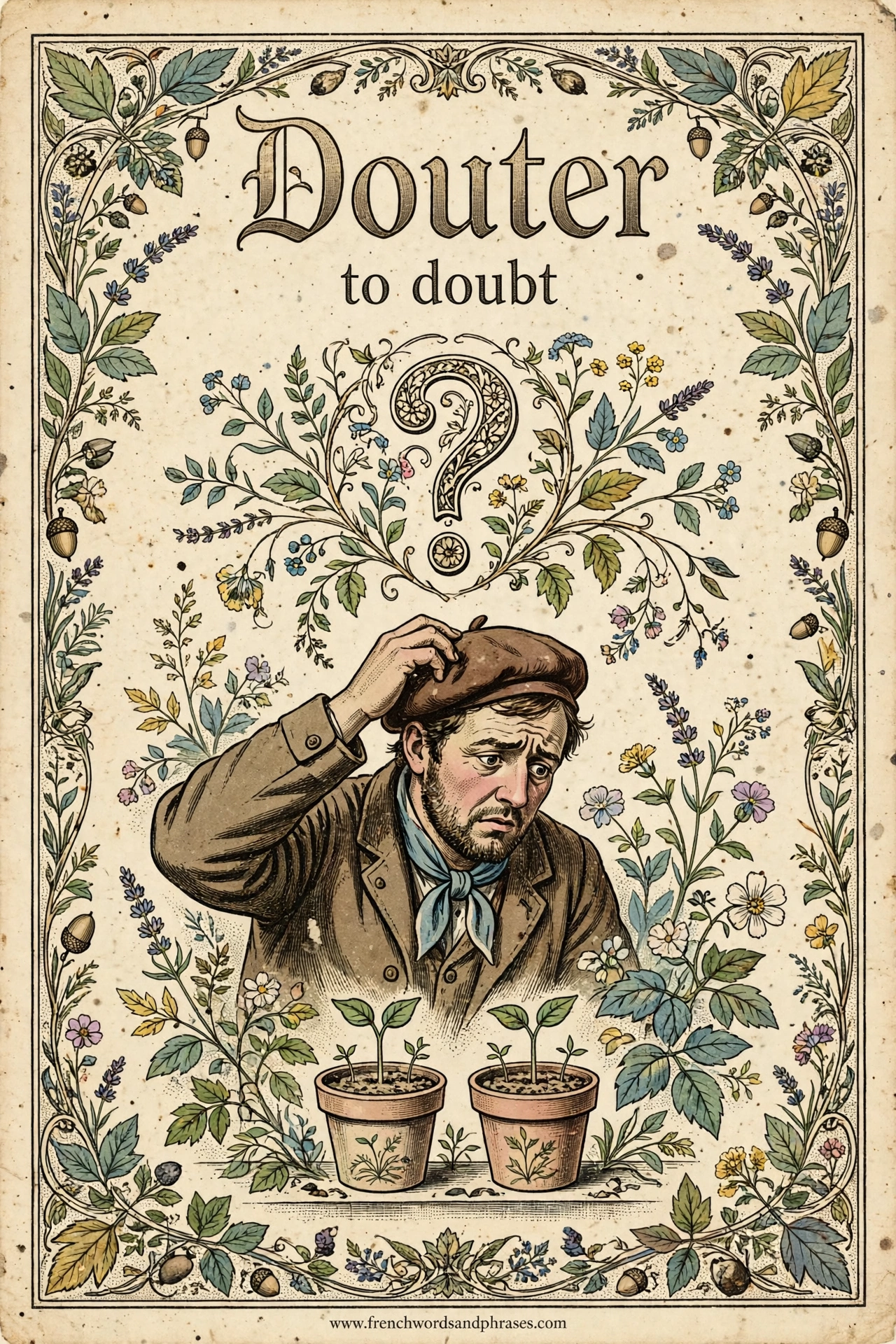
Douter means to doubt — to hold something back from full belief, to feel the ground of a claim soften under your feet; douter de quelqu’un, to doubt someone; douter que, to doubt that, with the subjunctive waiting behind it.
A witness who changes his story, a promise made too quickly, a noise downstairs at three in the morning — douter is the verb of the raised eyebrow and the suspended judgement, the small honest pause between hearing and believing.
In this guide, you’ll learn how to conjugate douter in all the major French tenses and moods. Explore complete conjugation tables, French examples, English translations, and practice quizzes.
Understanding the French Verb Douter
Douter is a regular French verb belonging to the first group of verbs, those ending in-er.
It means to doubt. Its everyday centre is gentle uncertainty: douter d’une histoire, to doubt a story; douter de ses propres forces, to doubt one’s own strength. French also keeps the proud motto of philosophy in this family — Descartes built a method on douter — and the everyday exclamation of the suspicious: je m’en doutais ! I knew it, I suspected it all along.
Verb classification: First group (-er)
Auxiliary verb: Avoir
Past participle: douté
Present participle: doutant
English equivalents: To doubt, to question, to be unsure; douter de quelque chose — to doubt something; je doute qu’il vienne — I doubt he’ll come; sans douter — unsuspecting; se douter de — to suspect, to have an inkling (the reflexive twin, and the great trap).
One important detail: douter is perfectly regular — je doute, nous doutons, ils doutent, past participle douté. The interest is grammatical: douter que takes the subjunctive (je doute qu’il vienne), because the doubting mind does not grant the fact. And beware the reflexive: se douter de means the opposite direction — to suspect, to guess: je m’en doutais, I suspected as much.
Experience the Word
Douter is the mind’s hand raised halfway — not a refusal to believe, but a refusal to believe too fast.
Imagine the old fisherman listening to the weather forecast over his morning coffee: fine all day, says the radio, and he looks at the sky, at the gulls, at the glass falling on the wall. Il doute du beau temps promis — he doubts the promised fine weather, packs the oilskin anyway, and is dry at noon when the rain arrives. Doubt, in his hands, is not fear; it is seamanship.
He believed the sky, not the voice. That is douter — belief held back until the world earns it.
How to Conjugate Douter: Complete French Conjugation Guide
Let’s explore every major conjugation of douter, beginning with the indicative mood.
How to Conjugate Douter in the Indicative Mood
The indicative mood is used to express facts, observations, actions, and events.
How to Conjugate Douter in the Present Tense (Présent)
Used for actions happening now, habitual actions, and general truths.
| Subject | Conjugation |
|---|---|
| je | doute |
| tu | doutes |
| il / elle | doute |
| nous | doutons |
| vous | doutez |
| ils / elles | doutent |
Example
Je doute de cette histoire.
I doubt this story.
Quick Quiz 1
Complete the sentence:
Nous ______ de sa parole dès le début.
Reveal the answer
doutons
Nous doutons de sa parole dès le début.
We doubt his word from the start.
How to Conjugate Douter in the Passé Composé
Used for completed actions in the past. Douter takes the auxiliary verb avoir.
| Subject | Conjugation |
|---|---|
| j’ | ai douté |
| tu | as douté |
| il / elle | a douté |
| nous | avons douté |
| vous | avez douté |
| ils / elles | ont douté |
Example
Nous avons douté de sa parole dès le début.
We doubted his word from the start.
How to Conjugate Douter in the Imparfait (Imperfect Tense)
Used for habitual past actions, descriptions, and ongoing situations in the past.
| Subject | Conjugation |
|---|---|
| je | doutais |
| tu | doutais |
| il / elle | doutait |
| nous | doutions |
| vous | doutiez |
| ils / elles | doutaient |
Example
Autrefois, elle doutait de tout.
In the old days, she used to doubt everything.
Quick Quiz 2
Choose the correct form:
I doubt he’ll come.
Je doute qu’il ______ . (vient / vienne)
Reveal the answer
vienne
Je doute qu’il vienne.
Douter que takes the subjunctive.
How to Conjugate Douter in the Plus-que-parfait
Used to describe an action that had already been completed before another past event.
| Subject | Conjugation |
|---|---|
| j’ | avais douté |
| tu | avais douté |
| il / elle | avait douté |
| nous | avions douté |
| vous | aviez douté |
| ils / elles | avaient douté |
Example
Il avait douté du résultat avant même le vote.
He had doubted the result even before the vote.
How to Conjugate Douter in the Passé Simple
Primarily used in formal writing, literature, and historical narratives. It is rarely used in everyday conversation.
| Subject | Conjugation |
|---|---|
| je | doutai |
| tu | doutas |
| il / elle | douta |
| nous | doutâmes |
| vous | doutâtes |
| ils / elles | doutèrent |
Example
Les juges doutèrent de sa bonne foi.
The judges doubted his good faith.
How to Conjugate Douter in the Passé Antérieur
A literary tense used to express an action completed immediately before another past action, generally in the passé simple.
| Subject | Conjugation |
|---|---|
| j’ | eus douté |
| tu | eus douté |
| il / elle | eut douté |
| nous | eûmes douté |
| vous | eûtes douté |
| ils / elles | eurent douté |
Example
Quand il eut douté un instant, il reprit son récit.
When he had doubted for a moment, he resumed his account.
How to Conjugate Douter in the Future Tense (Futur Simple)
Used to describe actions that will take place in the future.
| Subject | Conjugation |
|---|---|
| je | douterai |
| tu | douteras |
| il / elle | doutera |
| nous | douterons |
| vous | douterez |
| ils / elles | douteront |
Example
Tu douteras de moins en moins avec l’expérience.
You will doubt less and less with experience.
How to Conjugate Douter in the Futur Antérieur (Future Perfect)
Used for an action that will have been completed before a particular point in the future.
| Subject | Conjugation |
|---|---|
| j’ | aurai douté |
| tu | auras douté |
| il / elle | aura douté |
| nous | aurons douté |
| vous | aurez douté |
| ils / elles | auront douté |
Example
À la fin de l’enquête, ils auront douté de tout le monde.
By the end of the investigation, they will have doubted everyone.
How to Conjugate Douter in the Near Future (Futur Proche)
Used to describe something that is going to happen soon. Formed with aller + infinitive.
| Subject | Conjugation |
|---|---|
| je | vais douter |
| tu | vas douter |
| il / elle | va douter |
| nous | allons douter |
| vous | allez douter |
| ils / elles | vont douter |
Example
Je vais douter de cette promesse si elle tarde encore.
I am going to doubt this promise if it is delayed any longer.
How to Conjugate Douter in the Conditional Mood
The conditional mood expresses what would happen under certain circumstances. It is also frequently used to make polite requests or express wishes.
How to Conjugate Douter in the Present Conditional
| Subject | Conjugation |
|---|---|
| je | douterais |
| tu | douterais |
| il / elle | douterait |
| nous | douterions |
| vous | douteriez |
| ils / elles | douteraient |
Example
Sans preuves, je douterais aussi.
Without proof, I would doubt too.
How to Conjugate Douter in the Past Conditional
| Subject | Conjugation |
|---|---|
| j’ | aurais douté |
| tu | aurais douté |
| il / elle | aurait douté |
| nous | aurions douté |
| vous | auriez douté |
| ils / elles | auraient douté |
Example
Elle aurait douté de lui si elle avait su.
She would have doubted him if she had known.
Douter in the Literary Past Conditional Form
This less common literary form uses the imperfect subjunctive of avoir.
| Subject | Conjugation |
|---|---|
| j’ | eusse douté |
| tu | eusses douté |
| il / elle | eût douté |
| nous | eussions douté |
| vous | eussiez douté |
| ils / elles | eussent douté |
Example
Les sages eussent douté d’une si belle promesse.
The wise would have doubted such a fine promise.
How to Conjugate Douter in the Subjunctive Mood
The subjunctive is used to express wishes, emotions, doubts, necessity, and uncertainty. It frequently follows expressions such as il faut que (it is necessary that) or bien que (although).
How to Conjugate Douter in the Present Subjunctive
| Subject | Conjugation |
|---|---|
| que je | doute |
| que tu | doutes |
| qu’il / qu’elle | doute |
| que nous | doutions |
| que vous | doutiez |
| qu’ils / qu’elles | doutent |
Example
Il est normal que tu doutes au début.
It is normal that you doubt at first.
Quick Quiz 3
Complete the sentence using the subjunctive:
Je suis content que tu n’______ pas douté de moi.
Reveal the answer
aies
Je suis content que tu n’aies pas douté de moi.
I am glad you did not doubt me.
How to Conjugate Douter in the Imperfect Subjunctive
A literary tense, rarely encountered in modern spoken French.
| Subject | Conjugation |
|---|---|
| que je | doutasse |
| que tu | doutasses |
| qu’il / qu’elle | doutât |
| que nous | doutassions |
| que vous | doutassiez |
| qu’ils / qu’elles | doutassent |
Example
Je ne pensais pas qu’il doutât de nous.
I did not think he doubted us.
How to Conjugate Douter in the Pluperfect Subjunctive
A literary construction used to express an action completed before another past action.
| Subject | Conjugation |
|---|---|
| que j’ | eusse douté |
| que tu | eusses douté |
| qu’il / qu’elle | eût douté |
| que nous | eussions douté |
| que vous | eussiez douté |
| qu’ils / qu’elles | eussent douté |
Example
On craignait qu’ils eussent douté de la mission.
People feared they had doubted the mission.
How to Conjugate Douter in the Past Subjunctive
| Subject | Conjugation |
|---|---|
| que j’ | aie douté |
| que tu | aies douté |
| qu’il / qu’elle | ait douté |
| que nous | ayons douté |
| que vous | ayez douté |
| qu’ils / qu’elles | aient douté |
Example
Je suis content que tu n’aies pas douté de moi.
I am glad you did not doubt me.
How to Conjugate Douter in the Imperative
The imperative is used to give commands, instructions, invitations, or suggestions. Subject pronouns are omitted.
How to Conjugate Douter in the Present Imperative
| Person | Conjugation |
|---|---|
| (tu) | doute |
| (nous) | doutons |
| (vous) | doutez |
Example
Ne doute jamais de tes amis !
Never doubt your friends!
Quick Quiz 4
How would you say I suspected as much (with douter)?
Reveal the answer
Je m’en doutais !
French Participles of Douter
Participles are verb forms that can be used in compound tenses and other grammatical constructions.
Present Participle of Douter
doutant
En doutant de tout, on finit par ne rien apprendre.
By doubting everything, you end up learning nothing.
Past Participle of Douter
douté
Doutée par tous, sa version a fini par triompher.
Doubted by everyone, her version ended up triumphing.
Douter in Everyday French: Real-Life Examples
Now that you know the conjugations, let’s see how douter appears in everyday French.
Example 1 — Present
Je doute de cette histoire.
I doubt this story.
Example 2 — Passé composé
Nous avons douté de sa parole dès le début.
We doubted his word from the start.
Example 3 — Imparfait
Elle doutait de tout, autrefois.
She used to doubt everything, in the old days.
Example 4 — Future
Tu douteras moins avec l’expérience.
You will doubt less with experience.
Example 5 — Conditional
Sans preuves, je douterais aussi.
Without proof, I would doubt too.
Example 6 — Imperative
Ne doute jamais de tes amis !
Never doubt your friends!
Beyond Translation: The Meaning of Douter
Douter descends from the Latin dubitare — to waver between two, the same root as dubious and doubt itself. French philosophy adopted the verb as a tool: Descartes made douter the first step of thinking, doubting everything to find what cannot be doubted. And daily French kept the verb’s mischievous twin: se douter, to suspect — doubt turned towards a hidden truth one half-knows already.
To doubt in French is a discipline, not a defect.
Learn douter beside se douter, and you hold both sides of suspicion: I doubt it, and I suspected it all along.
How to Remember the French Verb Douter
Remember it this way: Douter is about the fisherman doubting the forecast — and packing the oilskin anyway.
- The subjunctive follows: douter que + subjonctif — je doute qu’il vienne.
- The reflexive flips it: se douter de = to suspect — je m’en doutais, I suspected as much.
- Regular -er: je doute, nous doutons, past participle douté; douter de quelque chose, to doubt something.
The key idea is the fisherman doubting the forecast — and packing the oilskin anyway.
Test Your Knowledge of Douter
Let’s see how much you’ve learned. Try answering these questions before revealing the answers.
Question 1
What follows douter que: the indicative or the subjunctive?
Reveal the answer
The subjunctive — je doute qu’il vienne: doubt does not grant the fact.
Question 2
How do you say I doubt this story in French?
Reveal the answer
Je doute de cette histoire.
Question 3
Translate: I suspected as much!
Reveal the answer
Je m’en doutais !
Question 4
What is the past participle of douter?
Reveal the answer
Douté.
Question 5
Complete the sentence:
Il est normal que tu ______ au début.
Reveal the answer
doutes
Il est normal que tu doutes au début.
It is normal that you doubt at first.
Your Final Challenge
Can You Use It?
How would you say this in French?
The old fisherman doubts the promised fine weather and takes his oilskin.
Reveal the answer
Le vieux pêcheur doute du beau temps promis et prend son ciré.
The old fisherman doubts the promised fine weather and takes his oilskin.
A little French. A little curiosity. A richer everyday life.
LEARN FRENCH ONE WORD AT A TIME