A French Word to Live By
How to Conjugate Défatiguer in French
/de.fa.ti.ɡe/
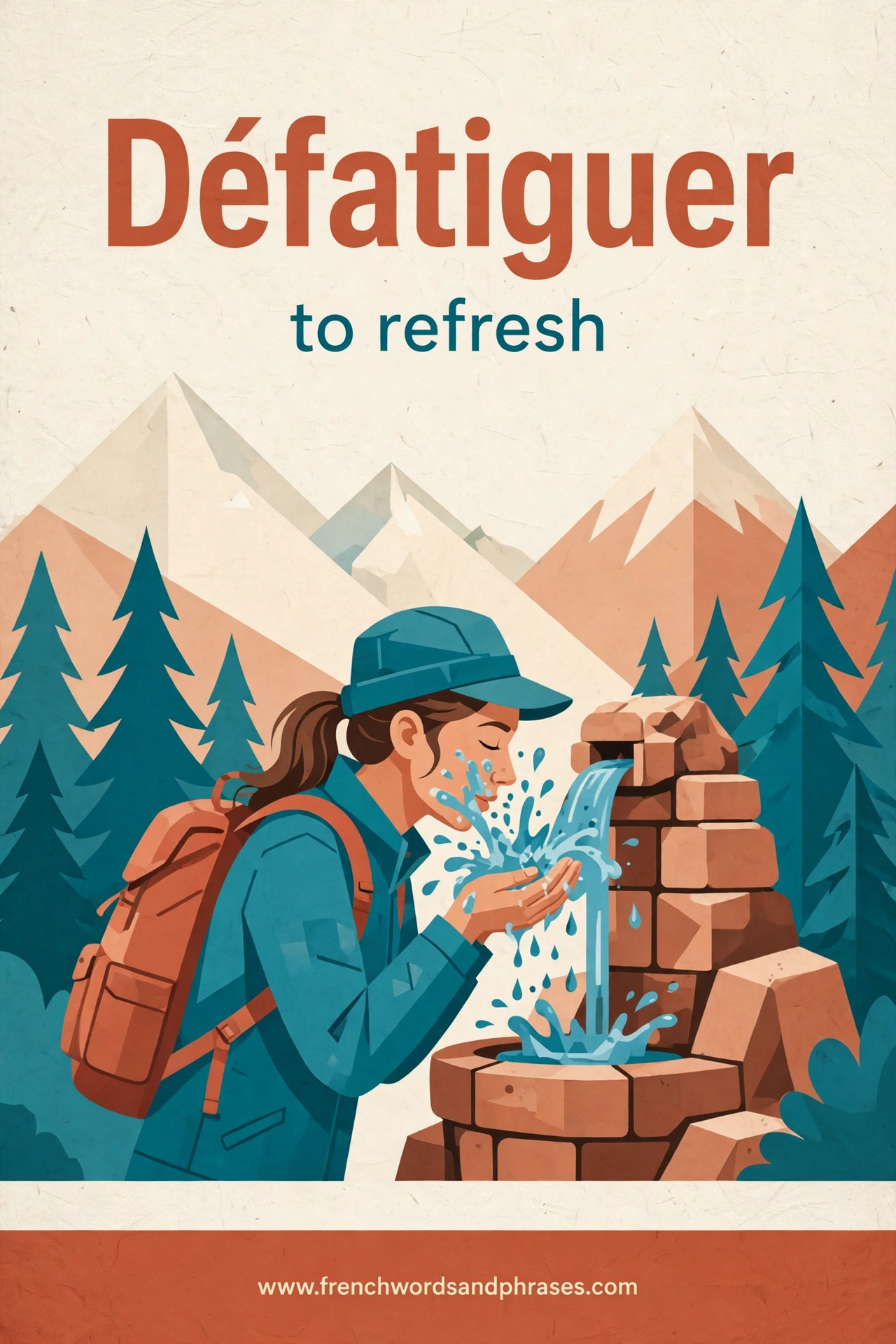
Défatiguer means to refresh — to wash the tiredness out of someone and give them their strength back.
A glass of cold water after the climb, a shower after the long drive, ten minutes in the shade with your eyes closed — défatiguer is the verb of the small rescue that takes tiredness away and hands you back to yourself.
In this guide, you’ll learn how to conjugate défatiguer in all the major French tenses and moods. Explore complete conjugation tables, French examples, English translations, and practice quizzes.
Understanding the French Verb Défatiguer
Défatiguer is a regular French verb belonging to the first group of verbs, those ending in -er.
It means to refresh. It is commonly used for anything that revives a tired person — a cold drink, a shower, a nap, a sit-down — for hosts who refresh their guests after a journey, and in the reflexive for the traveller, the walker or the worker who stops a moment to recover before going on.
Verb classification: First group (-er)
Auxiliary verb: Avoir
Past participle: défatigué
Present participle: défatiguant
English equivalents: To refresh, to revive, to take away tiredness; se défatiguer — to refresh oneself, to have a rest and recover.
One important detail: défatiguer is simply fatiguer turned around by the prefix dé- — fatiguer tires you out, défatiguer untires you. Watch the spelling: the u in -gu- is never dropped, because it keeps the g hard before e and i — je défatigue, nous défatiguons. The everyday form is reflexive: se défatiguer, to rest and get your strength back — assieds-toi, défatigue-toi un peu. The family is everywhere: la fatigue, tiredness; fatigué, tired; fatigant, tiring.
Experience the Word
Défatiguer is the verb of the pause that works — not sleep, not rest for hours, just the right small thing at the right moment.
Imagine hikers reaching a mountain refuge at noon, legs heavy, faces red. The guardian brings out a jug of cold water and a plate of cheese, and twenty minutes later the same legs are ready for the next climb — the pause has défatigué everybody.
The mountain has not got any smaller. The walkers have been refreshed — untired, restored, ready.
How to Conjugate Défatiguer: Complete French Conjugation Guide
Let’s explore every major conjugation of défatiguer, beginning with the indicative mood.
How to Conjugate Défatiguer in the Indicative Mood
The indicative mood is used to express facts, observations, actions, and events.
How to Conjugate Défatiguer in the Present Tense (Présent)
Used for actions happening now, habitual actions, and general truths.
| Subject | Conjugation |
|---|---|
| je | défatigue |
| tu | défatigues |
| il / elle | défatigue |
| nous | défatiguons |
| vous | défatiguez |
| ils / elles | défatiguent |
Example
Ce verre d’eau fraîche me défatigue d’un coup.
This glass of cold water refreshes me at once.
Quick Quiz 1
Complete the sentence:
Nous nous ______ à la fontaine.
Reveal the answer
défatiguons
Nous nous défatiguons à la fontaine.
We refresh ourselves at the fountain.
How to Conjugate Défatiguer in the Passé Composé
Used for completed actions in the past. Défatiguer takes the auxiliary verb avoir.
| Subject | Conjugation |
|---|---|
| j’ | ai défatigué |
| tu | as défatigué |
| il / elle | a défatigué |
| nous | avons défatigué |
| vous | avez défatigué |
| ils / elles | ont défatigué |
Example
La douche froide l’a défatigué après le match.
The cold shower refreshed him after the match.
How to Conjugate Défatiguer in the Imparfait (Imperfect Tense)
Used for habitual past actions, descriptions, and ongoing situations in the past.
| Subject | Conjugation |
|---|---|
| je | défatiguais |
| tu | défatiguais |
| il / elle | défatiguait |
| nous | défatiguions |
| vous | défatiguiez |
| ils / elles | défatiguaient |
Example
Autrefois, une sieste courte défatiguait les moissonneurs.
In the old days, a short nap used to refresh the harvesters.
Quick Quiz 2
Choose the correct form:
The nap refreshed me.
La sieste ______ . (m’a défatigué / me suis défatigué)
Reveal the answer
m’a défatigué
La sieste m’a défatigué.
Défatiguer takes avoir.
How to Conjugate Défatiguer in the Plus-que-parfait
Used to describe an action that had already been completed before another past event.
| Subject | Conjugation |
|---|---|
| j’ | avais défatigué |
| tu | avais défatigué |
| il / elle | avait défatigué |
| nous | avions défatigué |
| vous | aviez défatigué |
| ils / elles | avaient défatigué |
Example
Elle s’était défatiguée un moment avant de reprendre la route.
She had rested a while to refresh herself before setting off again.
How to Conjugate Défatiguer in the Passé Simple
Primarily used in formal writing, literature, and historical narratives. It is rarely used in everyday conversation.
| Subject | Conjugation |
|---|---|
| je | défatiguai |
| tu | défatiguas |
| il / elle | défatigua |
| nous | défatiguâmes |
| vous | défatiguâtes |
| ils / elles | défatiguèrent |
Example
Le bain de rivière défatigua les voyageurs en une heure.
The swim in the river refreshed the travellers in an hour.
How to Conjugate Défatiguer in the Passé Antérieur
A literary tense used to express an action completed immediately before another past action, generally in the passé simple.
| Subject | Conjugation |
|---|---|
| j’ | eus défatigué |
| tu | eus défatigué |
| il / elle | eut défatigué |
| nous | eûmes défatigué |
| vous | eûtes défatigué |
| ils / elles | eurent défatigué |
Example
Quand le thé eut défatigué les invités, la conversation repartit.
When the tea had refreshed the guests, the conversation started up again.
How to Conjugate Défatiguer in the Future Tense (Futur Simple)
Used to describe actions that will take place in the future.
| Subject | Conjugation |
|---|---|
| je | défatiguerai |
| tu | défatigueras |
| il / elle | défatiguera |
| nous | défatiguerons |
| vous | défatiguerez |
| ils / elles | défatigueront |
Example
Cette pause vous défatiguera, vous verrez.
This break will refresh you, you will see.
How to Conjugate Défatiguer in the Futur Antérieur (Future Perfect)
Used for an action that will have been completed before a particular point in the future.
| Subject | Conjugation |
|---|---|
| j’ | aurai défatigué |
| tu | auras défatigué |
| il / elle | aura défatigué |
| nous | aurons défatigué |
| vous | aurez défatigué |
| ils / elles | auront défatigué |
Example
À midi, la fontaine aura défatigué tous les pèlerins.
By noon, the fountain will have refreshed all the pilgrims.
How to Conjugate Défatiguer in the Near Future (Futur Proche)
Used to describe something that is going to happen soon. Formed with aller + infinitive.
| Subject | Conjugation |
|---|---|
| je | vais défatiguer |
| tu | vas défatiguer |
| il / elle | va défatiguer |
| nous | allons défatiguer |
| vous | allez défatiguer |
| ils / elles | vont défatiguer |
Example
Je vais me défatiguer sous la douche.
I am going to refresh myself under the shower.
How to Conjugate Défatiguer in the Conditional Mood
The conditional mood expresses what would happen under certain circumstances. It is also frequently used to make polite requests or express wishes.
How to Conjugate Défatiguer in the Present Conditional
| Subject | Conjugation |
|---|---|
| je | défatiguerais |
| tu | défatiguerais |
| il / elle | défatiguerait |
| nous | défatiguerions |
| vous | défatigueriez |
| ils / elles | défatigueraient |
Example
Un peu d’ombre défatiguerait les enfants.
A little shade would refresh the children.
How to Conjugate Défatiguer in the Past Conditional
| Subject | Conjugation |
|---|---|
| j’ | aurais défatigué |
| tu | aurais défatigué |
| il / elle | aurait défatigué |
| nous | aurions défatigué |
| vous | auriez défatigué |
| ils / elles | auraient défatigué |
Example
La sieste les aurait défatigués si le téléphone n’avait pas sonné.
The nap would have refreshed them if the phone had not rung.
Défatiguer in the Literary Past Conditional Form
This less common literary form uses the imperfect subjunctive of avoir.
| Subject | Conjugation |
|---|---|
| j’ | eusse défatigué |
| tu | eusses défatigué |
| il / elle | eût défatigué |
| nous | eussions défatigué |
| vous | eussiez défatigué |
| ils / elles | eussent défatigué |
Example
Le ruisseau eût défatigué l’armée entière.
The stream would have refreshed the whole army.
How to Conjugate Défatiguer in the Subjunctive Mood
The subjunctive is used to express wishes, emotions, doubts, necessity, and uncertainty. It frequently follows expressions such as il faut que (it is necessary that) or bien que (although).
How to Conjugate Défatiguer in the Present Subjunctive
| Subject | Conjugation |
|---|---|
| que je | défatigue |
| que tu | défatigues |
| qu’il / qu’elle | défatigue |
| que nous | défatiguions |
| que vous | défatiguiez |
| qu’ils / qu’elles | défatiguent |
Example
Il faut que ce repos te défatigue vraiment.
This rest must really refresh you.
Quick Quiz 3
Complete the sentence using the subjunctive:
Il faut que vous vous ______ avant la route.
Reveal the answer
défatiguiez
Il faut que vous vous défatiguiez avant la route.
You must refresh yourselves before the journey.
How to Conjugate Défatiguer in the Imperfect Subjunctive
A literary tense, rarely encountered in modern spoken French.
| Subject | Conjugation |
|---|---|
| que je | défatiguasse |
| que tu | défatiguasses |
| qu’il / qu’elle | défatiguât |
| que nous | défatiguassions |
| que vous | défatiguassiez |
| qu’ils / qu’elles | défatiguassent |
Example
On attendait que la fraîcheur du soir défatiguât les promeneurs.
People waited for the cool of the evening to refresh the walkers.
How to Conjugate Défatiguer in the Pluperfect Subjunctive
A literary construction used to express an action completed before another past action.
| Subject | Conjugation |
|---|---|
| que j’ | eusse défatigué |
| que tu | eusses défatigué |
| qu’il / qu’elle | eût défatigué |
| que nous | eussions défatigué |
| que vous | eussiez défatigué |
| qu’ils / qu’elles | eussent défatigué |
Example
Elle sourit, bien qu’elle se fût à peine défatiguée.
She smiled, although she had barely had time to refresh herself.
How to Conjugate Défatiguer in the Past Subjunctive
| Subject | Conjugation |
|---|---|
| que j’ | aie défatigué |
| que tu | aies défatigué |
| qu’il / qu’elle | ait défatigué |
| que nous | ayons défatigué |
| que vous | ayez défatigué |
| qu’ils / qu’elles | aient défatigué |
Example
Je suis content que la pause vous ait défatigués.
I am glad the break refreshed you.
How to Conjugate Défatiguer in the Imperative
The imperative is used to give commands, instructions, invitations, or suggestions. Subject pronouns are omitted.
How to Conjugate Défatiguer in the Present Imperative
| Person | Conjugation |
|---|---|
| (tu) | défatigue |
| (nous) | défatiguons |
| (vous) | défatiguez |
Example
Défatigue-toi un peu avant de repartir !
Rest a little and refresh yourself before setting off again!
Quick Quiz 4
How would you say Refresh yourself a little (tu form)?
Reveal the answer
Défatigue-toi un peu !
French Participles of Défatiguer
Participles are verb forms that can be used in compound tenses and other grammatical constructions.
Present Participle of Défatiguer
défatiguant
En défatiguant les chevaux, le cocher chantonnait.
While resting the horses to refresh them, the coachman hummed.
Past Participle of Défatiguer
défatigué
Défatigués par la douche et le thé, ils reprirent la route en chantant.
Refreshed by the shower and the tea, they set off again singing.
Défatiguer in Everyday French: Real-Life Examples
Now that you know the conjugations, let’s see how défatiguer appears in everyday French.
Example 1 — Present
Rien ne me défatigue comme une douche froide.
Nothing refreshes me like a cold shower.
Example 2 — Passé composé
La sieste m’a complètement défatigué.
The nap completely refreshed me.
Example 3 — Imparfait
Le jus de citron défatiguait les ouvriers en été.
Lemon juice used to refresh the workers in summer.
Example 4 — Future
Nous nous défatiguerons à la fontaine avant la montée.
We will refresh ourselves at the fountain before the climb.
Example 5 — Conditional
Tu te défatiguerais plus vite à l’ombre.
You would refresh yourself faster in the shade.
Example 6 — Imperative
Défatiguez-vous, il reste encore dix kilomètres !
Refresh yourselves, there are still ten kilometres to go!
Beyond Translation: The Meaning of Défatiguer
English refresh mostly refreshes screens and drinks these days; French défatiguer aims straight at the tired body and says what it does — it un-tires.
The dé- does the magic.
French loves this reversible world: fatiguer and défatiguer, faire and défaire — build a tiredness up, then take it apart, one prefix at a time.
How to Remember the French Verb Défatiguer
Remember it this way: Défatiguer is about the pause that works — tiredness taken away, strength handed back.
- Dé- + fatiguer: défatiguer is to un-tire, to take the fatigue away.
- Se défatiguer — to rest and get your strength back; the everyday reflexive form.
- Regular -er, and keep the u: je défatigue, nous défatiguons, past participle défatigué.
The key idea is the pause that works — tiredness taken away, strength handed back.
Test Your Knowledge of Défatiguer
Let’s see how much you’ve learned. Try answering these questions before revealing the answers.
Question 1
How do you say Rest a little and refresh yourself in French?
Reveal the answer
Défatigue-toi un peu.
Question 2
How do you say Nothing refreshes me like a cold shower in French?
Reveal the answer
Rien ne me défatigue comme une douche froide.
Question 3
Translate: The nap completely refreshed me.
Reveal the answer
La sieste m’a complètement défatigué.
Question 4
What is the past participle of défatiguer?
Reveal the answer
Défatigué.
Question 5
Complete the sentence:
Il faut que ce repos te ______ vraiment.
Reveal the answer
défatigue
Il faut que ce repos te défatigue vraiment.
This rest must really refresh you.
Your Final Challenge
Can You Use It?
How would you say this in French?
A glass of water, ten minutes in the shade, and the refreshed hiker sets off again towards the summit.
Reveal the answer
Un verre d’eau, dix minutes à l’ombre, et le randonneur défatigué repart vers le sommet.
A glass of water, ten minutes in the shade, and the refreshed hiker sets off again towards the summit.
A little French. A little curiosity. A richer everyday life.
LEARN FRENCH ONE WORD AT A TIME