
A French Word to Live By
Translate Cri to English
/kʁi/
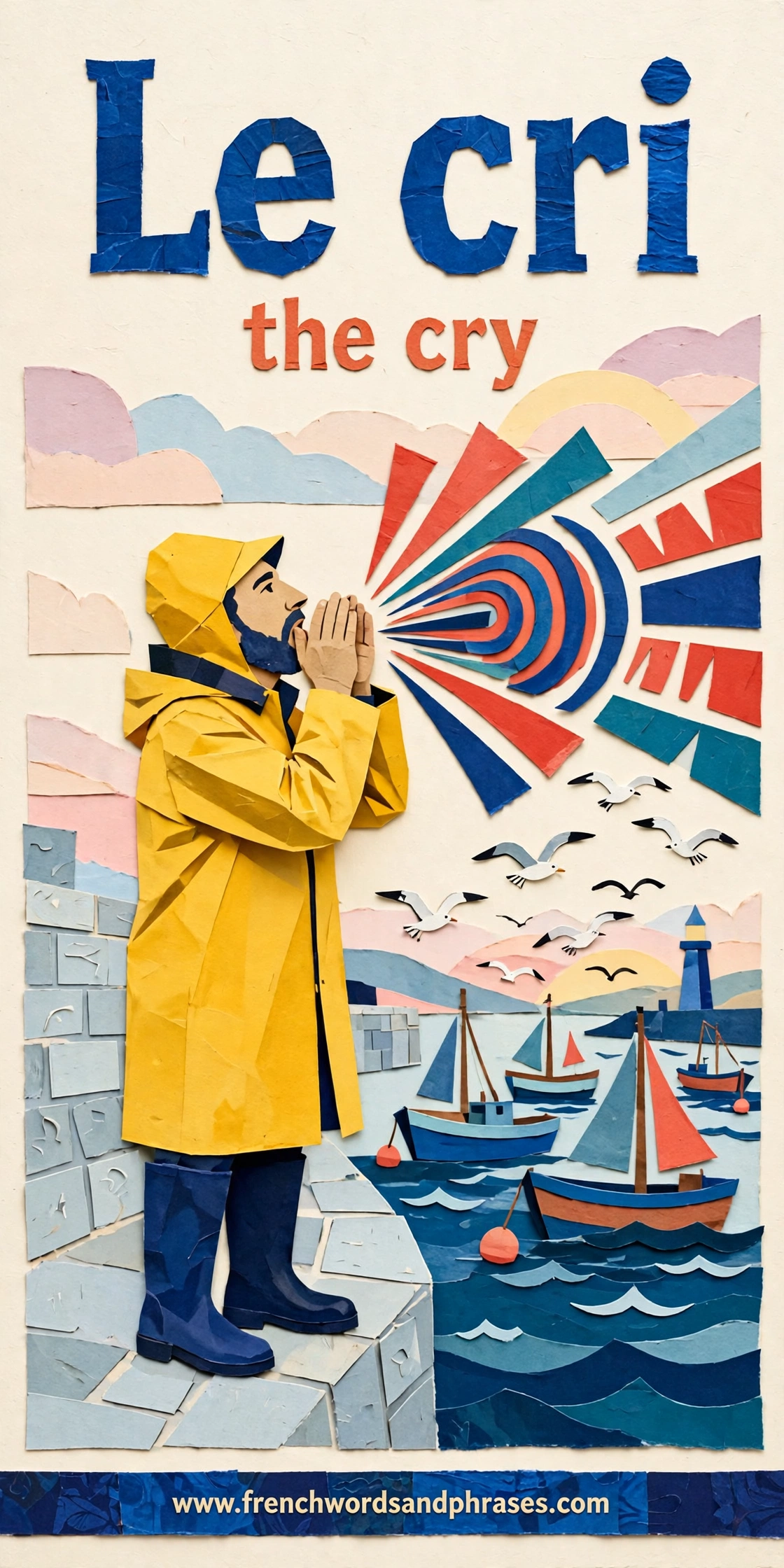
Le cri means the cry, the shout.
A child’s shout across a playground, a gull’s cry over the harbour, the single cry that escapes before a surprise: le cri, the cry — the voice at its rawest, before words arrive to dress it.
In this guide, you’ll learn what cri means in English, how to use it with its articles, how to form its plural, and how it appears in everyday French. Explore French examples, English translations, and practice quizzes.
Understanding the French Noun Cri
Cri is a masculine French noun, learned with its article: le cri, un cri. It is formed on the verb crier, to cry out, to shout — from the Latin quiritare, the cry of the citizen calling for help, which is why a French cry still sounds like an appeal to the whole square.
It means a cry, a shout, a scream — the loud, sudden voice of joy, pain, fear or warning: un cri de joie, a cry of joy, un cri de douleur, a cry of pain, pousser un cri, to let out a cry. It is also the name of each animal’s voice: le cri de la mouette, the gull’s cry, le cri du hibou, the owl’s cry. Two set phrases carry it far from the throat: le dernier cri, the very latest fashion, the last word in style, and un cri du cœur, a cry from the heart — a spontaneous, heartfelt appeal.
Gender: Masculine — le cri
Definite article: le — le cri (the cry)
Indefinite article: un — un cri (a cry)
Plural: les cris — regular, with a simple -s
Spelling note: the verb is crier — pousser un cri, to let out a cry
Star phrases: le dernier cri — the latest fashion; un cri du cœur — a heartfelt appeal
English equivalents: The cry; the shout; the scream.
To emit one is pousser un cri — never faire un cri in careful French. A cri is shorter and sharper than a hurlement (a howl, a wail): the cri startles, the hurlement lasts. And when fashion is at its newest, French says c’est le dernier cri — the last cry — a phrase Paris gave the world.
Experience the Word
Cri is language before language — the one sound every throat on earth makes the same way, in joy as in alarm.
Imagine the harbour at dawn, white gulls quarrelling over the fishing boats: le cri des mouettes tears the quiet, and every head on the quay turns. A second later a child on the beach pousse un cri de joie at the first wave — same instrument, opposite news.
You have not just named a noise. You have named the voice unarmed — le cri, the cry that needs no translation.
How to Use Cri in French: Complete Guide
Let’s explore how cri works in French, beginning with its articles — le cri, un cri, pousser un cri.
Cri with the Definite Article (Le, Les)
Used for a specific cry — the one everyone heard, the one the animal is known by.
| Form | French |
|---|---|
| Masculine singular | le cri |
| Plural | les cris |
Example
Le cri de la mouette réveille le port à l’aube.
The gull’s cry wakes the harbour at dawn.
Cri with the Indefinite Article (Un, Des)
Used for a cry in general — one sudden shout in the dark.
| Form | French |
|---|---|
| Masculine singular | un cri |
| Plural | des cris |
Example
Un cri a traversé la nuit, puis plus rien.
A cry crossed the night, then nothing more.
The Kinds of Cris (Joie, Douleur, Guerre…)
A cry takes the colour of its cause — French names them all with de.
| Kind | French |
|---|---|
| a cry of joy | un cri de joie |
| a cry of pain | un cri de douleur |
| a cry of fright | un cri d’effroi |
| a war cry | un cri de guerre |
| a sharp, piercing cry | un cri perçant |
Example
Les enfants ont poussé un cri de joie en voyant la neige.
The children let out a cry of joy on seeing the snow.
Quick Quiz 1
Complete the sentence:
______ cri du hibou a traversé la forêt. (the)
Reveal the answer
Le
Le cri du hibou a traversé la forêt.
The owl’s cry crossed the forest — cri is masculine, so le.
The Plural of Cri
Cri takes a regular plural in -s — playgrounds, harbours and stadiums are full of them.
| Number | French |
|---|---|
| Singular | le cri |
| Plural | les cris |
Example
Les cris des enfants remplissent la cour de récréation.
The children’s cries fill the playground.
Cri with Possessive Adjectives (Mon, Ton, Son…)
Possessives agree with the noun: cri is masculine, so mon, ton, son in the singular.
| Owner | French |
|---|---|
| my | mon cri |
| your (tu) | ton cri |
| his / her | son cri |
| our | notre cri |
| your (vous) | votre cri |
| their | leur cri |
Example
Son cri de surprise a fait rire toute la classe.
His cry of surprise made the whole class laugh.
Quick Quiz 2
Complete the sentence:
Elle a poussé ______ cri en voyant l’araignée. (a)
Reveal the answer
un
Elle a poussé un cri en voyant l’araignée.
She let out a cry on seeing the spider — pousser un cri is the set phrase.
Cri with Demonstrative Adjectives (Ce, Ces)
Used to point: ce cri, this cry — the one still ringing in everyone’s ears.
| Form | French |
|---|---|
| Masculine singular | ce cri |
| Plural | ces cris |
Example
Ce cri, je l’entendrai encore longtemps.
That cry, I will hear it for a long time yet.
Cri with Adjectives
Adjectives agree with cri — masculine singular: un cri aigu, un grand cri.
| Adjective | With Cri |
|---|---|
| aigu (shrill, high-pitched) | un cri aigu |
| perçant (piercing) | un cri perçant |
| grand (loud, great) | un grand cri |
| joyeux (joyful) | un cri joyeux |
| déchirant (heart-rending) | un cri déchirant |
Example
Un cri aigu a déchiré le silence du matin.
A shrill cry tore the morning silence.
Quick Quiz 3
Complete the sentence:
On a entendu un cri ______ dans la nuit. (piercing)
Reveal the answer
perçant
On a entendu un cri perçant dans la nuit.
A piercing cry was heard in the night.
Everyday Expressions with Cri
Hearts, battlefields and fashion weeks — the cri phrases of daily life.
| Expression | In English |
|---|---|
| pousser un cri | to let out a cry |
| un cri du cœur | a cry from the heart, a heartfelt appeal |
| le dernier cri | the very latest fashion |
| un cri de guerre | a war cry, a battle cry |
| à grands cris | with loud cries, clamouring |
Example
Son discours était un vrai cri du cœur pour sauver l’école.
His speech was a real cry from the heart to save the school.
Words from the Same Family as Cri
Voices and their volumes — the words that travel with cri.
| French | In English |
|---|---|
| crier | to shout, to cry out (the verb) |
| un hurlement | a howl, a wail — the long cry |
| un appel | a call, an appeal |
| la voix | the voice |
| un gémissement | a moan, a groan |
Example
Le hurlement du vent couvre les cris des mouettes.
The howling of the wind covers the gulls’ cries.
Quick Quiz 4
What does le dernier cri mean in a fashion magazine?
Reveal the answer
The very latest fashion — the newest thing, the last word in style.
Cette robe est le dernier cri à Paris.
This dress is the latest fashion in Paris.
Cri in Everyday French: Real-Life Examples
Now that you know the word, let’s see how cri appears in everyday French.
Example 1 — Surprise
Elle a poussé un cri en ouvrant la boîte.
She let out a cry on opening the box.
Example 2 — At the harbour
Le cri des mouettes annonce l’arrivée des bateaux.
The gulls’ cry announces the boats’ arrival.
Example 3 — Joy
Un cri de joie a salué le but de la victoire.
A cry of joy greeted the winning goal.
Example 4 — Fashion
Ce sac est le dernier cri, toutes les boutiques le vendent.
This bag is the latest fashion, every shop sells it.
Example 5 — The heart
Sa lettre est un cri du cœur, lisez-la.
Her letter is a cry from the heart, read it.
Example 6 — Night
Un cri d’oiseau a traversé la nuit silencieuse.
A bird’s cry crossed the silent night.
Beyond Translation: The Meaning of Cri
Cri began as a citizen’s alarm — Latin quiritare, to call the Quirites to one’s aid — and it has kept the urgency of that first appeal: a French cri is never decoration, it summons. The language then trusted the word with two of its most tender phrases: the cri du cœur, sincerity at full voice, and the dernier cri, where the shout of the crowd becomes the verdict of fashion.
To say cri is to hear the square turn its head.
It evokes the gull over the harbour, the child at the first snow, and the speaker whose heart speaks louder than his notes.
How to Remember the French Noun Cri
Remember it this way: Cri is the cry — masculine: le cri, and you let one out with pousser un cri.
- Always masculine — le cri, un cri, mon cri.
- The verb phrase — pousser un cri, to let out a cry.
- The two star phrases — un cri du cœur, a heartfelt appeal; le dernier cri, the latest fashion.
The key idea is le cri — the cry, masculine; pousser un cri = to let out a cry.
Test Your Knowledge of Cri
Let’s see how much you’ve learned. Try answering these questions before revealing the answers.
Question 1
Is cri masculine or feminine?
Reveal the answer
Masculine — le cri, un cri.
Question 2
How do you say to let out a cry in French?
Reveal the answer
Pousser un cri.
Question 3
Translate: The children let out a cry of joy.
Reveal the answer
Les enfants ont poussé un cri de joie.
Question 4
What does le dernier cri mean?
Reveal the answer
The very latest fashion — the newest style of the moment.
Question 5
Complete the sentence:
______ cris des supporters remplissent le stade. (the)
Reveal the answer
Les
Les cris des supporters remplissent le stade.
The fans’ cries fill the stadium.
Your Final Challenge
Can You Use It?
How would you say this in French?
“The children let out a cry of joy on seeing the snow.”
Reveal the answer
Les enfants ont poussé un cri de joie en voyant la neige.
The children let out a cry of joy on seeing the snow.
A little French. A little curiosity. A richer everyday life.
LEARN FRENCH ONE WORD AT A TIME




