A French Word to Live By
Translate Crevette to English
/kʁə.vɛt/
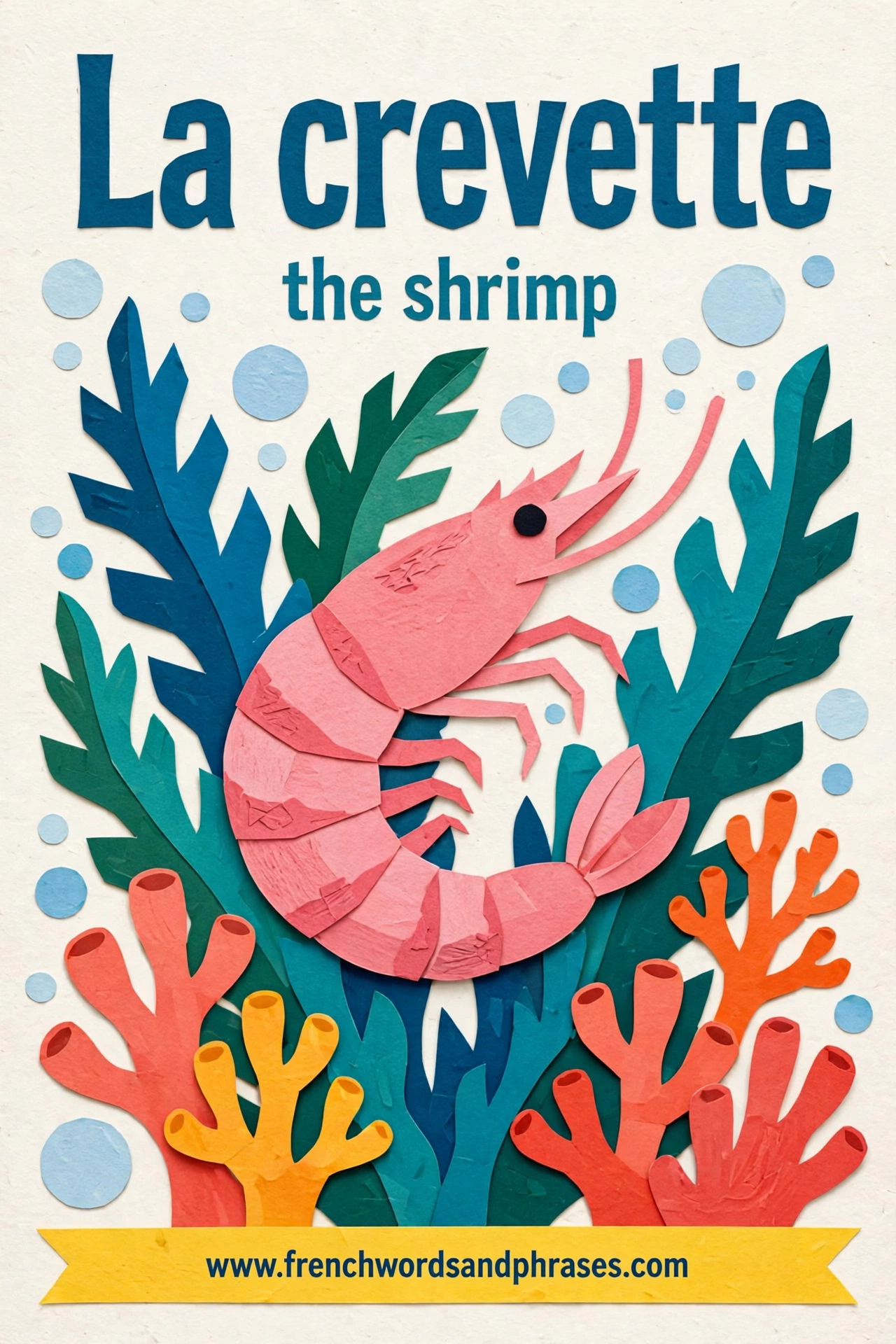
La crevette means the shrimp.
At the fish stall, a glistening pink pile curves like a hundred tiny commas — fresh from the morning boats: la crevette.
In this guide, you’ll learn what crevette means in English, how to use it with its articles, how to form its plural, and how it appears in everyday French. Explore French examples, English translations, and practice quizzes.
Understanding the French Noun Crevette
Crevette is a feminine French noun, learned with its article: la crevette, une crevette. It covers both of the English words: the small pink crevette rose is the prawn of the fishmonger’s stall, while the tiny grey crevette grise is the shrimp of the northern coasts.
It means the shrimp — the small curved shellfish that turns pink when cooked and fills the seafood platters of France: les fruits de mer. You peel it — décortiquer — dip it in mayonnaise or garlic butter, and eat it with your fingers at the seaside.
Gender: Feminine
Definite article: la — la crevette (the shrimp)
Indefinite article: une — une crevette (a shrimp)
Plural: les crevettes
Two kinds: la crevette rose (the pink prawn) and la crevette grise (the grey shrimp)
English equivalents: The shrimp; the prawn.
One important usage detail: crevettes are almost always ordered in the plural or by weight — deux cents grammes de crevettes, s’il vous plaît. And the word has a kind slang life: a small, slight person can be nicknamed une crevette, just as English says a shrimp.
Experience the Word
Crevette is more than seafood. It is the seaside lunch itself — the paper cone of pink prawns, the lemon wedge, the gulls waiting for the shells.
Imagine the port at noon: the boats unloaded, the stall piled high, and your fingers pink from peeling crevettes faster than the conversation can keep up.
You have not just eaten shellfish. You have tasted the harbour — la crevette, the little comma of the sea.
How to Use Crevette in French: Complete Guide
Let’s explore how crevette works in French, beginning with its articles — la crevette, une crevette.
Crevette with the Definite Article (La, Les)
Used for the shrimps everyone knows — the ones on the platter in front of you.
| Form | French |
|---|---|
| Feminine singular | la crevette |
| Plural | les crevettes |
Example
La crevette devient rose quand elle cuit.
The shrimp turns pink when it cooks.
Crevette with the Indefinite Article (Une, Des)
Used for a shrimp in general — though in real life they arrive by the dozen.
| Form | French |
|---|---|
| Feminine singular | une crevette |
| Plural | des crevettes |
Example
Elle mange une crevette avec un peu de mayonnaise.
She eats a shrimp with a little mayonnaise.
At the Fish Stall: Words of the Sea
Platters, shells and lemon — the vocabulary of the crevette.
| French | In English |
|---|---|
| les fruits de mer | seafood |
| la carapace | the shell (of a shellfish) |
| décortiquer | to peel, to shell |
| le citron | the lemon |
| la mayonnaise | mayonnaise |
| le poissonnier | the fishmonger |
Example
Le poissonnier vend des crevettes roses très fraîches.
The fishmonger sells very fresh pink prawns.
Quick Quiz 1
What happens to une crevette when it is cooked?
Reveal the answer
It turns pink — elle devient rose.
La crevette grise devient rose à la cuisson.
The grey shrimp turns pink when cooked.
The Plural of Crevette
Crevette adds an -s in the plural — and the plural is where this word truly lives.
| Number | French |
|---|---|
| Singular | la crevette |
| Plural | les crevettes |
Example
Les crevettes du plateau sont déjà décortiquées.
The shrimps on the platter are already peeled.
Crevette with Possessive Adjectives (Ma, Ta, Sa…)
Possessives agree with the noun: crevette is feminine, so it takes ma, ta, sa.
| Owner | French |
|---|---|
| my | ma crevette |
| your (tu) | ta crevette |
| his / her | sa crevette |
| our | notre crevette |
| your (vous) | votre crevette |
| their | leur crevette |
Example
Ne prends pas ma crevette, il en reste plein dans l’assiette !
Don’t take my shrimp; there are plenty left on the plate!
Quick Quiz 2
Complete the sentence:
______ crevettes sont délicieuses avec de l’ail. (These)
Reveal the answer
Ces
Ces crevettes sont délicieuses avec de l’ail.
These shrimps are delicious with garlic.
Crevette with Demonstrative Adjectives (Cette, Ces)
Used to point: cette crevette, the biggest one on the platter.
| Form | French |
|---|---|
| Feminine singular | cette crevette |
| Plural | ces crevettes |
Example
Cette crevette est énorme, on dirait une langoustine !
This shrimp is enormous; it looks like a langoustine!
Crevette with Adjectives
Adjectives agree with the feminine noun: frais becomes fraîche, gros becomes grosse.
| Adjective | With Crevette |
|---|---|
| frais (fresh) | une crevette fraîche |
| gros (big) | une crevette grosse |
| rose (pink) | une crevette rose |
| gris (grey) | une crevette grise |
| délicieux (delicious) | une crevette délicieuse |
Example
Au marché, nous choisissons des crevettes fraîches et roses.
At the market, we choose fresh, pink shrimps.
Quick Quiz 3
Complete the sentence:
J’aime les crevettes ______ de la mer du Nord. (grey)
Reveal the answer
grises
J’aime les crevettes grises de la mer du Nord.
I like the grey shrimps of the North Sea — grises, feminine plural.
Everyday Expressions with Crevette
Platters, peeling and seaside lunches — the crevette phrases of daily life.
| Expression | In English |
|---|---|
| un plateau de fruits de mer | a seafood platter |
| décortiquer les crevettes | to peel the shrimps |
| des crevettes à l’ail | garlic shrimps |
| une brochette de crevettes | a shrimp skewer |
| le cocktail de crevettes | the prawn cocktail |
| pêcher la crevette | to go shrimping |
Example
Le soir, nous commandons des crevettes à l’ail au petit restaurant du port.
In the evening, we order garlic shrimps at the little restaurant by the harbour.
Words from the Same Family as Crevette
Shellfish, harbours and fishing — the words that travel with crevette.
| French | In English |
|---|---|
| le crabe | the crab |
| la moule | the mussel |
| l’huître | the oyster |
| la langoustine | the langoustine |
| la pêche | fishing |
| le port | the harbour, the port |
Example
Le plateau de fruits de mer réunit crevettes, huîtres et moules.
The seafood platter brings together shrimps, oysters and mussels.
Quick Quiz 4
What does décortiquer mean?
Reveal the answer
To peel, to shell — to take the carapace off the crevette.
Les enfants décortiquent leurs crevettes tout seuls.
The children peel their shrimps all by themselves.
Crevette in Everyday French: Real-Life Examples
Now that you know the word, let’s see how crevette appears in everyday French.
Example 1 — At the market
Deux cents grammes de crevettes roses, s’il vous plaît.
Two hundred grams of pink prawns, please.
Example 2 — At the seaside
Les enfants pêchent la crevette avec un petit filet.
The children go shrimping with a little net.
Example 3 — Cooking
Elle fait revenir les crevettes dans l’ail et le persil.
She fries the shrimps in garlic and parsley.
Example 4 — A platter
Le plateau de crevettes arrive avec du citron et du pain.
The platter of shrimps arrives with lemon and bread.
Example 5 — A nickname
Il est petit et mince, on le surnomme la crevette.
He is small and slim; they nickname him the shrimp.
Example 6 — Freshness
Ces crevettes sentent la mer, elles sont très fraîches.
These shrimps smell of the sea; they are very fresh.
Beyond Translation: The Meaning of Crevette
The crevette is the pride of two French coasts: the crevette grise of the North Sea, tiny and sweet, eaten on buttered bread in Belgium and the Nord, and the crevette rose of the Atlantic and Mediterranean stalls, queen of the plateau de fruits de mer. Shrimping itself — la pêche à la crevette, net in hand in the rock pools — is a childhood rite on every French holiday coast. The word even swam into slang: to call someone une crevette is to tease them, kindly, for being small.
To say crevette is to taste the seaside in a single word.
It evokes the harbour stalls and the pink piles, fingers busy peeling, and the gulls circling for their share of the shells.
How to Remember the French Noun Crevette
Remember it this way: Crevette is the shrimp — feminine, la crevette, grey in the sea and pink on the plate.
- You see the shellfish — la crevette, petite, courbée, rose.
- You order by weight — des crevettes, presque toujours au pluriel.
- You peel it — décortiquer la crevette, puis un peu de citron.
The key idea is la crevette — grey in the sea, pink on the plate.
Test Your Knowledge of Crevette
Let’s see how much you’ve learned. Try answering these questions before revealing the answers.
Question 1
Is crevette masculine or feminine?
Reveal the answer
Feminine — la crevette, une crevette.
Question 2
What colour does a shrimp turn when cooked?
Reveal the answer
Pink — la crevette devient rose à la cuisson.
Question 3
Translate: These shrimps are delicious.
Reveal the answer
Ces crevettes sont délicieuses.
Question 4
What are les fruits de mer?
Reveal the answer
Seafood — shrimps, oysters, mussels and the rest of the platter.
Question 5
Complete the sentence:
Je voudrais ______ crevettes à l’ail.
Reveal the answer
des
Je voudrais des crevettes à l’ail.
I would like some garlic shrimps.
Your Final Challenge
Can You Use It?
How would you say this in French?
“We order garlic shrimps at the harbour.”
Reveal the answer
Nous commandons des crevettes à l’ail au port.
We order garlic shrimps at the harbour.
A little French. A little curiosity. A richer everyday life.
LEARN FRENCH ONE WORD AT A TIME