A French Word to Live By
Translate Côte to English
/kot/
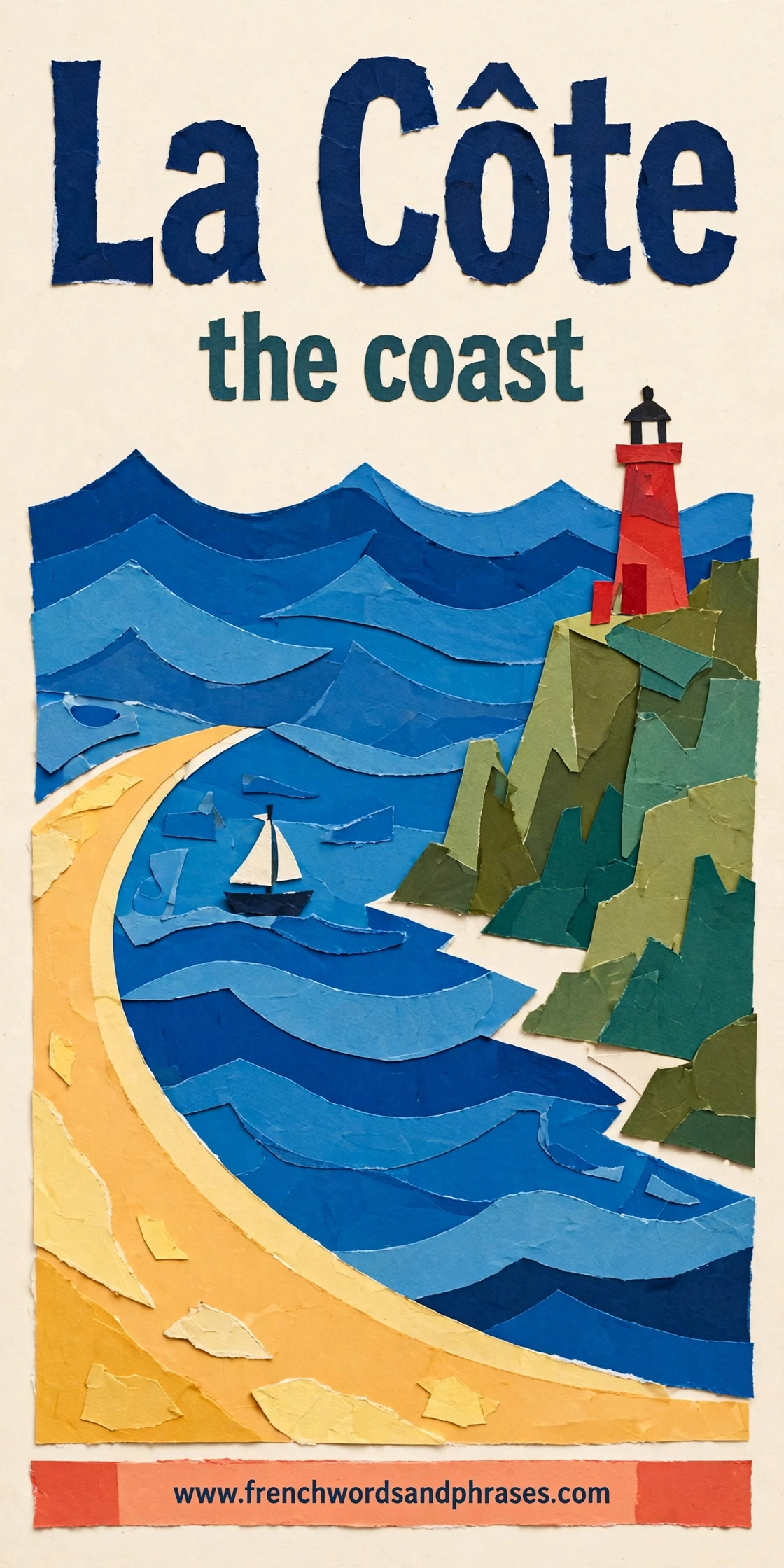
La Côte means the coast.
The train window fills with blue. After hours of fields and tunnels, the carriage gasps as the Mediterranean appears, and the driver announces: « Nous longeons la côte. » We are running along the coast — la côte, the bright edge where France meets the sea.
In this guide, you’ll learn what côte means in English, how to use it with its articles, how to form its plural, and how it appears in everyday French. Explore French examples, English translations, and practice quizzes.
Understanding the French Noun Côte
Côte is a feminine French noun, learned with its article: la côte, une côte. It lives three lives: the coast where land meets sea, the rib in your body and on your plate, and the slope that cyclists climb. It must not be confused with its two near-twins: le côté (the side) and la cote (a rating, a quoted price) — same sound, different words.
First of all, it means the coast — the seashore, as in la Côte d’Azur, the famous Riviera. But order une côte de bœuf in a restaurant and you get a rib of beef; have your côtes examined after a fall and they are your ribs; and when the Tour de France annonce une côte, it means a climb, a hillside slope. Context always tells you which côte is meant.
Gender: Feminine — la côte, une côte
Definite article: la — la côte (the coast)
Indefinite article: une — une côte (a coast; a rib; a slope)
Plural: les côtes
Watch out: le côté = the side; la cote = a rating, a price quote
English equivalents: The coast; a rib; a slope, a climb
One important usage detail: the trio côte / côté / cote is pronounced almost identically and traps every learner. Remember them by their articles and accents: la côte with its little hat (the coast, the rib, the slope), le côté with the accent at the end (the side), and la cote with no accent at all (the rating).
Experience the Word
Côte is the geography of French holidays. La Côte d’Azur, la Côte d’Ivoire, la côte atlantique — the word smells of salt, pine trees and long lunches above the harbour, where the road follows the water and every village faces the sea.
It is also the word of effort. In July, the whole country watches riders suffer up une côte in the mountains, the crowd shouting as the slope bites — and at the butcher’s, une côte de bœuf is the king of Sunday roasts, thick and marbled.
You have not just learned a coastline. You have learned the edge of the land, the bone in the body and the hill on the road — one word, three Frances.
How to Use Côte in French: Complete Guide
Let’s explore how côte works in French, beginning with its articles — then we will follow its three meanings: the sea, the table and the road.
Côte with the Definite Article (La, Les)
Feminine: la in the singular, les in the plural.
| Form | French |
|---|---|
| Singular | la côte |
| Plural | les côtes |
Example
La côte est magnifique entre Nice et Menton.
The coast is magnificent between Nice and Menton.
Côte with the Indefinite Article (Une, Des)
Une côte can be a stretch of coast, a rib, or a climb — the sentence decides.
| Form | French |
|---|---|
| Singular | une côte |
| Plural | des côtes |
Example
Le cycliste attaque une côte très raide.
The cyclist attacks a very steep climb.
The Three Lives of Côte: Sea, Table and Road
One spelling, three worlds. Here are the côtes you will actually meet.
| French | In English |
|---|---|
| la côte | the coast, the shore |
| une côte de bœuf | a rib of beef |
| les côtes levées | spare ribs |
| une côte raide | a steep slope |
| le littoral | the coastline |
| gravir une côte | to climb a hill, a slope |
Example
Nous avons commandé une côte de bœuf pour deux.
We ordered a rib of beef for two.
Quick Quiz 1
A menu offers « une côte de porc ». What is it?
Reveal the answer
A pork chop — a rib cut.
At the table, côte is the rib, not the coast: une côte de porc, une côte de bœuf, une côtelette.
The Plural of Côte
Regular: add -s, and the circumflex stays.
| Number | French |
|---|---|
| Singular | la côte |
| Plural | les côtes |
Example
Les côtes françaises attirent des millions de touristes.
The French coasts attract millions of tourists.
Côte with Possessive Adjectives (Ma, Ta, Sa…)
Côte is feminine, so my/your/his-her take ma, ta, sa.
| Owner | French |
|---|---|
| my | ma côte |
| your (tu) | ta côte |
| his / her | sa côte |
| our | notre côte |
| your (vous) | votre côte |
| their | leur côte |
Example
Il s’est cassé une côte et il protège sa côte jour et nuit.
He broke a rib and he protects his rib day and night.
Quick Quiz 2
Complete the sentence:
Nous roulons le long de ______ côte. (the)
Reveal the answer
la
Nous roulons le long de la côte.
We are driving along the coast — côte is feminine, so the article is la.
Côte with Demonstrative Adjectives (Cette, Ces)
Feminine singular takes cette; the plural is ces for everyone.
| Form | French |
|---|---|
| Feminine singular | cette côte |
| Plural | ces côtes |
Example
Cette côte est célèbre dans le monde entier.
This coast is famous throughout the world.
Côte with Adjectives
Adjectives agree with the feminine côte and follow it.
| Adjective | With Côte |
|---|---|
| rocheuse (rocky) | une côte rocheuse |
| sauvage (wild) | une côte sauvage |
| raide (steep) | une côte raide |
| découpée (jagged, indented) | une côte découpée |
Example
La Bretagne possède une côte sauvage et découpée.
Brittany has a wild, jagged coast.
Quick Quiz 3
Which word means « the side » — la côte, le côté, or la cote?
Reveal the answer
Le côté
Le côté is the side. La côte is the coast, the rib or the slope, and la cote (no accent) is a rating or a quoted price.
Everyday Expressions with Côte
From the Riviera to the dinner table, côte is everywhere in French life.
| Expression | In English |
|---|---|
| la Côte d’Azur | the French Riviera |
| la Côte d’Ivoire | Ivory Coast |
| une côte de porc | a pork chop |
| à mi-côte | halfway up the slope |
| côte à côte | side by side |
| se tenir les côtes (de rire) | to split one’s sides laughing |
Example
Ils marchent côte à côte le long de la plage.
They walk side by side along the beach.
Words from the Same Family as Côte
The coastal branch of the family — and one famous cousin who is NOT the same word.
| French | In English |
|---|---|
| côtier | coastal (une route côtière) |
| la côtelette | a cutlet |
| accoster | to come alongside, to dock |
| le littoral | the coastline, the shore |
| le côté | the side — a close cousin, a different word |
Example
Le bateau accoste lentement le long de la côte.
The boat slowly comes alongside the coast.
Quick Quiz 4
What is la Côte d’Azur?
Reveal the answer
The French Riviera
La Côte d’Azur is the azure coast of the south-east — Nice, Cannes, Menton — the most famous côte of all.
Côte in Everyday French: Real-Life Examples
Now that you know the word, let’s see how côte appears in everyday French.
Example 1 — On holiday
Cet été, nous longeons la côte en voiture, de Marseille à Nice.
This summer, we are driving along the coast, from Marseille to Nice.
Example 2 — At the butcher’s
Je voudrais une belle côte de bœuf pour dimanche, s’il vous plaît.
I would like a nice rib of beef for Sunday, please.
Example 3 — Watching the Tour
Attention, les coureurs arrivent à la grande côte du jour !
Careful, the riders are reaching the big climb of the day!
Example 4 — At the doctor’s
Il est tombé de vélo et il s’est fait mal à une côte.
He fell off his bike and hurt a rib.
Example 5 — A steep street
Cette côte est trop raide pour les enfants à vélo.
This slope is too steep for children on bikes.
Example 6 — Laughing
Avec ses histoires, on se tient les côtes du début à la fin.
With his stories, we split our sides laughing from start to finish.
Beyond Translation: The Meaning of Côte
Côte is a small lesson in how French recycles its words. The Latin costa meant a rib — and look: the coast is the rib of the land, the long bone along the sea; the slope is a rib of the mountain; and the rib on your plate kept the original meaning. English borrowed the same root twice, in coast and in cutlet’s cousin côtelette. One old word for a curved bone now organises the map, the menu and the mountain stage.
Wherever something long and curved holds a shape, French sees a côte.
Learn to spot which of the three you are facing — sea, table or road — and the word will never confuse you again.
How to Remember the French Noun Côte
Remember it this way: Côte wears a little hat — the circumflex — and it is the rib word: the rib of the land is the coast, the rib of the mountain is the slope, and the rib itself is dinner.
- You see the map — la côte, the long rib where France meets the sea.
- You see the plate — une côte de bœuf, the rib, thick and roasted.
- You see the road — une côte raide, the rib of the hill the cyclists climb.
The key idea is la côte — the rib of the land, the table and the road.
Test Your Knowledge of Côte
Let’s see how much you’ve learned. Try answering these questions before revealing the answers.
Question 1
What are the three main meanings of côte?
Reveal the answer
The coast, a rib, and a slope — context tells you which one.
Question 2
Is côte masculine or feminine?
Reveal the answer
Feminine — la côte, une côte.
Question 3
How do you say the French Riviera?
Reveal the answer
La Côte d’Azur — literally, the azure coast.
Question 4
What is the difference between la côte and le côté?
Reveal the answer
La côte is the coast, a rib or a slope; le côté is the side. The accents and articles keep them apart.
Question 5
Translate: We are driving along the coast.
Reveal the answer
Nous roulons le long de la côte.
Your Final Challenge
Can You Use It?
How would you say this in French?
“We are driving along the coast.”
Reveal the answer
Nous roulons le long de la côte.
We are driving along the coast.
A little French. A little curiosity. A richer everyday life.
LEARN FRENCH ONE WORD AT A TIME