
A French Word to Live By
Translate Consonne to English
/kɔ̃.sɔn/
La consonne means the consonant.
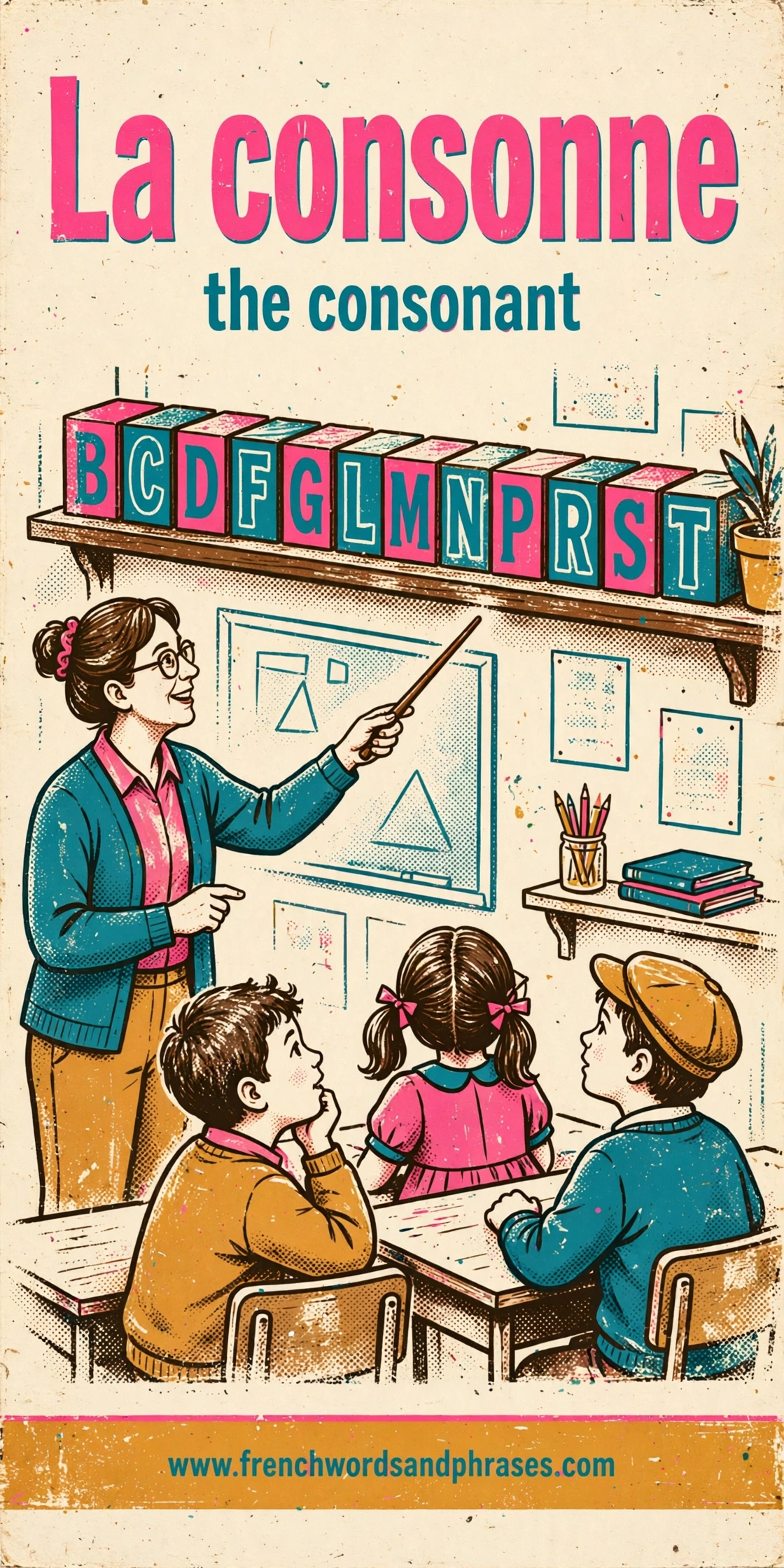
B, D, K, T — the letters that click, tap and stop the breath, standing in a row on the classroom wall opposite their singing sisters: la consonne, the consonant — every letter of the alphabet that is not a vowel, the bones of every French word.
In this guide, you’ll learn what consonne means in English, how to use it with its articles, how to form its plural, and how it appears in everyday French. Explore French examples, English translations, and practice quizzes.
Understanding the French Noun Consonne
Consonne is a feminine French noun, learned with its article: la consonne, une consonne. It comes from the Latin consonans — sounding with: the letter that can only sound with a vowel beside it. French has twenty consonants in its alphabet of twenty-six letters, and they are the skeleton on which the voyelles hang the music.
It means a consonant — a speech sound made by narrowing or closing the breath channel, and the letter that writes it: les consonnes et les voyelles, the consonants and the vowels, une consonne double, a double consonant, la consonne finale, the final consonant. In French the great drama of the consonne is silence: many final consonants are written but not pronounced — the t of chat, the s of les — except before a vowel, where the liaison wakes them up.
Gender: Feminine — la consonne
Definite article: la — la consonne (the consonant)
Indefinite article: une — une consonne (a consonant)
Plural: les consonnes — regular, with a simple -s
Spelling note: double n in the middle: consonne — con-sonne, sounding with
The partner: la voyelle — the vowel; consonnes and voyelles build every word
English equivalents: The consonant.
School French divides the alphabet in two: six voyelles (a, e, i, o, u, y) and twenty consonnes. The traps for learners live here: a consonne finale is often silent (trop, grand), the h is a consonne that never sounds at all, and double consonnes — les consonnes doubles like ll, nn, ss — usually sound as one. When a word ends in a silent consonne and the next begins with a vowel, la liaison pronounces the sleeper: les amis, “lay-ZA-mee”.
Experience the Word
Consonne is the percussion section of the language: if the vowels are the singing, the consonants are the drums, the taps and the stops that give French its rhythm.
Imagine the dictée in a village school: the teacher reads « les grandes maisons » slowly, and twenty pencils hesitate over the s’s — silent here, sung there. Every hesitation is a consonne deciding whether to sleep or to sound: that is the whole music of French spelling.
You have not just named a letter type. You have named the bones of the word — la consonne, the consonant, the sound that needs a vowel to sing.
How to Use Consonne in French: Complete Guide
Let’s explore how consonne works in French, beginning with its articles — la consonne, une consonne, les consonnes et les voyelles.
Consonne with the Definite Article (La, Les)
Used for a specific consonne — the one at the end, the one that sleeps.
| Form | French |
|---|---|
| Feminine singular | la consonne |
| Plural | les consonnes |
Example
La consonne finale de ce mot ne se prononce pas.
The final consonant of this word is not pronounced.
Consonne with the Indefinite Article (Une, Des)
Used for a consonne in general — any of the twenty.
| Form | French |
|---|---|
| Feminine singular | une consonne |
| Plural | des consonnes |
Example
Le b est une consonne, le a est une voyelle.
B is a consonant, A is a vowel.
Consonne with Its Kinds (Double, Finale, Muette…)
Doubled, final, silent — the consonnes lead dramatic lives in French.
| Quantity | French |
|---|---|
| a double consonant | une consonne double |
| the final consonant | la consonne finale |
| a silent consonant | une consonne muette |
| consonants and vowels | les consonnes et les voyelles |
| a consonant sound | un son consonne |
Example
Dans « terre », la consonne double se prononce comme une seule.
In “terre”, the double consonant is pronounced as one.
Quick Quiz 1
Complete the sentence:
______ consonne h ne se prononce jamais en français. (the)
Reveal the answer
La
La consonne h ne se prononce jamais en français.
The consonant h is never pronounced in French — consonne is feminine, so la.
The Plural of Consonne
Consonne takes a regular plural in -s — twenty of them hold up the alphabet.
| Number | French |
|---|---|
| Singular | la consonne |
| Plural | les consonnes |
Example
Les consonnes finales sont souvent muettes.
Final consonants are often silent.
Consonne with Possessive Adjectives (Ma, Ta, Sa…)
Possessives agree with the noun: consonne is feminine, so ma, ta, sa in the singular.
| Owner | French |
|---|---|
| my | ma consonne |
| your (tu) | ta consonne |
| his / her | sa consonne |
| our | notre consonne |
| your (vous) | votre consonne |
| their | leur consonne |
Example
Chaque lettre choisit sa consonne ou sa voyelle.
Each letter chooses its consonant or its vowel.
Quick Quiz 2
Complete the sentence:
Le mot « chat » finit par ______ consonne muette. (a)
Reveal the answer
une
Le mot « chat » finit par une consonne muette.
The word “chat” ends in a silent consonant — une, because consonne is feminine.
Consonne with Demonstrative Adjectives (Cette, Ces)
Used to point: cette consonne, this consonant — the one under the teacher’s finger.
| Form | French |
|---|---|
| Feminine singular | cette consonne |
| Plural | ces consonnes |
Example
Cette consonne se prononce devant une voyelle.
This consonant is pronounced before a vowel.
Consonne with Adjectives
Adjectives agree with consonne — feminine singular: une consonne double, une consonne muette.
| Adjective | With Consonne |
|---|---|
| double (double) | une consonne double |
| finale (final) | la consonne finale |
| muette (silent) | une consonne muette |
| dure (hard) | une consonne dure |
| douce (soft) | une consonne douce |
Example
Une consonne muette termine beaucoup de mots français.
A silent consonant ends many French words.
Quick Quiz 3
Complete the sentence:
Dans « pomme », il y a une consonne ______. (double)
Reveal the answer
double
Dans « pomme », il y a une consonne double.
In “pomme”, there is a double consonant — double has the same form for masculine and feminine.
Everyday Expressions with Consonne
Classrooms and dictées — the consonne phrases of daily life.
| Expression | In English |
|---|---|
| les consonnes et les voyelles | the consonants and the vowels |
| une consonne double | a double consonant |
| la consonne finale | the final consonant |
| une consonne muette | a silent consonant |
| la liaison | the liaison — the sleeping consonant waking before a vowel |
Example
Dans « les amis », la liaison fait entendre la consonne.
In “les amis”, the liaison makes the consonant heard.
Words from the Same Family as Consonne
Letters and sounds — the words that travel with consonne.
| French | In English |
|---|---|
| une voyelle | a vowel — the singing partner |
| une lettre | a letter |
| l’alphabet | the alphabet |
| une syllabe | a syllable |
| prononcer | to pronounce (the verb) |
Example
Une syllabe contient souvent une voyelle et des consonnes.
A syllable often contains a vowel and consonants.
Quick Quiz 4
What is une consonne muette?
Reveal the answer
A silent consonant — written but not pronounced, like the t of chat or the s of les.
Le t de « chat » est une consonne muette.
The t of “chat” is a silent consonant.
Consonne in Everyday French: Real-Life Examples
Now that you know the word, let’s see how consonne appears in everyday French.
Example 1 — At school
Le b et le d sont des consonnes.
B and D are consonants.
Example 2 — Spelling
Ce mot finit par une consonne muette.
This word ends in a silent consonant.
Example 3 — The alphabet
Il y a vingt consonnes dans l’alphabet français.
There are twenty consonants in the French alphabet.
Example 4 — Doubles
« Terre » s’écrit avec une consonne double.
“Terre” is written with a double consonant.
Example 5 — Liaison
La consonne se réveille dans la liaison.
The consonant wakes up in the liaison.
Example 6 — Reading
L’enfant sépare les voyelles et les consonnes.
The child separates the vowels and the consonants.
Beyond Translation: The Meaning of Consonne
Consonne tells its own definition: Latin consonans, sounding-with — the letter that cannot sound alone and must lean on a vowel. Grammarians of Rome divided the alphabet into the self-singing voyelles and the dependent consonnes, and French schoolchildren still learn the same division. The French drama is that so many consonnes fell silent at the ends of words over the centuries, leaving the spelling full of sleeping letters that only the liaison, before a vowel, can wake.
To say consonne is to name the letter that waits for a partner to be heard.
It evokes the classroom wall chart, the hesitant pencil of the dictée, the zzz of les amis — the bones and percussion of every French word.
How to Remember the French Noun Consonne
Remember it this way: Consonne is the consonant — feminine: la consonne, partner of la voyelle, and often silent at the end of a word.
- Always feminine — la consonne, une consonne, ma consonne.
- The pair — les consonnes et les voyelles; twenty consonnes, six voyelles.
- The sleepers — une consonne muette, a silent consonant; the liaison wakes it before a vowel.
The key idea is la consonne — the consonant, feminine; une consonne muette = a silent consonant.
Test Your Knowledge of Consonne
Let’s see how much you’ve learned. Try answering these questions before revealing the answers.
Question 1
Is consonne masculine or feminine?
Reveal the answer
Feminine — la consonne, une consonne.
Question 2
What is the partner word of consonne?
Reveal the answer
La voyelle — the vowel; consonnes sound with voyelles.
Question 3
Translate: The final consonant is not pronounced.
Reveal the answer
La consonne finale ne se prononce pas.
Question 4
How many consonants are there in the French alphabet?
Reveal the answer
Twenty — and six vowels: a, e, i, o, u, y.
Question 5
Complete the sentence:
______ consonnes doubles se prononcent comme une seule. (the)
Reveal the answer
Les
Les consonnes doubles se prononcent comme une seule.
Double consonants are pronounced as one.
Your Final Challenge
Can You Use It?
How would you say this in French?
“B and D are consonants, A is a vowel.”
Reveal the answer
Le b et le d sont des consonnes, le a est une voyelle.
B and D are consonants, A is a vowel.
A little French. A little curiosity. A richer everyday life.
LEARN FRENCH ONE WORD AT A TIME




