
A French Word to Live By
Translate Concurrence to English
/kɔ̃.ky.ʁɑ̃s/
La concurrence means competition.
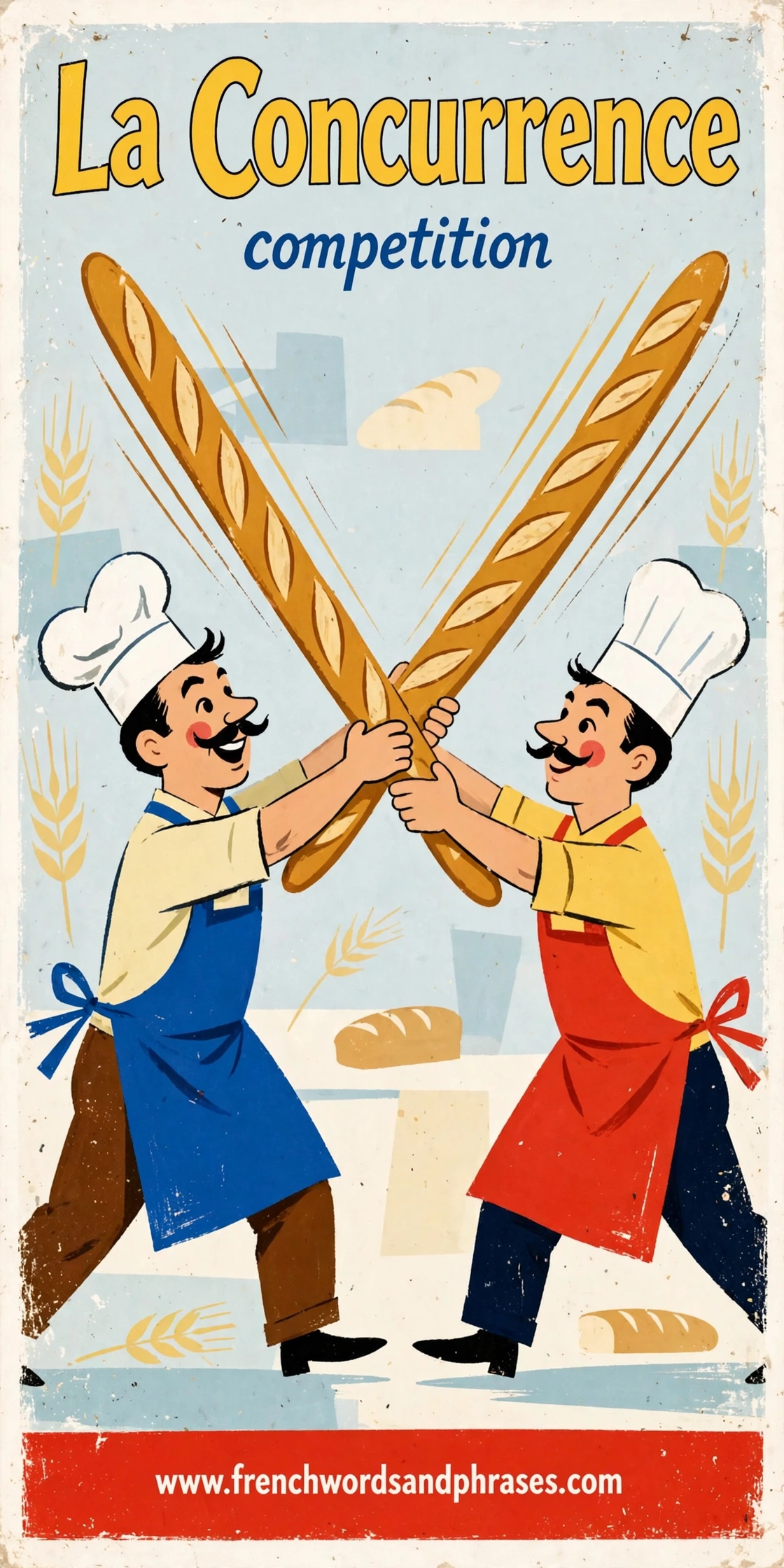
A new baker opens across the street from the old one, and within a week both windows shine brighter, both queues move faster and the croissants have somehow improved. The old baker shrugs with a smile: « C’est la concurrence. » That is competition.
In this guide, you’ll learn what concurrence means in English, how to use it with its articles, how to form its plural, and how it appears in everyday French. Explore French examples, English translations, and practice quizzes.
Understanding the French Noun Concurrence
Concurrence is a feminine French noun. It is learned together with its article: la concurrence, une concurrence. In business French it is the everyday word for competition — the rivalry between companies, shops and brands fighting for the same customers.
It means competition — the contest between sellers for your money: la concurrence entre les supermarchés, competition between the supermarkets. A business that rivals yours is un concurrent, a competitor, and to compete with someone is faire concurrence à quelqu’un. Mind the border with English: a competition you enter to win a prize — an exam, a contest — is usually un concours, not la concurrence.
Gender: Feminine
Definite article: la — la concurrence (the competition)
Indefinite article: une — une concurrence (competition)
Plural: les concurrences
English equivalents: Competition; rivalry between businesses.
One important usage detail: concurrence is mostly a mass noun — you speak of la concurrence in general, and the plural is rare. Its most useful fixed phrase is faire concurrence à: ce magasin fait concurrence au supermarché, this shop competes with the supermarket. And watch for the formal phrase jusqu’à concurrence de, meaning up to an amount of — un prêt jusqu’à concurrence de dix mille euros, a loan of up to ten thousand euros.
Experience the Word
Concurrence is more than a business word. It is the engine French shopkeepers both curse and bless — the rival across the street who forces everyone to do better.
Imagine two cafés on the same square: one adds a terrace, the other answers with better coffee, and the whole square wakes up. Nobody planned it together; la concurrence did the work.
You have not just named a rivalry. You have named the pressure that improves everything — la concurrence.
How to Use Concurrence in French: Complete Guide
Let’s explore how concurrence works in French, beginning with its articles.
Concurrence with the Definite Article (La, Les)
Used for the competition everyone in the conversation knows — the rivals of this market, on this street.
| Number | French |
|---|---|
| Singular | la concurrence |
| Plural | les concurrences |
Example
La concurrence est forte dans ce quartier.
Competition is strong in this neighbourhood.
Concurrence with the Indefinite Article (Une, Des)
Used for competition in general — the pressure every business feels.
| Number | French |
|---|---|
| Singular | une concurrence |
| Plural | des concurrences |
Example
Les petites boutiques souffrent d’une concurrence terrible.
Small shops suffer from terrible competition.
Concurrence at Work: Rivals and Rules
Competitors, fair play and the phrases of the marketplace.
| French | In English |
|---|---|
| un concurrent | a competitor |
| faire concurrence à | to compete with |
| la concurrence libre | free competition |
| la concurrence déloyale | unfair competition |
| un concurrent direct | a direct competitor |
| jusqu’à concurrence de | up to an amount of (formal) |
Example
Ce nouveau magasin fait concurrence au supermarché.
This new shop competes with the supermarket.
Quick Quiz 1
What is un concurrent?
Reveal the answer
A competitor — the rival business fighting for the same customers.
Notre concurrent principal vient d’ouvrir en face.
Our main competitor has just opened across the street.
The Plural of Concurrence
Concurrence adds an -s in the plural — les concurrences — though in everyday business French the singular does almost all the work.
| Number | French |
|---|---|
| Singular | la concurrence |
| Plural | les concurrences |
Example
Sur internet, les concurrences viennent du monde entier.
On the internet, competition comes from all over the world.
Concurrence with Possessive Adjectives (Ma, Ta, Sa…)
Possessives agree with the noun, not with the owner — and concurrence is feminine, so it takes ma, ta, sa.
| Owner | French |
|---|---|
| my | ma concurrence |
| your (tu) | ta concurrence |
| his / her | sa concurrence |
| our | notre concurrence |
| your (vous) | votre concurrence |
| their | leur concurrence |
Example
Notre entreprise connaît bien sa concurrence.
Our company knows its competition well.
Quick Quiz 2
Complete the sentence:
Cette marque surveille ______ concurrence de près. (its)
Reveal the answer
sa
Cette marque surveille sa concurrence de près.
This brand watches its competition closely.
Concurrence with Demonstrative Adjectives (Cette, Ces)
Used to point: this competition here, those rivals there.
| Number | French |
|---|---|
| Singular | cette concurrence |
| Plural | ces concurrences |
Example
Cette concurrence nous oblige à baisser nos prix.
This competition forces us to lower our prices.
Concurrence with Adjectives
Adjectives agree with concurrence, feminine — forte, libre, déloyale.
| Adjective | With Concurrence |
|---|---|
| forte (strong) | une concurrence forte |
| libre (free) | la concurrence libre |
| déloyale (unfair) | une concurrence déloyale |
| internationale (international) | la concurrence internationale |
| rude (tough) | une concurrence rude |
Example
La concurrence déloyale est interdite par la loi.
Unfair competition is forbidden by law.
Quick Quiz 3
Complete the sentence:
C’est une concurrence ______ : ils copient tous nos produits. (unfair)
Reveal the answer
déloyale
C’est une concurrence déloyale : ils copient tous nos produits.
It is unfair competition: they copy all our products.
Everyday Expressions with Concurrence
In the office and in the papers — the concurrence phrases of the week.
| Expression | In English |
|---|---|
| faire face à la concurrence | to face the competition |
| un prix sans concurrence | an unbeatable price |
| la libre concurrence | free competition |
| être en concurrence avec | to be in competition with |
| un avantage sur la concurrence | an advantage over the competition |
| la concurrence des prix | price competition |
Example
Pour faire face à la concurrence, le magasin ouvre le dimanche.
To face the competition, the shop opens on Sundays.
Words from the Same Family as Concurrence
Rivals, contests and competing — the words that travel with concurrence.
| French | In English |
|---|---|
| un concurrent | a competitor |
| concurrentiel | competitive (of a market or price) |
| un concours | a contest, a competitive exam |
| la compétition | a sporting competition |
| rivaliser | to rival, to compete |
| un rival | a rival |
Example
Le concours d’entrée est très difficile cette année.
The entrance exam is very difficult this year.
Quick Quiz 4
Your friend says: « Je passe une concurrence de piano samedi. » What is the trap?
Reveal the answer
A contest or exam is un concours, not la concurrence — concurrence is business rivalry.
Je passe un concours de piano samedi.
I am taking a piano competition on Saturday.
Concurrence in Everyday French: Real-Life Examples
Now that you know the word, let’s see how concurrence appears in everyday French.
Example 1 — On the high street
La concurrence entre les boulangeries est rude.
Competition between the bakeries is tough.
Example 2 — At work
Nous devons faire face à la concurrence chinoise.
We have to face Chinese competition.
Example 3 — Shopping
Grâce à la concurrence, les prix baissent.
Thanks to competition, prices are falling.
Example 4 — In business news
Cette entreprise domine la concurrence depuis dix ans.
This company has dominated the competition for ten years.
Example 5 — Opening a shop
Avant d’ouvrir, étudie bien la concurrence du quartier.
Before opening, study the neighbourhood competition carefully.
Example 6 — Advertising
Nos prix sont sans concurrence !
Our prices are unbeatable!
Beyond Translation: The Meaning of Concurrence
French law takes la concurrence seriously enough to police it: la concurrence déloyale, unfair competition, is a legal wrong, and a national authority — l’Autorité de la concurrence — watches over markets from supermarkets to search engines.
To say concurrence is to name the contest that keeps prices honest.
It evokes the two cafés on the square outbidding each other in kindness, the price war in the Sunday papers, and the small shopkeeper who checks the rival’s window every morning before opening his own.
How to Remember the French Noun Concurrence
Remember it this way: Concurrence is competition — feminine, the business rivalry between companies, with un concurrent for the rival himself.
- You face the rivals — faire face à la concurrence.
- You name the rival — un concurrent fait concurrence aux autres.
- You dodge the trap — a contest you enter is un concours, jamais une concurrence.
The key idea is la concurrence is rivalry — un concours is a contest.
Test Your Knowledge of Concurrence
Let’s see how much you’ve learned. Try answering these questions before revealing the answers.
Question 1
Is concurrence masculine or feminine?
Reveal the answer
Feminine — la concurrence, une concurrence.
Question 2
How do you say a competitor in French?
Reveal the answer
Un concurrent — the rival business itself.
Question 3
Translate: Competition is good for customers.
Reveal the answer
La concurrence est bonne pour les clients.
Question 4
What is la concurrence déloyale?
Reveal the answer
Unfair competition — copying, misleading or undercutting outside the rules.
Question 5
Complete the sentence:
Ce café fait ______ au restaurant d’en face.
Reveal the answer
concurrence
Ce café fait concurrence au restaurant d’en face.
This café competes with the restaurant across the street.
Your Final Challenge
Can You Use It?
How would you say this in French?
“Competition between the shops keeps prices low.”
Reveal the answer
La concurrence entre les magasins garde les prix bas.
Competition between the shops keeps prices low.
A little French. A little curiosity. A richer everyday life.
LEARN FRENCH ONE WORD AT A TIME




