A French Word to Live By
How to Conjugate Concerner in French
/kɔ̃.sɛʁ.ne/
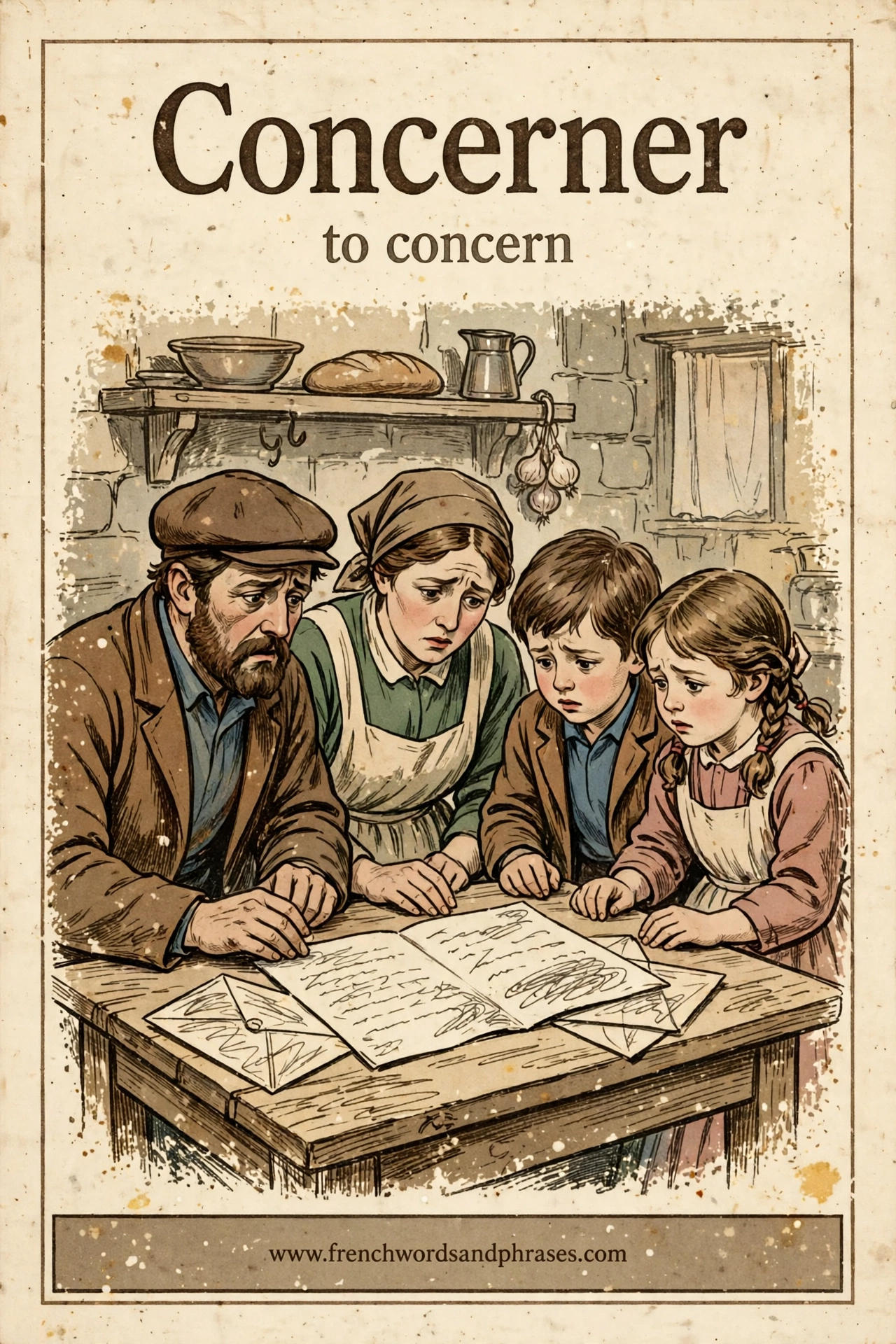
Concerner means to concern — to be about someone or something, and to affect them directly.
A letter that begins « cela ne vous concerne pas », a minister announcing that the new tax concerne every household in the country — concerner is the verb of ‘this is about you’: it draws the circle of who is affected, and who is not.
In this guide, you’ll learn how to conjugate concerner in all the major French tenses and moods. Explore complete conjugation tables, French examples, English translations, and practice quizzes.
Understanding the French Verb Concerner
Concerner is a regular French verb belonging to the first group of verbs, those ending in-er.
It means to concern. Administrative and journalistic French loves this verb: la mesure concerne 40 000 foyers — the measure affects 40,000 households. It is cooler than toucher (to touch, emotionally) and broader than intéresser (to interest): concerner simply marks who falls inside the circle of a rule, a decision or a piece of news.
Verb classification: First group (-er)
Auxiliary verb: Avoir
Past participle: concerné
Present participle: concernant
English equivalents: To concern, to be about, to affect; en ce qui concerne X — as far as X is concerned, regarding X; cela ne te concerne pas — that is none of your business; concerner quelqu’un — to concern someone directly; les personnes concernées — the people concerned.
One important detail: concerner is perfectly regular, but its grammar has two traps. First, the person concerned is a direct object — ça me concerne, cela concerne Paul — never with à: « ça concerne à Paul » is impossible. Second, learn the frame whole: en ce qui concerne les délais… — as far as the deadlines are concerned. The past participle doubles as an adjective: les élèves concernés, the students concerned.
Experience the Word
Concerner is the verb that decides whether something is your business or not — it draws a line, and you are either inside it or outside.
Imagine an old man at the mairie, reading a notice about new parking rules and shaking his head — other people’s problem. Then the clerk points at the last line: « Ça concerne tous les riverains, monsieur — donc vous aussi. » Suddenly the small print is about him, and he reads every word twice.
The rule has not changed by a comma. It concerns — concerne — him now, and that changes everything.
How to Conjugate Concerner: Complete French Conjugation Guide
Let’s explore every major conjugation of concerner, beginning with the indicative mood.
How to Conjugate Concerner in the Indicative Mood
The indicative mood is used to express facts, observations, actions, and events.
How to Conjugate Concerner in the Present Tense (Présent)
Used for actions happening now, habitual actions, and general truths.
| Subject | Conjugation |
|---|---|
| je | concerne |
| tu | concernes |
| il / elle | concerne |
| nous | concernons |
| vous | concernez |
| ils / elles | concernent |
Example
Cette décision concerne tous les habitants du quartier.
This decision concerns all the residents of the neighbourhood.
Quick Quiz 1
Complete the sentence:
Nous savons que cela ______ les enfants.
Reveal the answer
concerne
Nous savons que cela concerne les enfants.
We know that this concerns the children.
How to Conjugate Concerner in the Passé Composé
Used for completed actions in the past. Concerner takes the auxiliary verb avoir.
| Subject | Conjugation |
|---|---|
| j’ | ai concerné |
| tu | as concerné |
| il / elle | a concerné |
| nous | avons concerné |
| vous | avez concerné |
| ils / elles | ont concerné |
Example
La réforme a concerné plus de dix mille familles.
The reform affected more than ten thousand families.
How to Conjugate Concerner in the Imparfait (Imperfect Tense)
Used for habitual past actions, descriptions, and ongoing situations in the past.
| Subject | Conjugation |
|---|---|
| je | concernais |
| tu | concernais |
| il / elle | concernait |
| nous | concernions |
| vous | concerniez |
| ils / elles | concernaient |
Example
Autrefois, cette loi ne concernait que les grandes entreprises.
In the past, this law only concerned large companies.
Quick Quiz 2
Choose the correct form:
This concerns you.
Cela ______ concerne. (te / à toi)
Reveal the answer
te
Cela te concerne.
Concerner takes a direct object pronoun — never à toi.
How to Conjugate Concerner in the Plus-que-parfait
Used to describe an action that had already been completed before another past event.
| Subject | Conjugation |
|---|---|
| j’ | avais concerné |
| tu | avais concerné |
| il / elle | avait concerné |
| nous | avions concerné |
| vous | aviez concerné |
| ils / elles | avaient concerné |
Example
Le problème avait concerné trois générations de directeurs.
The problem had concerned three generations of managers.
How to Conjugate Concerner in the Passé Simple
Primarily used in formal writing, literature, and historical narratives. It is rarely used in everyday conversation.
| Subject | Conjugation |
|---|---|
| je | concernai |
| tu | concernas |
| il / elle | concerna |
| nous | concernâmes |
| vous | concernâtes |
| ils / elles | concernèrent |
Example
Le décret concerna d’abord les ports, puis tout le pays.
The decree first concerned the ports, then the whole country.
How to Conjugate Concerner in the Passé Antérieur
A literary tense used to express an action completed immediately before another past action, generally in the passé simple.
| Subject | Conjugation |
|---|---|
| j’ | eus concerné |
| tu | eus concerné |
| il / elle | eut concerné |
| nous | eûmes concerné |
| vous | eûtes concerné |
| ils / elles | eurent concerné |
Example
Quand la mesure eut concerné tout le village, on organisa une réunion.
When the measure had come to concern the whole village, a meeting was organized.
How to Conjugate Concerner in the Future Tense (Futur Simple)
Used to describe actions that will take place in the future.
| Subject | Conjugation |
|---|---|
| je | concernerai |
| tu | concerneras |
| il / elle | concernera |
| nous | concernerons |
| vous | concernerez |
| ils / elles | concerneront |
Example
Dès janvier, la nouvelle taxe concernera les résidences secondaires.
From January, the new tax will concern second homes.
How to Conjugate Concerner in the Futur Antérieur (Future Perfect)
Used for an action that will have been completed before a particular point in the future.
| Subject | Conjugation |
|---|---|
| j’ | aurai concerné |
| tu | auras concerné |
| il / elle | aura concerné |
| nous | aurons concerné |
| vous | aurez concerné |
| ils / elles | auront concerné |
Example
En 2030, cette réforme aura concerné toute une génération.
By 2030, this reform will have affected a whole generation.
How to Conjugate Concerner in the Near Future (Futur Proche)
Used to describe something that is going to happen soon. Formed with aller + infinitive.
| Subject | Conjugation |
|---|---|
| je | vais concerner |
| tu | vas concerner |
| il / elle | va concerner |
| nous | allons concerner |
| vous | allez concerner |
| ils / elles | vont concerner |
Example
Attention, ce changement va vous concerner directement.
Careful, this change is going to concern you directly.
How to Conjugate Concerner in the Conditional Mood
The conditional mood expresses what would happen under certain circumstances. It is also frequently used to make polite requests or express wishes.
How to Conjugate Concerner in the Present Conditional
| Subject | Conjugation |
|---|---|
| je | concernerais |
| tu | concernerais |
| il / elle | concernerait |
| nous | concernerions |
| vous | concerneriez |
| ils / elles | concerneraient |
Example
Sans ce paragraphe, la règle concernerait beaucoup moins de monde.
Without this paragraph, the rule would concern far fewer people.
How to Conjugate Concerner in the Past Conditional
| Subject | Conjugation |
|---|---|
| j’ | aurais concerné |
| tu | aurais concerné |
| il / elle | aurait concerné |
| nous | aurions concerné |
| vous | auriez concerné |
| ils / elles | auraient concerné |
Example
La loi aurait concerné les étudiants si l’amendement était passé.
The law would have concerned students if the amendment had passed.
Concerner in the Literary Past Conditional Form
This less common literary form uses the imperfect subjunctive of avoir.
| Subject | Conjugation |
|---|---|
| j’ | eusse concerné |
| tu | eusses concerné |
| il / elle | eût concerné |
| nous | eussions concerné |
| vous | eussiez concerné |
| ils / elles | eussent concerné |
Example
Cette affaire n’eût concerné personne sans la lettre anonyme.
This affair would have concerned nobody without the anonymous letter.
How to Conjugate Concerner in the Subjunctive Mood
The subjunctive is used to express wishes, emotions, doubts, necessity, and uncertainty. It frequently follows expressions such as il faut que (it is necessary that) or bien que (although).
How to Conjugate Concerner in the Present Subjunctive
| Subject | Conjugation |
|---|---|
| que je | concerne |
| que tu | concernes |
| qu’il / qu’elle | concerne |
| que nous | concernions |
| que vous | concerniez |
| qu’ils / qu’elles | concernent |
Example
Il est juste que la mesure concerne aussi les plus riches.
It is fair that the measure should also concern the richest.
Quick Quiz 3
Complete the sentence using the subjunctive:
Il est juste que la règle ______ aussi les chefs.
Reveal the answer
concerne
Il est juste que la règle concerne aussi les chefs.
It is fair that the rule should also concern the bosses.
How to Conjugate Concerner in the Imperfect Subjunctive
A literary tense, rarely encountered in modern spoken French.
| Subject | Conjugation |
|---|---|
| que je | concernasse |
| que tu | concernasses |
| qu’il / qu’elle | concernât |
| que nous | concernassions |
| que vous | concernassiez |
| qu’ils / qu’elles | concernassent |
Example
On craignait que l’affaire concernât la famille entière.
People feared the affair might concern the whole family.
How to Conjugate Concerner in the Pluperfect Subjunctive
A literary construction used to express an action completed before another past action.
| Subject | Conjugation |
|---|---|
| que j’ | eusse concerné |
| que tu | eusses concerné |
| qu’il / qu’elle | eût concerné |
| que nous | eussions concerné |
| que vous | eussiez concerné |
| qu’ils / qu’elles | eussent concerné |
Example
Nul ne pensait que le scandale eût concerné le ministre lui-même.
Nobody thought the scandal had concerned the minister himself.
How to Conjugate Concerner in the Past Subjunctive
| Subject | Conjugation |
|---|---|
| que j’ | aie concerné |
| tu | aies concerné |
| qu’il / qu’elle | ait concerné |
| que nous | ayons concerné |
| que vous | ayez concerné |
| qu’ils / qu’elles | aient concerné |
Example
Je suis étonné que cela ait concerné autant de gens.
I am surprised that this concerned so many people.
How to Conjugate Concerner in the Imperative
The imperative is used to give commands, instructions, invitations, or suggestions. Subject pronouns are omitted.
How to Conjugate Concerner in the Present Imperative
| Person | Conjugation |
|---|---|
| (tu) | concerne |
| (nous) | concernons |
| (vous) | concernez |
Example
Retenez bien ceci : cette erreur concerne toute la famille !
Remember this well: this mistake concerns the whole family!
Quick Quiz 4
How would you say This is none of your brother’s business?
Reveal the answer
Cela ne concerne pas ton frère !
French Participles of Concerner
Participles are verb forms that can be used in compound tenses and other grammatical constructions.
Present Participle of Concerner
concernant
Concernant votre demande, nous avons le plaisir de l’accepter.
Regarding your request, we are pleased to accept it.
Past Participle of Concerner
concerné
Concernés par la grève, les usagers ont pris le bus.
Affected by the strike, the passengers took the bus.
Concerner in Everyday French: Real-Life Examples
Now that you know the conjugations, let’s see how concerner appears in everyday French.
Example 1 — Present
Cette histoire ne te concerne pas.
This business is none of your concern.
Example 2 — Passé composé
La réforme a concerné tous les locataires.
The reform affected all the tenants.
Example 3 — Imparfait
Avant, cela ne concernait que les cadres.
Before, it only concerned the executives.
Example 4 — Future
Le nouveau règlement concernera aussi les visiteurs.
The new rules will also concern visitors.
Example 5 — Conditional
Sans ce détail, l’affaire concernerait moins de monde.
Without this detail, the affair would concern fewer people.
Example 6 — Imperative
Écoutez-moi bien : ces soucis d’argent concernent aussi les enfants !
Listen to me carefully: these money worries concern the children too!
Beyond Translation: The Meaning of Concerner
English concern is the twin brother — both come from Latin concernere, to sift together and so to distinguish, to have to do with. French adds two gifts English lacks: the ready-made frame en ce qui concerne… (as far as… is concerned) and the participle concernant, which moonlights as a preposition meaning ‘regarding’: concernant votre demande… opens a thousand official letters.
And one small sentence carries a whole social warning.
Cela ne te concerne pas — that is none of your business — is the polite wall French builds around private life, one verb at a time.
How to Remember the French Verb Concerner
Remember it this way: Concerner is about the clerk’s finger on the notice — this rule concerns you too.
- The person concerned is a direct object: ça me concerne, cela concerne Paul — never à Paul.
- Learn the frame whole: en ce qui concerne X = as far as X is concerned.
- Regular -er: je concerne, nous concernons, participle concerné — also the adjective in les personnes concernées.
The key idea is the clerk’s finger on the notice — this rule concerns you too.
Test Your Knowledge of Concerner
Let’s see how much you’ve learned. Try answering these questions before revealing the answers.
Question 1
How do you say That is none of your business in French?
Reveal the answer
Cela ne te concerne pas.
Question 2
Why is « ça concerne à Paul » wrong?
Reveal the answer
Concerner takes a direct object — ça concerne Paul, with no preposition at all.
Question 3
Translate: As far as money is concerned, everything is settled.
Reveal the answer
En ce qui concerne l’argent, tout est réglé.
Question 4
What is the past participle of concerner?
Reveal the answer
Concerné — also an adjective: les élèves concernés, the students concerned.
Question 5
Complete the sentence:
Cette décision ______ tous les employés.
Reveal the answer
concerne
Cette décision concerne tous les employés.
This decision concerns all the employees.
Your Final Challenge
Can You Use It?
How would you say this in French?
As far as happiness is concerned, everyone is concerned, even those who pretend to laugh it off.
Reveal the answer
En ce qui concerne le bonheur, chacun est concerné, même ceux qui font semblant de s’en moquer.
As far as happiness is concerned, everyone is concerned, even those who pretend to laugh it off.
A little French. A little curiosity. A richer everyday life.
LEARN FRENCH ONE WORD AT A TIME