A French Word to Live By
How to Conjugate Concéder in French
/kɔ̃.se.de/
Concéder means to concede, to admit — to give up a point, a goal or an argument, gracefully or under pressure.
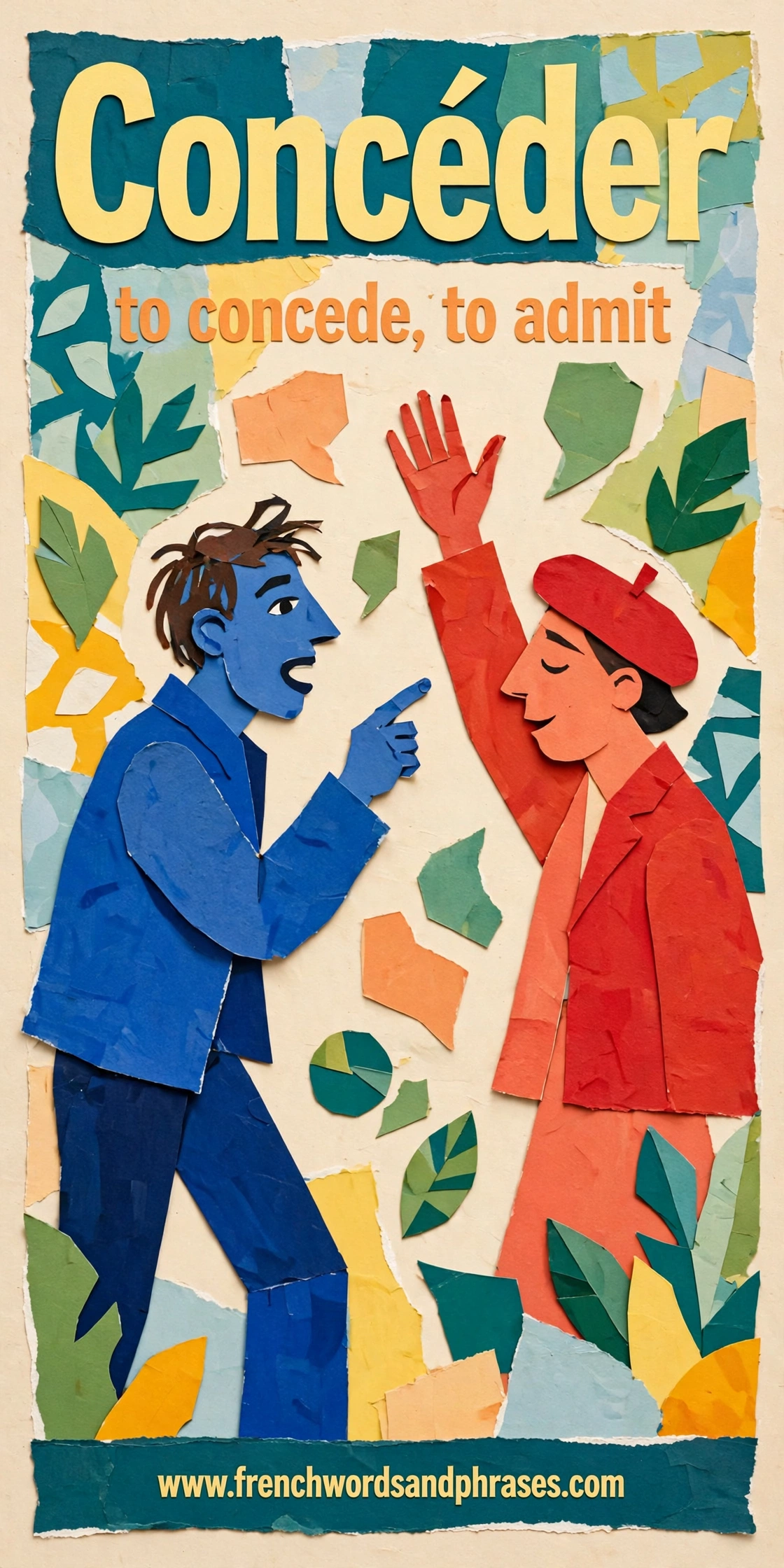
A debater smiling as he gives away one point to win the room, a goalkeeper fishing the ball out of his net for the second time — concéder is the verb of the strategic surrender: admitting what cannot be denied, and granting what cannot be held.
In this guide, you’ll learn how to conjugate concéder in all the major French tenses and moods. Explore complete conjugation tables, French examples, English translations, and practice quizzes.
Understanding the French Verb Concéder
Concéder is a regular French verb belonging to the first group of verbs, those ending in-er.
It means to concede, to admit. It works in three arenas: debate, where one concedes a point or admits an argument; sport, where a team concedes goals, penalties and matches; and history, where kings and governments conceded rights, charters and territory. In every case something held is formally given up — concéder is never an accident, it is an admission.
Verb classification: First group (-er)
Auxiliary verb: Avoir
Past participle: concédé
Present participle: concédant
English equivalents: To concede, to admit, to grant, to give away; concéder un point — to concede a point; concéder que — to admit that; concéder un but, un penalty — to concede a goal, a penalty (sport); concéder un avantage à quelqu’un — to grant someone an advantage; ne rien concéder — to give nothing away.
One important detail: concéder is a céder-type verb — the é of the stem opens to è wherever the next syllable is mute: je concède, tu concèdes, il concède, ils concèdent, and through the future and conditional: je concèderai, je concèderais. The é survives wherever the ending is sounded: nous concédons, vous concédez, je concédais, en concédant, and in the infinitive and participle, concéder, concédé. The subjunctive splits the same way: que je concède, but que nous concédions. Constructions: concéder quelque chose à quelqu’un, and concéder que + indicative for admitting a fact.
Experience the Word
Concéder is the verb of the graceful give-away — losing one small thing, openly, in order to keep the rest.
Imagine a televised debate in Paris. The younger candidate attacks; the old minister nods, smiles and says: « Je vous concède ce point. » The room relaxes, the audience warms to him — and ten minutes later he has won the whole argument, having given away exactly one point, on purpose.
He has not been beaten. He has conceded — concédé — one point, and bought the debate with it.
How to Conjugate Concéder: Complete French Conjugation Guide
Let’s explore every major conjugation of concéder, beginning with the indicative mood.
How to Conjugate Concéder in the Indicative Mood
The indicative mood is used to express facts, observations, actions, and events.
How to Conjugate Concéder in the Present Tense (Présent)
Used for actions happening now, habitual actions, and general truths.
| Subject | Conjugation |
|---|---|
| je | concède |
| tu | concèdes |
| il / elle | concède |
| nous | concédons |
| vous | concédez |
| ils / elles | concèdent |
Example
Je concède que vous avez raison sur ce point précis.
I concede that you are right on this precise point.
Quick Quiz 1
Complete the sentence:
Nous ______ un point à nos adversaires.
Reveal the answer
concédons
Nous concédons un point à nos adversaires.
We concede a point to our opponents.
How to Conjugate Concéder in the Passé Composé
Used for completed actions in the past. Concéder takes the auxiliary verb avoir.
| Subject | Conjugation |
|---|---|
| j’ | ai concédé |
| tu | as concédé |
| il / elle | a concédé |
| nous | avons concédé |
| vous | avez concédé |
| ils / elles | ont concédé |
Example
L’équipe a concédé deux buts en première mi-temps.
The team conceded two goals in the first half.
How to Conjugate Concéder in the Imparfait (Imperfect Tense)
Used for habitual past actions, descriptions, and ongoing situations in the past.
| Subject | Conjugation |
|---|---|
| je | concédais |
| tu | concédais |
| il / elle | concédait |
| nous | concédions |
| vous | concédiez |
| ils / elles | concédaient |
Example
Il ne concédait jamais rien à ses adversaires.
He never conceded anything to his opponents.
Quick Quiz 2
Choose the correct form:
The team conceded two goals.
L’équipe ______ deux buts. (a concédé / est concédée)
Reveal the answer
a concédé
L’équipe a concédé deux buts.
Concéder takes avoir.
How to Conjugate Concéder in the Plus-que-parfait
Used to describe an action that had already been completed before another past event.
| Subject | Conjugation |
|---|---|
| j’ | avais concédé |
| tu | avais concédé |
| il / elle | avait concédé |
| nous | avions concédé |
| vous | aviez concédé |
| ils / elles | avaient concédé |
Example
Elle avait concédé un point avant de reprendre l’avantage.
She had conceded a point before regaining the advantage.
How to Conjugate Concéder in the Passé Simple
Primarily used in formal writing, literature, and historical narratives. It is rarely used in everyday conversation.
| Subject | Conjugation |
|---|---|
| je | concédai |
| tu | concédas |
| il / elle | concéda |
| nous | concédâmes |
| vous | concédâtes |
| ils / elles | concédèrent |
Example
Le roi concéda une charte aux bourgeois de la ville.
The king granted a charter to the burghers of the town.
How to Conjugate Concéder in the Passé Antérieur
A literary tense used to express an action completed immediately before another past action, generally in the passé simple.
| Subject | Conjugation |
|---|---|
| j’ | eus concédé |
| tu | eus concédé |
| il / elle | eut concédé |
| nous | eûmes concédé |
| vous | eûtes concédé |
| ils / elles | eurent concédé |
Example
Quand il eut concédé ce point, le débat put enfin avancer.
When he had conceded that point, the debate could finally move forward.
How to Conjugate Concéder in the Future Tense (Futur Simple)
Used to describe actions that will take place in the future.
| Subject | Conjugation |
|---|---|
| je | concèderai |
| tu | concèderas |
| il / elle | concèdera |
| nous | concèderons |
| vous | concèderez |
| ils / elles | concèderont |
Example
Elle concèdera un point, mais pas deux.
She will concede one point, but not two.
How to Conjugate Concéder in the Futur Antérieur (Future Perfect)
Used for an action that will have been completed before a particular point in the future.
| Subject | Conjugation |
|---|---|
| j’ | aurai concédé |
| tu | auras concédé |
| il / elle | aura concédé |
| nous | aurons concédé |
| vous | aurez concédé |
| ils / elles | auront concédé |
Example
À la fin du match, ils auront concédé trois buts sur des erreurs évitables.
By the end of the match, they will have conceded three goals through avoidable mistakes.
How to Conjugate Concéder in the Near Future (Futur Proche)
Used to describe something that is going to happen soon. Formed with aller + infinitive.
| Subject | Conjugation |
|---|---|
| je | vais concéder |
| tu | vas concéder |
| il / elle | va concéder |
| nous | allons concéder |
| vous | allez concéder |
| ils / elles | vont concéder |
Example
Le gardien va concéder un penalty si la défense continue ainsi.
The goalkeeper is going to concede a penalty if the defence goes on like this.
How to Conjugate Concéder in the Conditional Mood
The conditional mood expresses what would happen under certain circumstances. It is also frequently used to make polite requests or express wishes.
How to Conjugate Concéder in the Present Conditional
| Subject | Conjugation |
|---|---|
| je | concèderais |
| tu | concèderais |
| il / elle | concèderait |
| nous | concèderions |
| vous | concèderiez |
| ils / elles | concèderaient |
Example
Je concèderais volontiers ce point si vous écoutiez le mien.
I would gladly concede this point if you would listen to mine.
How to Conjugate Concéder in the Past Conditional
| Subject | Conjugation |
|---|---|
| j’ | aurais concédé |
| tu | aurais concédé |
| il / elle | aurait concédé |
| nous | aurions concédé |
| vous | auriez concédé |
| ils / elles | auraient concédé |
Example
Elle aurait concédé le match nul si l’arbitre avait sifflé plus tôt.
She would have settled for the draw if the referee had blown the whistle earlier.
Concéder in the Literary Past Conditional Form
This less common literary form uses the imperfect subjunctive of avoir.
| Subject | Conjugation |
|---|---|
| j’ | eusse concédé |
| tu | eusses concédé |
| il / elle | eût concédé |
| nous | eussions concédé |
| vous | eussiez concédé |
| ils / elles | eussent concédé |
Example
Il eût concédé la victoire sans ce dernier effort désespéré.
He would have conceded victory without that last desperate effort.
How to Conjugate Concéder in the Subjunctive Mood
The subjunctive is used to express wishes, emotions, doubts, necessity, and uncertainty. It frequently follows expressions such as il faut que (it is necessary that) or bien que (although).
How to Conjugate Concéder in the Present Subjunctive
| Subject | Conjugation |
|---|---|
| que je | concède |
| que tu | concèdes |
| qu’il / qu’elle | concède |
| que nous | concédions |
| que vous | concédiez |
| qu’ils / qu’elles | concèdent |
Example
Il faut que tu concèdes ce point pour faire avancer la discussion.
You must concede this point to move the discussion forward.
Quick Quiz 3
Complete the sentence using the subjunctive:
Il faut que vous ______ ce point.
Reveal the answer
concédiez
Il faut que vous concédiez ce point.
You must concede this point.
How to Conjugate Concéder in the Imperfect Subjunctive
A literary tense, rarely encountered in modern spoken French.
| Subject | Conjugation |
|---|---|
| que je | concédasse |
| que tu | concédasses |
| qu’il / qu’elle | concédât |
| que nous | concédassions |
| que vous | concédassiez |
| qu’ils / qu’elles | concédassent |
Example
Je ne pensais pas qu’il concédât si facilement après des mois de refus.
I did not think he would concede so easily after months of refusal.
How to Conjugate Concéder in the Pluperfect Subjunctive
A literary construction used to express an action completed before another past action.
| Subject | Conjugation |
|---|---|
| que j’ | eusse concédé |
| que tu | eusses concédé |
| qu’il / qu’elle | eût concédé |
| que nous | eussions concédé |
| que vous | eussiez concédé |
| qu’ils / qu’elles | eussent concédé |
Example
On admirait qu’elle eût concédé un point sans perdre sa dignité.
People admired that she had conceded a point without losing her dignity.
How to Conjugate Concéder in the Past Subjunctive
| Subject | Conjugation |
|---|---|
| que j’ | aie concédé |
| que tu | aies concédé |
| qu’il / qu’elle | ait concédé |
| que nous | ayons concédé |
| que vous | ayez concédé |
| qu’ils / qu’elles | aient concédé |
Example
Je suis surpris qu’ils aient concédé trois buts en vingt minutes.
I am surprised they conceded three goals in twenty minutes.
How to Conjugate Concéder in the Imperative
The imperative is used to give commands, instructions, invitations, or suggestions. Subject pronouns are omitted.
How to Conjugate Concéder in the Present Imperative
| Person | Conjugation |
|---|---|
| (tu) | concède |
| (nous) | concédons |
| (vous) | concédez |
Example
Concède ce point et passons à la suite !
Concede this point and let us move on!
Quick Quiz 4
How would you say Concede this point and move on (tu form)?
Reveal the answer
Concède ce point et avance !
French Participles of Concéder
Participles are verb forms that can be used in compound tenses and other grammatical constructions.
Present Participle of Concéder
concédant
En concédant ce point, elle a gagné la confiance de toute la salle.
By conceding this point, she won the trust of the whole room.
Past Participle of Concéder
concédé
Concédé par l’arbitre après la faute, le penalty a changé le match.
Awarded by the referee after the foul, the penalty changed the match.
Concéder in Everyday French: Real-Life Examples
Now that you know the conjugations, let’s see how concéder appears in everyday French.
Example 1 — Present
Je concède que tu as raison.
I concede that you are right.
Example 2 — Passé composé
L’équipe a concédé deux buts.
The team conceded two goals.
Example 3 — Imparfait
Il ne concédait jamais rien.
He never conceded anything.
Example 4 — Future
Elle concèdera un point, mais pas deux.
She will concede one point, but not two.
Example 5 — Conditional
Je concèderais volontiers ce détail.
I would gladly concede that detail.
Example 6 — Imperative
Concède ce point et avance !
Concede that point and move on!
Beyond Translation: The Meaning of Concéder
English concede is the same word wearing a different coat — both descend from Latin concedere, to yield and go away, and both still carry the whiff of the formal surrender.
A concession is a gift you did not want to give.
That is why concéder is the diplomat’s favourite verb: it turns a defeat into a gesture, a lost goal into a statistic, and a lost argument into proof of your good faith — je vous concède ce point may be the most powerful sentence in French debate.
How to Remember the French Verb Concéder
Remember it this way: Concéder is about the debater giving one point to win the argument.
- Céder-type spelling: je concède with è, but nous concédons with é — and je concèderai in the future.
- Three arenas: debate (concéder un point), sport (concéder un but), history (concéder une charte).
- Construction: concéder quelque chose à quelqu’un; concéder que + indicative to admit a fact.
The key idea is the debater giving one point to win the argument.
Test Your Knowledge of Concéder
Let’s see how much you’ve learned. Try answering these questions before revealing the answers.
Question 1
Why does je concède have a grave accent but nous concédons an acute one?
Reveal the answer
The céder-type rule — é becomes è before a mute syllable (je concède), and stays é where the ending is sounded (nous concédons).
Question 2
How do you say The team conceded two goals in French?
Reveal the answer
L’équipe a concédé deux buts.
Question 3
Translate: I concede that you are right.
Reveal the answer
Je concède que tu as raison.
Question 4
What is the past participle of concéder?
Reveal the answer
Concédé.
Question 5
Complete the sentence:
Il faut que tu ______ ce point pour avancer.
Reveal the answer
concèdes
Il faut que tu concèdes ce point pour avancer.
You must concede this point to move forward.
Your Final Challenge
Can You Use It?
How would you say this in French?
He concedes one point, smiles, and wins the whole debate.
Reveal the answer
Il concède un point, sourit, et gagne le débat entier.
He concedes one point, smiles, and wins the whole debate.
A little French. A little curiosity. A richer everyday life.
LEARN FRENCH ONE WORD AT A TIME