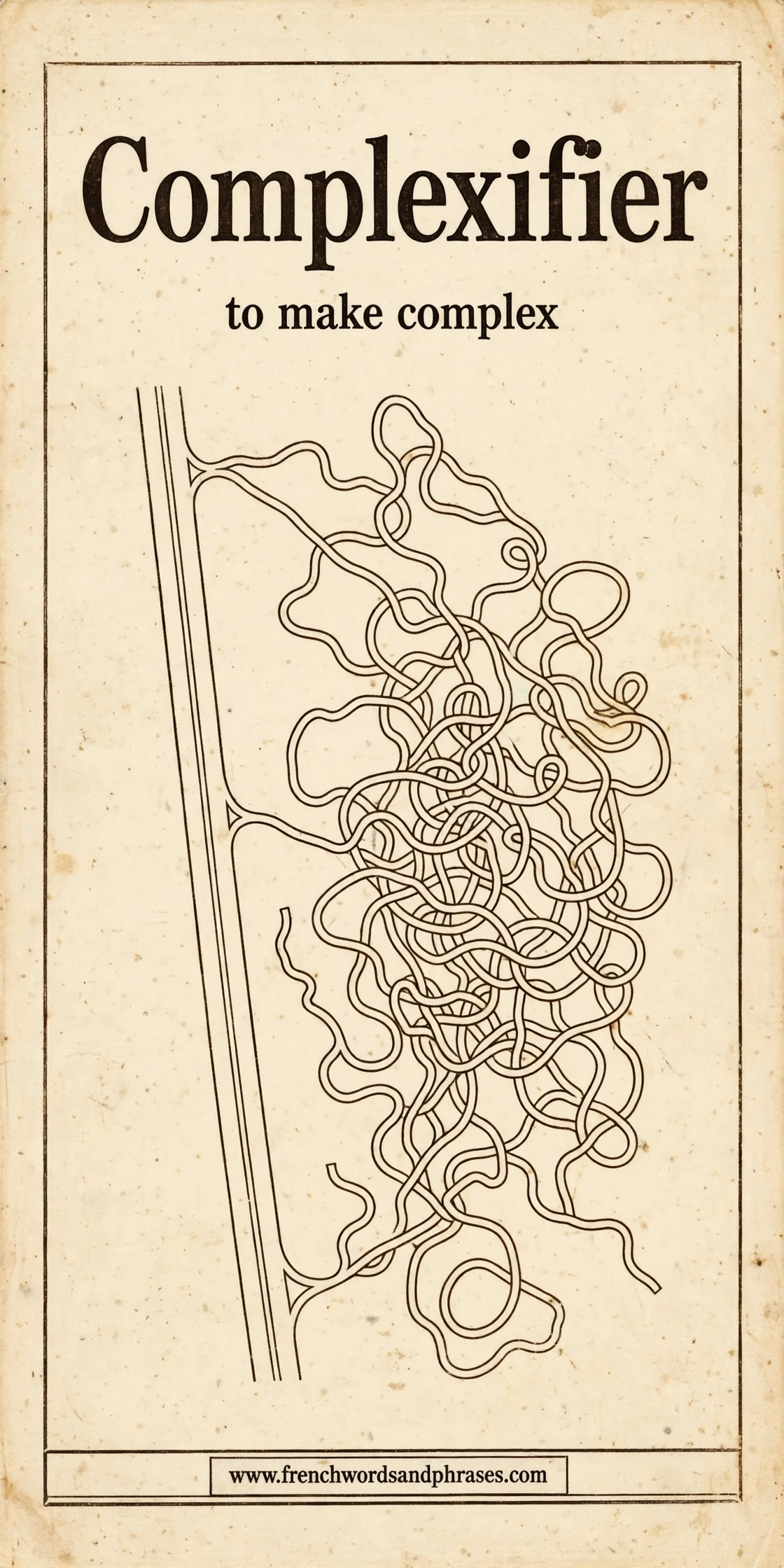
A French Word to Live By
How to Conjugate Complexer in French
/kɔ̃.plɛk.se/
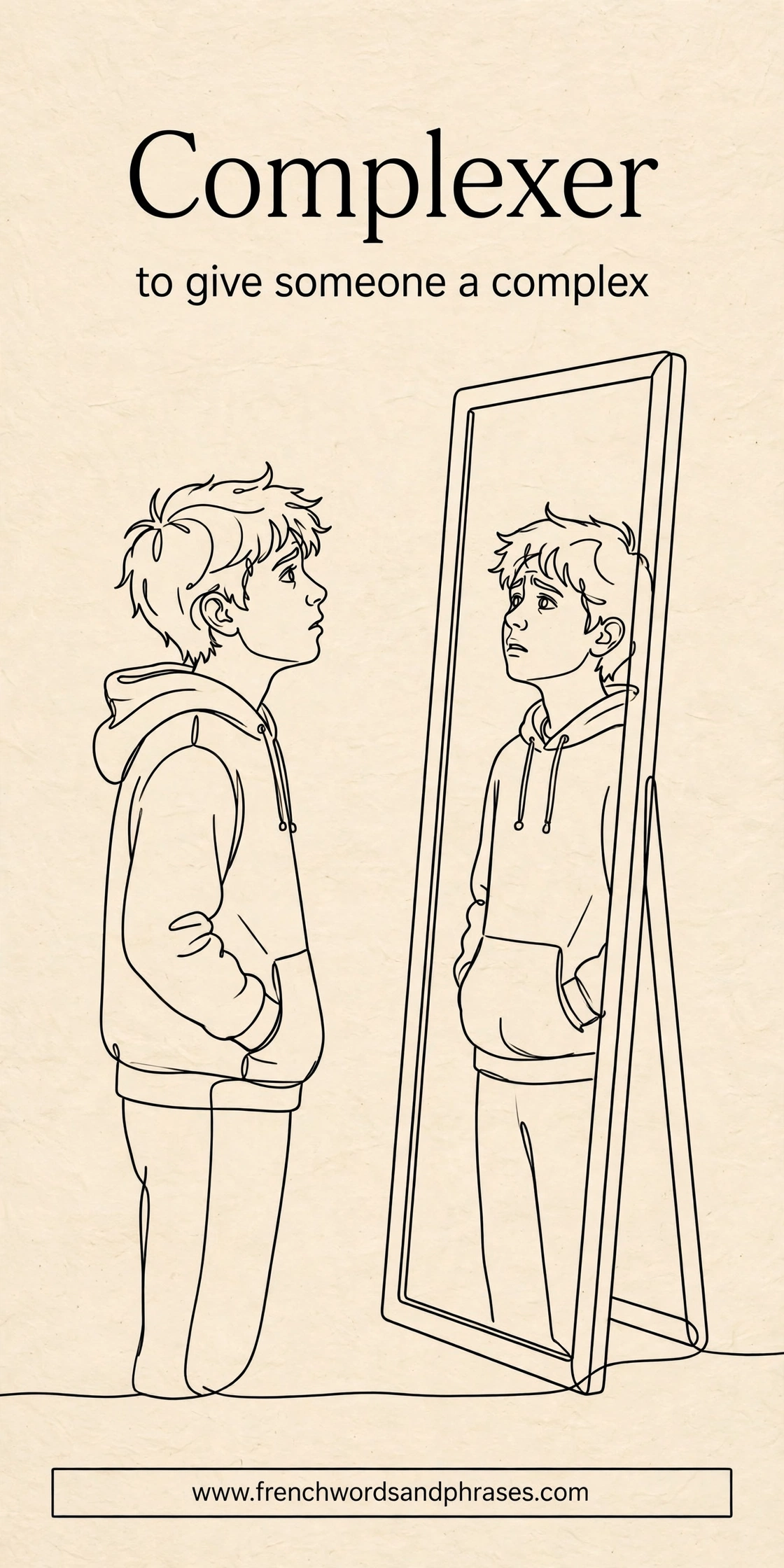
Complexer means to give someone a complex — to make a person painfully self-conscious about some part of themselves, real or imagined.
An older brother teasing his sister about her ears, one careless remark from a teacher that echoes for twenty years, a mirror in a dance studio — complexer is the verb of the small wound pride carries: something said or seen makes a person shrink around a flaw, and the flaw grows in the dark.
In this guide, you’ll learn how to conjugate complexer in all the major French tenses and moods. Explore complete conjugation tables, French examples, English translations, and practice quizzes.
Understanding the French Verb Complexer
Complexer is a regular French verb belonging to the first group of verbs, those ending in-er.
It means to give someone a complex. It belongs to the language of family, school and mirrors — the remark about ears, height, weight, an accent, a voice. Psychology gave French the noun (le complexe d’infériorité, the inferiority complex), and everyday French turned it into this verb: to complexer someone is to install the complex in them, often in a single sentence, often without meaning to.
Verb classification: First group (-er)
Auxiliary verb: Avoir
Past participle: complexé
Present participle: complexant
English equivalents: To give (someone) a complex, to make self-conscious; complexer quelqu’un — to give someone a complex; être complexé par son nez — to have a complex about one’s nose; ne complexe pas ! — don’t get hung up about it!; sans complexe — without embarrassment, unashamedly.
One important detail: in complexer, the complex lands on the other person — tes remarques le complexent, your remarks give him the complex. The form you will meet most in real life is the past participle used as an adjective: être complexé par quelque chose — il est complexé par sa taille, elle est complexée par sa voix. The verb itself is a regular -er verb (the x is simply pronounced /ks/: je complexe), and its opposite family is just as useful: décomplexé, relaxed and uninhibited, and sans complexe, without a trace of embarrassment.
Experience the Word
Complexer is the verb of the remark that stays — five seconds to say, twenty years to forget.
Imagine a boy at the swimming pool, twelve years old, laughing with everyone else. A classmate points at his ears and finds the nickname of the year. The pool goes quiet for one second. From that day, the boy checks every mirror, avoids every photograph — une seule phrase l’a complexé, and the sentence follows him into adulthood.
The ears were never the problem. A complex had been given — complexé — and he carried it like a second shadow.
How to Conjugate Complexer: Complete French Conjugation Guide
Let’s explore every major conjugation of complexer, beginning with the indicative mood.
How to Conjugate Complexer in the Indicative Mood
The indicative mood is used to express facts, observations, actions, and events.
How to Conjugate Complexer in the Present Tense (Présent)
Used for actions happening now, habitual actions, and general truths.
| Subject | Conjugation |
|---|---|
| je | complexe |
| tu | complexes |
| il / elle | complexe |
| nous | complexons |
| vous | complexez |
| ils / elles | complexent |
Example
Tes moqueries le complexent depuis l’école primaire.
Your teasing has been giving him a complex since primary school.
Quick Quiz 1
Complete the sentence:
Tes moqueries le ______ depuis des mois.
Reveal the answer
complexent
Tes moqueries le complexent depuis des mois.
Your teasing has been giving him a complex for months.
How to Conjugate Complexer in the Passé Composé
Used for completed actions in the past. Complexer takes the auxiliary verb avoir.
| Subject | Conjugation |
|---|---|
| j’ | ai complexé |
| tu | as complexé |
| il / elle | a complexé |
| nous | avons complexé |
| vous | avez complexé |
| ils / elles | ont complexé |
Example
Une remarque du professeur l’a complexée sur sa voix.
A remark from the teacher gave her a complex about her voice.
How to Conjugate Complexer in the Imparfait (Imperfect Tense)
Used for habitual past actions, descriptions, and ongoing situations in the past.
| Subject | Conjugation |
|---|---|
| je | complexais |
| tu | complexais |
| il / elle | complexait |
| nous | complexions |
| vous | complexiez |
| ils / elles | complexaient |
Example
Son frère aîné le complexait sans s’en rendre compte.
His older brother used to give him a complex without realizing it.
Quick Quiz 2
Choose the correct form:
She has a complex about her ears.
Elle ______ par ses oreilles. (est complexée / a complexé)
Reveal the answer
est complexée
Elle est complexée par ses oreilles.
The participle works as an adjective here: complexée, agreeing with elle.
How to Conjugate Complexer in the Plus-que-parfait
Used to describe an action that had already been completed before another past event.
| Subject | Conjugation |
|---|---|
| j’ | avais complexé |
| tu | avais complexé |
| il / elle | avait complexé |
| nous | avions complexé |
| vous | aviez complexé |
| ils / elles | avaient complexé |
Example
On l’avait complexé très jeune sur son accent.
People had given him a complex about his accent very young.
How to Conjugate Complexer in the Passé Simple
Primarily used in formal writing, literature, and historical narratives. It is rarely used in everyday conversation.
| Subject | Conjugation |
|---|---|
| je | complexai |
| tu | complexas |
| il / elle | complexa |
| nous | complexâmes |
| vous | complexâtes |
| ils / elles | complexèrent |
Example
Ce surnom cruel le complexa pour toute sa scolarité.
That cruel nickname gave him a complex for his whole schooling.
How to Conjugate Complexer in the Passé Antérieur
A literary tense used to express an action completed immediately before another past action, generally in the passé simple.
| Subject | Conjugation |
|---|---|
| j’ | eus complexé |
| tu | eus complexé |
| il / elle | eut complexé |
| nous | eûmes complexé |
| vous | eûtes complexé |
| ils / elles | eurent complexé |
Example
Quand ce commentaire l’eut complexée, elle cessa de chanter en public.
When that comment had given her a complex, she stopped singing in public.
How to Conjugate Complexer in the Future Tense (Futur Simple)
Used to describe actions that will take place in the future.
| Subject | Conjugation |
|---|---|
| je | complexerai |
| tu | complexeras |
| il / elle | complexera |
| nous | complexerons |
| vous | complexerez |
| ils / elles | complexeront |
Example
Ces critiques le complexeront davantage encore.
These criticisms will give him even more of a complex.
How to Conjugate Complexer in the Futur Antérieur (Future Perfect)
Used for an action that will have been completed before a particular point in the future.
| Subject | Conjugation |
|---|---|
| j’ | aurai complexé |
| tu | auras complexé |
| il / elle | aura complexé |
| nous | aurons complexé |
| vous | aurez complexé |
| ils / elles | auront complexé |
Example
À force de comparaisons, ils l’auront complexé sur tout.
With all the comparisons, they will have given him a complex about everything.
How to Conjugate Complexer in the Near Future (Futur Proche)
Used to describe something that is going to happen soon. Formed with aller + infinitive.
| Subject | Conjugation |
|---|---|
| je | vais complexer |
| tu | vas complexer |
| il / elle | va complexer |
| nous | allons complexer |
| vous | allez complexer |
| ils / elles | vont complexer |
Example
Ne dis pas ça, tu vas le complexer !
Don’t say that, you are going to give him a complex!
How to Conjugate Complexer in the Conditional Mood
The conditional mood expresses what would happen under certain circumstances. It is also frequently used to make polite requests or express wishes.
How to Conjugate Complexer in the Present Conditional
| Subject | Conjugation |
|---|---|
| je | complexerais |
| tu | complexerais |
| il / elle | complexerait |
| nous | complexerions |
| vous | complexeriez |
| ils / elles | complexeraient |
Example
Un mot de travers le complexerait pour des mois.
One wrong word would give him a complex for months.
How to Conjugate Complexer in the Past Conditional
| Subject | Conjugation |
|---|---|
| j’ | aurais complexé |
| tu | aurais complexé |
| il / elle | aurait complexé |
| nous | aurions complexé |
| vous | auriez complexé |
| ils / elles | auraient complexé |
Example
Sans ses amis, cette chute l’aurait complexé durablement.
Without his friends, that fall would have given him a lasting complex.
Complexer in the Literary Past Conditional Form
This less common literary form uses the imperfect subjunctive of avoir.
| Subject | Conjugation |
|---|---|
| j’ | eusse complexé |
| tu | eusses complexé |
| il / elle | eût complexé |
| nous | eussions complexé |
| vous | eussiez complexé |
| ils / elles | eussent complexé |
Example
Cette moquerie l’eût complexé pour la vie entière.
That mockery would have given him a complex for his whole life.
How to Conjugate Complexer in the Subjunctive Mood
The subjunctive is used to express wishes, emotions, doubts, necessity, and uncertainty. It frequently follows expressions such as il faut que (it is necessary that) or bien que (although).
How to Conjugate Complexer in the Present Subjunctive
| Subject | Conjugation |
|---|---|
| que je | complexe |
| que tu | complexes |
| qu’il / qu’elle | complexe |
| que nous | complexions |
| que vous | complexiez |
| qu’ils / qu’elles | complexent |
Example
Je ne veux pas que tes blagues le complexent.
I do not want your jokes to give him a complex.
Quick Quiz 3
Complete the sentence using the subjunctive:
Il faut que tu ne le ______ pas.
Reveal the answer
complexes
Il faut que tu ne le complexes pas.
You must not give him a complex.
How to Conjugate Complexer in the Imperfect Subjunctive
A literary tense, rarely encountered in modern spoken French.
| Subject | Conjugation |
|---|---|
| que je | complexasse |
| que tu | complexasses |
| qu’il / qu’elle | complexât |
| que nous | complexassions |
| que vous | complexassiez |
| qu’ils / qu’elles | complexassent |
Example
Elle parlait doucement pour qu’on ne le complexât pas davantage.
She spoke gently so that no one would give him more of a complex.
How to Conjugate Complexer in the Pluperfect Subjunctive
A literary construction used to express an action completed before another past action.
| Subject | Conjugation |
|---|---|
| que j’ | eusse complexé |
| que tu | eusses complexé |
| qu’il / qu’elle | eût complexé |
| que nous | eussions complexé |
| que vous | eussiez complexé |
| qu’ils / qu’elles | eussent complexé |
Example
Il semblait que ce regard l’eût complexée depuis l’enfance.
It seemed that look had given her a complex since childhood.
How to Conjugate Complexer in the Past Subjunctive
| Subject | Conjugation |
|---|---|
| que j’ | aie complexé |
| que tu | aies complexé |
| qu’il / qu’elle | ait complexé |
| que nous | ayons complexé |
| que vous | ayez complexé |
| qu’ils / qu’elles | aient complexé |
Example
Je regrette que mes paroles t’aient complexé.
I regret that my words gave you a complex.
How to Conjugate Complexer in the Imperative
The imperative is used to give commands, instructions, invitations, or suggestions. Subject pronouns are omitted.
How to Conjugate Complexer in the Present Imperative
| Person | Conjugation |
|---|---|
| (tu) | complexe |
| (nous) | complexons |
| (vous) | complexez |
Example
Ne le complexez pas avec vos comparaisons !
Do not give him a complex with your comparisons!
Quick Quiz 4
How would you say Do not give him a complex (tu form)?
Reveal the answer
Ne le complexe pas !
French Participles of Complexer
Participles are verb forms that can be used in compound tenses and other grammatical constructions.
Present Participle of Complexer
complexant
En le complexant sur son poids, ils ont détruit sa confiance.
By giving him a complex about his weight, they destroyed his confidence.
Past Participle of Complexer
complexé
Complexée par ses oreilles, elle portait toujours les cheveux longs.
Self-conscious about her ears, she always wore her hair long.
Complexer in Everyday French: Real-Life Examples
Now that you know the conjugations, let’s see how complexer appears in everyday French.
Example 1 — Present
Tes remarques le complexent.
Your remarks are giving him a complex.
Example 2 — Passé composé
Ce surnom l’a complexée pour des années.
That nickname gave her a complex for years.
Example 3 — Imparfait
Son frère le complexait sans le vouloir.
His brother used to give him a complex without meaning to.
Example 4 — Future
Ces photos le complexeront encore plus.
These photos will give him even more of a complex.
Example 5 — Conditional
Un rien le complexerait.
The slightest thing would give him a complex.
Example 6 — Imperative
Ne complexe pas ton frère !
Do not give your brother a complex!
Beyond Translation: The Meaning of Complexer
The noun comes first in history: un complexe, from Latin complexus, woven together — and psychology, with Adler’s famous complexe d’infériorité, taught the world to name the knot. French then did what French does: it made a verb of the damage.
The cure has a verb too.
Someone who has escaped the knot is décomplexé — at ease in photos, in mirrors, in their own skin — and doing something sans complexe means doing it boldly, without a flicker of shame.
How to Remember the French Verb Complexer
Remember it this way: Complexer is about the schoolyard nickname that echoes for twenty years.
- The living form is the participle: être complexé par — to have a complex about something.
- Complexer quelqu’un: the complex lands on the other person — tes remarques le complexent.
- The flip side is freedom: sans complexe, décomplexé — no hang-ups at all.
The key idea is the schoolyard nickname that echoes for twenty years.
Test Your Knowledge of Complexer
Let’s see how much you’ve learned. Try answering these questions before revealing the answers.
Question 1
In être complexé par son nez, what exactly does the person have?
Reveal the answer
A complex about his nose — he is painfully self-conscious about it.
Question 2
How do you say Your remarks are giving him a complex in French?
Reveal the answer
Tes remarques le complexent.
Question 3
Translate: A teacher’s remark gave her a complex about her voice.
Reveal the answer
Une remarque du professeur l’a complexée sur sa voix.
Question 4
What is the past participle of complexer?
Reveal the answer
Complexé.
Question 5
Complete the sentence:
Je ne veux pas que tes blagues le ______.
Reveal the answer
complexent
Je ne veux pas que tes blagues le complexent.
I do not want your jokes to give him a complex.
Your Final Challenge
Can You Use It?
How would you say this in French?
A school nickname had given him a complex; at forty, he still hears it in the mirror.
Reveal the answer
Un surnom d’école l’avait complexé ; à quarante ans, il l’entend encore dans le miroir.
A school nickname had given him a complex; at forty, he still hears it in the mirror.
A little French. A little curiosity. A richer everyday life.
LEARN FRENCH ONE WORD AT A TIME