A French Word to Live By
Translate Complexe to English
/kɔ̃plɛks/
Complexe means complex.
A watchmaker’s bench in Besançon, a magnifying glass, and three hundred tiny pieces arranged in circles on green cloth. A visitor leans over and whispers that it all looks terribly complexe. The watchmaker smiles without looking up: « Complexe, oui. Compliqué, non. » Complex — made of many parts that fit. Complicated is another story.
In this guide, you’ll learn what complexe means in English, why it never changes between masculine and feminine, how it differs from its near-twin compliqué, and why the same word names a sports centre and a state of mind. Explore French examples, English translations, and practice quizzes.
Understanding the French Adjective Complexe
Complexe is a French adjective of quality — the adjective of many interlocking parts. It already ends in -e, so masculine and feminine are identical: only the plural adds an s. Un problème complexe, une machine complexe, des systèmes complexes — one form does almost all the work.
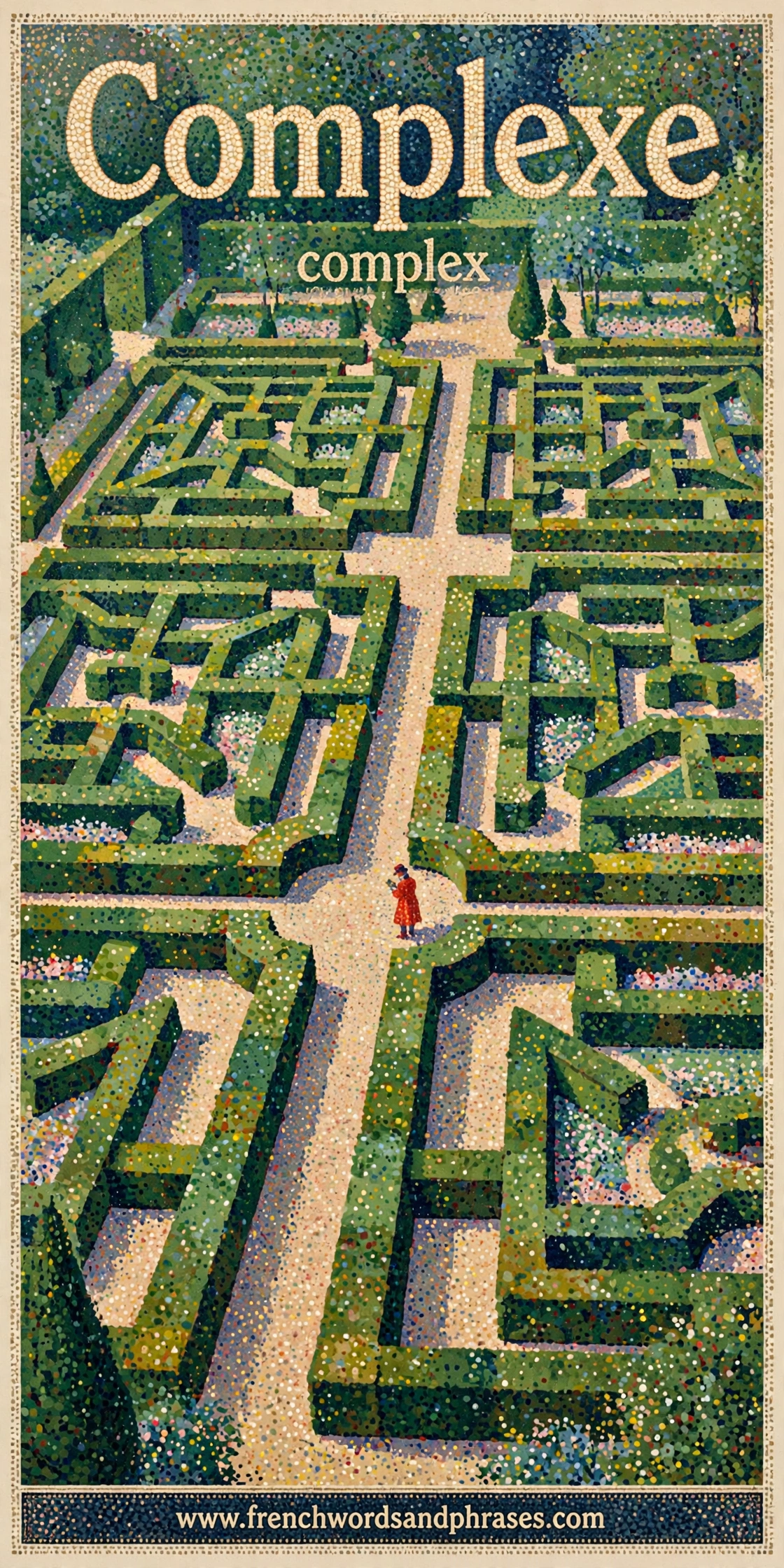
It means complex — made of many connected parts, intricate rather than simple. It describes problems (un problème complexe, a complex problem), machines, systems and questions. Where compliqué suggests a muddle, complexe suggests a structure: many pieces, each in its place, demanding patience rather than complaint.
Type: Adjective of quality — structure and intricacy
Answers the question: What is it like? — complex
Changes form: Only in the plural — complexe / complexes, the same for masculine and feminine
English equivalents: Complex; intricate; involved.
One important usage detail: complexe stands AFTER the noun — une question complexe — and careful speakers keep it apart from compliqué: a watch is complexe by design, while a form with twelve pages is compliqué by accident.
Experience the Word
Complexe is the adjective of the watchmaker’s bench — of recipes with forty steps, of weather systems, of families: nothing in them is random, and nothing in them is simple.
Imagine a child taking apart an old clock and laying the wheels in a row, each one exactly where it fell. She is not destroying the clock; she is meeting its complexity face to face, one wheel at a time, the way every complexe problem asks to be met.
You have not just described something difficult. You have said it is built of many parts — and that the parts fit.
How to Use Complexe in French: Complete Guide
Let’s explore how complexe works in French, beginning with the whole word on one card.
Complexe at a Glance
Before the details, here is the whole word on one card.
The Whole Word on One Card
Meaning, type, position and forms — complexe in four lines.
| Point | Complexe |
|---|---|
| Meaning | complex |
| Type | adjective of quality — structure |
| Usual position | after the noun — un problème complexe |
| Form | complexe for everyone — complexes in the plural |
Example
C’est un problème complexe mais intéressant.
It’s a complex but interesting problem.
The Four Forms of Complexe
Here is one of the easiest agreements in French: complexe already ends in -e, so the feminine changes nothing. Only the plural adds an s.
| Form | Complexe | Example |
|---|---|---|
| Masculine singular | complexe | un système complexe — a complex system |
| Feminine singular | complexe | une question complexe — a complex question |
| Masculine plural | complexes | des systèmes complexes — complex systems |
| Feminine plural | complexes | des questions complexes — complex questions |
Example
C’est un système complexe, plein de questions complexes.
It’s a complex system, full of complex questions.
Quick Quiz 1
Does complexe change for a feminine noun?
Reveal the answer
No
Un problème complexe, une question complexe — the form is identical.
A complex problem, a complex question.
The Feminine of Complexe: Nothing Changes
Most adjectives build their feminine by adding an e. Complexe was born with one, so the feminine has nothing to add — a small holiday for learners.
| Situation | Example |
|---|---|
| Masculine | un mécanisme complexe — a complex mechanism |
| Feminine | une situation complexe — identical |
| Why | complexe already ends in -e, so the feminine adds nothing |
| The plural | add s — des situations complexes, complex situations |
Example
La situation est complexe pour tout le monde.
The situation is complex for everyone.
Where Complexe Goes: After the Noun
Complexe follows the noun it describes, like most French adjectives, and it sits comfortably after être with an adverb in front of it.
| Pattern | Example |
|---|---|
| After the noun | une machine complexe — a complex machine |
| After être | ce calcul est complexe — this calculation is complex |
| With an adverb | un problème très complexe — a very complex problem |
| Before the noun | une complexe machine — not in everyday French |
Example
Ce texte est complexe mais clair.
This text is complex but clear.
Quick Quiz 2
How do you say ‘a complex question’ — une complexe question or une question complexe?
Reveal the answer
une question complexe
Complexe stands after the noun.
A complex question.
More Complex: Comparing with Complexe
Complexe compares the regular way, with plus, moins and aussi — and the superlative keeps the same single form: le plus complexe, la plus complexe.
| Degree | Example |
|---|---|
| As complex as | aussi complexe que — as complex as |
| More complex | plus complexe — more complex |
| Less complex | moins complexe — less complex |
| The most complex (masc.) | le plus complexe — le plus complexe des systèmes |
| The most complex (fem.) | la plus complexe — la plus complexe des machines |
Example
Ce système est plus complexe que l’ancien.
This system is more complex than the old one.
Everyday Expressions with Complexe
Complexe works in laboratories, in workshops and in honest conversation — wherever a thing refuses to be reduced to one simple cause.
| Expression | In English |
|---|---|
| un problème complexe | a complex problem |
| une situation complexe | a complex situation |
| un système complexe | a complex system |
| un complexe sportif | a sports complex — the noun, a place |
| un complexe d’infériorité | an inferiority complex — the noun, a state of mind |
| sans complexe | without embarrassment — unselfconsciously |
Example
Elle parle de son travail sans complexe.
She talks about her work without any embarrassment.
Quick Quiz 3
What is un complexe sportif?
Reveal the answer
A sports complex
Le complexe sportif ouvre à huit heures.
The sports complex opens at eight o’clock — here complexe is a noun, a place.
Complexe and Its Neighbours
Complexe shares its bench with compliqué — its muddled twin — while simple waits at the other end of the workshop.
| French | In English |
|---|---|
| compliqué | complicated — a muddle, often with a sigh |
| élaboré | elaborate, worked out in detail |
| sophistiqué | sophisticated — of machines and tastes |
| détaillé | detailed — full of details |
| simple | simple — the opposite |
| élémentaire | elementary, basic — the far opposite |
Example
C’est complexe, pas compliqué : chaque pièce a sa place.
It’s complex, not complicated: every piece has its place.
Watch Out: The Traps Around Complexe
The traps here are the twin compliqué, and the noun complexe that names places and states of mind.
| Trap | The truth |
|---|---|
| complexe or compliqué? | complexe = many parts that fit, by design; compliqué = muddled, by accident — un formulaire compliqué |
| The noun | un complexe is a noun — a sports complex, an inferiority complex |
| Agreement | do not add a second e — une question complexe, never ‘complexée’ |
| Spelling | the x stays in every form — complexes, with x and s |
Example
Il a un complexe d’infériorité malgré son travail complexe.
He has an inferiority complex despite his complex work.
Quick Quiz 4
A form with twelve pages and three signatures is best described as…?
Reveal the answer
compliqué
Un formulaire compliqué.
A complicated form — muddled by accident, not complex by design.
Complexe in Everyday French: Real-Life Examples
Now that you know the word, let’s see how complexe appears in everyday French.
Example 1 — At work
Le problème est complexe, mais nous avons une solution.
The problem is complex, but we have a solution.
Example 2 — Technology
Cette machine est complexe à réparer.
This machine is complex to repair.
Example 3 — Studying
La grammaire française est complexe mais logique.
French grammar is complex but logical.
Example 4 — A situation
C’est une situation complexe pour les deux familles.
It’s a complex situation for both families.
Example 5 — Cooking
La recette est complexe, avec quarante étapes.
The recipe is complex, with forty steps.
Example 6 — Honesty
Je trouve ce texte trop complexe pour les enfants.
I find this text too complex for children.
Beyond Translation: The Meaning of Complexe
English says complex for the meaning of complexe — the same Latin root, complexus, woven together. French keeps the weaving visible: a complexe thing is a thing of threads, each one tied to the others, none of them removable without changing the pattern.
To call something complexe is to respect its structure, not to complain about it.
That respect is the whole difference from compliqué — the watchmaker’s quiet pride against the taxpayer’s sigh — and French speakers feel it even when they cannot explain it.
How to Remember the French Adjective Complexe
Remember it this way: Complexe is the many-parts adjective — one form for him and her, an s for the plural, and a structure to respect, not a muddle to blame.
- You see one form for everyone — un problème complexe, une question complexe.
- You keep the twins apart — complexe by design, compliqué by accident.
- You meet the noun on the way — un complexe sportif, un complexe d’infériorité.
The key idea is complexe never changes except in the plural, and it means structured — not muddled.
Test Your Knowledge of Complexe
Let’s see how much you’ve learned. Try answering these questions before revealing the answers.
Question 1
What does complexe mean?
Reveal the answer
Complex — made of many connected parts.
Question 2
What is the feminine of complexe?
Reveal the answer
complexe — identical. The word already ends in -e.
Question 3
Translate: a complex problem.
Reveal the answer
Un problème complexe.
Question 4
Complete the sentence:
Cette machine est très ______ .
Reveal the answer
complexe
Cette machine est très complexe.
This machine is very complex.
Question 5
What is the difference between complexe and compliqué?
Reveal the answer
Structure versus muddle — complexe describes many parts that fit by design; compliqué describes something muddled or fiddly.
Your Final Challenge
Can You Use It?
How would you say this in French?
“The problem is complex, but the solution is simple.”
Reveal the answer
Le problème est complexe, mais la solution est simple.
The problem is complex, but the solution is simple.
A little French. A little curiosity. A richer everyday life.
LEARN FRENCH ONE WORD AT A TIME