A French Word to Live By
How to Conjugate Compenser in French
/kɔ̃.pɑ̃.se/
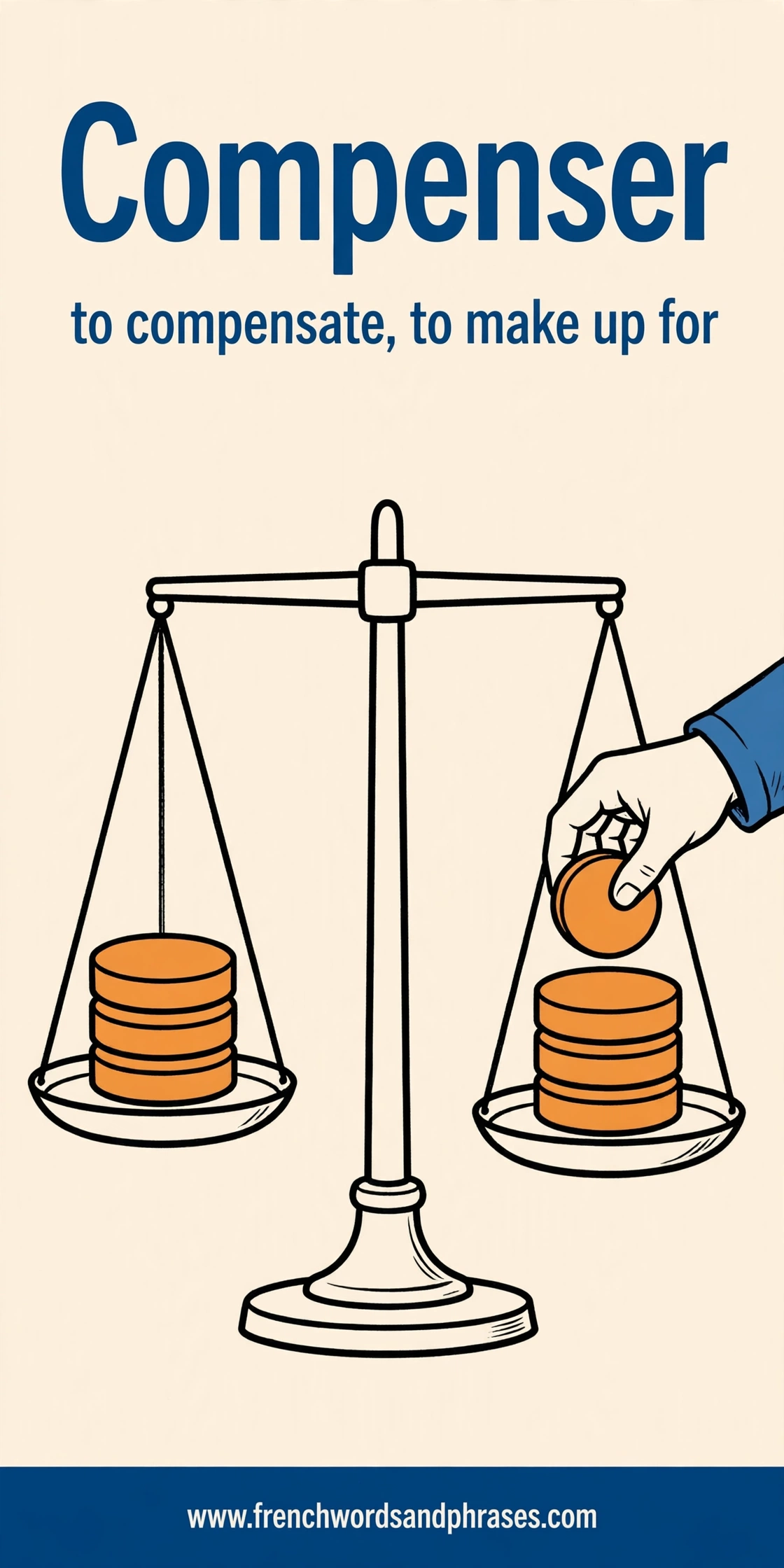
Compenser means to compensate — to balance a loss, a lack or a weakness with something of equal weight on the other side.
A small wage balanced by a big garden, a bad leg balanced by powerful arms, a week of rain balanced by one golden Sunday — compenser is the verb of the scales: something missing in one pan, something added to the other, until life levels out again.
In this guide, you’ll learn how to conjugate compenser in all the major French tenses and moods. Explore complete conjugation tables, French examples, English translations, and practice quizzes.
Understanding the French Verb Compenser
Compenser is a regular French verb belonging to the first group of verbs, those ending in-er.
It means to compensate, to make up for. It is used everywhere French talks about balance: finance (compenser une dette), work (la prime compense les heures), sport (un joueur lent qui compense par sa vision du jeu), and psychology, where compenser un complexe is the classic mechanism — working twice as hard exactly where one feels weakest.
Verb classification: First group (-er)
Auxiliary verb: Avoir
Past participle: compensé
Present participle: compensant
English equivalents: To compensate, to make up for, to offset; compenser une perte — to make up for a loss; compenser un manque — to make up for a lack; compenser quelque chose par autre chose — to offset something with something else; cela compense tout — that makes up for everything.
One important detail: compenser is a perfectly regular -er verb — je compense, nous compensons, ils compensent, past participle compensé — so its whole character is in its construction. It takes the lack as its direct object: compenser une perte, compenser son retard, compenser un handicap, and the balancing gift can be added with par: compenser son retard par un double effort. Do not confuse it with indemniser, which is the legal word for paying damages in money: compenser balances, indemniser reimburses.
Experience the Word
Compenser is the verb of the two pans of a balance — it never removes the lack, it answers it.
Imagine Karim, the slowest runner in his football team. The others tease him in September. By June he is the one they all look for: he cannot run, so he has learned to see — every pass arrives a second before the defence understands. Sa lenteur n’a pas disparu ; sa vision du jeu la compense, and the scales stand level.
The weakness is still there, on its side of the scale. Something else has been added — compensé — until the two sides balance.
How to Conjugate Compenser: Complete French Conjugation Guide
Let’s explore every major conjugation of compenser, beginning with the indicative mood.
How to Conjugate Compenser in the Indicative Mood
The indicative mood is used to express facts, observations, actions, and events.
How to Conjugate Compenser in the Present Tense (Présent)
Used for actions happening now, habitual actions, and general truths.
| Subject | Conjugation |
|---|---|
| je | compense |
| tu | compenses |
| il / elle | compense |
| nous | compensons |
| vous | compensez |
| ils / elles | compensent |
Example
Son humour compense sa timidité.
His humour makes up for his shyness.
Quick Quiz 1
Complete the sentence:
Nous ______ les dépenses par les ventes.
Reveal the answer
compensons
Nous compensons les dépenses par les ventes.
We offset the expenses with the sales.
How to Conjugate Compenser in the Passé Composé
Used for completed actions in the past. Compenser takes the auxiliary verb avoir.
| Subject | Conjugation |
|---|---|
| j’ | ai compensé |
| tu | as compensé |
| il / elle | a compensé |
| nous | avons compensé |
| vous | avez compensé |
| ils / elles | ont compensé |
Example
La prime a compensé les heures supplémentaires.
The bonus compensated for the overtime hours.
How to Conjugate Compenser in the Imparfait (Imperfect Tense)
Used for habitual past actions, descriptions, and ongoing situations in the past.
| Subject | Conjugation |
|---|---|
| je | compensais |
| tu | compensais |
| il / elle | compensait |
| nous | compensions |
| vous | compensiez |
| ils / elles | compensaient |
Example
Autrefois, le jardin compensait le petit salaire.
In the past, the garden made up for the small wage.
Quick Quiz 2
Choose the correct form:
The sun made up for the rain.
Le soleil ______ la pluie. (a compensé / est compensé)
Reveal the answer
a compensé
Le soleil a compensé la pluie.
Compenser takes avoir.
How to Conjugate Compenser in the Plus-que-parfait
Used to describe an action that had already been completed before another past event.
| Subject | Conjugation |
|---|---|
| j’ | avais compensé |
| tu | avais compensé |
| il / elle | avait compensé |
| nous | avions compensé |
| vous | aviez compensé |
| ils / elles | avaient compensé |
Example
Elle avait compensé son retard par un travail acharné.
She had made up for her lateness through relentless work.
How to Conjugate Compenser in the Passé Simple
Primarily used in formal writing, literature, and historical narratives. It is rarely used in everyday conversation.
| Subject | Conjugation |
|---|---|
| je | compensai |
| tu | compensas |
| il / elle | compensa |
| nous | compensâmes |
| vous | compensâtes |
| ils / elles | compensèrent |
Example
Le soleil du dimanche compensa la pluie de la semaine.
Sunday’s sun made up for the week’s rain.
How to Conjugate Compenser in the Passé Antérieur
A literary tense used to express an action completed immediately before another past action, generally in the passé simple.
| Subject | Conjugation |
|---|---|
| j’ | eus compensé |
| tu | eus compensé |
| il / elle | eut compensé |
| nous | eûmes compensé |
| vous | eûtes compensé |
| ils / elles | eurent compensé |
Example
Dès que la récolte eut compensé les pertes, le fermier respira.
As soon as the harvest had made up for the losses, the farmer breathed again.
How to Conjugate Compenser in the Future Tense (Futur Simple)
Used to describe actions that will take place in the future.
| Subject | Conjugation |
|---|---|
| je | compenserai |
| tu | compenseras |
| il / elle | compensera |
| nous | compenserons |
| vous | compenserez |
| ils / elles | compenseront |
Example
Cette expérience compensera ton manque de diplôme.
This experience will make up for your lack of a diploma.
How to Conjugate Compenser in the Futur Antérieur (Future Perfect)
Used for an action that will have been completed before a particular point in the future.
| Subject | Conjugation |
|---|---|
| j’ | aurai compensé |
| tu | auras compensé |
| il / elle | aura compensé |
| nous | aurons compensé |
| vous | aurez compensé |
| ils / elles | auront compensé |
Example
À la fin du mois, les ventes auront compensé les dépenses.
By the end of the month, sales will have offset the expenses.
How to Conjugate Compenser in the Near Future (Futur Proche)
Used to describe something that is going to happen soon. Formed with aller + infinitive.
| Subject | Conjugation |
|---|---|
| je | vais compenser |
| tu | vas compenser |
| il / elle | va compenser |
| nous | allons compenser |
| vous | allez compenser |
| ils / elles | vont compenser |
Example
Ce bonus va compenser les frais du déménagement.
This bonus is going to cover the moving costs.
How to Conjugate Compenser in the Conditional Mood
The conditional mood expresses what would happen under certain circumstances. It is also frequently used to make polite requests or express wishes.
How to Conjugate Compenser in the Present Conditional
| Subject | Conjugation |
|---|---|
| je | compenserais |
| tu | compenserais |
| il / elle | compenserait |
| nous | compenserions |
| vous | compenseriez |
| ils / elles | compenseraient |
Example
Un sourire compenserait bien des maladresses.
A smile would make up for many a blunder.
How to Conjugate Compenser in the Past Conditional
| Subject | Conjugation |
|---|---|
| j’ | aurais compensé |
| tu | aurais compensé |
| il / elle | aurait compensé |
| nous | aurions compensé |
| vous | auriez compensé |
| ils / elles | auraient compensé |
Example
Sans toi, rien n’aurait compensé son absence.
Without you, nothing would have made up for his absence.
Compenser in the Literary Past Conditional Form
This less common literary form uses the imperfect subjunctive of avoir.
| Subject | Conjugation |
|---|---|
| j’ | eusse compensé |
| tu | eusses compensé |
| il / elle | eût compensé |
| nous | eussions compensé |
| vous | eussiez compensé |
| ils / elles | eussent compensé |
Example
Le jardin eût compensé le petit loyer, autrefois.
The garden would have made up for the small rent, in the old days.
How to Conjugate Compenser in the Subjunctive Mood
The subjunctive is used to express wishes, emotions, doubts, necessity, and uncertainty. It frequently follows expressions such as il faut que (it is necessary that) or bien que (although).
How to Conjugate Compenser in the Present Subjunctive
| Subject | Conjugation |
|---|---|
| que je | compense |
| que tu | compenses |
| qu’il / qu’elle | compense |
| que nous | compensions |
| que vous | compensiez |
| qu’ils / qu’elles | compensent |
Example
Il faut que ce stage compense ton manque d’expérience.
This internship must make up for your lack of experience.
Quick Quiz 3
Complete the sentence using the subjunctive:
Il faut que vous ______ cette perte.
Reveal the answer
compensiez
Il faut que vous compensiez cette perte.
You must make up for this loss.
How to Conjugate Compenser in the Imperfect Subjunctive
A literary tense, rarely encountered in modern spoken French.
| Subject | Conjugation |
|---|---|
| que je | compensasse |
| que tu | compensasses |
| qu’il / qu’elle | compensât |
| que nous | compensassions |
| que vous | compensassiez |
| qu’ils / qu’elles | compensassent |
Example
On espérait que le beau temps compensât la mauvaise saison.
People hoped the fine weather would make up for the bad season.
How to Conjugate Compenser in the Pluperfect Subjunctive
A literary construction used to express an action completed before another past action.
| Subject | Conjugation |
|---|---|
| que j’ | eusse compensé |
| que tu | eusses compensé |
| qu’il / qu’elle | eût compensé |
| que nous | eussions compensé |
| que vous | eussiez compensé |
| qu’ils / qu’elles | eussent compensé |
Example
Elle doutait que le salaire eût compensé tant d’efforts.
She doubted the wage had made up for so much effort.
How to Conjugate Compenser in the Past Subjunctive
| Subject | Conjugation |
|---|---|
| que j’ | aie compensé |
| que tu | aies compensé |
| qu’il / qu’elle | ait compensé |
| que nous | ayons compensé |
| que vous | ayez compensé |
| qu’ils / qu’elles | aient compensé |
Example
Je suis content que ce poste ait compensé tes sacrifices.
I am glad this job made up for your sacrifices.
How to Conjugate Compenser in the Imperative
The imperative is used to give commands, instructions, invitations, or suggestions. Subject pronouns are omitted.
How to Conjugate Compenser in the Present Imperative
| Person | Conjugation |
|---|---|
| (tu) | compense |
| (nous) | compensons |
| (vous) | compensez |
Example
Compense ton retard par un double effort demain.
Make up for your lateness with double effort tomorrow.
Quick Quiz 4
How would you say Make up for your lateness (tu form)?
Reveal the answer
Compense ton retard !
French Participles of Compenser
Participles are verb forms that can be used in compound tenses and other grammatical constructions.
Present Participle of Compenser
compensant
En compensant ses faiblesses par son courage, elle a réussi.
By offsetting her weaknesses with her courage, she succeeded.
Past Participle of Compenser
compensé
Compensée par une belle prime, la perte semblait moins lourde.
Offset by a handsome bonus, the loss seemed less heavy.
Compenser in Everyday French: Real-Life Examples
Now that you know the conjugations, let’s see how compenser appears in everyday French.
Example 1 — Present
Son sourire compense tout.
His smile makes up for everything.
Example 2 — Passé composé
La prime a compensé les frais.
The bonus covered the costs.
Example 3 — Imparfait
Le jardin compensait le loyer.
The garden made up for the rent.
Example 4 — Future
Cela compensera ton retard.
That will make up for your lateness.
Example 5 — Conditional
Un merci compenserait bien des choses.
A thank-you would make up for many things.
Example 6 — Imperative
Compense par un effort, pas par des excuses.
Make up for it with effort, not excuses.
Beyond Translation: The Meaning of Compenser
English compensate and French compenser share the Latin compensare — to weigh together, from pensare, to weigh. The weighing never left the word: in French banking, la compensation is still the clearing of cheques, the daily weighing of what everyone owes everyone else.
Compenser is the optimist’s verb.
It admits the lack — the small wage, the slow legs, the week of rain — and immediately goes looking for the weight to put in the other pan.
How to Remember the French Verb Compenser
Remember it this way: Compenser is about the two pans of a balance coming level.
- Think of scales: something missing in one pan, compenser adds the weight to the other.
- Construction: compenser quelque chose, and compenser quelque chose par autre chose — cela compense tout.
- Regular -er: je compense, nous compensons, past participle compensé.
The key idea is the two pans of a balance coming level.
Test Your Knowledge of Compenser
Let’s see how much you’ve learned. Try answering these questions before revealing the answers.
Question 1
What picture does compenser paint?
Reveal the answer
A balance coming level — a loss in one pan answered by a gain in the other.
Question 2
How do you say His humour makes up for his shyness in French?
Reveal the answer
Son humour compense sa timidité.
Question 3
Translate: The bonus compensated for the overtime hours.
Reveal the answer
La prime a compensé les heures supplémentaires.
Question 4
What is the past participle of compenser?
Reveal the answer
Compensé.
Question 5
Complete the sentence:
Il faut que ce stage ______ ton manque d’expérience.
Reveal the answer
compense
Il faut que ce stage compense ton manque d’expérience.
This internship must make up for your lack of experience.
Your Final Challenge
Can You Use It?
How would you say this in French?
The evening sun makes up for the morning rain, and the day ends in balance.
Reveal the answer
Le soleil du soir compense la pluie du matin, et la journée finit en équilibre.
The evening sun makes up for the morning rain, and the day ends in balance.
A little French. A little curiosity. A richer everyday life.
LEARN FRENCH ONE WORD AT A TIME