
A French Word to Live By
Translate Commun to English
/kɔ.mɛ̃/
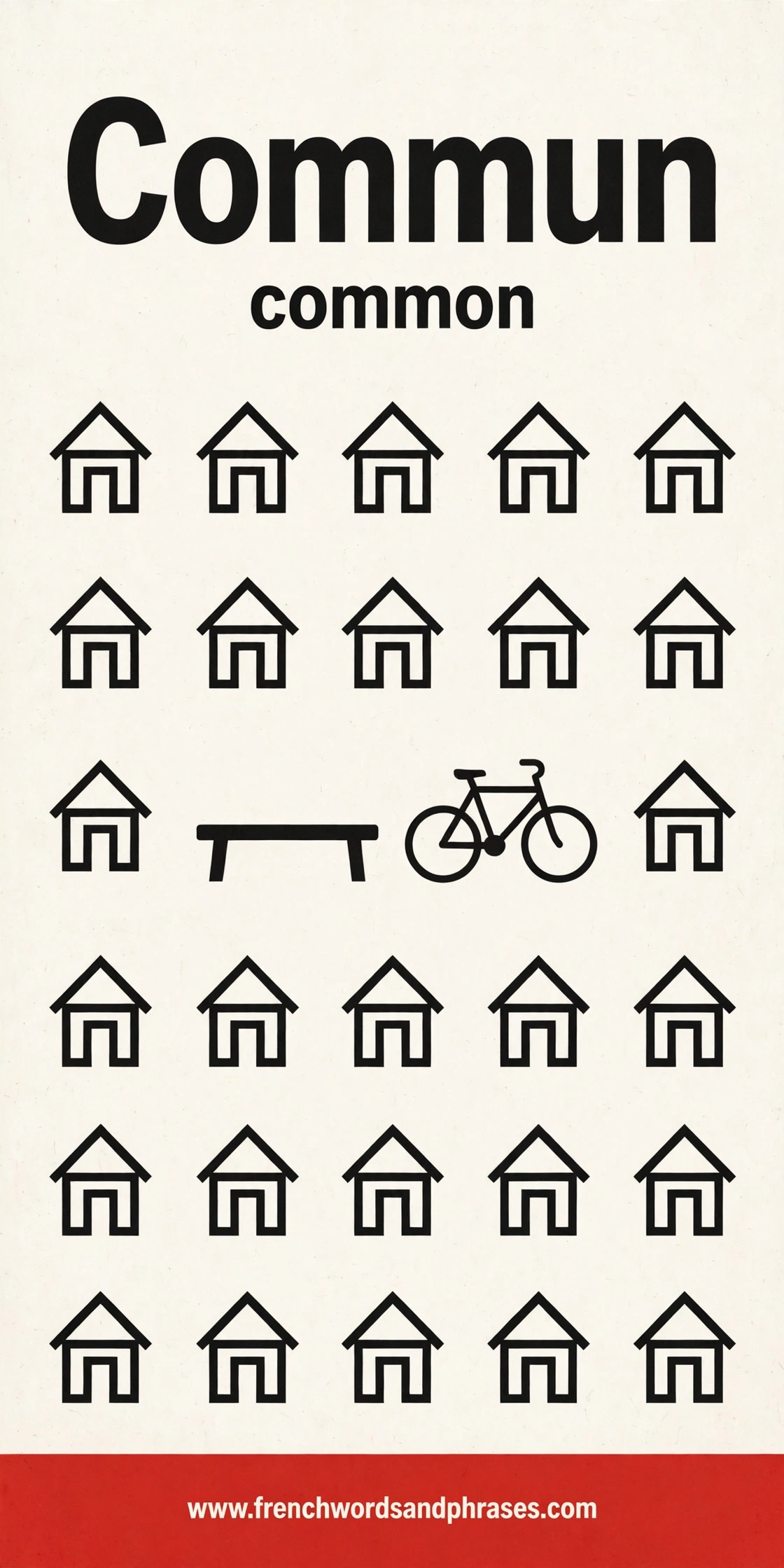
Commun means common.
The village square that belongs to everyone, the surname half the phone book shares, the friend you and your sister both have: commun, common — the adjective of what is shared, and of what is found everywhere.
In this guide, you’ll learn what commun means in English, how its feminine commune is formed, where it stands in the sentence, and why transports en commun means public transport. Explore French examples, English translations, and practice quizzes.
Understanding the French Adjective Commun
Commun is a French adjective of sharing and frequency. It comes from the Latin communis — com, together, plus munus, a duty or gift: what is held together. Its feminine is commune, where the n wakes up: commun /kɔ.mɛ̃/, commune /kɔ.myn/. As a noun, une commune is also a French municipality — the smallest unit of local government.
It means common in both its great senses. First, shared by several: un ami commun, a mutual friend; des intérêts communs, shared interests; une salle commune, a common room; la vie commune, life together. Second, frequent and ordinary: un nom commun, a common name; une erreur commune, a common mistake; peu commun, unusual. In the phrase en commun it becomes a way of holding things: mettre en commun, to pool, to share; les transports en commun, public transport — the vehicles a whole town holds in common.
Type: Adjective of sharing and frequency — what is held together, what is found everywhere
Answers the question: Shared by whom? / How frequent? — common, mutual, ordinary
Changes form: commun / commune / communs / communes — the feminine hears the n
English equivalents: Common; mutual, shared; ordinary; en commun — in common, public (transport).
One important usage detail: commun stands after the noun — un ami commun — and agrees fully: une amie commune, des intérêts communs. Do not confuse the adjective with the noun une commune, a municipality: la commune de Lyon is the city authority, not something shared. And for a mutual friend, French says un ami commun where English says a mutual friend — same word, both senses.
Experience the Word
Commun is the adjective of the village square — everything that is nobody’s alone because it is everybody’s together.
Imagine the small town at market time: the fountain, the square, the war memorial, les biens communs that no one owns and everyone maintains. An old man sweeps the steps of the mairie as if they were his own — pour la commune, he says, for the common good.
You have not just called something ordinary. You have named belonging shared — commun, what we hold together.
How to Use Commun in French: Complete Guide
Let’s explore how commun works in French, beginning with the whole word on one card.
Commun at a Glance
Before the details, here is the whole word on one card.
The Whole Word on One Card
Meaning, type, position and forms — commun in four lines.
| Point | Commun |
|---|---|
| Meaning | common — shared by several; frequent, ordinary |
| Type | adjective of sharing and frequency |
| Usual position | after the noun — un ami commun |
| Forms | commun, commune, communs, communes |
Example
Nous avons un ami commun à Paris.
We have a mutual friend in Paris.
The Four Forms of Commun
The feminine commune opens the nasal and hears the n: commun /kɔ.mɛ̃/, commune /kɔ.myn/.
| Form | Commun | Example |
|---|---|---|
| Masculine singular | commun | un jardin commun — a shared garden |
| Feminine singular | commune | une salle commune — a common room |
| Masculine plural | communs | des intérêts communs — shared interests |
| Feminine plural | communes | des erreurs communes — common mistakes |
Example
Des erreurs communes reviennent dans toutes les copies.
Common mistakes come back in all the exam papers.
Quick Quiz 1
What is the feminine of commun?
Reveal the answer
commune
Une salle commune — the n is heard in the feminine: /kɔ.myn/.
A common room.
The Feminine of Commun: Commune
Commune is one of the -un / -une feminines — brun, brune works the same way — and the same word doubles as the noun for a municipality.
| Situation | Example |
|---|---|
| Masculine | un compte commun — a joint account |
| Feminine | une vie commune — a life together |
| Why | the written e wakes the final n |
| The plural | add s — des vies communes, lives in common |
Example
Leur vie commune a commencé il y a trente ans.
Their life together began thirty years ago.
Where Commun Goes: After the Noun, and En commun
Commun follows its noun; the phrase en commun turns sharing into an arrangement — pooled money, pooled journeys.
| Pattern | Example |
|---|---|
| After the noun | un ami commun — a mutual friend |
| After être | ce nom est commun — this name is common |
| En commun | vivre en commun — to live communally |
| Mettre en commun | mettre l’argent en commun — to pool the money |
Example
Les étudiants ont mis leurs livres en commun.
The students pooled their books.
Quick Quiz 2
How do you say ‘a common room’ — un commun salle or une salle commune?
Reveal the answer
une salle commune
Commun stands after the noun and agrees with it: salle is feminine, so commune.
A common room.
More Commun: Comparing with Commun
Frequency compares the regular way — plus commun is the statistician’s favourite phrase.
| Degree | Example |
|---|---|
| As common as | aussi commun que — as common as |
| More common | plus commun — more common |
| Less common | moins commun — less common |
| The most common (masc.) | le plus commun — le plus commun des noms |
| Unusual | peu commun — uncommon, out of the ordinary |
Example
Martin est le nom de famille le plus commun en France.
Martin is the most common surname in France.
Everyday Expressions with Commun
Commun runs the town: shared accounts, public transport and the common good.
| Expression | In English |
|---|---|
| les transports en commun | public transport |
| un ami commun | a mutual friend |
| d’un commun accord | by common agreement, unanimously |
| le bien commun | the common good |
| un nom commun | a common noun (grammar); a common name |
| en commun | in common, jointly |
Example
Je vais au travail en transports en commun.
I go to work by public transport.
Quick Quiz 3
What does les transports en commun mean?
Reveal the answer
Public transport
Les transports en commun — the buses, trams and trains a whole town shares.
Public transport.
Commun and Its Neighbours
Commun keeps company with the words of sharing — and faces the private and the rare.
| French | In English |
|---|---|
| partagé | shared, divided between people |
| mutuel | mutual — feelings returned |
| ordinaire | ordinary, usual |
| fréquent | frequent |
| privé | private — the opposite |
| rare | rare — the opposite of frequent |
Example
Un jardin partagé demande des intérêts communs.
A shared garden needs shared interests.
Watch Out: The Traps Around Commun
The traps are the noun commune (a municipality), and English common in the sense vulgar, which French renders otherwise.
| Trap | The truth |
|---|---|
| Une commune | as a noun, une commune is a municipality, a town or village authority — not a shared thing |
| Common = vulgar | for a common, coarse person French says vulgaire or grossier, not commun |
| Mutual friend | un ami commun — French uses commun where English prefers mutual |
| The feminine sound | commune hears its n: /kɔ.myn/ — do not nasalise it |
Example
La commune organise la fête du village chaque été.
The municipality organises the village fête every summer.
Quick Quiz 4
How do you say ‘shared interests’?
Reveal the answer
des intérêts communs
Commun follows the noun and agrees, masculine plural: communs.
Shared interests.
Commun in Everyday French: Real-Life Examples
Now that you know the word, let’s see how commun appears in everyday French.
Example 1 — Introductions
Nous avons une amie commune, Claire, de Lyon.
We have a mutual friend, Claire, from Lyon.
Example 2 — Transport
Les transports en commun sont gratuits le dimanche ici.
Public transport is free on Sundays here.
Example 3 — At the bank
Ils ont ouvert un compte commun après le mariage.
They opened a joint account after the wedding.
Example 4 — In class
Le chat est un nom commun, pas un nom propre.
Chat is a common noun, not a proper noun.
Example 5 — Agreement
D’un commun accord, ils ont choisi la maison bleue.
By common agreement, they chose the blue house.
Example 6 — Statistics
C’est l’erreur la plus commune des débutants.
It is the most common mistake beginners make.
Beyond Translation: The Meaning of Commun
Commun is the Republic in a single adjective: the Latin communis held a duty inside it — munus, the service owed to the town — so what is commun is not just shared, it is owed to all and kept by all. France institutionalised the word: every village is une commune, every town hall guards le bien commun, and the bus you take is a transport en commun.
Commun is the opposite of alone.
Learn it beside partagé and mutuel, and you can grade togetherness like a French mayor: what is shared, what is returned, and what belongs to everyone.
How to Remember the French Adjective Commun
Remember it this way: Commun is common — shared and frequent: feminine commune, un ami commun, and les transports en commun for public transport.
- The four forms — commun, commune, communs, communes; the feminine hears the n.
- The two senses — shared (un ami commun) and frequent (une erreur commune).
- The phrases — en commun, in common; les transports en commun, public transport.
The key idea is commun means common and shared; feminine commune, en commun = in common.
Test Your Knowledge of Commun
Let’s see how much you’ve learned. Try answering these questions before revealing the answers.
Question 1
What does commun mean?
Reveal the answer
Common — shared by several, and frequent or ordinary.
Question 2
What is the feminine of commun?
Reveal the answer
commune — une salle commune, with the n pronounced.
Question 3
Translate: public transport.
Reveal the answer
Les transports en commun.
Question 4
Complete the sentence:
Ils partagent des intérêts ______.
Reveal the answer
communs
Ils partagent des intérêts communs.
They share common interests.
Question 5
As a noun, what is une commune?
Reveal the answer
A municipality — a town or village and its local authority.
Your Final Challenge
Can You Use It?
How would you say this in French?
“We have a mutual friend in Paris.”
Reveal the answer
Nous avons un ami commun à Paris.
We have a mutual friend in Paris.
A little French. A little curiosity. A richer everyday life.
LEARN FRENCH ONE WORD AT A TIME




