A French Word to Live By
How to Conjugate Commettre in French
/kɔ.mɛtʁ/
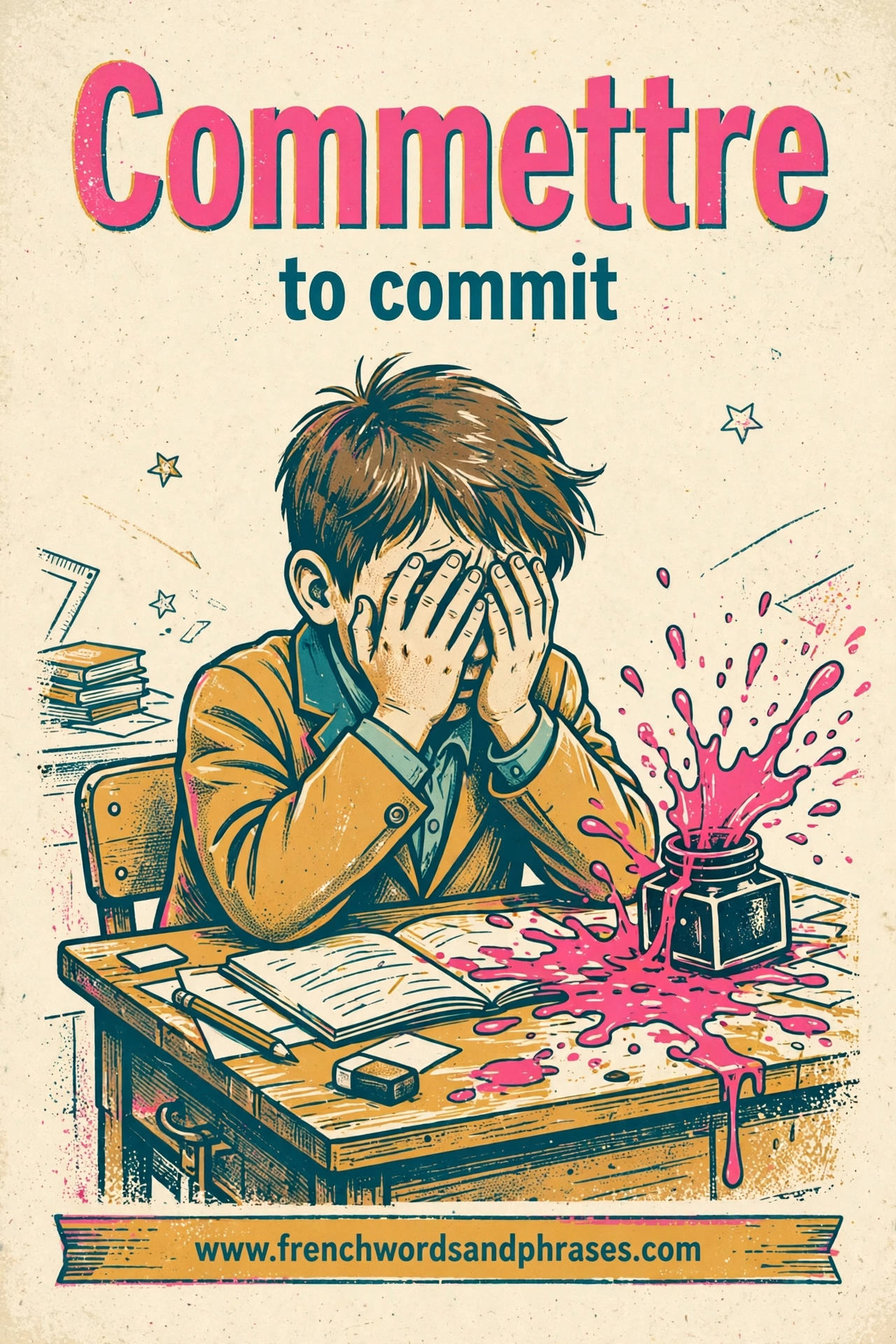
Commettre means to commit — to carry out a deed, usually a bad one, but also, in the language of courts, to appoint someone officially to a task.
A signature at the bottom of a confession, a judge naming an expert witness, a schoolboy caught with the broken window — commettre is the verb of the deed done and recorded: crimes, errors and sins are commis, and so are the officials appointed to investigate them.
In this guide, you’ll learn how to conjugate commettre in all the major French tenses and moods. Explore complete conjugation tables, French examples, English translations, and practice quizzes.
Understanding the French Verb Commettre
Commettre is an irregular French verb ending in -mettre, conjugated exactly like mettre.
It means to commit. Two families share the verb. The criminal one: commettre un crime, un attentat, une injustice — always something blameworthy; French does not commettre a good deed. The official one belongs to law and administration: commettre un expert, commettre un avocat d’office — to appoint by authority. A crime is commis, and the expert who examines it is commis too.
Verb classification: Irregular (-mettre)
Auxiliary verb: Avoir
Past participle: commis
Present participle: commettant
English equivalents: To commit, to perpetrate; commettre un crime — to commit a crime; commettre une erreur, une faute — to make a mistake, an error; commettre quelqu’un à une tâche — to appoint someone to a task; un avocat commis d’office — a court-appointed lawyer.
One important detail: commettre follows mettre exactly — single t in the singular of the present (je commets, il commet), double t in the plural and everywhere else (nous commettons, je commettais, en commettant), and a past participle in -is: commis (commise, commis, commises). The future doubles the t as well: je commettrai. That participle commis is also a noun — un commis is a clerk — straight out of Maupassant’s world of office workers.
Experience the Word
Commettre is the verb of the act that cannot be taken back — once it is commis, it exists, and someone must answer for it.
Imagine a quiet courtroom in Lyon. The judge opens the file: l’accusé a commis son crime en pleine nuit — the accused committed his crime in the middle of the night. Then the same judge, in the same breath, commet un expert — appoints an expert — to examine the evidence. One verb for the deed, the same verb for the man sent to judge it.
The crime was committed, the expert was appointed. Both were commis — the verb signs the act and the order alike.
How to Conjugate Commettre: Complete French Conjugation Guide
Let’s explore every major conjugation of commettre, beginning with the indicative mood.
How to Conjugate Commettre in the Indicative Mood
The indicative mood is used to express facts, observations, actions, and events.
How to Conjugate Commettre in the Present Tense (Présent)
Used for actions happening now, habitual actions, and general truths.
| Subject | Conjugation |
|---|---|
| je | commets |
| tu | commets |
| il / elle | commet |
| nous | commettons |
| vous | commettez |
| ils / elles | commettent |
Example
Il commet toujours la même erreur de calcul.
He always makes the same calculation error.
Quick Quiz 1
Complete the sentence:
Nous ______ une erreur de calcul.
Reveal the answer
commettons
Nous commettons une erreur de calcul.
We are making a calculation error — double t in the plural.
How to Conjugate Commettre in the Passé Composé
Used for completed actions in the past. Commettre takes the auxiliary verb avoir.
| Subject | Conjugation |
|---|---|
| j’ | ai commis |
| tu | as commis |
| il / elle | a commis |
| nous | avons commis |
| vous | avez commis |
| ils / elles | ont commis |
Example
Le voleur a commis trois cambriolages en une semaine.
The burglar committed three break-ins in one week.
How to Conjugate Commettre in the Imparfait (Imperfect Tense)
Used for habitual past actions, descriptions, and ongoing situations in the past.
| Subject | Conjugation |
|---|---|
| je | commettais |
| tu | commettais |
| il / elle | commettait |
| nous | commettions |
| vous | commettiez |
| ils / elles | commettaient |
Example
Autrefois, on commettait ce crime sans être puni.
In the old days, people committed this crime without being punished.
Quick Quiz 2
Choose the correct form:
The burglar committed three break-ins.
Le voleur ______ trois cambriolages. (a commis / est commis)
Reveal the answer
a commis
Le voleur a commis trois cambriolages.
Commettre takes avoir.
How to Conjugate Commettre in the Plus-que-parfait
Used to describe an action that had already been completed before another past event.
| Subject | Conjugation |
|---|---|
| j’ | avais commis |
| tu | avais commis |
| il / elle | avait commis |
| nous | avions commis |
| vous | aviez commis |
| ils / elles | avaient commis |
Example
Elle avait commis une faute grave avant de démissionner.
She had committed a serious error before resigning.
How to Conjugate Commettre in the Passé Simple
Primarily used in formal writing, literature, and historical narratives. It is rarely used in everyday conversation.
| Subject | Conjugation |
|---|---|
| je | commis |
| tu | commis |
| il / elle | commit |
| nous | commîmes |
| vous | commîtes |
| ils / elles | commirent |
Example
Il commit l’imprudence de partir sans prévenir personne.
He committed the folly of leaving without telling anyone.
How to Conjugate Commettre in the Passé Antérieur
A literary tense used to express an action completed immediately before another past action, generally in the passé simple.
| Subject | Conjugation |
|---|---|
| j’ | eus commis |
| tu | eus commis |
| il / elle | eut commis |
| nous | eûmes commis |
| vous | eûtes commis |
| ils / elles | eurent commis |
Example
Quand il eut commis son forfait, il quitta la ville pour toujours.
When he had committed his crime, he left the town forever.
How to Conjugate Commettre in the Future Tense (Futur Simple)
Used to describe actions that will take place in the future.
| Subject | Conjugation |
|---|---|
| je | commettrai |
| tu | commettras |
| il / elle | commettra |
| nous | commettrons |
| vous | commettrez |
| ils / elles | commettront |
Example
Celui qui commettra cette erreur la paiera cher.
Whoever makes this mistake will pay dearly for it.
How to Conjugate Commettre in the Futur Antérieur (Future Perfect)
Used for an action that will have been completed before a particular point in the future.
| Subject | Conjugation |
|---|---|
| j’ | aurai commis |
| tu | auras commis |
| il / elle | aura commis |
| nous | aurons commis |
| vous | aurez commis |
| ils / elles | auront commis |
Example
À la fin du procès, on saura qui aura commis le crime.
By the end of the trial, we will know who committed the crime.
How to Conjugate Commettre in the Near Future (Futur Proche)
Used to describe something that is going to happen soon. Formed with aller + infinitive.
| Subject | Conjugation |
|---|---|
| je | vais commettre |
| tu | vas commettre |
| il / elle | va commettre |
| nous | allons commettre |
| vous | allez commettre |
| ils / elles | vont commettre |
Example
Attention, tu vas commettre une injustice !
Careful, you are about to commit an injustice!
How to Conjugate Commettre in the Conditional Mood
The conditional mood expresses what would happen under certain circumstances. It is also frequently used to make polite requests or express wishes.
How to Conjugate Commettre in the Present Conditional
| Subject | Conjugation |
|---|---|
| je | commettrais |
| tu | commettrais |
| il / elle | commettrait |
| nous | commettrions |
| vous | commettriez |
| ils / elles | commettraient |
Example
À ta place, je ne commettrais jamais une telle erreur.
In your place, I would never make such a mistake.
How to Conjugate Commettre in the Past Conditional
| Subject | Conjugation |
|---|---|
| j’ | aurais commis |
| tu | aurais commis |
| il / elle | aurait commis |
| nous | aurions commis |
| vous | auriez commis |
| ils / elles | auraient commis |
Example
Elle aurait commis le crime si elle en avait eu l’occasion.
She would have committed the crime if she had had the opportunity.
Commettre in the Literary Past Conditional Form
This less common literary form uses the imperfect subjunctive of avoir.
| Subject | Conjugation |
|---|---|
| j’ | eusse commis |
| tu | eusses commis |
| il / elle | eût commis |
| nous | eussions commis |
| vous | eussiez commis |
| ils / elles | eussent commis |
Example
Il eût commis le forfait sans l’arrivée des gendarmes.
He would have committed the crime, had the police not arrived.
How to Conjugate Commettre in the Subjunctive Mood
The subjunctive is used to express wishes, emotions, doubts, necessity, and uncertainty. It frequently follows expressions such as il faut que (it is necessary that) or bien que (although).
How to Conjugate Commettre in the Present Subjunctive
| Subject | Conjugation |
|---|---|
| que je | commette |
| que tu | commettes |
| qu’il / qu’elle | commette |
| que nous | commettions |
| que vous | commettiez |
| qu’ils / qu’elles | commettent |
Example
Il est impossible qu’il commette deux fois la même faute.
It is impossible for him to make the same mistake twice.
Quick Quiz 3
Complete the sentence using the subjunctive:
Il est impossible que vous ______ cette faute.
Reveal the answer
commettiez
Il est impossible que vous commettiez cette faute.
It is impossible for you to commit this fault.
How to Conjugate Commettre in the Imperfect Subjunctive
A literary tense, rarely encountered in modern spoken French.
| Subject | Conjugation |
|---|---|
| que je | commisse |
| que tu | commisses |
| qu’il / qu’elle | commît |
| que nous | commissions |
| que vous | commissiez |
| qu’ils / qu’elles | commissent |
Example
On craignait qu’il commît une erreur irréparable.
People feared he might commit an irreparable error.
How to Conjugate Commettre in the Pluperfect Subjunctive
A literary construction used to express an action completed before another past action.
| Subject | Conjugation |
|---|---|
| que j’ | eusse commis |
| que tu | eusses commis |
| qu’il / qu’elle | eût commis |
| que nous | eussions commis |
| que vous | eussiez commis |
| qu’ils / qu’elles | eussent commis |
Example
On racontait qu’il eût commis le crime par jalousie.
It was said that he had committed the crime out of jealousy.
How to Conjugate Commettre in the Past Subjunctive
| Subject | Conjugation |
|---|---|
| que j’ | aie commis |
| que tu | aies commis |
| qu’il / qu’elle | ait commis |
| que nous | ayons commis |
| que vous | ayez commis |
| qu’ils / qu’elles | aient commis |
Example
Je ne crois pas qu’elle ait commis cette faute volontairement.
I do not believe she committed this fault deliberately.
How to Conjugate Commettre in the Imperative
The imperative is used to give commands, instructions, invitations, or suggestions. Subject pronouns are omitted.
How to Conjugate Commettre in the Present Imperative
| Person | Conjugation |
|---|---|
| (tu) | commets |
| (nous) | commettons |
| (vous) | commettez |
Example
Ne commets jamais l’erreur de sous-estimer ton adversaire !
Never make the mistake of underestimating your opponent!
Quick Quiz 4
How would you say Do not make this mistake (tu form)?
Reveal the answer
Ne commets pas cette erreur !
French Participles of Commettre
Participles are verb forms that can be used in compound tenses and other grammatical constructions.
Present Participle of Commettre
commettant
En commettant cette imprudence, il a tout perdu.
By committing this folly, he lost everything.
Past Participle of Commettre
commis
Commise en pleine nuit, l’agression n’a eu aucun témoin.
Committed in the middle of the night, the attack had no witnesses.
Commettre in Everyday French: Real-Life Examples
Now that you know the conjugations, let’s see how commettre appears in everyday French.
Example 1 — Present
Il commet toujours la même erreur.
He always makes the same mistake.
Example 2 — Passé composé
Le voleur a commis trois cambriolages.
The burglar committed three break-ins.
Example 3 — Imparfait
Elle commettait souvent des imprudences.
She often committed acts of folly.
Example 4 — Future
Qui commettra cette erreur la paiera cher.
Whoever makes this mistake will pay dearly.
Example 5 — Conditional
Je ne commettrais jamais une telle faute.
I would never commit such a fault.
Example 6 — Imperative
Ne commets pas cette erreur !
Do not make this mistake!
Beyond Translation: The Meaning of Commettre
Latin committere means to bring together, to entrust — and French commettre still carries both ends of the rope.
The deed and the appointment.
You commettre a crime, putting act and intention together; the court commettre an expert, putting a man and a mission together. English commit kept both senses too — to commit a crime, and to commit something to someone’s care.
How to Remember the French Verb Commettre
Remember it this way: Commettre is about the signature at the bottom of the confession — a deed that cannot be unsigned.
- Exactly like mettre: je commets, nous commettons, past participle commis.
- Only blameworthy deeds are commis — un crime, une erreur, une faute, une injustice.
- The courtroom twin: commettre un expert, un avocat commis d’office — to appoint officially.
The key idea is the signature at the bottom of the confession — a deed that cannot be unsigned.
Test Your Knowledge of Commettre
Let’s see how much you’ve learned. Try answering these questions before revealing the answers.
Question 1
How is commettre conjugated in the present, singular versus plural?
Reveal the answer
Je commets, il commet with one t; nous commettons, ils commettent with two — exactly like mettre.
Question 2
How do you say The burglar committed three break-ins in French?
Reveal the answer
Le voleur a commis trois cambriolages.
Question 3
Translate: He always makes the same mistake.
Reveal the answer
Il commet toujours la même erreur.
Question 4
What is the past participle of commettre?
Reveal the answer
Commis — commise, commis, commises.
Question 5
Complete the sentence:
Il est impossible qu’il ______ deux fois la même faute.
Reveal the answer
commette
Il est impossible qu’il commette deux fois la même faute.
It is impossible for him to make the same mistake twice.
Your Final Challenge
Can You Use It?
How would you say this in French?
He made a single mistake in his career, and that is the one everyone remembers.
Reveal the answer
Il a commis une seule erreur dans sa carrière, et c’est elle que tout le monde retient.
He made a single mistake in his career, and that is the one everyone remembers.
A little French. A little curiosity. A richer everyday life.
LEARN FRENCH ONE WORD AT A TIME