A French Word to Live By
How to Conjugate Colliger in French
/kɔ.li.ʒe/
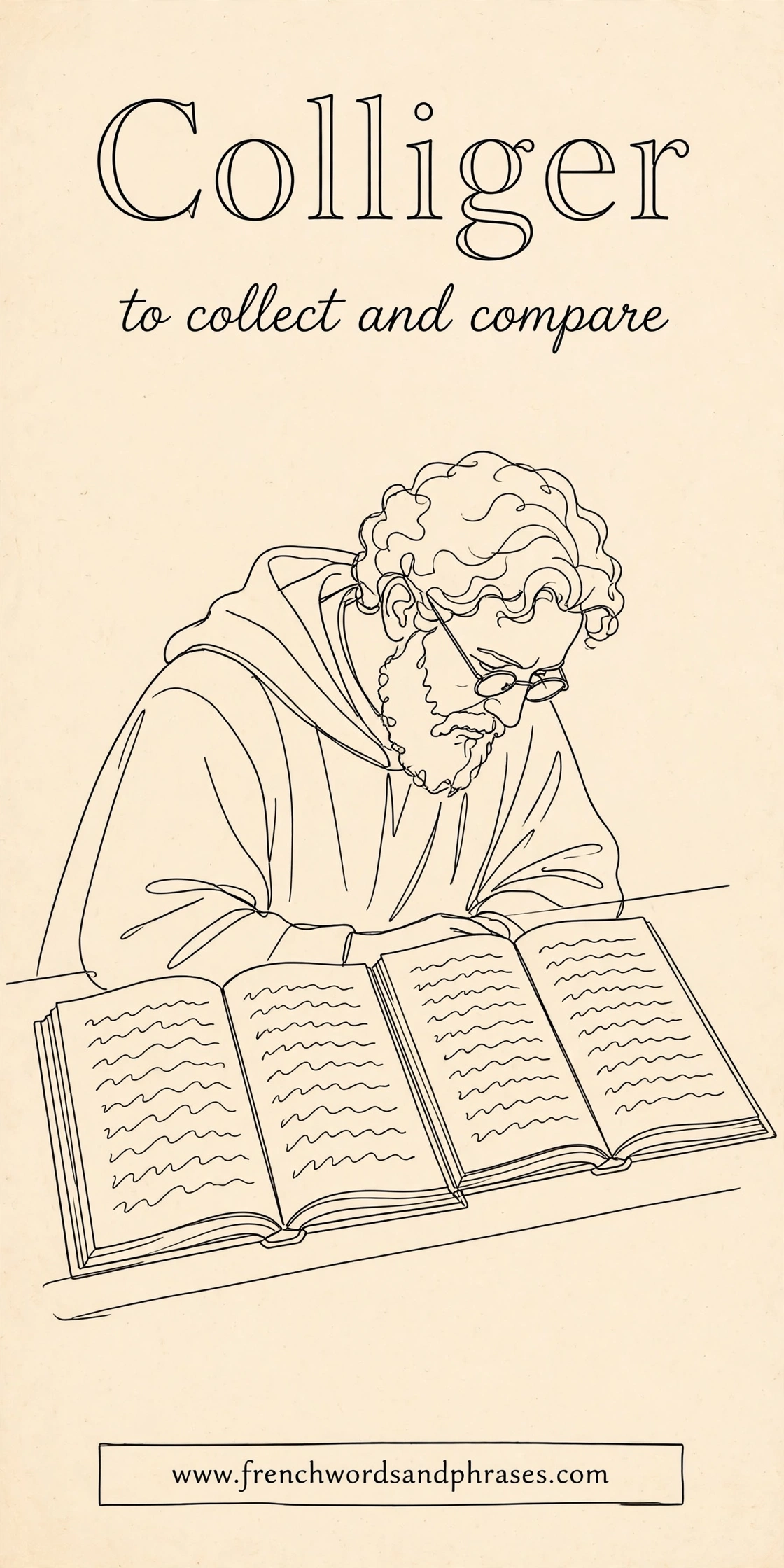
Colliger means to collect and compare — to gather texts, facts or testimonies together systematically, the scholar’s way of collecting.
A historian with forty witness statements spread across her desk, a monk copying three versions of the same chronicle side by side, an editor comparing every manuscript of a poem — colliger is collecting with a purpose: gathering in order to compare, check and compile.
In this guide, you’ll learn how to conjugate colliger in all the major French tenses and moods. Explore complete conjugation tables, French examples, English translations, and practice quizzes.
Understanding the French Verb Colliger
Colliger is a regular French verb belonging to the first group of verbs, those ending in-er.
It means to collect and compare. It lives in libraries, archives and courtrooms: historians colligent testimonies, editors colligent manuscript variants, commissions colligent facts and documents. Wherever things are gathered not to be owned but to be compared, colliger is the precise word.
Verb classification: First group (-er)
Auxiliary verb: Avoir
Past participle: colligé
Present participle: colligeant
English equivalents: To collate, to collect and compare; colliger des textes — to collate texts; colliger les témoignages — to gather testimonies; colliger les variantes — to collate the variant readings; un recueil — a compilation, a collection of pieces.
One important detail: colliger is a -ger verb, so the g keeps a protective e before a and o to stay soft: nous colligeons, je colligeais, en colligeant — but je collige, nous colligions need no help. The past participle is colligé. Do not confuse it with its cousin collectionner: collectionner is the hobbyist gathering stamps for pleasure; colliger is the scholar gathering evidence for an edition, a report or a verdict — from the same Latin colligere, to gather together.
Experience the Word
Colliger is collecting turned into a method — nothing is kept until it has been compared.
Imagine the editor of a medieval poem. Five monasteries hold five copies, no two alike; for years she travels, photographs, transcribes — elle collige les variantes, line by line, until the poem’s true text slowly stands up out of the differences.
She owns nothing and has gathered everything. She has collated — colligé — and the poem can finally be read.
How to Conjugate Colliger: Complete French Conjugation Guide
Let’s explore every major conjugation of colliger, beginning with the indicative mood.
How to Conjugate Colliger in the Indicative Mood
The indicative mood is used to express facts, observations, actions, and events.
How to Conjugate Colliger in the Present Tense (Présent)
Used for actions happening now, habitual actions, and general truths.
| Subject | Conjugation |
|---|---|
| je | collige |
| tu | colliges |
| il / elle | collige |
| nous | colligeons |
| vous | colligez |
| ils / elles | colligent |
Example
L’historien collige les témoignages des survivants.
The historian is collating the survivors’ testimonies.
Quick Quiz 1
Complete the sentence:
Nous ______ les témoignages des survivants.
Reveal the answer
colligeons
Nous colligeons les témoignages des survivants.
We are collating the survivors’ testimonies.
How to Conjugate Colliger in the Passé Composé
Used for completed actions in the past. Colliger takes the auxiliary verb avoir.
| Subject | Conjugation |
|---|---|
| j’ | ai colligé |
| tu | as colligé |
| il / elle | a colligé |
| nous | avons colligé |
| vous | avez colligé |
| ils / elles | ont colligé |
Example
Elle a colligé tous les manuscrits de l’abbaye.
She has collated all the abbey’s manuscripts.
How to Conjugate Colliger in the Imparfait (Imperfect Tense)
Used for habitual past actions, descriptions, and ongoing situations in the past.
| Subject | Conjugation |
|---|---|
| je | colligeais |
| tu | colligeais |
| il / elle | colligeait |
| nous | colligions |
| vous | colligiez |
| ils / elles | colligeaient |
Example
Les moines colligeaient les variantes des textes anciens.
The monks used to collate the variants of ancient texts.
Quick Quiz 2
Choose the correct form:
She collated the texts.
Elle ______ les textes. (a colligé / est colligée)
Reveal the answer
a colligé
Elle a colligé les textes.
Colliger takes avoir.
How to Conjugate Colliger in the Plus-que-parfait
Used to describe an action that had already been completed before another past event.
| Subject | Conjugation |
|---|---|
| j’ | avais colligé |
| tu | avais colligé |
| il / elle | avait colligé |
| nous | avions colligé |
| vous | aviez colligé |
| ils / elles | avaient colligé |
Example
Il avait colligé les faits avant d’écrire son rapport.
He had gathered the facts before writing his report.
How to Conjugate Colliger in the Passé Simple
Primarily used in formal writing, literature, and historical narratives. It is rarely used in everyday conversation.
| Subject | Conjugation |
|---|---|
| je | colligeai |
| tu | colligeas |
| il / elle | colligea |
| nous | colligeâmes |
| vous | colligeâtes |
| ils / elles | colligeèrent |
Example
Le savant colligea pendant vingt ans les lettres du poète.
The scholar collated the poet’s letters for twenty years.
How to Conjugate Colliger in the Passé Antérieur
A literary tense used to express an action completed immediately before another past action, generally in the passé simple.
| Subject | Conjugation |
|---|---|
| j’ | eus colligé |
| tu | eus colligé |
| il / elle | eut colligé |
| nous | eûmes colligé |
| vous | eûtes colligé |
| ils / elles | eurent colligé |
Example
Quand elle eut colligé toutes les versions, elle publia l’édition critique.
When she had collated all the versions, she published the critical edition.
How to Conjugate Colliger in the Future Tense (Futur Simple)
Used to describe actions that will take place in the future.
| Subject | Conjugation |
|---|---|
| je | colligerai |
| tu | colligeras |
| il / elle | colligera |
| nous | colligerons |
| vous | colligerez |
| ils / elles | colligeront |
Example
Nous colligerons les réponses de l’enquête la semaine prochaine.
We will collate the survey responses next week.
How to Conjugate Colliger in the Futur Antérieur (Future Perfect)
Used for an action that will have been completed before a particular point in the future.
| Subject | Conjugation |
|---|---|
| j’ | aurai colligé |
| tu | auras colligé |
| il / elle | aura colligé |
| nous | aurons colligé |
| vous | aurez colligé |
| ils / elles | auront colligé |
Example
À la fin du projet, ils auront colligé des milliers de documents.
By the end of the project, they will have collated thousands of documents.
How to Conjugate Colliger in the Near Future (Futur Proche)
Used to describe something that is going to happen soon. Formed with aller + infinitive.
| Subject | Conjugation |
|---|---|
| je | vais colliger |
| tu | vas colliger |
| il / elle | va colliger |
| nous | allons colliger |
| vous | allez colliger |
| ils / elles | vont colliger |
Example
Je vais colliger les notes de tous les témoins.
I am going to collate all the witnesses’ notes.
How to Conjugate Colliger in the Conditional Mood
The conditional mood expresses what would happen under certain circumstances. It is also frequently used to make polite requests or express wishes.
How to Conjugate Colliger in the Present Conditional
| Subject | Conjugation |
|---|---|
| je | colligerais |
| tu | colligerais |
| il / elle | colligerait |
| nous | colligerions |
| vous | colligeriez |
| ils / elles | colligeraient |
Example
Avec plus de temps, il colligerait aussi les brouillons.
With more time, he would collate the drafts as well.
How to Conjugate Colliger in the Past Conditional
| Subject | Conjugation |
|---|---|
| j’ | aurais colligé |
| tu | aurais colligé |
| il / elle | aurait colligé |
| nous | aurions colligé |
| vous | auriez colligé |
| ils / elles | auraient colligé |
Example
Elle aurait colligé les textes si l’archive avait été ouverte.
She would have collated the texts if the archive had been open.
Colliger in the Literary Past Conditional Form
This less common literary form uses the imperfect subjunctive of avoir.
| Subject | Conjugation |
|---|---|
| j’ | eusse colligé |
| tu | eusses colligé |
| il / elle | eût colligé |
| nous | eussions colligé |
| vous | eussiez colligé |
| ils / elles | eussent colligé |
Example
Il eût colligé tous les fragments sans la guerre.
He would have collated all the fragments without the war.
How to Conjugate Colliger in the Subjunctive Mood
The subjunctive is used to express wishes, emotions, doubts, necessity, and uncertainty. It frequently follows expressions such as il faut que (it is necessary that) or bien que (although).
How to Conjugate Colliger in the Present Subjunctive
| Subject | Conjugation |
|---|---|
| que je | collige |
| que tu | colliges |
| qu’il / qu’elle | collige |
| que nous | colligions |
| que vous | colligiez |
| qu’ils / qu’elles | colligent |
Example
Il faut que vous colligiez les versions avant de conclure.
You must collate the versions before concluding.
Quick Quiz 3
Complete the sentence using the subjunctive:
Il faut que tu ______ les variantes.
Reveal the answer
colliges
Il faut que tu colliges les variantes.
You must collate the variants.
How to Conjugate Colliger in the Imperfect Subjunctive
A literary tense, rarely encountered in modern spoken French.
| Subject | Conjugation |
|---|---|
| que je | colligasse |
| que tu | colligasses |
| qu’il / qu’elle | colligât |
| que nous | colligassions |
| que vous | colligassiez |
| qu’ils / qu’elles | colligassent |
Example
Le professeur exigeait que nous colligeassions les variantes.
The professor required us to collate the variants.
How to Conjugate Colliger in the Pluperfect Subjunctive
A literary construction used to express an action completed before another past action.
| Subject | Conjugation |
|---|---|
| que j’ | eusse colligé |
| que tu | eusses colligé |
| qu’il / qu’elle | eût colligé |
| que nous | eussions colligé |
| que vous | eussiez colligé |
| qu’ils / qu’elles | eussent colligé |
Example
On admirait qu’elle eût colligé tant de sources diverses.
People admired that she had collated so many diverse sources.
How to Conjugate Colliger in the Past Subjunctive
| Subject | Conjugation |
|---|---|
| que j’ | aie colligé |
| que tu | aies colligé |
| qu’il / qu’elle | ait colligé |
| que nous | ayons colligé |
| que vous | ayez colligé |
| qu’ils / qu’elles | aient colligé |
Example
Je suis impressionné qu’il ait colligé autant de témoignages.
I am impressed he collated so many testimonies.
How to Conjugate Colliger in the Imperative
The imperative is used to give commands, instructions, invitations, or suggestions. Subject pronouns are omitted.
How to Conjugate Colliger in the Present Imperative
| Person | Conjugation |
|---|---|
| (tu) | collige |
| (nous) | colligeons |
| (vous) | colligez |
Example
Colligez les faits, puis seulement jugez !
Collate the facts, and only then judge!
Quick Quiz 4
How would you say Collate the facts first (tu form)?
Reveal the answer
Collige les faits d’abord !
French Participles of Colliger
Participles are verb forms that can be used in compound tenses and other grammatical constructions.
Present Participle of Colliger
colligeant
En colligeant les manuscrits, elle a découvert une page inconnue.
While collating the manuscripts, she discovered an unknown page.
Past Participle of Colliger
colligé
Colligés avec soin, les témoignages racontent une autre histoire.
Carefully collated, the testimonies tell a different story.
Colliger in Everyday French: Real-Life Examples
Now that you know the conjugations, let’s see how colliger appears in everyday French.
Example 1 — Present
L’historien collige les témoignages.
The historian is collating the testimonies.
Example 2 — Passé composé
Elle a colligé tous les manuscrits.
She has collated all the manuscripts.
Example 3 — Imparfait
Les moines colligeaient les variantes.
The monks used to collate the variants.
Example 4 — Future
Nous colligerons les réponses.
We will collate the responses.
Example 5 — Conditional
Il colligerait aussi les brouillons.
He would collate the drafts too.
Example 6 — Imperative
Colligez les faits d’abord !
Collate the facts first!
Beyond Translation: The Meaning of Colliger
English collate is the exact cousin — printers and scholars use it the same way — and both come from Latin colligere, to gather together, the root French also turned into collectionner.
Two verbs, two kinds of gathering.
The collectionneur gathers to keep; the scholar who collige gathers to compare. One fills an album, the other fills an edition — and French, precise as ever, refuses to confuse them.
How to Remember the French Verb Colliger
Remember it this way: Colliger is about the editor comparing five manuscripts of one poem, line by line.
- The -ger spelling keeps the g soft: nous colligeons, je colligeais, en colligeant — but je collige and colligé.
- Scholar’s collecting: colliger des textes, des variantes, des témoignages — gathering in order to compare.
- Regular -er with avoir: je collige, nous colligeons, past participle colligé.
The key idea is the editor comparing five manuscripts of one poem, line by line.
Test Your Knowledge of Colliger
Let’s see how much you’ve learned. Try answering these questions before revealing the answers.
Question 1
How does colliger differ from collectionner?
Reveal the answer
Collectionner is collecting as a hobby; colliger is the scholar’s gathering of texts, variants or evidence in order to compare and compile them.
Question 2
How do you say The historian is collating the testimonies in French?
Reveal the answer
L’historien collige les témoignages.
Question 3
Translate: She has collated all the manuscripts.
Reveal the answer
Elle a colligé tous les manuscrits.
Question 4
Why does nous colligeons keep an e after the g?
Reveal the answer
To keep the g soft — the -ger rule: colligeons, colligeant, je colligeais, wherever a or o follows the g.
Question 5
Complete the sentence:
Il faut que vous ______ les versions avant de conclure.
Reveal the answer
colligiez
Il faut que vous colligiez les versions avant de conclure.
You must collate the versions before concluding.
Your Final Challenge
Can You Use It?
How would you say this in French?
The historian collates the testimonies one by one, and the past slowly finds its voice again.
Reveal the answer
L’historien collige les témoignages un à un, et le passé, lentement, retrouve sa voix.
The historian collates the testimonies one by one, and the past slowly finds its voice again.
A little French. A little curiosity. A richer everyday life.
LEARN FRENCH ONE WORD AT A TIME