A French Word to Live By
Translate Choqué to English
/ʃɔke/
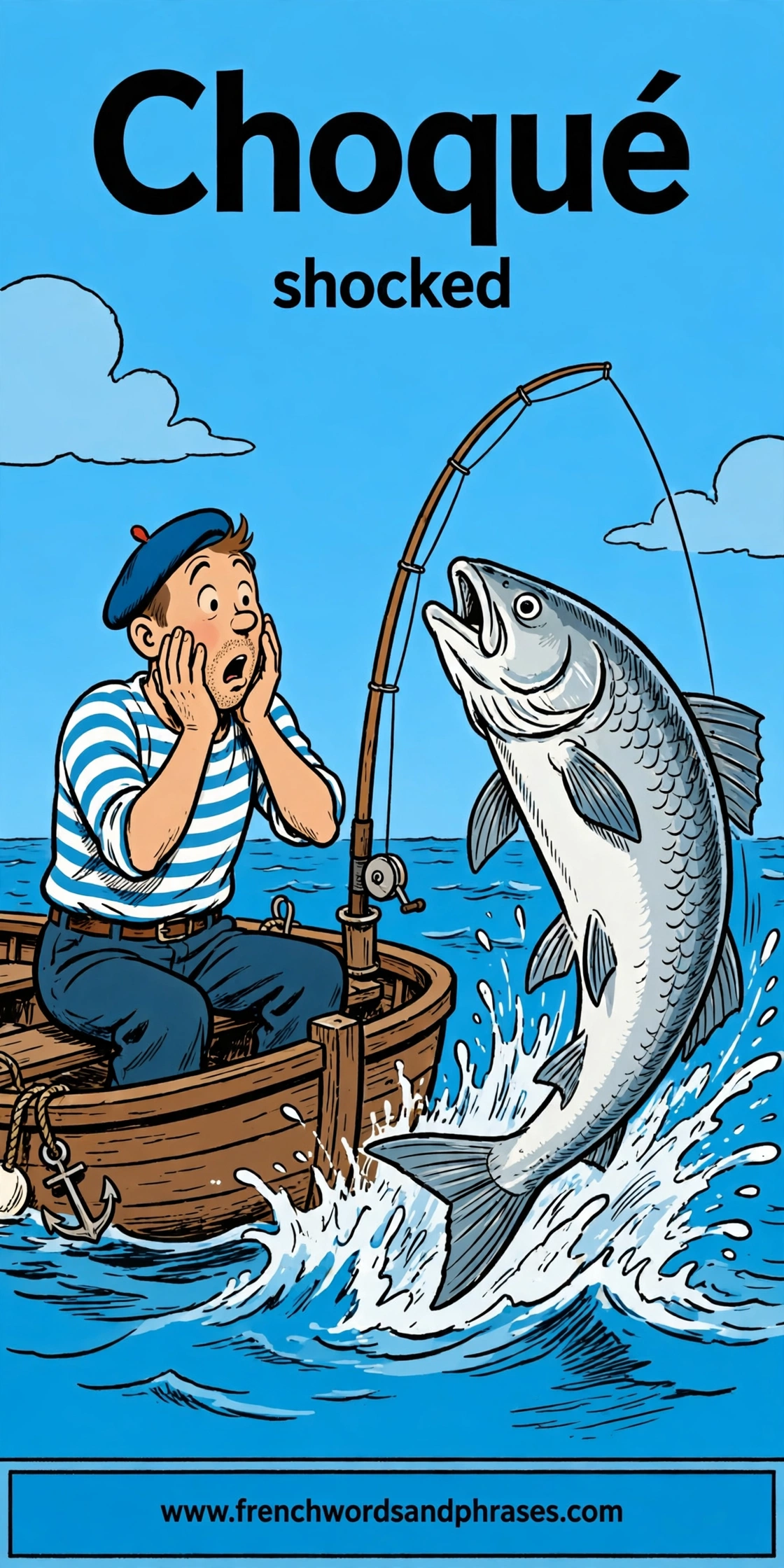
Choqué means shocked.
A quiet kitchen, the radio murmuring the morning news, and a man who stops with the coffee pot in mid-air. He sets it down very carefully, sits down without deciding to, and stares at the table as if it had spoken. The news was not sad exactly, and not frightening — it was impossible. He is choqué.
In this guide, you’ll learn what choqué means in English, how its regular feminine is formed, how it ranges from scandalised to stunned, and why French also uses it for the body after an accident. Explore French examples, English translations, and practice quizzes.
Understanding the French Adjective Choqué
Choqué is a French adjective of quality — the adjective of the jolt. It is the past participle of choquer, to shock or collide, and it agrees in the regular -é way: choqué, choquée, choqués, choquées.
It means shocked — jolted by something sudden, whether scandalous, surprising or violent. It describes faces after bad news (un visage choqué, a shocked face), witnesses (les témoins sont choqués, the witnesses are shocked), and, in the older French sense, people mildly scandalised by manners (choqué par son langage, shocked by his language). At its strongest it is the medical word too: un patient choqué is a patient in shock.
Type: Adjective of quality — feelings and reaction
Answers the question: What is he or she like? — shocked
Changes form: Yes — choqué, choquée, choqués, choquées
Feminine: choquée
English equivalents: Shocked; stunned; scandalised.
One important usage detail: choqué stands after être — elle est choquée — and the cause follows with par: choqué par la nouvelle (shocked by the news). The scale runs wide: choqué can be a raised eyebrow at a rude word, or a whole room silenced by an announcement — context sets the voltage.
Experience the Word
Choqué is the adjective of the coffee pot stopped in mid-air — the half-second where the world has changed and the body has not yet caught up.
Imagine a theatre audience at the twist of a play: a thousand people draw the same breath at the same moment, and the silence afterwards is thicker than applause. Nobody is hurt. Everybody is choqué, deliciously.
You have not just described surprise. You have described the jolt itself, still travelling through the room.
How to Use Choqué in French: Complete Guide
Let’s explore how choqué works in French, beginning with the whole word on one card.
Choqué at a Glance
Before the details, here is the whole word on one card.
The Whole Word on One Card
Meaning, type, position and forms — choqué in four lines.
| Point | Choqué |
|---|---|
| Meaning | shocked |
| Type | adjective of quality — feelings and reaction |
| Usual position | after être — ils sont choqués par la nouvelle |
| Form | choqué / choquée / choqués / choquées |
Example
Ils sont choqués par la nouvelle.
They are shocked by the news.
The Four Forms of Choqué
Choqué agrees with the person who is shocked, following the regular pattern of adjectives in -é: the feminine adds an e, the plurals add an s.
| Form | Choqué | Example |
|---|---|---|
| Masculine singular | choqué | un témoin choqué — a shocked witness |
| Feminine singular | choquée | une témoin choquée — a shocked witness |
| Masculine plural | choqués | des témoins choqués — shocked witnesses |
| Feminine plural | choquées | des voisines choquées — shocked neighbours |
Example
Il est choqué et elle est choquée par l’annonce.
He is shocked and she is shocked by the announcement.
Quick Quiz 1
Which form of choqué goes with voisine (feminine)?
Reveal the answer
choquée
Une voisine choquée.
A shocked neighbour.
Choquée: The Regular Feminine in -ée
The feminine of choqué is formed by adding a single e. It changes the spelling only — choqué and choquée sound exactly alike.
| Situation | Example |
|---|---|
| The rule | just add -e — choqué → choquée |
| The sound | choqué and choquée sound exactly the same: /ʃɔke/ |
| Masculine plural | choqués — des spectateurs choqués |
| Feminine plural | choquées — des spectatrices choquées |
Example
Elle est choquée par les images aux informations.
She is shocked by the pictures on the news.
Where Choqué Goes: After Être, with Par for the Cause
Choqué follows être and the verbs of feeling, and the thing that delivered the jolt follows behind with par.
| Pattern | Example |
|---|---|
| After être | il est choqué — he is shocked |
| With par (the cause) | choquée par la nouvelle — shocked by the news |
| After rester | ils sont restés choqués — they remained shocked |
| Before the noun | un choqué témoin — not in everyday French |
Example
Nous sommes choqués par cette décision.
We are shocked by this decision.
Quick Quiz 2
How do you say ‘shocked by the news’?
Reveal the answer
choqué par la nouvelle
The cause of the shock follows choqué with par.
Shocked by the news.
More Shocked: Comparing with Choqué
Choqué compares the regular way, with plus, moins and aussi — and profondément choqué does the everyday deepening.
| Degree | Example |
|---|---|
| As shocked as | aussi choqué que — as shocked as |
| More shocked | plus choqué — more shocked |
| Less shocked | moins choqué — less shocked |
| The most shocked (masc.) | le plus choqué — le plus choqué des témoins |
| The most shocked (fem.) | la plus choquée — la plus choquée des témoins |
Example
Elle est plus choquée que lui par ces images.
She is more shocked than him by these pictures.
Everyday Expressions with Choqué
Choqué runs from the drawing room to the hospital — one word for the raised eyebrow and for the silenced room.
| Expression | In English |
|---|---|
| choqué par la nouvelle | shocked by the news |
| profondément choqué | deeply shocked |
| un visage choqué | a shocked face |
| choqué par son comportement | shocked (scandalised) by his behaviour |
| être en état de choc | to be in a state of shock (the noun cousin, medical) |
| un silence choqué | a shocked silence |
Example
Un silence choqué a suivi l’annonce.
A shocked silence followed the announcement.
Quick Quiz 3
What does profondément choqué mean?
Reveal the answer
Deeply shocked
Nous sommes profondément choqués.
We are deeply shocked.
Choqué and Its Neighbours
Choqué shares its jolted field with surpris, the mild surprise, and bouleversé, the deep upheaval; scandalisé names the manners sense exactly.
| French | In English |
|---|---|
| surpris | surprised — the mild, everyday jolt |
| stupéfait | stunned, dumbfounded |
| bouleversé | deeply upset, overwhelmed |
| scandalisé | scandalised — shocked by behaviour |
| sidéré | flabbergasted (familiar and vivid) |
| indifférent | indifferent — the opposite: unshaken |
Example
Il n’est pas seulement surpris, il est choqué.
He isn’t just surprised, he is shocked.
Watch Out: The Traps Around Choqué
The traps here are the word’s wide voltage, and its physical past as a collision.
| Trap | The truth |
|---|---|
| How strong? | choqué ranges from scandalised to stunned — context sets the strength |
| From choc | un choc is a bang or a collision first — choqué keeps the jolt of the impact |
| Medical sense | un patient choqué is a patient in shock — the body’s version of the word |
| Agreement | elle est choquée, with the e — the shock agrees with its owner |
Example
Les témoins, encore choqués, racontent l’accident.
The witnesses, still shocked, describe the accident.
Quick Quiz 4
Can choqué describe someone merely scandalised by rude language?
Reveal the answer
Yes
Choqué covers the raised eyebrow as well as the jolt.
Elle est choquée par son langage — she is shocked by his language.
Choqué in Everyday French: Real-Life Examples
Now that you know the word, let’s see how choqué appears in everyday French.
Example 1 — The news
Nous sommes choqués par la nouvelle de ce matin.
We are shocked by this morning’s news.
Example 2 — At the theatre
Le public est choqué par la fin de la pièce.
The audience is shocked by the end of the play.
Example 3 — Manners
Ma grand-mère est choquée par son langage.
My grandmother is shocked by his language.
Example 4 — An accident
Les témoins sont choqués mais ils vont bien.
The witnesses are shocked but they are all right.
Example 5 — A decision
Elle est choquée par la décision du directeur.
She is shocked by the director’s decision.
Example 6 — Between friends
Tu as l’air choqué, qu’est-ce qui se passe ?
You look shocked, what’s happening?
Beyond Translation: The Meaning of Choqué
English says shocked for the meaning of choqué — and the French word keeps its physics showing: un choc is first of all a collision, a bang, two things meeting too fast.
Choqué is what happens when the news hits like a vehicle.
That is why the word stretches so far without breaking — from a grandmother scandalised by a swear word to a patient in medical shock, it is always the same picture at different speeds: something has struck, and the struck thing is still ringing.
How to Remember the French Adjective Choqué
Remember it this way: Choqué is the shocked adjective — the jolt of a collision, regular in -ée, with the cause delivered by par.
- You picture the impact — un choc is a bang, and choqué is still ringing from it.
- You add only an e for the feminine — choqué, choquée, same sound.
- You name the cause with par — choqué par la nouvelle.
The key idea is choqué means shocked at any voltage, its feminine choquée sounds identical, and the cause follows with par.
Test Your Knowledge of Choqué
Let’s see how much you’ve learned. Try answering these questions before revealing the answers.
Question 1
What does choqué mean?
Reveal the answer
Shocked — jolted by something sudden, from scandalised to stunned.
Question 2
What is the feminine of choqué?
Reveal the answer
choquée — just add an e; the sound does not change.
Question 3
Translate: shocked by the news.
Reveal the answer
Choqué par la nouvelle.
Question 4
Complete the sentence:
Elle est ______ par son comportement.
Reveal the answer
choquée
Elle est choquée par son comportement.
She is shocked by his behaviour.
Question 5
What is un choc, the noun behind choqué?
Reveal the answer
A bang, a collision — choqué keeps the jolt of the impact.
Your Final Challenge
Can You Use It?
How would you say this in French?
“The whole village is shocked by the decision.”
Reveal the answer
Tout le village est choqué par la décision.
The whole village is shocked by the decision.
A little French. A little curiosity. A richer everyday life.
LEARN FRENCH ONE WORD AT A TIME