
A French Word to Live By
Translate Chez to English
/ʃe/
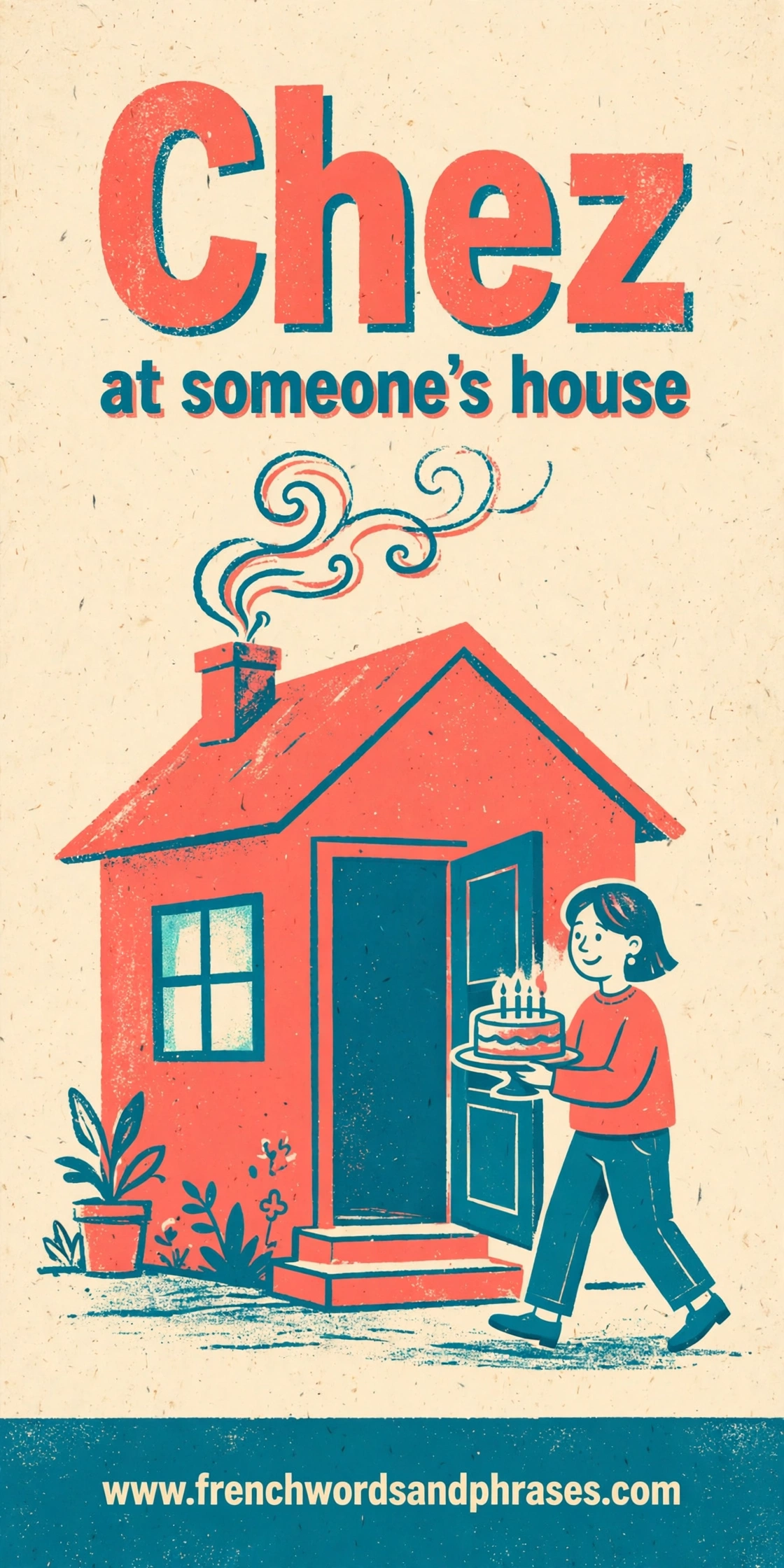
Chez means at someone’s house.
Sunday, one o’clock: the smell of roast chicken drifts from an open kitchen window, bikes lean by the gate, and three generations squeeze around a table that is slightly too small. « Dimanche, on mange chez mamie » — on Sundays, we eat at grandma’s. Chez is the French word that turns a person into a place: wherever that person lives, works or welcomes you.
Let’s explore how chez works in French, beginning with the whole word on one card.
Understanding the French Preposition Chez
Chez is a French simple preposition with one strict rule: it is always followed by a person — a pronoun, a name, a family word or a professional. It means at that person’s home, and by extension at their workplace or shop: chez le médecin, chez le boulanger.
It means at someone’s house — or at the doctor’s, at the hairdresser’s, at the Duponts’. English needs a possessive (‘at Paul’s’) or a whole phrase (‘at my house’); French simply names the person and lets the place appear by itself.
Type: Simple preposition — person-based place
Answers the question: Chez qui ? — At whose place? (Answer: the person’s home or workplace)
What follows it: A PERSON — pronoun, name or person-noun: chez moi, chez Paul, chez le médecin
Watch the pair: chez (a person’s place) vs à la maison (the house itself, at home)
One important usage detail: after chez, pronouns are the stressed forms — chez moi, chez toi, chez lui, chez elle, chez nous, chez vous, chez eux. And chez stretches beyond houses: chez les jeunes (among young people), chez Racine (in Racine’s works).
Experience the Word
Chez is the preposition of the open door — it never names a building, always the person waiting inside it.
Imagine rain starting on a village street, and a friend waving from a doorway: « Viens, on se met à l’abri chez moi ! » — come on, let’s shelter at my place! The house matters because it is hers.
You have not just said where you are going. You have said whose world you are stepping into.
How to Use Chez in French: Complete Guide
Let’s explore how chez works in French, beginning with the whole word on one card.
Chez at a Glance
The Whole Word on One Card
Meaning, job, pattern and pair — chez in four lines.
| Point | Chez |
|---|---|
| Meaning | at / to someone’s house or place |
| Job | points to a place through the person who lives or works there |
| What follows | a person only — pronoun, name, family word, profession |
| Contraction note | no contractions with chez — chez le dentiste, chez les Martin |
Example
Ce soir, nous dînons chez Marie.
Tonight, we are having dinner at Marie’s.
The Pattern in Action: The Person Is the Place
Chez connects a verb of going, being or staying to a person — and the person’s home comes with them, unspoken.
| Pattern | Example |
|---|---|
| a meal at a friend’s | nous dînons chez Marie ce soir — we are having dinner at Marie’s tonight |
| going home | je rentre chez moi après le travail — I go home after work |
| at a professional’s | elle est chez le médecin — she is at the doctor’s |
| sleeping at relatives’ | les enfants dorment chez leurs grands-parents — the children are sleeping at their grandparents’ |
Example
Les enfants passent le week-end chez leur tante.
The children are spending the weekend at their aunt’s.
Quick Quiz 1
Can chez be followed by a place like le parc?
Reveal the answer
No — chez only takes a person. For the park itself, use au parc or dans le parc.
Chez Paul.
At Paul’s.
The Tricky Bit: Chez + Pronoun, and Chez vs À la maison
Chez names the person; à la maison names the building. And its pronouns are always the stressed set.
| Form | The difference |
|---|---|
| chez moi / toi / lui | stressed pronouns only — ‘at my place, at your place, at his place’ (never ‘chez je’) |
| à la maison | at home — the house as a building, no person named: je reste à la maison |
| chez le boulanger | at the baker’s — the shop is named by the person who runs it |
| chez les Dupont | at the Duponts’ — family names take no s in French: les Dupont, les Martin |
Example
Je reste à la maison ce soir, mais demain je dîne chez les Dupont.
I’m staying at home tonight, but tomorrow I’m having dinner at the Duponts’.
Where It Goes: Straight Before the Person
Chez sits directly in front of the person word, most often after verbs like aller, être, rentrer, dîner and dormir.
| Position / pattern | Example |
|---|---|
| verb + chez + person | je vais chez le médecin demain — I’m going to the doctor’s tomorrow |
| at the start of a sentence | chez nous, on dîne à huit heures — at our place, we eat at eight |
| chez + name, no article | chez Paul, chez Sophie — names stand bare after chez |
| the extended sense | chez les enfants, tout est un jeu — with children, everything is a game |
Example
Chez ma sœur, les dimanches sont sacrés.
At my sister’s, Sundays are sacred.
Quick Quiz 2
“At my house” — chez moi or à la mienne?
Reveal the answer
chez moi — chez plus a stressed pronoun is the whole phrase.
Viens chez moi.
Come to my place.
Everyday Expressions with Chez
Chez builds some of the warmest phrases in everyday French.
| Expression | In English |
|---|---|
| chez moi / chez toi | at my place / at your place |
| fais comme chez toi | make yourself at home |
| chez le coiffeur | at the hairdresser’s |
| un chez-soi | a home of one’s own (chez turned into a noun) |
| chez les jeunes | among young people, with the younger generation |
Example
Entre, assieds-toi, fais comme chez toi.
Come in, sit down, make yourself at home.
Close Cousins: The Other Ways Home
Four neighbours that also talk about houses — only chez insists on a person.
| Word | The difference |
|---|---|
| à la maison | at home — the building or the idea of home, no person named |
| dans | inside a place — dans la maison stresses being within the walls |
| près de chez | near someone’s place — près de chez moi, near my place |
| au domicile de | at the residence of — the formal, administrative cousin |
Example
Il habite près de chez ses parents, à deux rues d’ici.
He lives near his parents’ place, two streets from here.
Quick Quiz 3
Which cousin names the building rather than the person?
Reveal the answer
à la maison — it points at the house itself; chez points at its owner.
Je suis à la maison.
I am at home.
Chez and Its Neighbours
The home shelf: at someone’s, next door to it, opposite it, far from it, at home.
| French | In English |
|---|---|
| chez | at someone’s place |
| à côté de chez | next door to someone’s place |
| en face de chez | opposite someone’s place |
| loin de chez | far from home |
| à la maison | at home |
Example
Le nouveau café est juste en face de chez moi.
The new café is right opposite my place.
Watch Out: The Traps Around Chez
The traps: a place after chez, an English-style possessive, and the family-name s.
| Trap | The truth |
|---|---|
| chez + a place: ‘chez le parc’ | chez takes people — for places use à or dans: au parc, dans le parc |
| ‘chez ma maison’ for ‘at my house’ | French drops the house word: chez moi says it all |
| adding an s to family names: ‘les Martins’ | French family names never take an s: chez les Martin |
| ‘chez je’ for ‘at my place’ | stressed pronouns only: chez moi, chez toi, chez lui |
Example
Nous passons Noël chez les Martin cette année.
We are spending Christmas at the Martins’ this year.
Quick Quiz 4
Complete: Ce soir, nous mangeons ______ Paul.
Reveal the answer
chez — Paul is a person, so his home comes with his name.
Ce soir, nous mangeons chez Paul.
Tonight, we are eating at Paul’s.
Chez in Everyday French: Real-Life Examples
Now that you know the word, let’s see how chez appears in everyday French.
Example Example 1 — Grandma’s
Dimanche, nous déjeunons chez ma grand-mère.
On Sundays, we have lunch at my grandmother’s.
Example Example 2 — The doctor’s
Il est chez le dentiste depuis une heure.
He has been at the dentist’s for an hour.
Example Example 3 — The hairdresser’s
Elle passe chez le coiffeur avant la fête.
She is stopping at the hairdresser’s before the party.
Example Example 4 — A friend’s dinner
On se retrouve chez Karim à huit heures.
We’re meeting at Karim’s at eight o’clock.
Example Example 5 — Home
Après le voyage, je suis enfin chez moi.
After the trip, I am finally home.
Example Example 6 — Neighbours
Les voisins font un barbecue chez eux samedi.
The neighbours are having a barbecue at their place on Saturday.
Beyond Translation: The Meaning of Chez
Chez comes from the Latin casa, a house — and then French did something quietly radical: it let the person replace the house. Chez moi does not describe walls and a roof; it describes a world with me at its centre, my habits, my table, my welcome.
To say chez is to say that a place is its people.
English kept a fossil of the same idea — ‘at the doctor’s’, ‘at grandma’s’ — but French made it the rule for everywhere a person can receive you.
How to Remember the French Preposition Chez
Remember it this way: Remember it this way: Chez is the open door — name the person, and their home appears with them.
- You name a person, never a place — chez Paul, chez le médecin, chez mamie.
- You use stressed pronouns — chez moi, chez toi, chez lui, never ‘chez je’.
- You keep family names bare — chez les Martin, with no s, ever.
The key idea is chez means at someone’s place, is followed only by a person, and uses stressed pronouns.
Test Your Knowledge of Chez
Let’s see how much you’ve learned. Try answering these questions before revealing the answers.
Question 1
What does chez mean?
Reveal the answer
At someone’s house / at someone’s place — the place is named through its person.
Question 2
What must follow chez?
Reveal the answer
A person — a pronoun (chez moi), a name (chez Paul), a family word (chez mamie) or a professional (chez le médecin). Never a place.
Question 3
Translate: We’re eating at Sophie’s tonight.
Reveal the answer
Nous mangeons chez Sophie ce soir.
Question 4
What is the difference between chez and à la maison?
Reveal the answer
Chez names a person and means at their place; à la maison names the house itself — at home, with nobody specified.
Question 5
Complete the sentence:
Je rentre ______ moi après le travail. (I go back to my place)
Reveal the answer
chez
Je rentre chez moi après le travail.
I go back to my place after work.
Your Final Challenge
Can You Use It?
How would you say this in French?
“How would you say this in French?”
Reveal the answer
Dimanche, nous déjeunons chez ma sœur.
On Sunday, we’re having lunch at my sister’s.
A little French. A little curiosity. A richer everyday life.
LEARN FRENCH ONE WORD AT A TIME




