A French Word to Live By
How to Conjugate Chevaler in French
/ʃə.va.le/
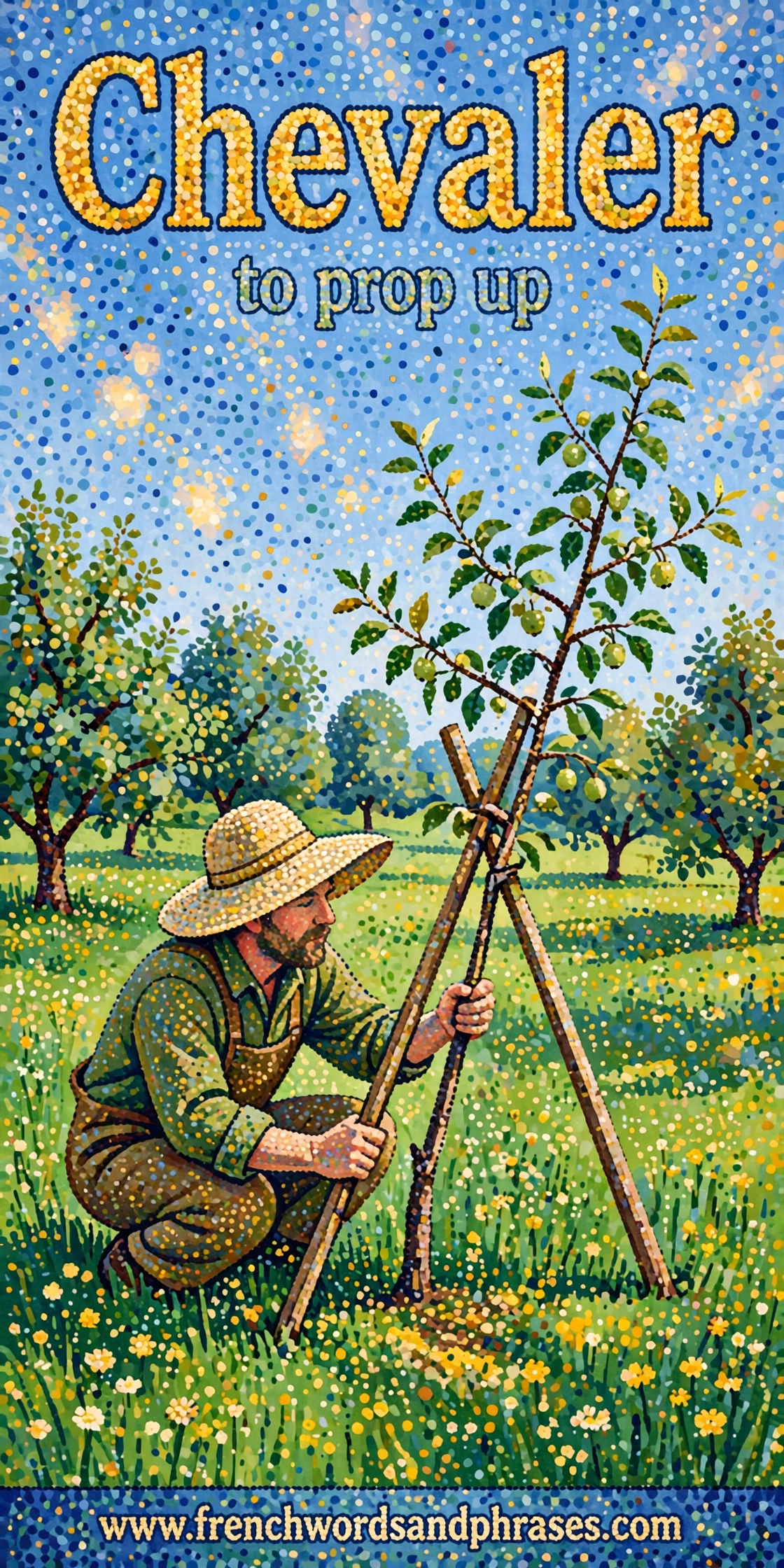
Chevaler means to prop up — to support a beam, a gallery or a vault with stout wooden props until it can stand alone.
Deep in a coal gallery, miners are setting timber props under a roof of rock; in a barn, carpenters are slipping trestles under a sagging beam. Chevaler is the sober, technical verb of propping: giving a heavy thing a wooden leg to lean on before it falls.
In this guide, you’ll learn how to conjugate chevaler in all the major French tenses and moods. Explore complete conjugation tables, French examples, English translations, and practice quizzes.
Understanding the French Verb Chevaler
Chevaler is a regular French verb belonging to the first group of verbs, those ending in-er.
It means to prop up. You will meet it in mining reports, restoration work and old building manuals rather than in conversation: chevaler une galerie, chevaler une voûte, chevaler un plafond. For everyday propping French prefers étayer, and a single prop is un étai; chevaler keeps the older world of timbered galleries and hand-set trestles.
Verb classification: First group (-er)
Auxiliary verb: Avoir
Past participle: chevalé
Present participle: chevalant
English equivalents: To prop up, to shore up, to timber; chevaler une poutre — to prop up a beam; chevaler une galerie de mine — to prop up a mine gallery; chevaler un mur — to shore up a wall; chevaler une voûte — to prop up a vault.
One important detail: chevaler is a rare, technical verb of miners and builders, built on un chevalet — a trestle, an easel, literally a little horse that carries a load on its back. To chevaler a gallery is to set those wooden horses under it in a row. Do not confuse it with its near-neighbour chevaucher, to ride astride: one letter changes, and you pass from the pit to the saddle. The verb itself is a perfectly regular -er: je chevale, nous chevalons, ils chevalent.
Experience the Word
Chevaler is the verb of the wooden horse at work — a row of timber legs holding up the dark until men can pass safely beneath.
Imagine a mine gallery in 1900, the lamps low, the rock overhead ticking as it settles. Before a single cart rolls, the timbermen move along the gallery chevalant beam after beam, each prop wedged tight, until the whole roof stands on a forest of little wooden horses.
Nothing here is decorative. Chevalé, the gallery holds — and the shift can go down.
How to Conjugate Chevaler: Complete French Conjugation Guide
Let’s explore every major conjugation of chevaler, beginning with the indicative mood.
How to Conjugate Chevaler in the Indicative Mood
The indicative mood is used to express facts, observations, actions, and events.
How to Conjugate Chevaler in the Present Tense (Présent)
Used for actions happening now, habitual actions, and general truths.
| Subject | Conjugation |
|---|---|
| je | chevale |
| tu | chevales |
| il / elle | chevale |
| nous | chevalons |
| vous | chevalez |
| ils / elles | chevalent |
Example
Les mineurs chevalent la galerie avant d’avancer plus loin.
The miners prop up the gallery before advancing any further.
Quick Quiz 1
Complete the sentence:
Nous ______ la voûte de la cave demain.
Reveal the answer
chevalerons
Nous chevalerons la voûte de la cave demain.
We will prop up the cellar vault tomorrow.
How to Conjugate Chevaler in the Passé Composé
Used for completed actions in the past. Chevaler takes the auxiliary verb avoir.
| Subject | Conjugation |
|---|---|
| j’ | ai chevalé |
| tu | as chevalé |
| il / elle | a chevalé |
| nous | avons chevalé |
| vous | avez chevalé |
| ils / elles | ont chevalé |
Example
Ils ont chevalé la poutre maîtresse pendant les travaux.
They propped up the main beam during the works.
How to Conjugate Chevaler in the Imparfait (Imperfect Tense)
Used for habitual past actions, descriptions, and ongoing situations in the past.
| Subject | Conjugation |
|---|---|
| je | chevalais |
| tu | chevalais |
| il / elle | chevalait |
| nous | chevalions |
| vous | chevaliez |
| ils / elles | chevalaient |
Example
Autrefois, on chevalait les galeries avec du bois de pin.
In the old days, galleries were propped up with pine wood.
Quick Quiz 2
Choose the correct form:
They propped up the wall in time.
Ils ______ le mur à temps. (ont chevalé / sont chevalés)
Reveal the answer
ont chevalé
Ils ont chevalé le mur à temps.
Chevaler takes avoir.
How to Conjugate Chevaler in the Plus-que-parfait
Used to describe an action that had already been completed before another past event.
| Subject | Conjugation |
|---|---|
| j’ | avais chevalé |
| tu | avais chevalé |
| il / elle | avait chevalé |
| nous | avions chevalé |
| vous | aviez chevalé |
| ils / elles | avaient chevalé |
Example
L’équipe avait chevalé le mur avant l’arrivée de l’inspecteur.
The team had propped up the wall before the inspector arrived.
How to Conjugate Chevaler in the Passé Simple
Primarily used in formal writing, literature, and historical narratives. It is rarely used in everyday conversation.
| Subject | Conjugation |
|---|---|
| je | chevalai |
| tu | chevalas |
| il / elle | chevala |
| nous | chevalâmes |
| vous | chevalâtes |
| ils / elles | chevalèrent |
Example
Les charpentiers chevalèrent la charpente en une journée.
The carpenters propped up the frame in a single day.
How to Conjugate Chevaler in the Passé Antérieur
A literary tense used to express an action completed immediately before another past action, generally in the passé simple.
| Subject | Conjugation |
|---|---|
| j’ | eus chevalé |
| tu | eus chevalé |
| il / elle | eut chevalé |
| nous | eûmes chevalé |
| vous | eûtes chevalé |
| ils / elles | eurent chevalé |
Example
Quand ils eurent chevalé la galerie, les mineurs descendirent sans crainte.
When they had propped up the gallery, the miners went down without fear.
How to Conjugate Chevaler in the Future Tense (Futur Simple)
Used to describe actions that will take place in the future.
| Subject | Conjugation |
|---|---|
| je | chevalerai |
| tu | chevaleras |
| il / elle | chevalera |
| nous | chevalerons |
| vous | chevalerez |
| ils / elles | chevaleront |
Example
Demain, nous chevalerons la voûte de la cave.
Tomorrow, we will prop up the vault of the cellar.
How to Conjugate Chevaler in the Futur Antérieur (Future Perfect)
Used for an action that will have been completed before a particular point in the future.
| Subject | Conjugation |
|---|---|
| j’ | aurai chevalé |
| tu | auras chevalé |
| il / elle | aura chevalé |
| nous | aurons chevalé |
| vous | aurez chevalé |
| ils / elles | auront chevalé |
Example
À la fin de la semaine, ils auront chevalé toutes les galeries du fond.
By the end of the week, they will have propped up all the deep galleries.
How to Conjugate Chevaler in the Near Future (Futur Proche)
Used to describe something that is going to happen soon. Formed with aller + infinitive.
| Subject | Conjugation |
|---|---|
| je | vais chevaler |
| tu | vas chevaler |
| il / elle | va chevaler |
| nous | allons chevaler |
| vous | allez chevaler |
| ils / elles | vont chevaler |
Example
Vite, on va chevaler ce mur avant qu’il ne s’écroule !
Quick, we are going to prop up this wall before it collapses!
How to Conjugate Chevaler in the Conditional Mood
The conditional mood expresses what would happen under certain circumstances. It is also frequently used to make polite requests or express wishes.
How to Conjugate Chevaler in the Present Conditional
| Subject | Conjugation |
|---|---|
| je | chevalerais |
| tu | chevalerais |
| il / elle | chevalerait |
| nous | chevalerions |
| vous | chevaleriez |
| ils / elles | chevaleraient |
Example
Avec des étais de fer, on chevalerait la voûte plus vite.
With iron props, we would prop up the vault more quickly.
How to Conjugate Chevaler in the Past Conditional
| Subject | Conjugation |
|---|---|
| j’ | aurais chevalé |
| tu | aurais chevalé |
| il / elle | aurait chevalé |
| nous | aurions chevalé |
| vous | auriez chevalé |
| ils / elles | auraient chevalé |
Example
Ils auraient chevalé le plafond si le bois avait été livré.
They would have propped up the ceiling if the wood had been delivered.
Chevaler in the Literary Past Conditional Form
This less common literary form uses the imperfect subjunctive of avoir.
| Subject | Conjugation |
|---|---|
| j’ | eusse chevalé |
| tu | eusses chevalé |
| il / elle | eût chevalé |
| nous | eussions chevalé |
| vous | eussiez chevalé |
| ils / elles | eussent chevalé |
Example
Il eût chevalé la poutre, mais le bois manquait.
He would have propped up the beam, but the wood was lacking.
How to Conjugate Chevaler in the Subjunctive Mood
The subjunctive is used to express wishes, emotions, doubts, necessity, and uncertainty. It frequently follows expressions such as il faut que (it is necessary that) or bien que (although).
How to Conjugate Chevaler in the Present Subjunctive
| Subject | Conjugation |
|---|---|
| que je | chevale |
| que tu | chevales |
| qu’il / qu’elle | chevale |
| que nous | chevalions |
| que vous | chevaliez |
| qu’ils / qu’elles | chevalent |
Example
Il faut que vous chevaliez cette poutre avant midi.
You must prop up this beam before noon.
Quick Quiz 3
Complete the sentence using the subjunctive:
Il faut que tu ______ cette poutre avant midi.
Reveal the answer
chevales
Il faut que tu chevales cette poutre avant midi.
You must prop up this beam before noon.
How to Conjugate Chevaler in the Imperfect Subjunctive
A literary tense, rarely encountered in modern spoken French.
| Subject | Conjugation |
|---|---|
| que je | chevalasse |
| que tu | chevalasses |
| qu’il / qu’elle | chevalât |
| que nous | chevalassions |
| que vous | chevalassiez |
| qu’ils / qu’elles | chevalassent |
Example
Le chef exigeait que l’on chevalât chaque galerie neuve.
The foreman required every new gallery to be propped up.
How to Conjugate Chevaler in the Pluperfect Subjunctive
A literary construction used to express an action completed before another past action.
| Subject | Conjugation |
|---|---|
| que j’ | eusse chevalé |
| que tu | eusses chevalé |
| qu’il / qu’elle | eût chevalé |
| que nous | eussions chevalé |
| que vous | eussiez chevalé |
| qu’ils / qu’elles | eussent chevalé |
Example
On vérifia que les mineurs eussent chevalé la voûte.
They checked that the miners had propped up the vault.
How to Conjugate Chevaler in the Past Subjunctive
| Subject | Conjugation |
|---|---|
| que j’ | aie chevalé |
| que tu | aies chevalé |
| qu’il / qu’elle | ait chevalé |
| que nous | ayons chevalé |
| que vous | ayez chevalé |
| qu’ils / qu’elles | aient chevalé |
Example
Je suis rassuré qu’ils aient chevalé le mur à temps.
I am relieved that they propped up the wall in time.
How to Conjugate Chevaler in the Imperative
The imperative is used to give commands, instructions, invitations, or suggestions. Subject pronouns are omitted.
How to Conjugate Chevaler in the Present Imperative
| Person | Conjugation |
|---|---|
| (tu) | chevale |
| (nous) | chevalons |
| (vous) | chevalez |
Example
Chevalez la poutre avant de retirer l’échafaudage !
Prop up the beam before removing the scaffolding!
Quick Quiz 4
How would you say Prop up the beam (tu form)?
Reveal the answer
Chevale la poutre !
French Participles of Chevaler
Participles are verb forms that can be used in compound tenses and other grammatical constructions.
Present Participle of Chevaler
chevalant
En chevalant la galerie, les mineurs ont trouvé une source.
While propping up the gallery, the miners found a spring.
Past Participle of Chevaler
chevalé
Chevalée avec soin, la voûte a tenu tout l’hiver.
Propped up with care, the vault held all winter.
Chevaler in Everyday French: Real-Life Examples
Now that you know the conjugations, let’s see how chevaler appears in everyday French.
Example 1 — Present
Les mineurs chevalent la galerie.
The miners prop up the gallery.
Example 2 — Passé composé
Ils ont chevalé la poutre maîtresse.
They propped up the main beam.
Example 3 — Imparfait
On chevalait les galeries avec du pin.
Galleries were propped up with pine.
Example 4 — Future
Nous chevalerons la voûte de la cave.
We will prop up the cellar vault.
Example 5 — Conditional
On chevalerait plus vite avec des étais de fer.
We would prop it up faster with iron props.
Example 6 — Imperative
Chevalez la poutre avant midi !
Prop up the beam before noon!
Beyond Translation: The Meaning of Chevaler
The whole cheval family works in this word: a chevalet is a little horse of wood — the painter’s easel, the sawyer’s trestle, the prop in the mine — anything with four legs that carries a load.
Chevaler is to give a building its horses.
English does the same trick without knowing it: a sawhorse is exactly un chevalet, and to prop a gallery with them is, in both languages, to set the wooden horses in a row.
How to Remember the French Verb Chevaler
Remember it this way: Chevaler is about a row of wooden horses holding up the mine roof.
- Picture the chevalet — the little wooden horse (easel, trestle, sawhorse): chevaler is to set those horses under a beam or a gallery.
- A technical verb of mines and building sites: chevaler une galerie, une voûte, une poutre — everyday French usually says étayer.
- Regular -er: je chevale, nous chevalons, past participle chevalé — and do not confuse it with chevaucher, to ride.
The key idea is a row of wooden horses holding up the mine roof.
Test Your Knowledge of Chevaler
Let’s see how much you’ve learned. Try answering these questions before revealing the answers.
Question 1
What is a chevalet, and how does it explain chevaler?
Reveal the answer
A trestle or easel — a little wooden horse; to chevaler is to prop something up on such trestles.
Question 2
How do you say The miners prop up the gallery in French?
Reveal the answer
Les mineurs chevalent la galerie.
Question 3
Translate: They propped up the main beam.
Reveal the answer
Ils ont chevalé la poutre maîtresse.
Question 4
What is the past participle of chevaler?
Reveal the answer
Chevalé.
Question 5
Complete the sentence:
Il faut que vous ______ cette poutre avant midi.
Reveal the answer
chevaliez
Il faut que vous chevaliez cette poutre avant midi.
You must prop up this beam before noon.
Your Final Challenge
Can You Use It?
How would you say this in French?
The miners prop up the gallery in silence, and the mountain agrees to hold for one more day.
Reveal the answer
Les mineurs chevalent la galerie en silence, et la montagne accepte de tenir encore un jour.
The miners prop up the gallery in silence, and the mountain agrees to hold for one more day.
A little French. A little curiosity. A richer everyday life.
LEARN FRENCH ONE WORD AT A TIME