A French Word to Live By
How to Conjugate Châtier in French
/ʃa.tje/
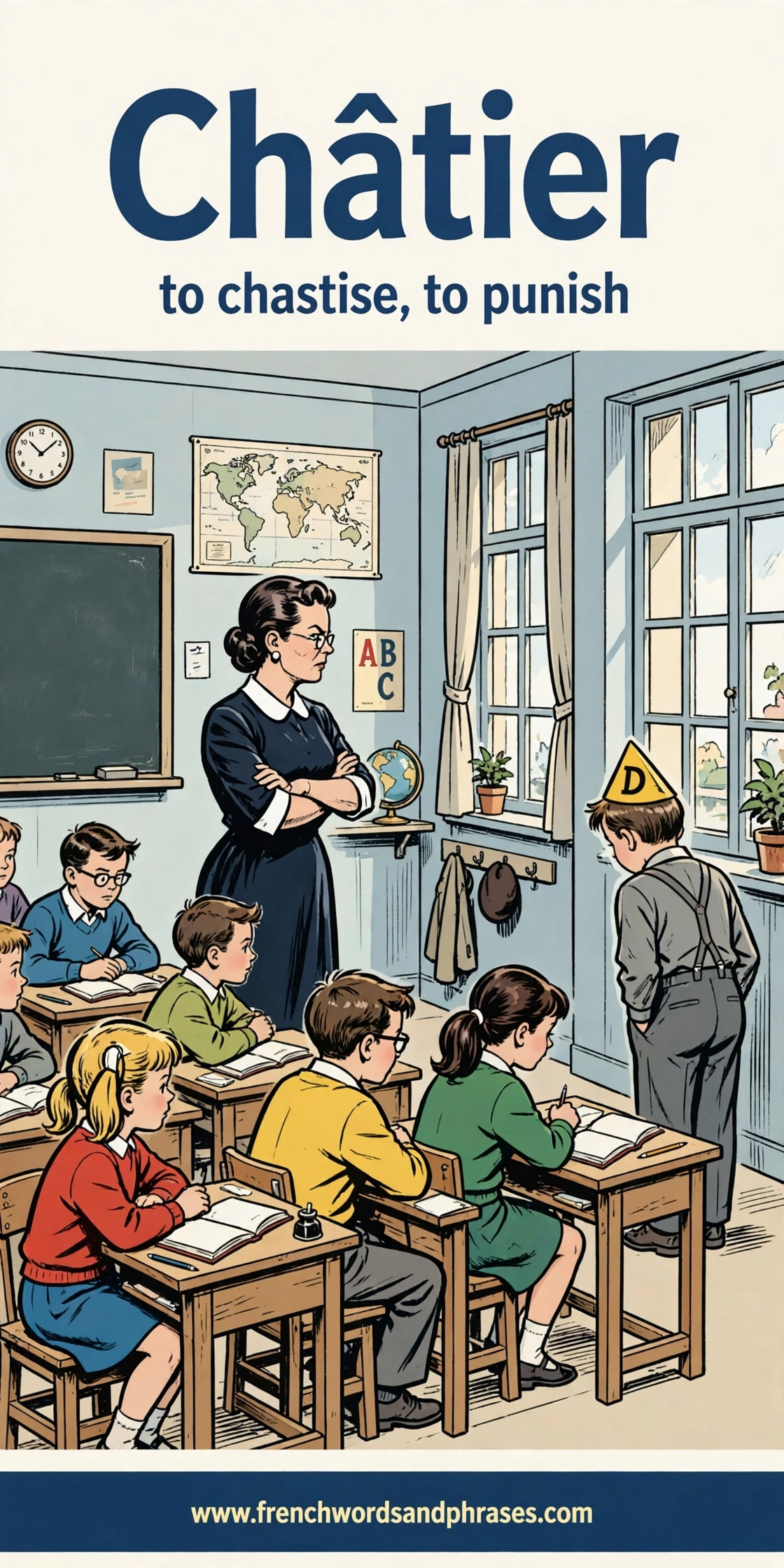
Châtier means to chastise, to punish — to correct someone with a punishment, and, for a writer, to discipline a style until it shines.
A stern schoolmaster of another century, ruler in hand; a judge pronouncing sentence; and, in a quiet study, a poet crossing out line after line of his own verse. Châtier is the old, formal verb of punishment — of others, and of one’s own prose.
In this guide, you’ll learn how to conjugate châtier in all the major French tenses and moods. Explore complete conjugation tables, French examples, English translations, and practice quizzes.
Understanding the French Verb Châtier
Châtier is a regular French verb belonging to the first group of verbs, those ending in-er.
It means to chastise, to punish. It is used in formal and literary French for punishing the guilty, correcting children in older texts, and — its living use today — for the careful refining of language: un langage châtié is faultless, elegant French, and writers still châtient their manuscripts page by page.
Verb classification: First group (-er)
Auxiliary verb: Avoir
Past participle: châtié
Present participle: châtiant
English equivalents: To chastise, to punish, to castigate; châtier un enfant — to punish a child (old-fashioned); châtier les coupables — to punish the guilty; châtier son style — to refine one’s style carefully; un langage châtié — polished, correct language.
One important detail: châtier is the literary elder of punir — everyday French punishes with punir, while châtier belongs to judges, proverbs and older books, and its noun is le châtiment, punishment. Keep the circumflex: châtier, châtiment. And watch the double i where the stem meets an i-ending: present nous châtions (one i), but imparfait and subjunctive nous châtiions, que nous châtiiez (two). Its finest use is reflexive work on words: châtier son style is to polish one’s style, and un style châtié is prose that has been punished into perfection.
Experience the Word
Châtier is punishment with a purpose — not revenge, but correction: of a culprit, of a child, or of a sentence that dares to be clumsy.
Imagine a writer at midnight, the lamp low, the manuscript covered in crossings-out. Every loose phrase is punished, every lazy word struck through. Demain, le texte sera châtié — lean, exact, and twice as strong.
No one has been struck or scolded. Only the prose has been châtiée — disciplined until it gleams.
How to Conjugate Châtier: Complete French Conjugation Guide
Let’s explore every major conjugation of châtier, beginning with the indicative mood.
How to Conjugate Châtier in the Indicative Mood
The indicative mood is used to express facts, observations, actions, and events.
How to Conjugate Châtier in the Present Tense (Présent)
Used for actions happening now, habitual actions, and general truths.
| Subject | Conjugation |
|---|---|
| je | châtie |
| tu | châties |
| il / elle | châtie |
| nous | châtions |
| vous | châtiez |
| ils / elles | châtient |
Example
Le maître châtie rarement ses élèves.
The schoolmaster rarely punishes his pupils.
Quick Quiz 1
Complete the sentence:
Le juge ______ les coupables.
Reveal the answer
châtie
Le juge châtie les coupables.
The judge punishes the guilty.
How to Conjugate Châtier in the Passé Composé
Used for completed actions in the past. Châtier takes the auxiliary verb avoir.
| Subject | Conjugation |
|---|---|
| j’ | ai châtié |
| tu | as châtié |
| il / elle | a châtié |
| nous | avons châtié |
| vous | avez châtié |
| ils / elles | ont châtié |
Example
Le juge a châtié les coupables avec sévérité.
The judge punished the guilty severely.
How to Conjugate Châtier in the Imparfait (Imperfect Tense)
Used for habitual past actions, descriptions, and ongoing situations in the past.
| Subject | Conjugation |
|---|---|
| je | châtiais |
| tu | châtiais |
| il / elle | châtiait |
| nous | châtiions |
| vous | châtiiez |
| ils / elles | châtiaient |
Example
Autrefois, on châtiait les enfants pour un rien.
In the old days, children were punished for nothing at all.
Quick Quiz 2
Choose the correct form:
The king punished the rebels.
Le roi ______ les rebelles. (a châtié / est châtié)
Reveal the answer
a châtié
Le roi a châtié les rebelles.
Châtier takes avoir.
How to Conjugate Châtier in the Plus-que-parfait
Used to describe an action that had already been completed before another past event.
| Subject | Conjugation |
|---|---|
| j’ | avais châtié |
| tu | avais châtié |
| il / elle | avait châtié |
| nous | avions châtié |
| vous | aviez châtié |
| ils / elles | avaient châtié |
Example
Il avait châtié son style pendant des mois avant de publier.
He had polished his style for months before publishing.
How to Conjugate Châtier in the Passé Simple
Primarily used in formal writing, literature, and historical narratives. It is rarely used in everyday conversation.
| Subject | Conjugation |
|---|---|
| je | châtiai |
| tu | châtias |
| il / elle | châtia |
| nous | châtiâmes |
| vous | châtiâtes |
| ils / elles | châtièrent |
Example
Le roi châtia les rebelles sans pitié.
The king punished the rebels without mercy.
How to Conjugate Châtier in the Passé Antérieur
A literary tense used to express an action completed immediately before another past action, generally in the passé simple.
| Subject | Conjugation |
|---|---|
| j’ | eus châtié |
| tu | eus châtié |
| il / elle | eut châtié |
| nous | eûmes châtié |
| vous | eûtes châtié |
| ils / elles | eurent châtié |
Example
Quand le père eut châtié l’enfant, un silence pesant suivit.
When the father had punished the child, a heavy silence followed.
How to Conjugate Châtier in the Future Tense (Futur Simple)
Used to describe actions that will take place in the future.
| Subject | Conjugation |
|---|---|
| je | châtierai |
| tu | châtieras |
| il / elle | châtiera |
| nous | châtierons |
| vous | châtierez |
| ils / elles | châtieront |
Example
La loi châtiera les fraudeurs.
The law will punish the fraudsters.
How to Conjugate Châtier in the Futur Antérieur (Future Perfect)
Used for an action that will have been completed before a particular point in the future.
| Subject | Conjugation |
|---|---|
| j’ | aurai châtié |
| tu | auras châtié |
| il / elle | aura châtié |
| nous | aurons châtié |
| vous | aurez châtié |
| ils / elles | auront châtié |
Example
À la fin du procès, le tribunal aura châtié les coupables.
By the end of the trial, the court will have punished the guilty.
How to Conjugate Châtier in the Near Future (Futur Proche)
Used to describe something that is going to happen soon. Formed with aller + infinitive.
| Subject | Conjugation |
|---|---|
| je | vais châtier |
| tu | vas châtier |
| il / elle | va châtier |
| nous | allons châtier |
| vous | allez châtier |
| ils / elles | vont châtier |
Example
Je vais châtier ce paragraphe jusqu’à ce qu’il soit parfait.
I am going to polish this paragraph until it is perfect.
How to Conjugate Châtier in the Conditional Mood
The conditional mood expresses what would happen under certain circumstances. It is also frequently used to make polite requests or express wishes.
How to Conjugate Châtier in the Present Conditional
| Subject | Conjugation |
|---|---|
| je | châtierais |
| tu | châtierais |
| il / elle | châtierait |
| nous | châtierions |
| vous | châtieriez |
| ils / elles | châtieraient |
Example
Un bon juge châtierait avec mesure.
A good judge would punish with measure.
How to Conjugate Châtier in the Past Conditional
| Subject | Conjugation |
|---|---|
| j’ | aurais châtié |
| tu | aurais châtié |
| il / elle | aurait châtié |
| nous | aurions châtié |
| vous | auriez châtié |
| ils / elles | auraient châtié |
Example
Il aurait châtié son fils si la faute avait été grave.
He would have punished his son if the offence had been serious.
Châtier in the Literary Past Conditional Form
This less common literary form uses the imperfect subjunctive of avoir.
| Subject | Conjugation |
|---|---|
| j’ | eusse châtié |
| tu | eusses châtié |
| il / elle | eût châtié |
| nous | eussions châtié |
| vous | eussiez châtié |
| ils / elles | eussent châtié |
Example
Le ciel eût châtié les traîtres, croyait-on.
Heaven would have punished the traitors, so people believed.
How to Conjugate Châtier in the Subjunctive Mood
The subjunctive is used to express wishes, emotions, doubts, necessity, and uncertainty. It frequently follows expressions such as il faut que (it is necessary that) or bien que (although).
How to Conjugate Châtier in the Present Subjunctive
| Subject | Conjugation |
|---|---|
| que je | châtie |
| que tu | châties |
| qu’il / qu’elle | châtie |
| que nous | châtiions |
| que vous | châtiiez |
| qu’ils / qu’elles | châtient |
Example
Il faut que la justice châtie les coupables.
Justice must punish the guilty.
Quick Quiz 3
Complete the sentence using the subjunctive:
Il faut que tu ______ ton style avant de publier.
Reveal the answer
châties
Il faut que tu châties ton style avant de publier.
You must polish your style before publishing.
How to Conjugate Châtier in the Imperfect Subjunctive
A literary tense, rarely encountered in modern spoken French.
| Subject | Conjugation |
|---|---|
| que je | châtiasse |
| que tu | châtiasses |
| qu’il / qu’elle | châtiât |
| que nous | châtiassions |
| que vous | châtiassiez |
| qu’ils / qu’elles | châtiassent |
Example
On ne voulait pas que le maître châtiât l’enfant devant la classe.
Nobody wanted the master to punish the child in front of the class.
How to Conjugate Châtier in the Pluperfect Subjunctive
A literary construction used to express an action completed before another past action.
| Subject | Conjugation |
|---|---|
| que j’ | eusse châtié |
| que tu | eusses châtié |
| qu’il / qu’elle | eût châtié |
| que nous | eussions châtié |
| que vous | eussiez châtié |
| qu’ils / qu’elles | eussent châtié |
Example
On craignait que le roi eût châtié des innocents.
People feared the king had punished innocent people.
How to Conjugate Châtier in the Past Subjunctive
| Subject | Conjugation |
|---|---|
| que j’ | aie châtié |
| que tu | aies châtié |
| qu’il / qu’elle | ait châtié |
| que nous | ayons châtié |
| que vous | ayez châtié |
| qu’ils / qu’elles | aient châtié |
Example
Je doute qu’il ait châtié son style assez longtemps.
I doubt he polished his style for long enough.
How to Conjugate Châtier in the Imperative
The imperative is used to give commands, instructions, invitations, or suggestions. Subject pronouns are omitted.
How to Conjugate Châtier in the Present Imperative
| Person | Conjugation |
|---|---|
| (tu) | châtie |
| (nous) | châtions |
| (vous) | châtiez |
Example
Châtie ton style, chaque mot doit compter !
Polish your style, every word must count!
Quick Quiz 4
How would you say Polish your style (tu form)?
Reveal the answer
Châtie ton style !
French Participles of Châtier
Participles are verb forms that can be used in compound tenses and other grammatical constructions.
Present Participle of Châtier
châtiant
En châtiant sa prose, elle a trouvé sa vraie voix.
By refining her prose, she found her true voice.
Past Participle of Châtier
châtié
Châtié par les critiques, l’auteur récrivit tout son roman.
Castigated by the critics, the author rewrote his whole novel.
Châtier in Everyday French: Real-Life Examples
Now that you know the conjugations, let’s see how châtier appears in everyday French.
Example 1 — Present
Le juge châtie les coupables.
The judge punishes the guilty.
Example 2 — Passé composé
Il a châtié son style.
He polished his style.
Example 3 — Imparfait
On châtiait les enfants autrefois.
Children were punished in the old days.
Example 4 — Future
La loi châtiera les fraudeurs.
The law will punish the fraudsters.
Example 5 — Conditional
Elle châtierait sa prose avec plus de temps.
She would refine her prose with more time.
Example 6 — Imperative
Châtiez votre langage devant les enfants !
Watch your language in front of the children!
Beyond Translation: The Meaning of Châtier
Latin castigare — to drive towards purity — gave French châtier and English both chastise and castigate, so the three are cousins.
Punishment, in this word, aims at purity.
That is why its kindest descendant is un style châtié: language that has been corrected so thoroughly that nothing loose or vulgar remains — the rod turned into a polishing cloth.
How to Remember the French Verb Châtier
Remember it this way: Châtier is about the stern judge — and the writer polishing every sentence.
- Formal and literary: everyday French says punir; châtier belongs to judges, proverbs and careful writers.
- Its living treasure: châtier son style — to polish one’s style; un langage châtié — faultless language.
- Mind the double i: nous châtions (present) but nous châtiions (imparfait); past participle châtié.
The key idea is the stern judge — and the writer polishing every sentence.
Test Your Knowledge of Châtier
Let’s see how much you’ve learned. Try answering these questions before revealing the answers.
Question 1
What is the everyday modern verb that has replaced châtier for punish?
Reveal the answer
Punir — châtier survives in formal, legal and literary French.
Question 2
How do you say The judge punished the guilty in French?
Reveal the answer
Le juge a châtié les coupables.
Question 3
Translate: He polished his style for months.
Reveal the answer
Il a châtié son style pendant des mois.
Question 4
What is the past participle of châtier?
Reveal the answer
Châtié.
Question 5
Complete the sentence:
Il faut que la justice ______ les coupables.
Reveal the answer
châtie
Il faut que la justice châtie les coupables.
Justice must punish the guilty.
Your Final Challenge
Can You Use It?
How would you say this in French?
She polishes every sentence of her novel, and the book comes out stronger for it.
Reveal the answer
Elle châtie chaque phrase de son roman, et le livre en sort plus fort.
She polishes every sentence of her novel, and the book comes out stronger for it.
A little French. A little curiosity. A richer everyday life.
LEARN FRENCH ONE WORD AT A TIME