A French Word to Live By
Translate Charrue to English
/ʃa.ʁy/
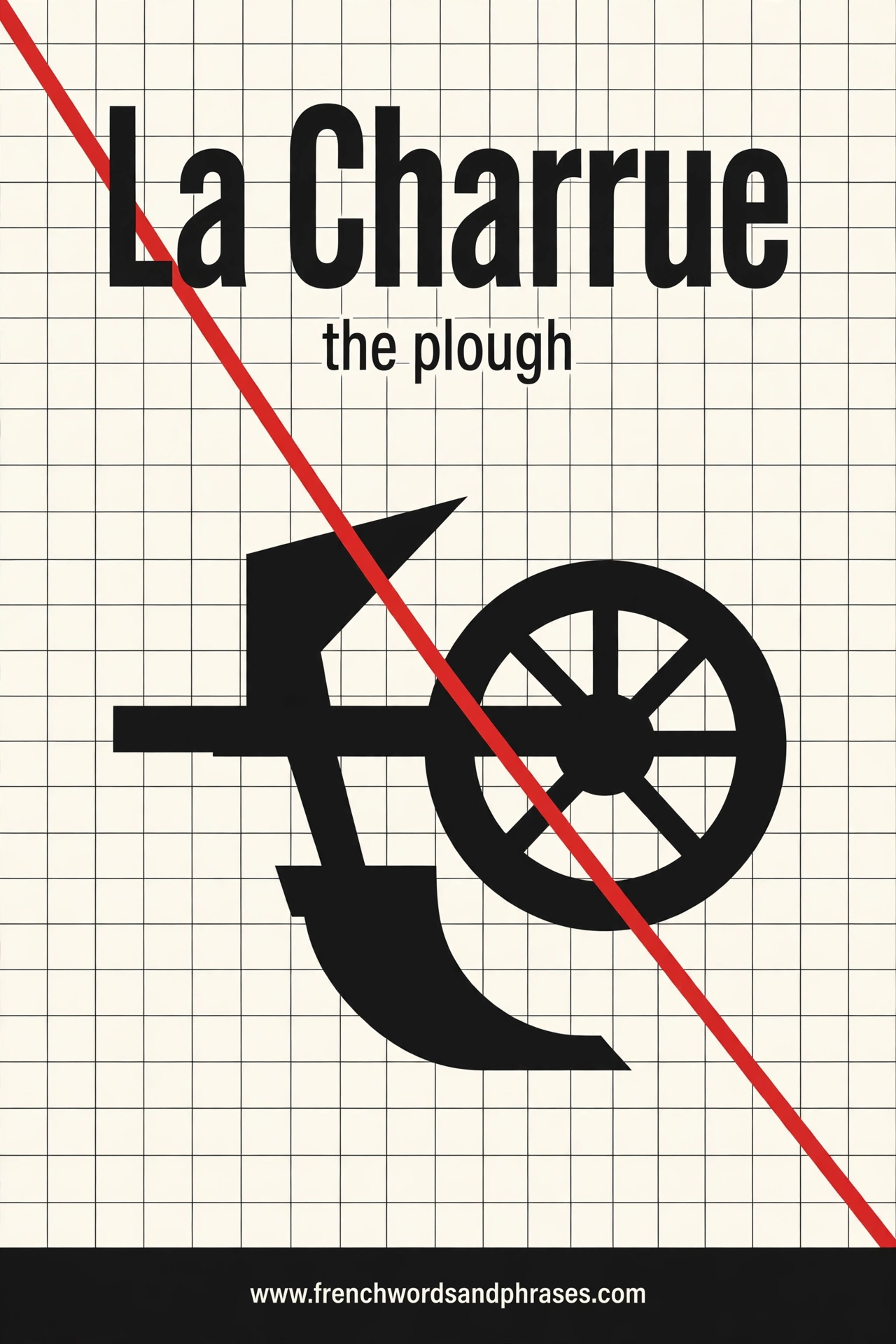
La charrue means the plough.
First light on the farm: the share bites the cold earth, the furrow unrolls behind like a brown ribbon, and the whole field turns over in its sleep. The day begins behind la charrue.
In this guide, you’ll learn what charrue means in English, how to use it with its articles, how to form its plural, and how it appears in everyday French. Explore French examples, English translations, and practice quizzes.
Understanding the French Noun Charrue
Charrue is a feminine French noun, learned with its article: la charrue, une charrue. The word is ancient — it comes from the Gaulish carts of Roman times — and it has been turning French soil, and French sentences, ever since.
It means the plough — the implement that cuts and turns the soil before sowing, drawn for centuries by oxen or horses and today by the tractor. Its blade is le soc (the ploughshare) and its work is le labour (ploughing). Above all, the charrue is immortal for one sentence: mettre la charrue avant les bœufs — to put the plough before the oxen — is the French way of saying the cart before the horse, everything in the wrong order.
Gender: Feminine
Definite article: la — la charrue (the plough)
Indefinite article: une — une charrue (a plough)
Plural: les charrues
Its blade: le soc — the ploughshare, the part that cuts the earth
English equivalents: The plough (American spelling: plow).
One important usage detail: the verb that goes with charrue is labourer — to plough a field is labourer un champ, and the ploughed earth itself is le labour. And when a French speaker accuses you of putting la charrue avant les bœufs, they are not discussing farming: your plan is simply in the wrong order.
Experience the Word
Charrue is more than a farm tool. It is the instrument that made France a farming nation — the slow blade that turned wild earth into wheat fields, one furrow at a time.
Imagine the museum of old agriculture: a wooden charrue worn smooth by ten thousand mornings, its share still bright where the soil polished it, retired like an old soldier.
You have not just turned some earth. You have written on the land itself — ligne après ligne, sillon après sillon, line after line.
How to Use Charrue in French: Complete Guide
Let’s explore how charrue works in French, beginning with its articles — the plough that must always, always come behind the oxen.
Charrue with the Definite Article (La, Les)
Used for a particular plough — the one by the barn, ready for the morning’s work.
| Form | French |
|---|---|
| Singular | la charrue |
| Plural | les charrues |
Example
La charrue attend près de la grange.
The plough is waiting near the barn.
Charrue with the Indefinite Article (Une, Des)
Used for a plough in general — une charrue, wooden in the old days, steel today.
| Form | French |
|---|---|
| Singular | une charrue |
| Plural | des charrues |
Example
Le musée expose une charrue en bois du siècle dernier.
The museum displays a wooden plough from the last century.
Charrue in Quantities and Negatives
Ploughs are countable, and after quantity words French uses de — plusieurs charrues, pas de charrue.
| Expression | French |
|---|---|
| several ploughs | plusieurs charrues |
| an old plough | une vieille charrue |
| each plough | chaque charrue |
| no plough | pas de charrue |
| two ploughs | deux charrues |
Example
La ferme possède deux charrues modernes.
The farm owns two modern ploughs.
Quick Quiz 1
Complete the sentence:
Les bœufs tirent ______ dans le champ. (the plough)
Reveal the answer
la charrue
Les bœufs tirent la charrue dans le champ.
The oxen are pulling the plough in the field.
The Plural of Charrue
Charrue adds an -s in the plural — les charrues, lined up at the agricultural fair.
| Number | French |
|---|---|
| Singular | la charrue |
| Plural | les charrues |
Example
Les charrues modernes sont tirées par des tracteurs.
Modern ploughs are pulled by tractors.
Charrue with Possessive Adjectives (Ma, Ta, Sa…)
Possessives agree with the noun: charrue is feminine, so ma, ta, sa in the singular.
| Owner | French |
|---|---|
| my | ma charrue |
| your (tu) | ta charrue |
| his / her | sa charrue |
| our | notre charrue |
| your (vous) | votre charrue |
| their | leur charrue |
Example
Sa charrue est un héritage de son grand-père.
His plough is an heirloom from his grandfather.
Quick Quiz 2
Complete the sentence:
______ charrue ouvre de longs sillons. (Our)
Reveal the answer
Notre
Notre charrue ouvre de longs sillons.
Our plough opens long furrows.
Charrue with Demonstrative Adjectives (Cette, Ces)
Used to point: cette charrue — this plough here, the one in the museum photograph.
| Form | French |
|---|---|
| Singular | cette charrue |
| Plural | ces charrues |
Example
Cette charrue a plus de cent ans.
This plough is more than a hundred years old.
Charrue with Adjectives
Adjectives agree with charrue and take the feminine form: vieille, moderne, lourde.
| Adjective | With Charrue |
|---|---|
| vieux (old) | une vieille charrue |
| moderne (modern) | une charrue moderne |
| lourd (heavy) | une charrue lourde |
| ancien (ancient, former) | une ancienne charrue |
| en bois (wooden) | une charrue en bois |
Example
Une vieille charrue en bois dort dans la grange.
An old wooden plough is sleeping in the barn.
Quick Quiz 3
Complete the sentence:
C’est une charrue très ______. (old)
Reveal the answer
vieille
C’est une charrue très vieille.
It is a very old plough — vieille, the feminine of vieux.
Everyday Expressions with Charrue
Wrong orders and long furrows — the charrue phrases of daily life.
| Expression | In English |
|---|---|
| mettre la charrue avant les bœufs | to put the cart before the horse |
| tirer la charrue | to pull the plough — to slog away at hard work |
| labourer avec une charrue | to plough with a plough |
| une charrue moderne | a modern plough |
| derrière la charrue | behind the plough, at the ploughing |
Example
Tu mets la charrue avant les bœufs : apprends d’abord les bases !
You’re putting the cart before the horse: learn the basics first!
Words from the Same Family as Charrue
Furrows, fields and ploughing — the words that travel with charrue.
| French | In English |
|---|---|
| labourer | to plough |
| le labour | ploughing; ploughed land |
| le sillon | the furrow |
| le soc | the ploughshare |
| le champ | the field |
| le bœuf | the ox |
Example
La charrue ouvre un long sillon dans le champ.
The plough opens a long furrow in the field.
Quick Quiz 4
What is le sillon?
Reveal the answer
The furrow — the long line the charrue cuts and turns in the earth.
Les sillons réguliers traversent tout le champ.
The regular furrows run across the whole field.
Charrue in Everyday French: Real-Life Examples
Now that you know the word, let’s see how charrue appears in everyday French.
Example 1 — Morning work
La charrue ouvre de longs sillons dans le champ.
The plough is opening long furrows in the field.
Example 2 — The idiom
Ne mets pas la charrue avant les bœufs !
Don’t put the cart before the horse!
Example 3 — At the museum
Cette charrue en bois date de 1890.
This wooden plough dates from 1890.
Example 4 — Modern farming
Aujourd’hui, le tracteur tire la charrue.
Today, the tractor pulls the plough.
Example 5 — Hard slog
Depuis janvier, il tire la charrue sur ce projet.
Since January, he has been slogging away at this project.
Example 6 — Grandfather’s farm
La vieille charrue de mon grand-père est toujours là.
My grandfather’s old plough is still there.
Beyond Translation: The Meaning of Charrue
The charrue may be the oldest machine in the French language — its name comes from the Gaulish wagons the Romans admired, and for two thousand years nothing about its job changed: cut, turn, sow, eat. The tractor retired it to the museum and the barn corner, but its idiom works harder than ever. Every project launched backwards, every conclusion jumped to, every wedding planned before the proposal earns the same gentle verdict: tu as mis la charrue avant les bœufs.
To say charrue is to name the right order of things — the oxen first, then the plough, then the harvest.
It evokes the creak of the yoke and the smell of turned earth, the straight furrow running to the horizon — patience itself, drawn in a line across the field.
How to Remember the French Noun Charrue
Remember it this way: Charrue is the plough — feminine, ancient, and famous above all for standing in the wrong place in France’s favourite warning.
- You keep the order — les bœufs d’abord, la charrue ensuite : never the reverse.
- You name its work — labourer un champ, ouvrir des sillons.
- You spot its parts — le soc cuts, la charrue turns, le champ receives.
The key idea is la charrue — always behind the oxen.
Test Your Knowledge of Charrue
Let’s see how much you’ve learned. Try answering these questions before revealing the answers.
Question 1
Is charrue masculine or feminine?
Reveal the answer
Feminine — la charrue, une charrue.
Question 2
What does « mettre la charrue avant les bœufs » mean?
Reveal the answer
To put the cart before the horse — to do things in the wrong order.
Question 3
Translate: The plough opens long furrows in the field.
Reveal the answer
La charrue ouvre de longs sillons dans le champ.
Question 4
What is the verb for to plough?
Reveal the answer
Labourer — labourer un champ, to plough a field; the work itself is le labour.
Question 5
Complete the sentence:
______ charrue est très vieille. (This)
Reveal the answer
Cette
Cette charrue est très vieille.
This plough is very old.
Your Final Challenge
Can You Use It?
How would you say this in French?
“The plough opens long furrows in the field.”
Reveal the answer
La charrue ouvre de longs sillons dans le champ.
The plough opens long furrows in the field.
A little French. A little curiosity. A richer everyday life.
LEARN FRENCH ONE WORD AT A TIME