A French Word to Live By
How to Conjugate Charger in French
/ʃaʁ.ʒe/
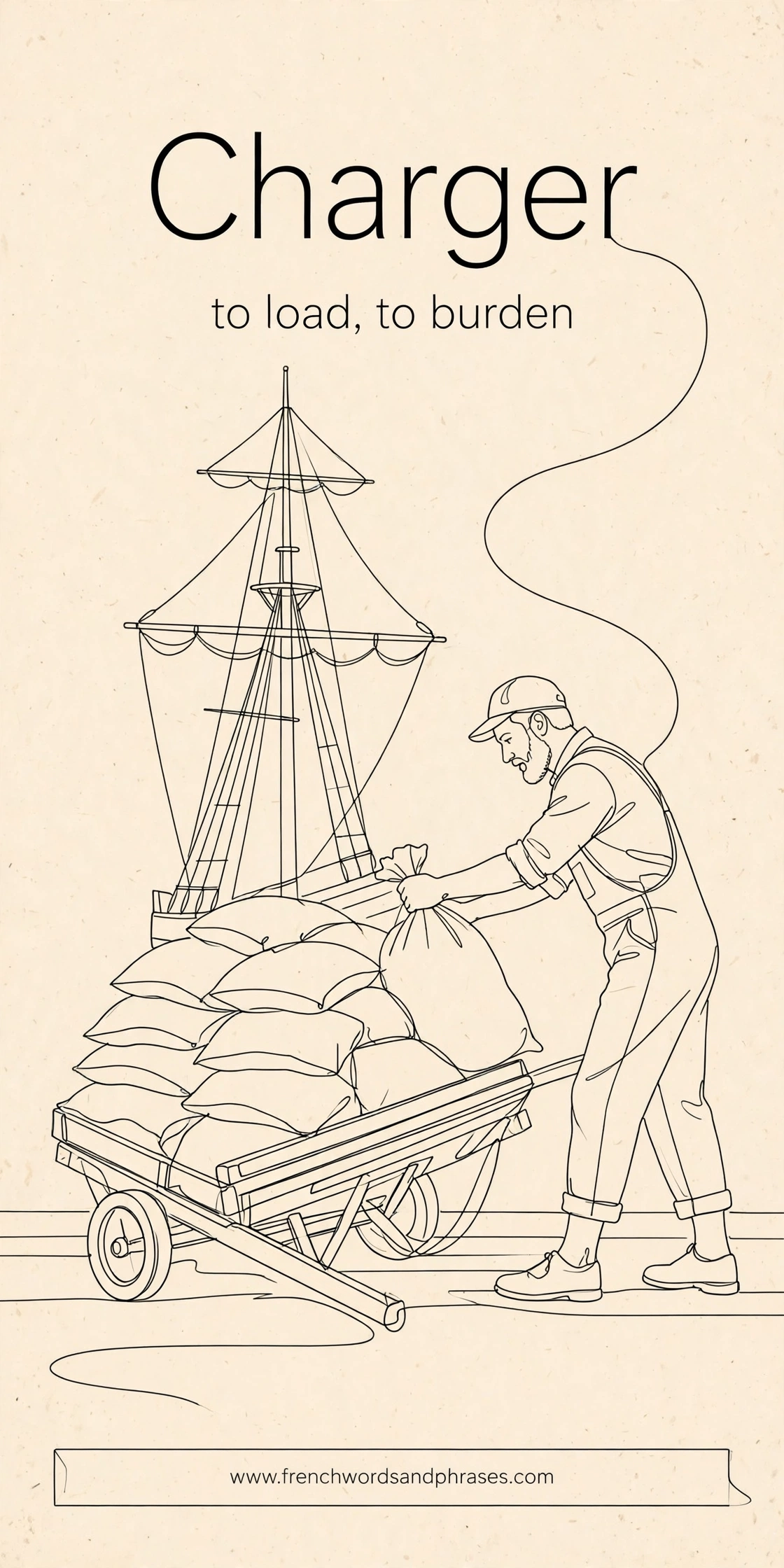
Charger means to load, to burden — to pile weight onto a lorry, a donkey, a rifle or a phone, until the load itself becomes the story.
Dockers loading a ship at dawn, a courier piling parcels into a van, a phone plugged in overnight and a soldier sliding cartridges into a rifle — charger is the verb of putting a load on: cargo, ammunition, electricity and responsibility all charge the same way.
In this guide, you’ll learn how to conjugate charger in all the major French tenses and moods. Explore complete conjugation tables, French examples, English translations, and practice quizzes.
Understanding the French Verb Charger
Charger is a regular French verb belonging to the first group of verbs, those ending in-er.
It means to load, to burden. One of the busiest verbs in the C pages: transport loads it with cargo, the army with cartridges and cavalry charges, the electric age with batteries, and the office with duties — charger un employé des achats, to put an employee in charge of purchasing. The meaning is always the same at heart: weight, transferred onto something or someone.
Verb classification: First group (-er)
Auxiliary verb: Avoir
Past participle: chargé
Present participle: chargeant
English equivalents: To load, to burden, to charge; charger un camion — to load a lorry; charger un fusil — to load a rifle; charger un téléphone — to charge a phone; charger l’ennemi — to charge the enemy; charger quelqu’un de quelque chose — to entrust someone with something, to put someone in charge of something.
Two things to master. First, the spelling of -ger verbs: the e is kept before a and o, to keep the g soft — nous chargeons, je chargeais, en chargeant, il chargea — and dropped elsewhere: je charge, ils chargent, que nous chargions. Second, the great office construction charger quelqu’un de quelque chose: to entrust someone with a task — je te charge de ce dossier, I am putting you in charge of this file. Its reflexive twin, where you take the load on yourself, is se charger de. Add the modern senses — charger un téléphone, to charge a phone, and charger l’ennemi, to charge in battle — and one verb carries half of daily life.
Experience the Word
Charger is the verb of the load going on — crate by crate, volt by volt, duty by duty.
Imagine a courier at dawn in a depot outside Lyon. The van fills crate by crate — il charge les colis du plus lourd au plus léger — while on the dashboard his phone, plugged in all night, finit de charger: by seven o’clock, man, machine and van are all loaded and ready for the road.
Everything that leaves full has been charged. He has loaded — chargé — the van, the phone and the day itself.
How to Conjugate Charger: Complete French Conjugation Guide
Let’s explore every major conjugation of charger, beginning with the indicative mood.
How to Conjugate Charger in the Indicative Mood
The indicative mood is used to express facts, observations, actions, and events.
How to Conjugate Charger in the Present Tense (Présent)
Used for actions happening now, habitual actions, and general truths.
| Subject | Conjugation |
|---|---|
| je | charge |
| tu | charges |
| il / elle | charge |
| nous | chargeons |
| vous | chargez |
| ils / elles | chargent |
Example
Les dockers chargent le navire depuis l’aube.
The dockers have been loading the ship since dawn.
Quick Quiz 1
Complete the sentence:
Nous ______ les meubles dans le camion.
Reveal the answer
chargeons
Nous chargeons les meubles dans le camion.
We are loading the furniture into the lorry — note the e that keeps the g soft.
How to Conjugate Charger in the Passé Composé
Used for completed actions in the past. Charger takes the auxiliary verb avoir.
| Subject | Conjugation |
|---|---|
| j’ | ai chargé |
| tu | as chargé |
| il / elle | a chargé |
| nous | avons chargé |
| vous | avez chargé |
| ils / elles | ont chargé |
Example
Nous avons chargé la voiture en vingt minutes.
We loaded the car in twenty minutes.
How to Conjugate Charger in the Imparfait (Imperfect Tense)
Used for habitual past actions, descriptions, and ongoing situations in the past.
| Subject | Conjugation |
|---|---|
| je | chargeais |
| tu | chargeais |
| il / elle | chargeait |
| nous | chargions |
| vous | chargiez |
| ils / elles | chargeaient |
Example
Chaque matin, il chargeait son âne de sacs de farine.
Every morning, he used to load his donkey with sacks of flour.
Quick Quiz 2
Choose the correct form:
The dockers loaded the ship.
Les dockers ______ le navire. (ont chargé / sont chargés)
Reveal the answer
ont chargé
Les dockers ont chargé le navire.
Charger takes avoir.
How to Conjugate Charger in the Plus-que-parfait
Used to describe an action that had already been completed before another past event.
| Subject | Conjugation |
|---|---|
| j’ | avais chargé |
| tu | avais chargé |
| il / elle | avait chargé |
| nous | avions chargé |
| vous | aviez chargé |
| ils / elles | avaient chargé |
Example
Elle avait chargé son téléphone avant de partir.
She had charged her phone before leaving.
How to Conjugate Charger in the Passé Simple
Primarily used in formal writing, literature, and historical narratives. It is rarely used in everyday conversation.
| Subject | Conjugation |
|---|---|
| je | chargeai |
| tu | chargeas |
| il / elle | chargea |
| nous | chargeâmes |
| vous | chargeâtes |
| ils / elles | chargeèrent |
Example
La cavalerie chargea l’ennemi au lever du soleil.
The cavalry charged the enemy at sunrise.
How to Conjugate Charger in the Passé Antérieur
A literary tense used to express an action completed immediately before another past action, generally in the passé simple.
| Subject | Conjugation |
|---|---|
| j’ | eus chargé |
| tu | eus chargé |
| il / elle | eut chargé |
| nous | eûmes chargé |
| vous | eûtes chargé |
| ils / elles | eurent chargé |
Example
Quand les soldats eurent chargé leurs fusils, le silence se fit.
When the soldiers had loaded their rifles, silence fell.
How to Conjugate Charger in the Future Tense (Futur Simple)
Used to describe actions that will take place in the future.
| Subject | Conjugation |
|---|---|
| je | chargerai |
| tu | chargeras |
| il / elle | chargera |
| nous | chargerons |
| vous | chargerez |
| ils / elles | chargeront |
Example
Demain, nous chargerons les meubles dans le camion.
Tomorrow, we will load the furniture into the lorry.
How to Conjugate Charger in the Futur Antérieur (Future Perfect)
Used for an action that will have been completed before a particular point in the future.
| Subject | Conjugation |
|---|---|
| j’ | aurai chargé |
| tu | auras chargé |
| il / elle | aura chargé |
| nous | aurons chargé |
| vous | aurez chargé |
| ils / elles | auront chargé |
Example
À midi, ils auront chargé tout le matériel.
By noon, they will have loaded all the equipment.
How to Conjugate Charger in the Near Future (Futur Proche)
Used to describe something that is going to happen soon. Formed with aller + infinitive.
| Subject | Conjugation |
|---|---|
| je | vais charger |
| tu | vas charger |
| il / elle | va charger |
| nous | allons charger |
| vous | allez charger |
| ils / elles | vont charger |
Example
Branche ton téléphone, il va charger pendant la nuit.
Plug in your phone, it is going to charge overnight.
How to Conjugate Charger in the Conditional Mood
The conditional mood expresses what would happen under certain circumstances. It is also frequently used to make polite requests or express wishes.
How to Conjugate Charger in the Present Conditional
| Subject | Conjugation |
|---|---|
| je | chargerais |
| tu | chargerais |
| il / elle | chargerait |
| nous | chargerions |
| vous | chargeriez |
| ils / elles | chargeraient |
Example
Sans la grue, on chargerait les caisses à la main.
Without the crane, we would load the crates by hand.
How to Conjugate Charger in the Past Conditional
| Subject | Conjugation |
|---|---|
| j’ | aurais chargé |
| tu | aurais chargé |
| il / elle | aurait chargé |
| nous | aurions chargé |
| vous | auriez chargé |
| ils / elles | auraient chargé |
Example
Je t’aurais chargé de ce dossier si tu avais été là.
I would have entrusted you with this file if you had been there.
Charger in the Literary Past Conditional Form
This less common literary form uses the imperfect subjunctive of avoir.
| Subject | Conjugation |
|---|---|
| j’ | eusse chargé |
| tu | eusses chargé |
| il / elle | eût chargé |
| nous | eussions chargé |
| vous | eussiez chargé |
| ils / elles | eussent chargé |
Example
Le général eût chargé l’ennemi sans l’ordre contraire.
The general would have charged the enemy without the counter-order.
How to Conjugate Charger in the Subjunctive Mood
The subjunctive is used to express wishes, emotions, doubts, necessity, and uncertainty. It frequently follows expressions such as il faut que (it is necessary that) or bien que (although).
How to Conjugate Charger in the Present Subjunctive
| Subject | Conjugation |
|---|---|
| que je | charge |
| que tu | charges |
| qu’il / qu’elle | charge |
| que nous | chargions |
| que vous | chargiez |
| qu’ils / qu’elles | chargent |
Example
Il faut que vous chargiez la voiture avant midi.
You must load the car before noon.
Quick Quiz 3
Complete the sentence using the subjunctive:
Il faut que tu ______ ton téléphone ce soir.
Reveal the answer
charges
Il faut que tu charges ton téléphone ce soir.
You must charge your phone this evening.
How to Conjugate Charger in the Imperfect Subjunctive
A literary tense, rarely encountered in modern spoken French.
| Subject | Conjugation |
|---|---|
| que je | chargasse |
| que tu | chargasses |
| qu’il / qu’elle | chargât |
| que nous | chargassions |
| que vous | chargassiez |
| qu’ils / qu’elles | chargassent |
Example
Le capitaine ordonna que l’on chargeât les canons.
The captain ordered the cannons to be loaded.
How to Conjugate Charger in the Pluperfect Subjunctive
A literary construction used to express an action completed before another past action.
| Subject | Conjugation |
|---|---|
| que j’ | eusse chargé |
| que tu | eusses chargé |
| qu’il / qu’elle | eût chargé |
| que nous | eussions chargé |
| que vous | eussiez chargé |
| qu’ils / qu’elles | eussent chargé |
Example
On racontait que l’armée eût chargé sans attendre les renforts.
It was said the army had charged without waiting for reinforcements.
How to Conjugate Charger in the Past Subjunctive
| Subject | Conjugation |
|---|---|
| que j’ | aie chargé |
| que tu | aies chargé |
| qu’il / qu’elle | ait chargé |
| que nous | ayons chargé |
| que vous | ayez chargé |
| qu’ils / qu’elles | aient chargé |
Example
Je suis content que tu aies chargé la batterie à temps.
I am glad you charged the battery in time.
How to Conjugate Charger in the Imperative
The imperative is used to give commands, instructions, invitations, or suggestions. Subject pronouns are omitted.
How to Conjugate Charger in the Present Imperative
| Person | Conjugation |
|---|---|
| (tu) | charge |
| (nous) | chargeons |
| (vous) | chargez |
Example
Chargez les cartons dans l’ordre, du plus lourd au plus léger !
Load the boxes in order, heaviest to lightest!
Quick Quiz 4
How would you say Load the car (tu form)?
Reveal the answer
Charge la voiture !
French Participles of Charger
Participles are verb forms that can be used in compound tenses and other grammatical constructions.
Present Participle of Charger
chargeant
En chargeant trop le camion, ils ont cassé un essieu.
By overloading the lorry, they broke an axle.
Past Participle of Charger
chargé
Chargé de courses, il peinait à ouvrir la porte.
Loaded with shopping, he struggled to open the door.
Charger in Everyday French: Real-Life Examples
Now that you know the conjugations, let’s see how charger appears in everyday French.
Example 1 — Present
Nous chargeons la voiture avant le départ.
We are loading the car before leaving.
Example 2 — Passé composé
J’ai chargé mon téléphone cette nuit.
I charged my phone last night.
Example 3 — Imparfait
Il chargeait son âne de sacs de farine.
He used to load his donkey with sacks of flour.
Example 4 — Future
Ils chargeront le camion demain matin.
They will load the lorry tomorrow morning.
Example 5 — Conditional
Je te chargerais de ce dossier avec confiance.
I would entrust you with this file with confidence.
Example 6 — Imperative
Charge la batterie avant de partir !
Charge the battery before you leave!
Beyond Translation: The Meaning of Charger
Latin carricare meant to load a cart — carrus — and English charge is the very same word come home by another road.
A charge is a load, in every language of the family.
A load of cargo, a load of powder, a load of electricity, a load of blame laid on an accused person, a cavalry charge throwing its weight at the enemy — French charger simply kept all the loads in one verb, and lets the context choose the cargo.
How to Remember the French Verb Charger
Remember it this way: Charger is about the load going on — cargo, powder, electricity, responsibility.
- Keep the e where the g must stay soft: nous chargeons, en chargeant, il chargea — but je charge, que nous chargions.
- Charger quelqu’un de quelque chose is the office sense: je te charge de ce dossier — I am putting you in charge of this file.
- One verb, four cargoes: charger un camion, un fusil, un téléphone, l’ennemi. Past participle chargé.
The key idea is the load going on — cargo, powder, electricity, responsibility.
Test Your Knowledge of Charger
Let’s see how much you’ve learned. Try answering these questions before revealing the answers.
Question 1
Why do we write nous chargeons with an e, but je charge without one?
Reveal the answer
To keep the g soft — -ger verbs keep the e before a and o (nous chargeons, en chargeant), and drop it elsewhere (je charge).
Question 2
How do you say We loaded the car in French?
Reveal the answer
Nous avons chargé la voiture.
Question 3
Translate: I am putting you in charge of this file.
Reveal the answer
Je te charge de ce dossier.
Question 4
What is the past participle of charger?
Reveal the answer
Chargé.
Question 5
Complete the sentence:
Il faut que vous ______ la voiture avant midi.
Reveal the answer
chargiez
Il faut que vous chargiez la voiture avant midi.
You must load the car before noon.
Your Final Challenge
Can You Use It?
How would you say this in French?
They load the lorry at dawn, crate after crate, and the road awaits them.
Reveal the answer
Ils chargent le camion à l’aube, caisse après caisse, et la route les attend.
They load the lorry at dawn, crate after crate, and the road awaits them.
A little French. A little curiosity. A richer everyday life.
LEARN FRENCH ONE WORD AT A TIME