A French Word to Live By
How to Conjugate Chapitrer in French
/ʃa.pi.tʁe/
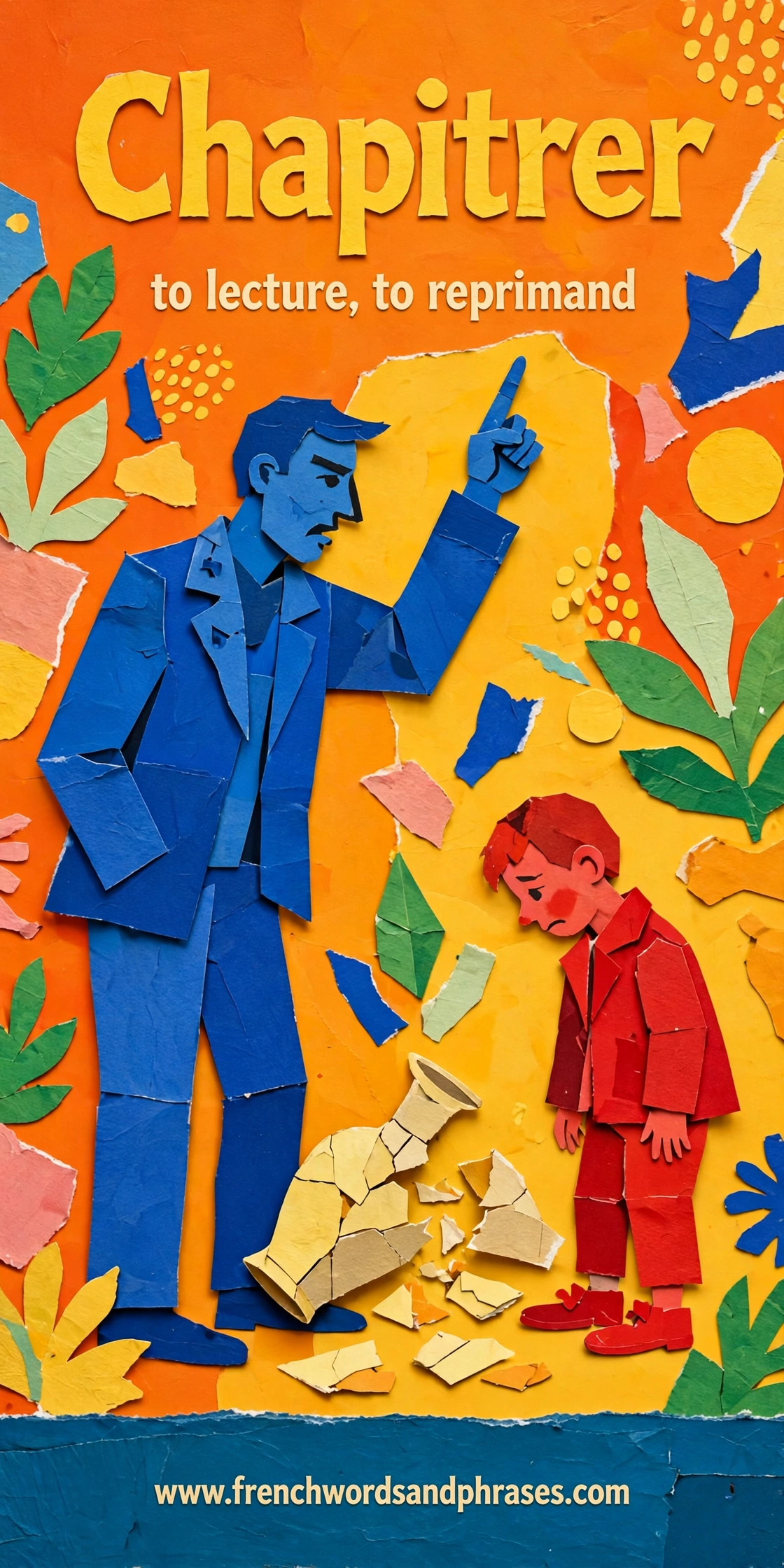
Chapitrer means to lecture, to reprimand — to read someone a whole chapter of reproaches for something they have done.
A father waiting up at midnight for a teenager who missed his curfew, a manager calling an employee into the office and closing the door — chapitrer is the solemn telling-off: a chapter of faults, read aloud from beginning to end.
In this guide, you’ll learn how to conjugate chapitrer in all the major French tenses and moods. Explore complete conjugation tables, French examples, English translations, and practice quizzes.
Understanding the French Verb Chapitrer
Chapitrer is a regular French verb belonging to the first group of verbs, those ending in-er.
It means to lecture, to reprimand. It belongs to people in authority — parents, teachers, headmasters, officers, coaches — delivering a formal, moralising lecture, and narrators often use it with a smile, because the punishment is made of words and everyone in the room knows the chapter by heart.
Verb classification: First group (-er)
Auxiliary verb: Avoir
Past participle: chapitré
Present participle: chapitrant
English equivalents: To lecture, to reprimand, to give a talking-to; chapitrer quelqu’un — to lecture someone; se faire chapitrer — to get a lecture, to be told off; chapitrer un élève — to tell off a pupil; (rare, of a book) to divide into chapters.
One important detail: chapitrer grew out of un chapitre, a chapter — the joke is built into the word, because a real chapitrage is a reprimand long enough to fill a chapter. The commonest survival pattern is the passive-flavoured se faire chapitrer, to get a good lecture: il s’est fait chapitrer par le directeur. The tone is formal with a hint of irony; everyday French also says gronder, sermonner, or, in familiar speech, passer un savon à quelqu’un. The verb itself is a perfectly regular -er.
Experience the Word
Chapitrer is the verb of the closed door and the long speech — no shouting, just a chapter of reproaches, page after page.
Imagine a teenager slipping into the house at two in the morning. His father is sitting at the kitchen table, the lamp still on, the speech already prepared: il le chapitre pendant vingt minutes — the hour, the worry, the rules, the whole chapter — and the boy stands there, shoes in hand, saying nothing.
Nothing is broken and nobody is punished. He has simply been lectured — chapitré — thoroughly, and it is enough.
How to Conjugate Chapitrer: Complete French Conjugation Guide
Let’s explore every major conjugation of chapitrer, beginning with the indicative mood.
How to Conjugate Chapitrer in the Indicative Mood
The indicative mood is used to express facts, observations, actions, and events.
How to Conjugate Chapitrer in the Present Tense (Présent)
Used for actions happening now, habitual actions, and general truths.
| Subject | Conjugation |
|---|---|
| je | chapitre |
| tu | chapitres |
| il / elle | chapitre |
| nous | chapitrons |
| vous | chapitrez |
| ils / elles | chapitrent |
Example
Le professeur chapitre l’élève qui a copié.
The teacher lectures the pupil who cheated.
Quick Quiz 1
Complete the sentence:
Le professeur ______ les élèves en retard.
Reveal the answer
chapitre
Le professeur chapitre les élèves en retard.
The teacher lectures the pupils who are late.
How to Conjugate Chapitrer in the Passé Composé
Used for completed actions in the past. Chapitrer takes the auxiliary verb avoir.
| Subject | Conjugation |
|---|---|
| j’ | ai chapitré |
| tu | as chapitré |
| il / elle | a chapitré |
| nous | avons chapitré |
| vous | avez chapitré |
| ils / elles | ont chapitré |
Example
Mon père m’a chapitré pour être rentré si tard.
My father gave me a lecture for coming home so late.
How to Conjugate Chapitrer in the Imparfait (Imperfect Tense)
Used for habitual past actions, descriptions, and ongoing situations in the past.
| Subject | Conjugation |
|---|---|
| je | chapitrais |
| tu | chapitrais |
| il / elle | chapitrait |
| nous | chapitrions |
| vous | chapitriez |
| ils / elles | chapitraient |
Example
Chaque semaine, le directeur chapitrait les retardataires.
Every week, the headmaster used to lecture the latecomers.
Quick Quiz 2
Choose the correct form:
My father gave me a lecture last night.
Mon père ______ hier soir. (m’a chapitré / m’est chapitré)
Reveal the answer
m’a chapitré
Mon père m’a chapitré hier soir.
Chapitrer takes avoir.
How to Conjugate Chapitrer in the Plus-que-parfait
Used to describe an action that had already been completed before another past event.
| Subject | Conjugation |
|---|---|
| j’ | avais chapitré |
| tu | avais chapitré |
| il / elle | avait chapitré |
| nous | avions chapitré |
| vous | aviez chapitré |
| ils / elles | avaient chapitré |
Example
Elle avait chapitré son fils avant l’arrivée des invités.
She had lectured her son before the guests arrived.
How to Conjugate Chapitrer in the Passé Simple
Primarily used in formal writing, literature, and historical narratives. It is rarely used in everyday conversation.
| Subject | Conjugation |
|---|---|
| je | chapitrai |
| tu | chapitras |
| il / elle | chapitra |
| nous | chapitrâmes |
| vous | chapitrâtes |
| ils / elles | chapitrèrent |
Example
Le capitaine chapitra sévèrement le jeune soldat.
The captain severely reprimanded the young soldier.
How to Conjugate Chapitrer in the Passé Antérieur
A literary tense used to express an action completed immediately before another past action, generally in the passé simple.
| Subject | Conjugation |
|---|---|
| j’ | eus chapitré |
| tu | eus chapitré |
| il / elle | eut chapitré |
| nous | eûmes chapitré |
| vous | eûtes chapitré |
| ils / elles | eurent chapitré |
Example
Quand il eut chapitré son apprenti, il lui serra la main.
When he had lectured his apprentice, he shook his hand.
How to Conjugate Chapitrer in the Future Tense (Futur Simple)
Used to describe actions that will take place in the future.
| Subject | Conjugation |
|---|---|
| je | chapitrerai |
| tu | chapitreras |
| il / elle | chapitrera |
| nous | chapitrerons |
| vous | chapitrerez |
| ils / elles | chapitreront |
Example
Si tu recommences, je te chapitrerai devant tout le monde.
If you do it again, I will lecture you in front of everyone.
How to Conjugate Chapitrer in the Futur Antérieur (Future Perfect)
Used for an action that will have been completed before a particular point in the future.
| Subject | Conjugation |
|---|---|
| j’ | aurai chapitré |
| tu | auras chapitré |
| il / elle | aura chapitré |
| nous | aurons chapitré |
| vous | aurez chapitré |
| ils / elles | auront chapitré |
Example
Demain à cette heure, elle aura chapitré la moitié de la classe.
By this time tomorrow, she will have lectured half the class.
How to Conjugate Chapitrer in the Near Future (Futur Proche)
Used to describe something that is going to happen soon. Formed with aller + infinitive.
| Subject | Conjugation |
|---|---|
| je | vais chapitrer |
| tu | vas chapitrer |
| il / elle | va chapitrer |
| nous | allons chapitrer |
| vous | allez chapitrer |
| ils / elles | vont chapitrer |
Example
Attention, le chef va te chapitrer pour ce retard.
Watch out, the boss is going to lecture you about being late.
How to Conjugate Chapitrer in the Conditional Mood
The conditional mood expresses what would happen under certain circumstances. It is also frequently used to make polite requests or express wishes.
How to Conjugate Chapitrer in the Present Conditional
| Subject | Conjugation |
|---|---|
| je | chapitrerais |
| tu | chapitrerais |
| il / elle | chapitrerait |
| nous | chapitrerions |
| vous | chapitreriez |
| ils / elles | chapitreraient |
Example
À ta place, je le chapitrerais sans crier.
In your place, I would lecture him without shouting.
How to Conjugate Chapitrer in the Past Conditional
| Subject | Conjugation |
|---|---|
| j’ | aurais chapitré |
| tu | aurais chapitré |
| il / elle | aurait chapitré |
| nous | aurions chapitré |
| vous | auriez chapitré |
| ils / elles | auraient chapitré |
Example
Il aurait chapitré son fils s’il avait su la vérité.
He would have lectured his son if he had known the truth.
Chapitrer in the Literary Past Conditional Form
This less common literary form uses the imperfect subjunctive of avoir.
| Subject | Conjugation |
|---|---|
| j’ | eusse chapitré |
| tu | eusses chapitré |
| il / elle | eût chapitré |
| nous | eussions chapitré |
| vous | eussiez chapitré |
| ils / elles | eussent chapitré |
Example
Le père eût chapitré l’enfant sans la présence des invités.
The father would have lectured the child were it not for the guests.
How to Conjugate Chapitrer in the Subjunctive Mood
The subjunctive is used to express wishes, emotions, doubts, necessity, and uncertainty. It frequently follows expressions such as il faut que (it is necessary that) or bien que (although).
How to Conjugate Chapitrer in the Present Subjunctive
| Subject | Conjugation |
|---|---|
| que je | chapitre |
| que tu | chapitres |
| qu’il / qu’elle | chapitre |
| que nous | chapitrions |
| que vous | chapitriez |
| qu’ils / qu’elles | chapitrent |
Example
Il faut parfois qu’un père chapitre son fils.
Sometimes a father has to lecture his son.
Quick Quiz 3
Complete the sentence using the subjunctive:
Il faut qu’elle ______ son fils calmement.
Reveal the answer
chapitre
Il faut qu’elle chapitre son fils calmement.
She must lecture her son calmly.
How to Conjugate Chapitrer in the Imperfect Subjunctive
A literary tense, rarely encountered in modern spoken French.
| Subject | Conjugation |
|---|---|
| que je | chapitrasse |
| que tu | chapitrasses |
| qu’il / qu’elle | chapitrât |
| que nous | chapitrassions |
| que vous | chapitrassiez |
| qu’ils / qu’elles | chapitrassent |
Example
Elle ne voulait pas qu’on chapitrât les élèves en public.
She did not want the pupils to be lectured in public.
How to Conjugate Chapitrer in the Pluperfect Subjunctive
A literary construction used to express an action completed before another past action.
| Subject | Conjugation |
|---|---|
| que j’ | eusse chapitré |
| que tu | eusses chapitré |
| qu’il / qu’elle | eût chapitré |
| nous | eussions chapitré |
| vous | eussiez chapitré |
| qu’ils / qu’elles | eussent chapitré |
Example
On disait qu’il eût chapitré tout le régiment.
It was said he had reprimanded the whole regiment.
How to Conjugate Chapitrer in the Past Subjunctive
| Subject | Conjugation |
|---|---|
| que j’ | aie chapitré |
| que tu | aies chapitré |
| qu’il / qu’elle | ait chapitré |
| que nous | ayons chapitré |
| que vous | ayez chapitré |
| qu’ils / qu’elles | aient chapitré |
Example
Je regrette qu’elle ait chapitré l’enfant si durement.
I regret that she lectured the child so harshly.
How to Conjugate Chapitrer in the Imperative
The imperative is used to give commands, instructions, invitations, or suggestions. Subject pronouns are omitted.
How to Conjugate Chapitrer in the Present Imperative
| Subject | Conjugation |
|---|---|
| (tu) | chapitre |
| (nous) | chapitrons |
| (vous) | chapitrez |
Example
Ne le chapitre pas pour si peu !
Do not lecture him over so little!
Quick Quiz 4
How would you say Do not lecture him (tu form)?
Reveal the answer
Ne le chapitre pas !
French Participles of Chapitrer
Participles are verb forms that can be used in compound tenses and other grammatical constructions.
Present Participle of Chapitrer
chapitrant
En chapitrant son fils, elle gardait un ton calme.
While lecturing her son, she kept a calm tone.
Past Participle of Chapitrer
chapitré
Chapitré par son entraîneur, le joueur a baissé la tête.
Lectured by his coach, the player lowered his head.
Chapitrer in Everyday French: Real-Life Examples
Now that you know the conjugations, let’s see how chapitrer appears in everyday French.
Example 1 — Present
Le maître chapitre les élèves bruyants.
The teacher lectures the noisy pupils.
Example 2 — Passé composé
Mon père m’a chapitré hier soir.
My father gave me a lecture last night.
Example 3 — Imparfait
Le directeur chapitrait les retardataires.
The headmaster used to lecture the latecomers.
Example 4 — Future
Je te chapitrerai si tu recommences.
I will lecture you if you do it again.
Example 5 — Conditional
Elle le chapitrerait sans hésiter.
She would lecture him without hesitating.
Example 6 — Imperative
Ne le chapitre pas devant ses amis !
Do not lecture him in front of his friends!
Beyond Translation: The Meaning of Chapitrer
Un chapitre is first of all a chapter of a book — and also, in cathedral French, the assembly of canons who meet in chapter.
A scolding imagined as a text.
To chapitrer someone is to treat their faults as a book and read them the relevant chapter, in full, in order, without skipping the dull parts. English to read someone the riot act is a close cousin in spirit: an official text, delivered at full length, to a captive audience of one.
How to Remember the French Verb Chapitrer
Remember it this way: Chapitrer is about a reprimand long enough to fill a chapter.
- Picture the reprimand as a whole chapter of a book — that is why chapitrer means a long, solemn lecture, not a quick shout.
- The survival phrase is se faire chapitrer: il s’est fait chapitrer par le chef — he got a lecture from the boss.
- Regular -er: je chapitre, nous chapitrons, past participle chapitré.
The key idea is a reprimand long enough to fill a chapter.
Test Your Knowledge of Chapitrer
Let’s see how much you’ve learned. Try answering these questions before revealing the answers.
Question 1
What does se faire chapitrer mean?
Reveal the answer
To get a lecture — to be told off at length: il s’est fait chapitrer par le directeur.
Question 2
How do you say My father gave me a lecture last night in French?
Reveal the answer
Mon père m’a chapitré hier soir.
Question 3
Translate: The teacher lectures the pupil who cheated.
Reveal the answer
Le professeur chapitre l’élève qui a copié.
Question 4
What is the past participle of chapitrer?
Reveal the answer
Chapitré.
Question 5
Complete the sentence:
Il faut parfois qu’un père ______ son fils.
Reveal the answer
chapitre
Il faut parfois qu’un père chapitre son fils.
Sometimes a father has to lecture his son.
Your Final Challenge
Can You Use It?
How would you say this in French?
The headmaster lectures him for ten minutes, then offers him a coffee.
Reveal the answer
Le directeur le chapitre pendant dix minutes, puis lui offre un café.
The headmaster lectures him for ten minutes, then offers him a coffee.
A little French. A little curiosity. A richer everyday life.
LEARN FRENCH ONE WORD AT A TIME