A French Word to Live By
Translate Chapeau to English
/ʃa.po/
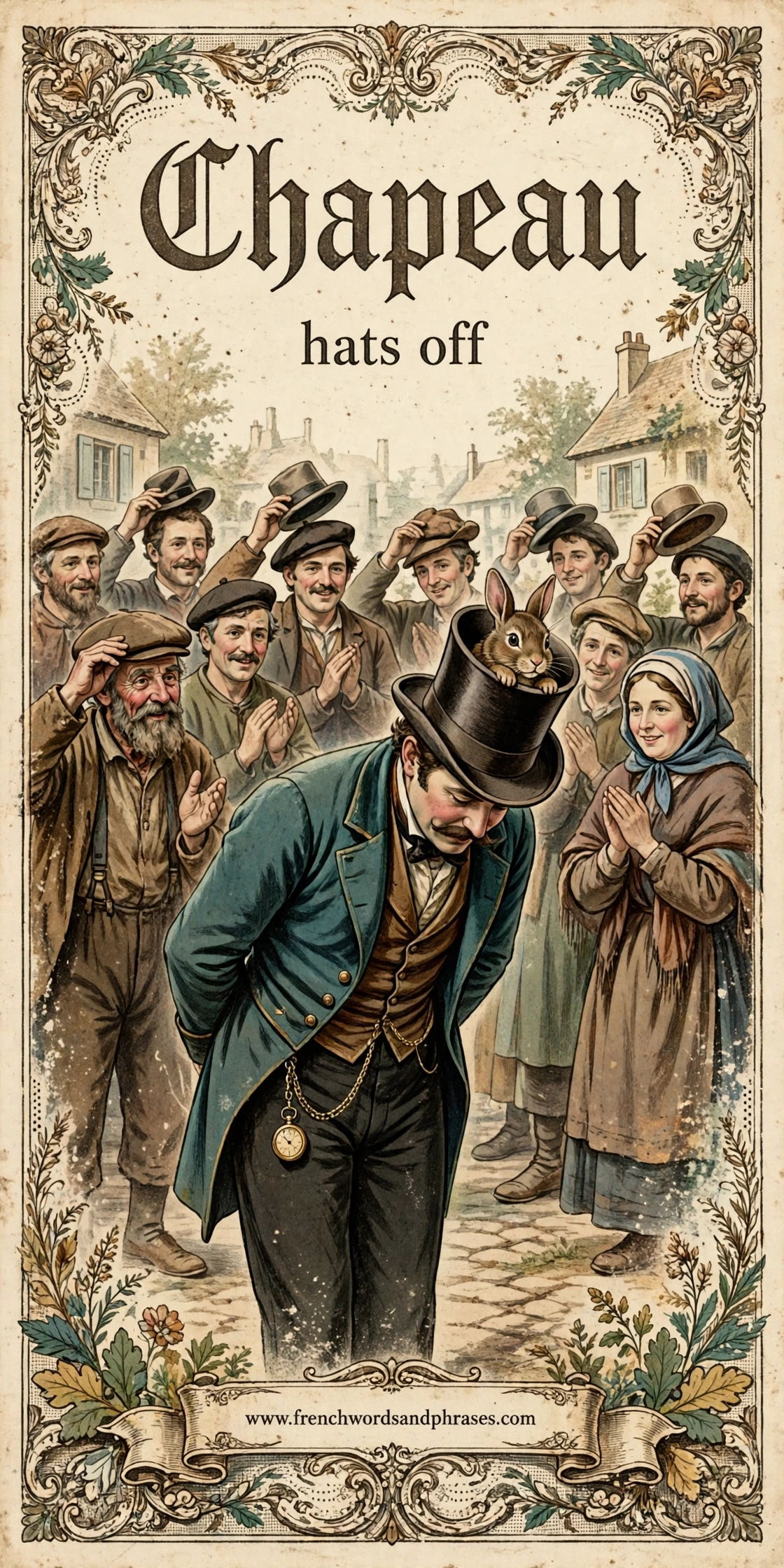
Chapeau means hats off — I take my hat off to you, in admiration.
The little theatre is silent as the juggler adds a fifth, then a sixth ball, one foot balanced on the rope. When he lands, smiling, the whole room exhales — and from the back row an old man rises, lifts an imaginary hat high off his head, and pronounces the verdict: « Chapeau ! »
Let’s explore how chapeau works in French, beginning with the whole phrase on one card.
Understanding the French Phrase Chapeau
Chapeau is a French exclamation of admiration built from a single noun: un chapeau, a hat. Behind it stands the old gesture of respect — removing your hat before someone impressive — and its fuller form: je te tire mon chapeau, I draw off my hat to you.
It means hats off — I take my hat off to you. Nobody is discussing headwear: the word carries the whole bow inside it. Chapeau is admiration with elegance, the compliment you pay a real feat — a performance, a rescue, a piece of work so good it deserves a gesture, not just a word.
Type: Exclamation of admiration — a compliment (a noun standing alone)
Answers the need: Saluting a feat that genuinely impresses you
Register: Neutral to warm — elegant praise, safe almost everywhere
Strength: High — a notch above bravo; it bows as it applauds
One important usage detail: chapeau can stand alone as the whole compliment, or take a complement — chapeau pour ce travail, hats off for this work. The expanded forms aim it at a person: je vous tire mon chapeau, formal and full, or the set phrase chapeau bas, hats off, deep respect. Playful version for a show-off friend: chapeau, l’artiste !
Experience the Word
Chapeau is applause with a bow inside it — the compliment that still remembers its manners.
Imagine the neighbour who rebuilds the flooded bakery in three weeks, sleeping on a camp bed between the ovens. On the morning it reopens, the queue goes quiet, and the mayor says the only word big enough for the occasion.
French keeps a wardrobe of feelings. Chapeau is the one it takes off in respect.
How to Use Chapeau in French: Complete Guide
Let’s explore how chapeau works in French, beginning with the whole phrase on one card.
Chapeau at a Glance
The Whole Phrase on One Card
Real meaning, inner picture, English twin and register — chapeau in five lines.
| Point | Chapeau |
|---|---|
| What it really means | hats off — I take my hat off to you, in admiration |
| Word for word | hat |
| English equivalent | hats off / I take my hat off to you / respect |
| Register | neutral to warm — elegant, safe almost everywhere |
| Use it for | performances, rescues, feats of skill, generosity, endurance |
Example
Trois semaines de travail sans un jour de repos : chapeau !
Three weeks of work without a day off: hats off!
Word by Word: Building the Bow
Three small pieces — the hat, the gesture, and the depth of the bow.
| Word | Literal meaning | Its job in the phrase |
|---|---|---|
| chapeau | a hat | the object whose removal once signalled respect |
| tirer | to pull, to draw off | the verb of the full form — je te tire mon chapeau, I draw my hat off to you |
| bas | low, down | in chapeau bas, the hat comes right down: deep respect |
Example
Je te tire mon chapeau, vraiment.
I take my hat off to you, truly.
Quick Quiz 1
What gesture hides inside the compliment chapeau?
Reveal the answer
Removing your hat — the old sign of respect before someone impressive; the word keeps the bow.
Devant un tel courage, chapeau bas.
Before such courage, hats off.
When You Say It: The Admiration Moments
Chapeau fires at moments like these — wherever a feat deserves more than applause.
| Situation | Example |
|---|---|
| A performance | chapeau, quelle voix ! — hats off, what a voice! |
| A difficult feat | il a réparé le toit tout seul : chapeau — he fixed the roof alone: hats off |
| A generous act | chapeau pour ta patience avec les enfants — hats off for your patience with the children |
| An unlikely success | réussir sans un sou, chapeau — succeeding without a penny, hats off |
| A witty rescue | chapeau, l’artiste, tu nous as sauvés — hats off, artist, you saved us |
Example
Elle a couru le marathon à soixante-dix ans : chapeau !
She ran the marathon at seventy: hats off!
Make It Yours: The Bow for Every Occasion
One word, several depths of bow — choose how low the hat comes down.
| Form | French | In English |
|---|---|---|
| The classic | chapeau ! | hats off! |
| Deeper | chapeau bas ! | hats off — deep respect |
| The full sentence | je te tire mon chapeau | I take my hat off to you |
| Formal and full | je vous tire mon chapeau | I take my hat off to you (vous) |
| With the reason | chapeau pour ce travail | hats off for this work |
| Playful | chapeau, l’artiste ! | hats off, artist! |
Example
Chapeau bas, Madame, pour ces cinquante ans de service.
Hats off, Madame, for these fifty years of service.
Quick Quiz 2
Which form adds the deepest respect: chapeau or chapeau bas?
Reveal the answer
Chapeau bas — the hat comes right down: the fullest bow of the family.
Sauver trois enfants de la rivière, chapeau bas.
Saving three children from the river — hats off.
Everyday Expressions: Building on the Bow
Chapeau slots into these everyday frames — each one ready to use as it stands.
| Frame | In English |
|---|---|
| chapeau ! | hats off! |
| chapeau bas ! | hats off — deep respect |
| je te tire mon chapeau | I take my hat off to you |
| chapeau pour… | hats off for… |
| chapeau, l’artiste ! | hats off, artist! — playful |
Example
Chapeau pour l’organisation, tout était parfait.
Hats off for the organisation, everything was perfect.
Close Cousins: The Other Salutes
French has a whole shelf of praise phrases — chapeau is the bowing one; its cousins applaud, congratulate or simply marvel.
| Expression | The difference |
|---|---|
| chapeau | hats off — admiration for a feat, with a bow inside |
| bravo | well done — applause for a performance or a success |
| bien joué | nicely done — for a clever move, at games and beyond |
| félicitations | congratulations — the formal word for life events and results |
| impressionnant | impressive — describes the feat rather than saluting the person |
| respect | respect — the modern, informal one-word salute among friends |
Example
Bravo pour le concert, et chapeau pour l’organisation.
Well done for the concert, and hats off for the organisation.
Quick Quiz 3
A colleague passes her driving test. Which cousin is the standard congratulation — chapeau or félicitations?
Reveal the answer
Félicitations — the set word for results and life events. Chapeau salutes a feat that impresses you.
Félicitations pour ton permis, tu l’as mérité.
Congratulations on your licence, you earned it.
Chapeau and Its Neighbours
The respect shelf around the phrase — the gesture, the admiration, the feat itself.
| French | In English |
|---|---|
| un chapeau | a hat |
| tirer son chapeau | to take one’s hat off (to someone) |
| admirer | to admire |
| un exploit | a feat, an achievement |
| le respect | respect |
| élégant | elegant |
Example
Devant un tel exploit, tout le village tire son chapeau.
Before such a feat, the whole village takes its hat off.
Watch Out: The Traps Around Chapeau
The traps: a hat that is sometimes just a hat, and a second hat idiom where the hat means blame.
| Trap | The truth |
|---|---|
| porter le chapeau | a different idiom entirely: to carry the can, to take the blame for others |
| sometimes a hat is a hat | j’ai acheté un chapeau is shopping, not praise — the exclamation needs its moment and its tone |
| too big for small thanks | chapeau salutes feats; for passing the salt, merci is the right size |
| the bow can go ironic | drawled slowly, chapeau can tease a show-off — the smile, again, decides |
Example
Il a porté le chapeau pour toute l’équipe, sans se plaindre.
He took the blame for the whole team, without complaining.
Quick Quiz 4
True or false: porter le chapeau means to receive a compliment.
Reveal the answer
False — porter le chapeau means to take the blame for others, to carry the can.
Le plus jeune a porté le chapeau pour l’erreur des autres.
The youngest took the blame for the others’ mistake.
Chapeau in Everyday French: Real-Life Examples
Now that you know the word, let’s see how chapeau appears in everyday French.
Example 1 — The performance
Quel concert ! Chapeau, vraiment.
What a concert! Hats off, truly.
Example 2 — The repair
Tu as réparé la voiture tout seul ? Chapeau !
You repaired the car all alone? Hats off!
Example 3 — The marathon
Elle a fini le marathon : chapeau bas.
She finished the marathon: hats off.
Example 4 — The patience
Chapeau pour ta patience avec les enfants.
Hats off for your patience with the children.
Example 5 — The rescue
Il a sauvé le chien de la rivière : chapeau !
He saved the dog from the river: hats off!
Example 6 — Playful
Tu as tout deviné ? Chapeau, l’artiste !
You guessed everything? Hats off, artist!
Beyond Translation: The Meaning of Chapeau
English takes its hat off too — but the phrase is fading into period costume. In French, chapeau is alive and working, a one-word ceremony: the hat rises, the head bows, the feat is honoured, all inside five letters of applause.
Chapeau is admiration that still stands up when it speaks.
Keep it for the moments that deserve the full gesture — a word this elegant should never be spent on small change.
How to Remember the French Phrase Chapeau
Remember it this way: Chapeau is a bow in a word — picture the hat sweeping off the head of the person who says it.
- You picture the gesture — the hat comes off: that removal is the compliment.
- You deepen it with bas — chapeau bas, the hat right down, is the fullest respect.
- You keep porter le chapeau apart — carrying the hat means taking the blame, not the praise.
The key idea is chapeau means hats off — admiration for a feat, from the old gesture of respect.
Test Your Knowledge of Chapeau
Let’s see how much you’ve learned. Try answering these questions before revealing the answers.
Question 1
What does chapeau ! mean?
Reveal the answer
Hats off — I take my hat off to you, in admiration of a feat.
Question 2
What is the full form of the compliment?
Reveal the answer
Je te tire mon chapeau — I draw my hat off to you; chapeau alone carries the whole gesture.
Question 3
How do you deepen the compliment?
Reveal the answer
Chapeau bas — the hat comes right down: deep respect.
Question 4
What does porter le chapeau mean?
Reveal the answer
To take the blame for others — to carry the can; nothing to do with praise.
Question 5
Complete the sentence:
Elle a élevé seule ses trois enfants : ______ ! (She raised her three children alone: hats off!)
Reveal the answer
chapeau
Elle a élevé seule ses trois enfants : chapeau !
She raised her three children alone: hats off!
Your Final Challenge
Can You Use It?
How would you say this in French?
“Hats off to you, that was remarkable.”
Reveal the answer
Chapeau, c’était remarquable.
Hats off to you, that was remarkable.
A little French. A little curiosity. A richer everyday life.
LEARN FRENCH ONE WORD AT A TIME