A French Word to Live By
Translate Chancre to English
/ʃɑ̃kʁ/
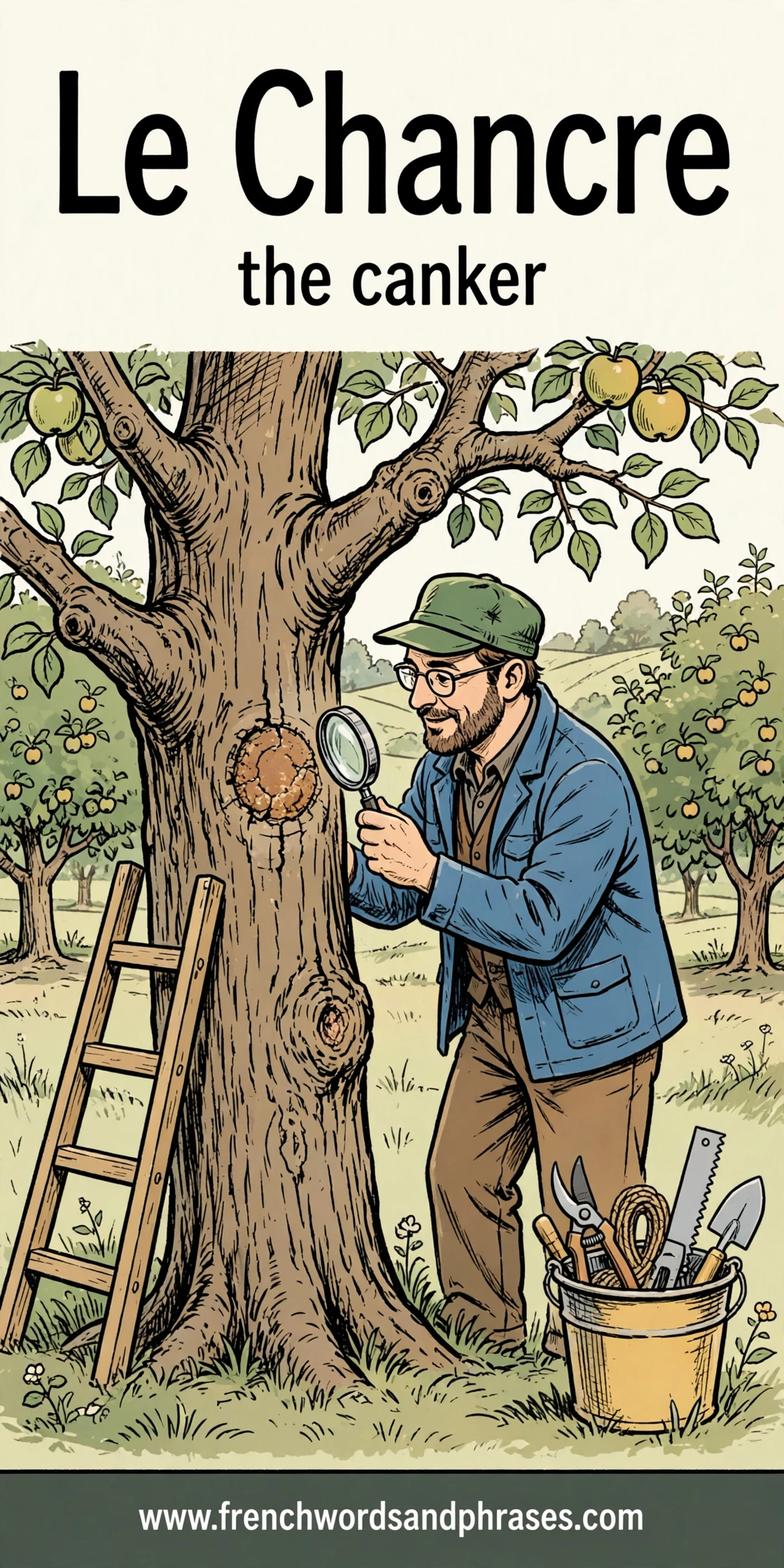
Le Chancre means the canker.
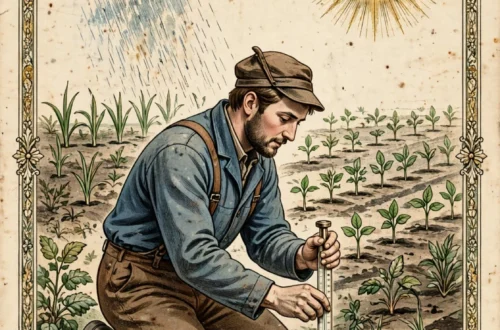
In the orchard, the old gardener stops at an apple tree and runs his thumb over a dark, sunken patch on the bark. « Un chancre. Si on le laisse, il rongera tout l’arbre. » A canker — a sore that eats into living wood. That gnawing wound, on trees and in old medical books, is le chancre.
In this guide, you’ll learn what chancre means in English, how to use it with its articles, how to form its plural, and how it appears in everyday French. Explore French examples, English translations, and practice quizzes.
Understanding the French Noun Chancre
Chancre is a masculine French noun: le chancre, un chancre. It names a canker — a diseased, eating sore: on trees, a sunken patch of dead bark that spreads and can kill the branch; in older medicine, an ulcer. Because a chancre eats relentlessly, the word also serves figuratively for anything that gnaws at a healthy body — and it gave French the marvellous idiom manger comme un chancre, to eat like a horse.
It means the canker. In the garden, le chancre is a disease of fruit trees and roses: a wound in the bark that deepens, cracks and spreads, until the branch dies — the gardener cuts it out and burns the wood. In figurative use, un chancre is a scourge that eats a healthy thing from inside: corruption, a vice, a slow decay. And in the idiom, the canker’s endless appetite becomes a compliment at the table: il mange comme un chancre — he eats and eats, he devours everything.
Gender: Masculine — le chancre, un chancre
Definite article: le — le chancre (the canker)
Indefinite article: un — un chancre (a canker)
Plural: les chancres — a regular plural in -s
Register: Technical in the garden, literary in figurative use; the eating idiom is familiar and cheerful
English equivalents: The canker; (figurative) a scourge, an eating sore
One important usage detail: the idiom is manger comme un chancre — to eat like a horse, to devour everything in sight. It is said with admiration, usually of teenagers and hungry workers, never as an insult about table manners. The canker eats without stopping, and so, gloriously, do they.
Experience the Word
Chancre is a word gardeners say quietly, the way you name a thing you respect. A chancre does not announce itself with drama; it begins as a small dark patch after a frost or a pruning cut, and then, season by season, it eats. The old orchard wisdom is ruthless: cut it out, burn the branch, disinfect the saw — mercy only feeds it.
Writers borrowed that quiet horror. When French calls corruption or gambling un chancre, it means a sore that gnaws a healthy body from within — not a blow from outside, but a rot that spreads while nobody watches. The word carries the smell of damp bark and slow damage.
And then the language turns the monster into a joke at the dinner table. The adolescent who empties the fridge mange comme un chancre — eats like a canker, endlessly, joyfully, leaving nothing standing. The same appetite that kills the apple tree is, in a growing boy, a family legend.
How to Use Chancre in French: Complete Guide
Let’s explore how chancre works in French, beginning with its articles — masculine throughout, from the orchard to the idiom.
Chancre with the Definite Article (Le, Les)
Chancre is masculine: le chancre for the sore on the tree, les chancres when the disease has spread.
| Form | French |
|---|---|
| Masculine singular | le chancre |
| Plural | les chancres |
| On the tree | le chancre du pommier — the apple tree’s canker |
Example
Le chancre s’étend sur le tronc du vieux pommier.
The canker is spreading over the trunk of the old apple tree.
Chancre with the Indefinite Article (Un, Des)
Un chancre is one sore too many for any gardener; des chancres means the tree is in real trouble.
| Form | French |
|---|---|
| Masculine singular | un chancre |
| Plural | des chancres |
| Figurative | un chancre de la société — a scourge of society |
Example
Un chancre est apparu sur le rosier après l’hiver.
A canker appeared on the rose bush after the winter.
Chancre with Partitive and Quantities
Cankers are counted by their spread — one patch, several patches, a tree full of them; the gardener’s quantities are a damage report.
| Quantity | French |
|---|---|
| One canker | un chancre |
| One more | un chancre de plus |
| Cankers everywhere | des chancres partout |
| A tree full of cankers | un arbre plein de chancres |
| Eaten away by a canker | rongé par un chancre |
Example
Si tu comptes trois chancres, il faut tailler sévèrement.
If you count three cankers, you must prune hard.
Quick Quiz 1
What does « manger comme un chancre » mean?
Reveal the answer
To eat like a horse — to devour everything, endlessly, like a canker eating into wood.
Après le match, il mange comme un chancre.
After the match, he eats like a horse.
The Plural of Chancre
The plural is regular: les chancres — the sight no orchard keeper wants to describe.
| Number | French |
|---|---|
| Singular | le chancre / un chancre |
| Plural | les chancres / des chancres |
Example
Les chancres ont tué deux branches du poirier.
The cankers killed two branches of the pear tree.
Chancre with Possessive Adjectives (Mon, Ton, Son…)
Possessives arrive in the orchard: the tree and its canker — son chancre — are the pair you will meet most.
| Owner | French |
|---|---|
| My | mon chancre |
| Your (tu) | ton chancre |
| His / Her / Its | son chancre |
| Our | notre chancre |
| Your (vous) | votre chancre |
| Their | leur chancre |
Example
Le pommier lutte contre son chancre depuis deux ans.
The apple tree has been fighting its canker for two years.
Quick Quiz 2
Complete the sentence:
Le jardinier coupe la branche malade : elle a ______ chancre. (a)
Reveal the answer
un
Elle a un chancre.
It has a canker — chancre is masculine, so the indefinite article is un.
Chancre with Demonstrative Adjectives (Ce, Ces)
Ce chancre points at the patch under the gardener’s thumb; ces chancres at the whole sorry row.
| Form | French |
|---|---|
| This | ce chancre |
| These | ces chancres |
| That one over there | ce chancre-là |
Example
Ce chancre-là date de l’hiver dernier.
That canker there dates from last winter.
Chancre with Adjectives
Adjectives agree with masculine chancre — gros, profond and dangereux describe its career only too well.
| Adjective | With Chancre |
|---|---|
| Big | un gros chancre |
| Deep | un chancre profond |
| Small | un petit chancre |
| Dangerous | un chancre dangereux |
| Old | un vieux chancre |
Example
Un chancre profond peut tuer la branche entière.
A deep canker can kill the whole branch.
Quick Quiz 3
In the orchard, what does the gardener do about un chancre?
Reveal the answer
He cuts it out — prunes the diseased branch and burns it, before the canker spreads.
Il faut couper le chancre et brûler le bois.
You must cut out the canker and burn the wood.
Everyday Expressions with Chancre
One idiom carries the word into daily life — and onto the dinner table.
| Expression | In English |
|---|---|
| manger comme un chancre | to eat like a horse, to devour everything |
| un chancre (au figuré) | a scourge, a rot that eats from within |
| rongé par un chancre | eaten away by a canker |
| le chancre du pommier | apple canker (the tree disease) |
| couper le chancre | to cut out the canker |
| un véritable chancre | a real scourge |
Example
À seize ans, mon frère mangeait comme un chancre.
At sixteen, my brother ate like a horse.
Words from the Same Family as Chancre
Chancre comes from the Latin cancer — the crab, and the eating sore — so its family includes a very famous cousin.
| French | In English |
|---|---|
| chancreux | cankered, eaten by canker |
| le cancer | the cancer — same Latin root, the eating disease |
| ronger | to gnaw, to eat away — the canker’s verb |
| rongé | eaten away, gnawed |
| manger comme un chancre | the family idiom: to eat like a horse |
| le chancre des arbres fruitiers | fruit-tree canker |
Example
Ce vieux tronc chancreux doit être abattu.
This old cankered trunk must be felled.
Quick Quiz 4
True or false: « il mange comme un chancre » is an insult about bad table manners.
Reveal the answer
False — it is said with admiration of a huge appetite.
Après sa journée de travail, il mange comme un chancre.
After his day’s work, he eats like a horse.
Chancre in Everyday French: Real-Life Examples
Now that you know the word, let’s see how chancre appears in everyday French.
Example 1 — In the orchard
Le jardinier examine chaque pommier à la recherche de chancres.
The gardener examines each apple tree looking for cankers.
Example 2 — At the table
Depuis la rentrée, mon fils mange comme un chancre.
Since school started again, my son eats like a horse.
Example 3 — Pruning day
Elle coupe la branche au-dessus du chancre et brûle le bois.
She cuts the branch above the canker and burns the wood.
Example 4 — In the newspaper
Le journaliste appelle la corruption un chancre de la région.
The journalist calls corruption a scourge of the region.
Example 5 — At the garden centre
On lui conseille un traitement contre le chancre des rosiers.
They advise him a treatment against rose canker.
Example 6 — After the match
Les joueurs mangent comme des chancres après la victoire.
The players eat like horses after the victory.
Beyond Translation: The Meaning of Chancre
Chancre is a small lesson in the migration of words. Born in Latin as cancer, the crab whose claws grip and never let go, it settled in French gardens as the sore that eats trees, haunted old medicine as an ulcer, and then — by the alchemy of the dinner table — became a compliment for appetite. A word that means slow destruction should not make people smile; yet « manger comme un chancre » is pure affection. Language, like the gardener, knows that even a canker has its season and its use.
How to Remember the French Noun Chancre
Remember it this way: Chancre is the canker — the sore that eats into the apple tree. Picture it gnawing the bark, remember the table compliment it inspired, and keep it masculine: le chancre, un chancre.
- You see a dark patch on bark — un chancre, a canker, cut it out.
- You watch a teenager empty the fridge — il mange comme un chancre, he eats like a horse.
- You hear its Latin cousin — le cancer shares the root: the eating sore.
The key idea is le chancre — the canker that eats wood, and appetites.
Test Your Knowledge of Chancre
Let’s see how much you’ve learned. Try answering these questions before revealing the answers.
Question 1
Is chancre masculine or feminine?
Reveal the answer
Masculine — le chancre, un chancre.
Question 2
What is un chancre on a fruit tree?
Reveal the answer
A canker — a diseased, sunken patch of bark that spreads and can kill the branch.
Question 3
What does « manger comme un chancre » mean?
Reveal the answer
To eat like a horse — to devour everything, like a canker eating into wood.
Question 4
Used figuratively, what is un chancre?
Reveal the answer
A scourge — something that gnaws a healthy body from within, like corruption.
Question 5
How do you say “the cankers” in French?
Reveal the answer
Les chancres — a regular plural in -s.
Your Final Challenge
Can You Use It?
How would you say this in French?
“This teenager eats like a horse.”
Reveal the answer
Cet adolescent mange comme un chancre.
This teenager eats like a horse.
A little French. A little curiosity. A richer everyday life.
LEARN FRENCH ONE WORD AT A TIME