A French Word to Live By
Translate Midi to English
/mi.di/
Le Midi means the midday.
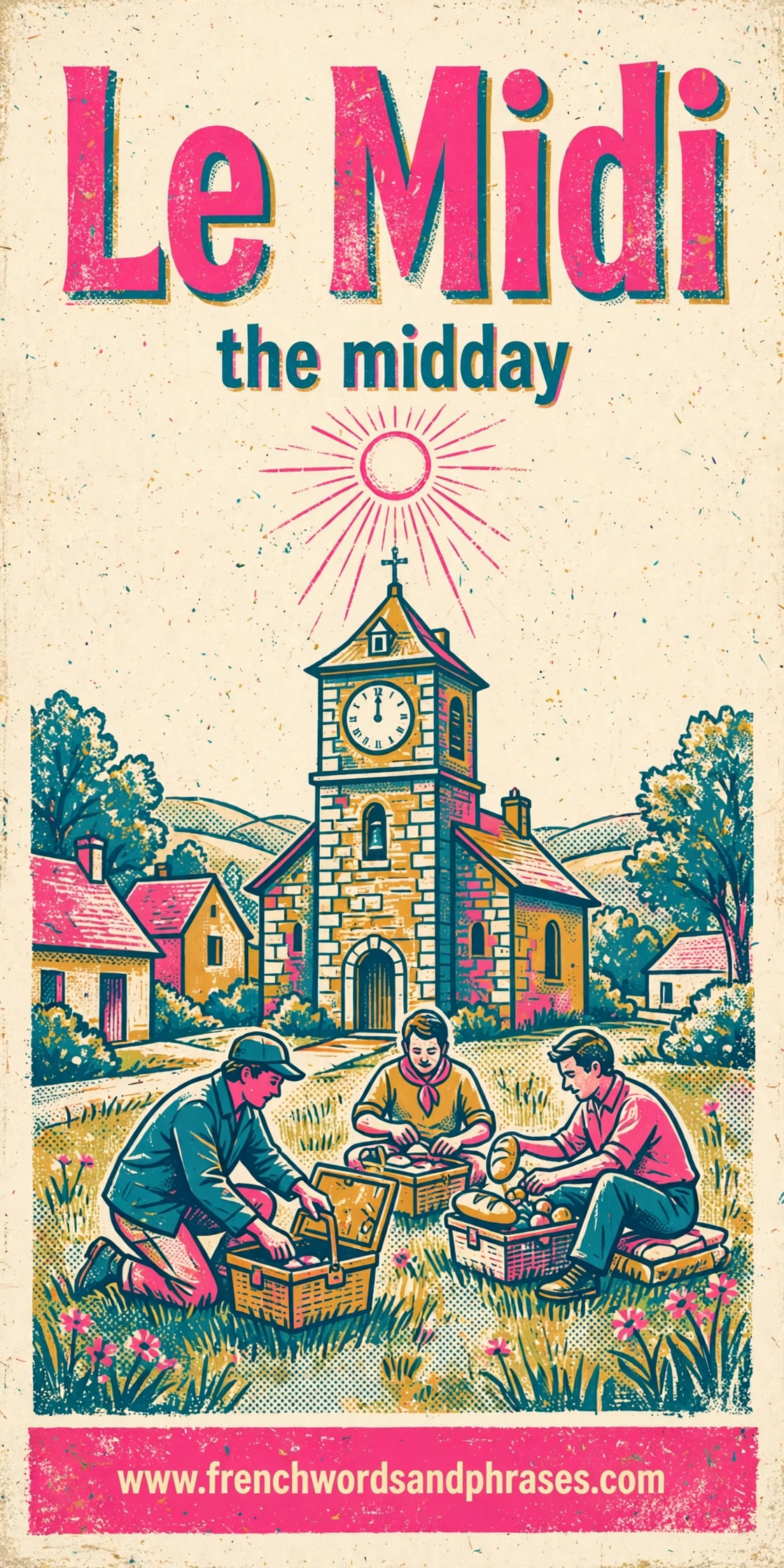
The church bell strikes twelve, the school doors burst open, and half the town heads for the table. « Il est midi ! » In France, that is not just a time — it is an institution, the sacred pause in the middle of the day. That moment, when the sun stands highest, is le midi.
In this guide, you’ll learn what midi means in English, how to use it with its articles, how to form its plural, and how it appears in everyday French. Explore French examples, English translations, and practice quizzes.
Understanding the French Noun Midi
Midi is a masculine French noun: le midi. It names midday, noon — the middle of the day, when the sun is at its highest. It tells the time (il est midi, it is noon), it names the lunch hour (ce midi, this lunchtime), and it hides inside l’après-midi, the afternoon — literally the after-midday. With a capital letter, le Midi becomes a place: the sunny South of France.
It means midday, noon. As a time, midi is exact: midi pile is noon on the dot, midi et demi is half past twelve. As a part of the day, it is the lunch break itself — entre midi et deux, between twelve and two, is when France eats, and shops close. To complicate life at midday is its famous idiom: chercher midi à quatorze heures, to look for noon at two o’clock — to make something simple complicated.
Gender: Masculine — le midi
Definite article: le — le midi (the midday)
Indefinite article: un — un midi (one midday, a noon)
Plural: les midis — every midday, as in tous les midis
Register: Everyday and essential — the hinge word of the French day
English equivalents: Midday, noon; ce midi = today at lunchtime
One important usage detail: watch the capital letter. Midi with a small m is the hour; le Midi with a capital M is the South of France — the land of lavender and cicadas. And the most useful phrase of all: ce midi means today at lunchtime — « On déjeune ensemble ce midi ? » is an invitation you will hear every working day.
Experience the Word
Midi is the hinge on which the French day swings. The morning works towards it; the afternoon begins only after it has been properly honoured — with lunch. In small towns the shutters close, the boulangerie queue forms, and between midi et deux the streets belong to the smell of cooking. To understand midi is to understand that France does not eat lunch; it celebrates a daily appointment with it.
The word also measures honesty. « Chercher midi à quatorze heures » — looking for noon at two in the afternoon — is the national reproach to anyone who complicates what is simple. Noon is noon; it is exactly where it should be, at twelve, and only a fool goes searching for it elsewhere. The idiom is a whole philosophy of common sense in six words.
And midi has its demon: le démon de midi, the midday demon, is the midlife crisis — the restlessness that strikes at the noon of life, when a settled forty-year-old suddenly wants a motorbike and a new story. Even the day’s brightest hour, French warns, has its shadow.
How to Use Midi in French: Complete Guide
Let’s explore how midi works in French, beginning with its articles — and quickly moving to the clock, where midi does its finest work.
Midi with the Definite Article (Le, Les)
Midi is masculine: le midi for the midday in question, les midis for the regular, repeated lunch hours.
| Form | French |
|---|---|
| Masculine singular | le midi |
| Plural | les midis |
| Every midday | tous les midis — every lunchtime |
Example
Le midi, la boulangerie ne désemplit pas.
At midday, the bakery is packed.
Midi with the Indefinite Article (Un, Des)
Un midi singles out one particular midday — a sunny one, a free one, a memorable one.
| Form | French |
|---|---|
| Masculine singular | un midi |
| Plural | des midis |
| A sunny midday | un midi ensoleillé |
Example
C’était un midi de juillet, brûlant et silencieux.
It was a July midday, burning hot and silent.
Midi with Partitive and Quantities: Midi and the Clock
Midi’s quantities are minutes: the quarters and halves around noon are the first clock French every learner needs.
| Time | French |
|---|---|
| Noon sharp | midi pile |
| Half past twelve | midi et demi |
| Quarter past twelve | midi et quart |
| Quarter to twelve | midi moins le quart |
| Five past twelve | midi cinq |
| Around noon | vers midi |
Example
Le train part à midi pile, ne sois pas en retard.
The train leaves at noon sharp, don’t be late.
Quick Quiz 1
How do you say “it is noon” in French?
Reveal the answer
Il est midi.
Il est midi, à table !
It’s noon, lunch is served! French uses il est with the hours.
The Plural of Midi
The plural adds a simple -s: les midis — the word for a routine of lunch hours.
| Number | French |
|---|---|
| Singular | le midi / un midi |
| Plural | les midis / des midis |
Example
Les midis, elle mange à la cantine avec ses collègues.
At lunchtime, she eats in the canteen with her colleagues.
Midi with Possessive Adjectives: The Lunch Break
Midi resists direct possessives — French owns the break, not the hour: ma pause de midi, my lunch break.
| Owner | French |
|---|---|
| My | ma pause de midi |
| Your (tu) | ta pause de midi |
| His / Her | sa pause de midi |
| Our | notre pause de midi |
| Your (vous) | votre pause de midi |
| Their | leur pause de midi |
Example
Pendant ma pause de midi, je vais courir.
During my lunch break, I go for a run.
Quick Quiz 2
What does « ce midi » mean in « On mange ensemble ce midi ? »
Reveal the answer
Today at lunchtime.
On mange ensemble ce midi ?
Shall we have lunch together today? Ce midi is the everyday way to say “this lunchtime”.
Midi with Demonstrative Adjectives (Ce, Ces)
Ce midi is one of the most useful phrases in French — this lunchtime, today at noon.
| Form | French |
|---|---|
| This (lunchtime) | ce midi |
| These | ces midis |
| That one | ce midi-là |
Example
Ce midi, le restaurant est complet.
This lunchtime, the restaurant is fully booked.
Midi with Adjectives
Adjectives agree with masculine midi and paint the hour — sunny, rainy, free or busy.
| Adjective | With Midi |
|---|---|
| Sunny | un midi ensoleillé |
| Rainy | un midi pluvieux |
| Free | un midi libre |
| Busy | un midi chargé |
| Of rest | un midi de repos |
Example
Après un midi chargé, elle rêve d’une sieste.
After a busy lunchtime, she dreams of a nap.
Quick Quiz 3
What does « chercher midi à quatorze heures » mean?
Reveal the answer
To make something simple complicated — literally, to look for noon at two o’clock.
Ne cherche pas midi à quatorze heures, la solution est simple.
Don’t overcomplicate it, the solution is simple.
Everyday Expressions with Midi
Midi organises the French day — its expressions cover lunch, common sense and the midlife crisis.
| Expression | In English |
|---|---|
| chercher midi à quatorze heures | to overcomplicate things |
| entre midi et deux | at lunchtime, between twelve and two |
| le démon de midi | the midlife crisis |
| chacun voit midi à sa porte | everyone sees things from their own angle |
| midi pile | noon sharp, on the dot |
| il est midi | it is noon |
Example
Les magasins ferment entre midi et deux.
The shops close between twelve and two.
Words from the Same Family as Midi
The family is built on the middle of the day: the afternoon that follows it, the midnight that mirrors it, and a charming antique.
| French | In English |
|---|---|
| l’après-midi | the afternoon — the after-midday |
| le minuit | midnight — midi’s twin at the other end |
| la mi-journée | the half-day |
| une midinette | a young Parisian working girl (dated, charming word) |
| le démon de midi | the midlife crisis (the family idiom) |
| à la mi-journée | at midday, halfway through the day |
Example
L’après-midi commence après le déjeuner de midi.
The afternoon begins after the midday lunch.
Quick Quiz 4
Complete the sentence:
Le rendez-vous est à midi ______ : pas une minute de retard. (sharp)
Reveal the answer
pile
Le rendez-vous est à midi pile.
The appointment is at noon sharp — midi pile means on the dot.
Midi in Everyday French: Real-Life Examples
Now that you know the word, let’s see how midi appears in everyday French.
Example 1 — Making lunch plans
On déjeune ensemble ce midi ?
Shall we have lunch together today?
Example 2 — At the office
Entre midi et deux, le bureau est désert.
Between twelve and two, the office is deserted.
Example 3 — The overcomplicator
Il cherche toujours midi à quatorze heures.
He always overcomplicates everything.
Example 4 — The bell strikes twelve
Il est midi, les enfants sortent de l’école.
It’s noon, the children are coming out of school.
Example 5 — Planning a trip south
Cet été, nous partons dans le Midi, près d’Avignon.
This summer, we’re going to the South of France, near Avignon.
Example 6 — The midlife joke
À quarante-cinq ans, il s’est acheté une moto : le démon de midi !
At forty-five, he bought himself a motorbike: the midlife crisis!
Beyond Translation: The Meaning of Midi
Midi is where French time becomes French life. Other languages have noon; France has an institution — a daily festival of lunch protected by closed shops and empty offices. The word stretches from the clock (midi pile) to the map (le Midi, the South) to the soul (le démon de midi). Learn midi and you hold the day’s golden hinge: everything in France is either before lunch or après-midi — after the midday that rules them all.
How to Remember the French Noun Midi
Remember it this way: Midi is midday — the hour when France sits down to lunch. Picture the church bell at twelve and the whole town heading for the table: il est midi.
- You hear the bell at twelve — il est midi, it is noon.
- You make lunch plans — ce midi, today at lunchtime.
- You spot an overcomplicator — chercher midi à quatorze heures, looking for noon at two o’clock.
The key idea is le midi — noon, the hinge of the French day.
Test Your Knowledge of Midi
Let’s see how much you’ve learned. Try answering these questions before revealing the answers.
Question 1
Is midi masculine or feminine?
Reveal the answer
Masculine — le midi.
Question 2
How do you say “half past twelve”?
Reveal the answer
Midi et demi — midday and a half.
Question 3
What does « entre midi et deux » refer to?
Reveal the answer
The lunch break — between twelve and two, when France eats and shops close.
Question 4
What is « le Midi » with a capital M?
Reveal the answer
The South of France — the sunny southern region.
Question 5
What does « le démon de midi » mean?
Reveal the answer
The midlife crisis — literally the midday demon, striking at the noon of life.
Your Final Challenge
Can You Use It?
How would you say this in French?
“We are having lunch together this lunchtime.”
Reveal the answer
Nous déjeunons ensemble ce midi.
We are having lunch together this lunchtime.
A little French. A little curiosity. A richer everyday life.
LEARN FRENCH ONE WORD AT A TIME