A French Word to Live By
How to Conjugate Chamarrer in French
/ʃa.ma.ʁe/
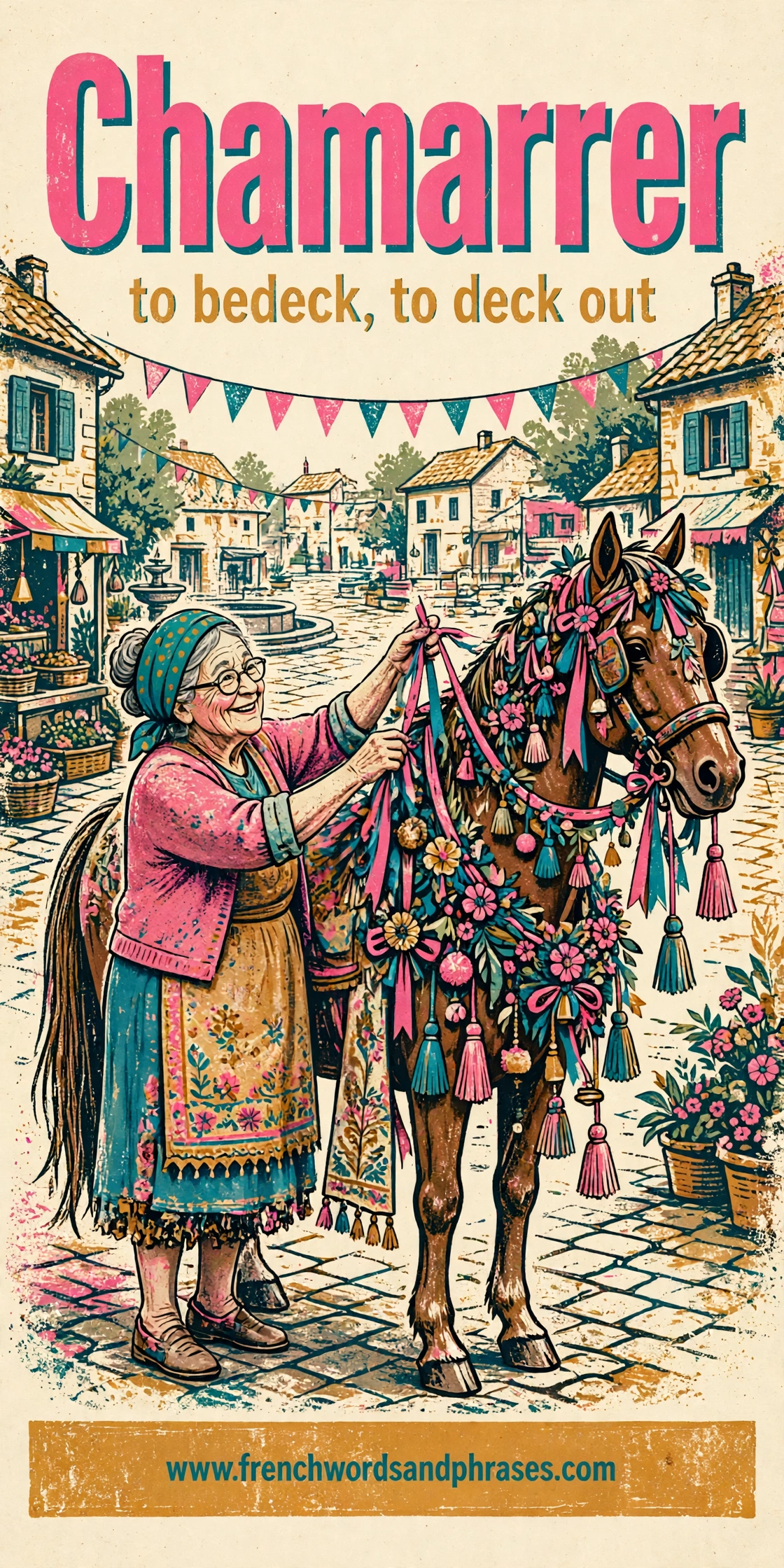
Chamarrer means to bedeck, to deck out — to load something with ribbons, medals, garlands and gold, often a ribbon too far.
A general whose chest has run out of room for medals, a Christmas tree disappearing under its garlands, a wedding car trailing ribbons and flowers — chamarrer is the verb of decoration pushed to the edge of too much: splendid, festive, and rarely tasteful.
In this guide, you’ll learn how to conjugate chamarrer in all the major French tenses and moods. Explore complete conjugation tables, French examples, English translations, and practice quizzes.
Understanding the French Verb Chamarrer
Chamarrer is a regular French verb belonging to the first group of verbs, those ending in-er.
It means to bedeck, to deck out. It is commonly used of uniforms and medals, Christmas trees and wedding cars, and of any outfit or interior loaded with ornament — nearly always with gentle irony, since French taste suspects anything chamarré of trying too hard.
Verb classification: First group (-er)
Auxiliary verb: Avoir
Past participle: chamarré
Present participle: chamarrant
English equivalents: To bedeck, to deck out, to adorn lavishly; chamarrer de rubans — to bedeck with ribbons; un uniforme chamarré de médailles — a uniform bedecked with medals; chamarrer un sapin de guirlandes — to deck a Christmas tree with garlands.
One important detail: chamarrer almost always travels with de — one is chamarré de something: chamarré de médailles, chamarrée de rubans, chamarré de pierreries. The past participle chamarré does much of the verb’s everyday work as an adjective, and it usually carries a raised eyebrow: to be chamarré is to be splendidly, excessively decorated. The verb itself is regular: je chamarre, nous chamarrons — note the double r throughout.
Experience the Word
Chamarrer is decoration with the volume turned up — if one ribbon is pretty, chamarrer adds ten.
Imagine the village fête. The mayor’s car arrives chamarrée de rubans tricolores, the band’s uniforms are chamarrés de boutons dorés, and even the donkey giving rides to children wears a hat chamarré de fleurs en papier. Nobody would call it tasteful. Everybody would call it a party.
Too much, on purpose. It is bedecked — chamarré — and the village loves it.
How to Conjugate Chamarrer: Complete French Conjugation Guide
Let’s explore every major conjugation of chamarrer, beginning with the indicative mood.
How to Conjugate Chamarrer in the Indicative Mood
The indicative mood is used to express facts, observations, actions, and events.
How to Conjugate Chamarrer in the Present Tense (Présent)
Used for actions happening now, habitual actions, and general truths.
| Subject | Conjugation |
|---|---|
| je | chamarre |
| tu | chamarres |
| il / elle | chamarre |
| nous | chamarrons |
| vous | chamarrez |
| ils / elles | chamarrent |
Example
Elle chamarre sa robe de rubans et de dentelles.
She is bedecking her dress with ribbons and lace.
Quick Quiz 1
Complete the sentence:
Nous ______ la salle de lanternes pour la fête.
Reveal the answer
chamarrons
Nous chamarrons la salle de lanternes pour la fête.
We are decking the hall with lanterns for the party.
How to Conjugate Chamarrer in the Passé Composé
Used for completed actions in the past. Chamarrer takes the auxiliary verb avoir.
| Subject | Conjugation |
|---|---|
| j’ | ai chamarré |
| tu | as chamarré |
| il / elle | a chamarré |
| nous | avons chamarré |
| vous | avez chamarré |
| ils / elles | ont chamarré |
Example
On a chamarré le sapin de guirlandes dorées.
They decked the Christmas tree with golden garlands.
How to Conjugate Chamarrer in the Imparfait (Imperfect Tense)
Used for habitual past actions, descriptions, and ongoing situations in the past.
| Subject | Conjugation |
|---|---|
| je | chamarrais |
| tu | chamarrais |
| il / elle | chamarrait |
| nous | chamarrions |
| vous | chamarriez |
| ils / elles | chamarraient |
Example
Les courtisans chamarraient leurs manteaux de broderies d’or.
The courtiers used to bedeck their coats with gold embroidery.
Quick Quiz 2
Choose the correct form:
They decked the tree with garlands.
On ______ le sapin de guirlandes. (a chamarré / est chamarré)
Reveal the answer
a chamarré
On a chamarré le sapin de guirlandes.
Chamarrer takes avoir.
How to Conjugate Chamarrer in the Plus-que-parfait
Used to describe an action that had already been completed before another past event.
| Subject | Conjugation |
|---|---|
| j’ | avais chamarré |
| tu | avais chamarré |
| il / elle | avait chamarré |
| nous | avions chamarré |
| vous | aviez chamarré |
| ils / elles | avaient chamarré |
Example
Elle avait chamarré la table de fleurs pour le banquet.
She had decked the table with flowers for the banquet.
How to Conjugate Chamarrer in the Passé Simple
Primarily used in formal writing, literature, and historical narratives. It is rarely used in everyday conversation.
| Subject | Conjugation |
|---|---|
| je | chamarrai |
| tu | chamarras |
| il / elle | chamarra |
| nous | chamarrâmes |
| vous | chamarrâtes |
| ils / elles | chamarrèrent |
Example
La reine chamarra son manteau de pierreries pour le bal.
The queen bedecked her cloak with jewels for the ball.
How to Conjugate Chamarrer in the Passé Antérieur
A literary tense used to express an action completed immediately before another past action, generally in the passé simple.
| Subject | Conjugation |
|---|---|
| j’ | eus chamarré |
| tu | eus chamarré |
| il / elle | eut chamarré |
| nous | eûmes chamarré |
| vous | eûtes chamarré |
| ils / elles | eurent chamarré |
Example
Quand il eut chamarré son uniforme de médailles, le général sortit.
When he had bedecked his uniform with medals, the general went out.
How to Conjugate Chamarrer in the Future Tense (Futur Simple)
Used to describe actions that will take place in the future.
| Subject | Conjugation |
|---|---|
| je | chamarrerai |
| tu | chamarreras |
| il / elle | chamarrera |
| nous | chamarrerons |
| vous | chamarrerez |
| ils / elles | chamarreront |
Example
Pour la fête, nous chamarrerons la salle de lanternes.
For the party, we will deck the hall with lanterns.
How to Conjugate Chamarrer in the Futur Antérieur (Future Perfect)
Used for an action that will have been completed before a particular point in the future.
| Subject | Conjugation |
|---|---|
| j’ | aurai chamarré |
| tu | auras chamarré |
| il / elle | aura chamarré |
| nous | aurons chamarré |
| vous | aurez chamarré |
| ils / elles | auront chamarré |
Example
À minuit, ils auront chamarré tout le village de drapeaux.
By midnight, they will have decked the whole village with flags.
How to Conjugate Chamarrer in the Near Future (Futur Proche)
Used to describe something that is going to happen soon. Formed with aller + infinitive.
| Subject | Conjugation |
|---|---|
| je | vais chamarrer |
| tu | vas chamarrer |
| il / elle | va chamarrer |
| nous | allons chamarrer |
| vous | allez chamarrer |
| ils / elles | vont chamarrer |
Example
Elle va chamarrer le gâteau de bougies et de paillettes.
She is going to deck the cake with candles and glitter.
How to Conjugate Chamarrer in the Conditional Mood
The conditional mood expresses what would happen under certain circumstances. It is also frequently used to make polite requests or express wishes.
How to Conjugate Chamarrer in the Present Conditional
| Subject | Conjugation |
|---|---|
| je | chamarrerais |
| tu | chamarrerais |
| il / elle | chamarrerait |
| nous | chamarrerions |
| vous | chamarreriez |
| ils / elles | chamarreraient |
Example
Avec plus de goût, il chamarrerait moins ses vêtements.
With more taste, he would deck out his clothes less.
How to Conjugate Chamarrer in the Past Conditional
| Subject | Conjugation |
|---|---|
| j’ | aurais chamarré |
| tu | aurais chamarré |
| il / elle | aurait chamarré |
| nous | aurions chamarré |
| vous | auriez chamarré |
| ils / elles | auraient chamarré |
Example
Tu aurais chamarré la robe de perles si tu avais osé.
You would have bedecked the dress with pearls if you had dared.
Chamarrer in the Literary Past Conditional Form
This less common literary form uses the imperfect subjunctive of avoir.
| Subject | Conjugation |
|---|---|
| j’ | eusse chamarré |
| tu | eusses chamarré |
| il / elle | eût chamarré |
| nous | eussions chamarré |
| vous | eussiez chamarré |
| ils / elles | eussent chamarré |
Example
Le roi eût chamarré ses courtisans d’or et de soie.
The king would have bedecked his courtiers in gold and silk.
How to Conjugate Chamarrer in the Subjunctive Mood
The subjunctive is used to express wishes, emotions, doubts, necessity, and uncertainty. It frequently follows expressions such as il faut que (it is necessary that) or bien que (although).
How to Conjugate Chamarrer in the Present Subjunctive
| Subject | Conjugation |
|---|---|
| que je | chamarre |
| que tu | chamarres |
| qu’il / qu’elle | chamarre |
| que nous | chamarrions |
| que vous | chamarriez |
| qu’ils / qu’elles | chamarrent |
Example
Je ne veux pas que tu chamarres le salon de guirlandes.
I do not want you decking the living room with garlands.
Quick Quiz 3
Complete the sentence using the subjunctive:
Je ne veux pas que vous ______ la voiture de fleurs.
Reveal the answer
chamarriez
Je ne veux pas que vous chamarriez la voiture de fleurs.
I do not want you decking the car with flowers.
How to Conjugate Chamarrer in the Imperfect Subjunctive
A literary tense, rarely encountered in modern spoken French.
| Subject | Conjugation |
|---|---|
| que je | chamarrasse |
| que tu | chamarrasses |
| qu’il / qu’elle | chamarrât |
| que nous | chamarrassions |
| que vous | chamarrassiez |
| qu’ils / qu’elles | chamarrassent |
Example
Il était ridicule qu’il chamarrât son chien de rubans roses.
It was ridiculous of him to bedeck his dog with pink ribbons.
How to Conjugate Chamarrer in the Pluperfect Subjunctive
A literary construction used to express an action completed before another past action.
| Subject | Conjugation |
|---|---|
| que j’ | eusse chamarré |
| que tu | eusses chamarré |
| qu’il / qu’elle | eût chamarré |
| que nous | eussions chamarré |
| que vous | eussiez chamarré |
| qu’ils / qu’elles | eussent chamarré |
Example
On racontait que le dictateur eût chamarré ses généraux de médailles en chocolat.
People said the dictator had bedecked his generals with chocolate medals.
How to Conjugate Chamarrer in the Past Subjunctive
| Subject | Conjugation |
|---|---|
| que j’ | aie chamarré |
| que tu | aies chamarré |
| qu’il / qu’elle | ait chamarré |
| que nous | ayons chamarré |
| que vous | ayez chamarré |
| qu’ils / qu’elles | aient chamarré |
Example
Je suis surpris qu’elle ait chamarré sa voiture de fleurs.
I am surprised she decked her car with flowers.
How to Conjugate Chamarrer in the Imperative
The imperative is used to give commands, instructions, invitations, or suggestions. Subject pronouns are omitted.
How to Conjugate Chamarrer in the Present Imperative
| Person | Conjugation |
|---|---|
| (tu) | chamarre |
| (nous) | chamarrons |
| (vous) | chamarrez |
Example
Ne chamarre pas ton CV de titres inutiles !
Do not bedeck your CV with useless titles!
Quick Quiz 4
How would you say Do not bedeck everything (tu form)?
Reveal the answer
Ne chamarre pas tout !
French Participles of Chamarrer
Participles are verb forms that can be used in compound tenses and other grammatical constructions.
Present Participle of Chamarrer
chamarrant
En chamarrant l’arbre de Noël, elle chante des cantiques.
While decking the Christmas tree, she sings carols.
Past Participle of Chamarrer
chamarré
Chamarré de médailles, le général pose pour le portrait officiel.
Bedecked with medals, the general poses for the official portrait.
Chamarrer in Everyday French: Real-Life Examples
Now that you know the conjugations, let’s see how chamarrer appears in everyday French.
Example 1 — Present
Elle chamarre sa robe de rubans.
She is bedecking her dress with ribbons.
Example 2 — Passé composé
On a chamarré le sapin de guirlandes.
They decked the tree with garlands.
Example 3 — Imparfait
Le général chamarrait son uniforme de médailles.
The general used to bedeck his uniform with medals.
Example 4 — Future
Nous chamarrerons la salle de lanternes.
We will deck the hall with lanterns.
Example 5 — Conditional
Il chamarrerait moins avec plus de goût.
He would deck things out less with more taste.
Example 6 — Imperative
Ne chamarre pas tout, reste simple !
Do not bedeck everything — keep it simple!
Beyond Translation: The Meaning of Chamarrer
English bedeck is the exact partner of chamarrer, raised eyebrow included: both words praise the decoration and doubt the taste in the same breath.
Chamarré is splendour that has gone one medal too far.
That is why the word belongs to fêtes, uniforms and wedding cars — occasions where too much is, for one day at least, exactly the point.
How to Remember the French Verb Chamarrer
Remember it this way: Chamarrer is about the general with no room left on his chest for one more medal.
- Chamarré de… is the pattern: bedecked with medals, ribbons, jewels — always de.
- The participle chamarré lives as an adjective, and it usually smiles: splendid, but too much.
- Regular -er with double r: je chamarre, nous chamarrons, past participle chamarré.
The key idea is the general with no room left on his chest for one more medal.
Test Your Knowledge of Chamarrer
Let’s see how much you’ve learned. Try answering these questions before revealing the answers.
Question 1
What preposition follows chamarrer, and what does it introduce?
Reveal the answer
De — it introduces the decoration: chamarré de médailles, chamarrée de rubans.
Question 2
How do you say They decked the tree with garlands in French?
Reveal the answer
On a chamarré le sapin de guirlandes.
Question 3
Translate: Bedecked with medals, the general poses for the portrait.
Reveal the answer
Chamarré de médailles, le général pose pour le portrait.
Question 4
What is the past participle of chamarrer?
Reveal the answer
Chamarré.
Question 5
Complete the sentence:
Je ne veux pas que tu ______ le salon de guirlandes.
Reveal the answer
chamarres
Je ne veux pas que tu chamarres le salon de guirlandes.
I do not want you decking the living room with garlands.
Your Final Challenge
Can You Use It?
How would you say this in French?
Bedecked with medals and ribbons, the whole village is getting ready for the festival.
Reveal the answer
Chamarré de médailles et de rubans, le village entier se prépare pour la fête.
Bedecked with medals and ribbons, the whole village is getting ready for the festival.
A little French. A little curiosity. A richer everyday life.
LEARN FRENCH ONE WORD AT A TIME