A French Word to Live By
How to Conjugate Challenger in French
/tʃa.lɛn.dʒe/
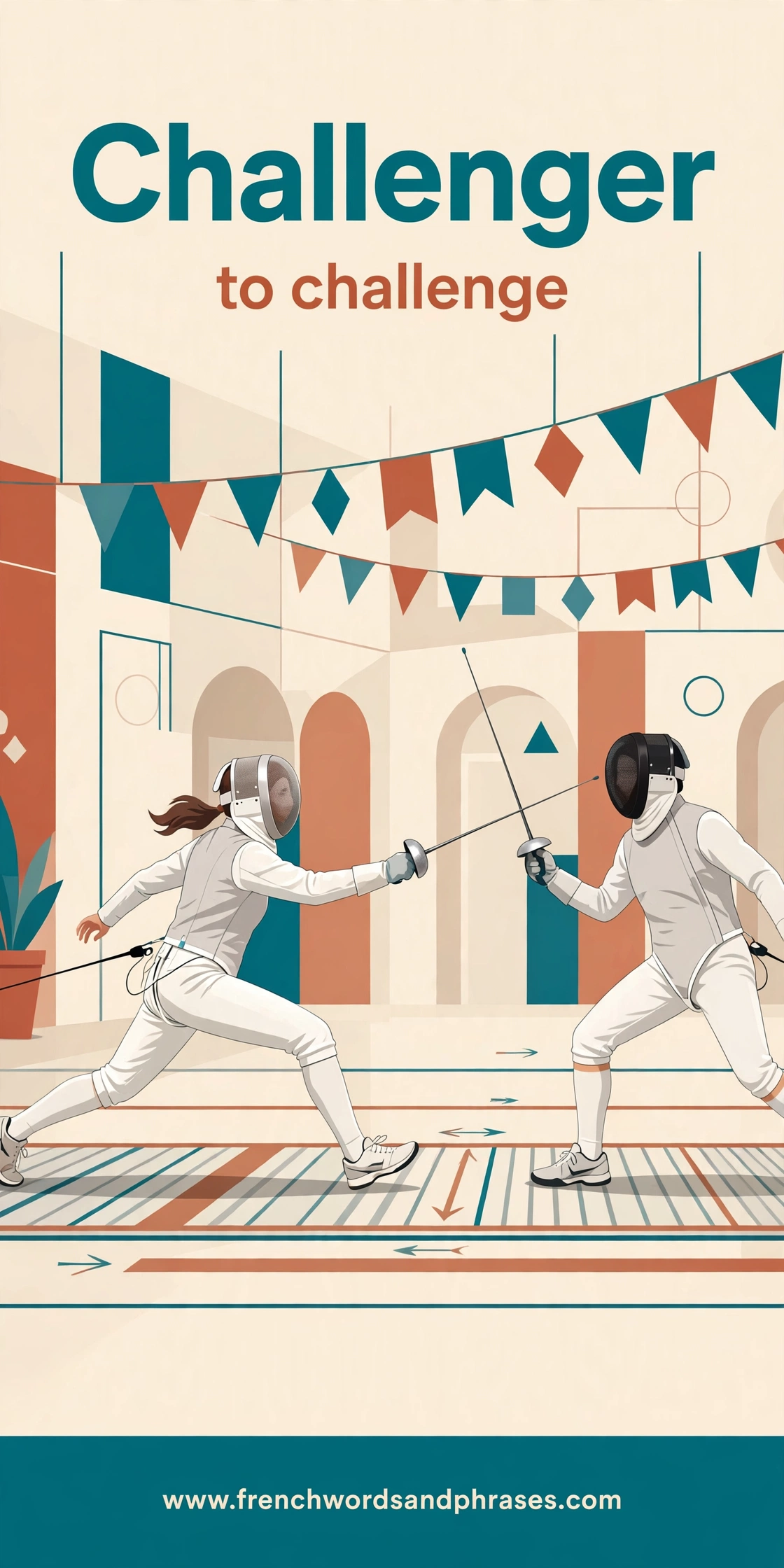
Challenger means to challenge — to take on the champion, the record or the boss, and try to take their place.
A young boxer pointing at the champion’s belt, a small club facing the giants of the league, a junior employee questioning the director in a meeting — challenger is the modern French verb of the challenger: the one who steps forward and says, why not me?
In this guide, you’ll learn how to conjugate challenger in all the major French tenses and moods. Explore complete conjugation tables, French examples, English translations, and practice quizzes.
Understanding the French Verb Challenger
Challenger is a regular French verb belonging to the first group of verbs, those ending in-er.
It means to challenge. It is commonly used in sport for taking on a title-holder or a record, and in offices for questioning a decision, a boss or the established order — always with the flavour of an outsider who might just win.
Verb classification: First group (-er)
Auxiliary verb: Avoir
Past participle: challengé
Present participle: challengeant
English equivalents: To challenge; challenger le champion — to challenge the champion; challenger un record — to challenge a record; challenger sa hiérarchie — to challenge one’s bosses; un challenger — a challenger (the English word kept as a noun).
One important detail: challenger is an English loanword, pronounced à l’anglaise — roughly ‘tcha-lèn-dje’ — but conjugated as a perfectly regular French -er verb: je challenge, nous challengeons (note the extra e that keeps the g soft in challengeons), past participle challengé. Purists prefer défier or mettre au défi, but in sport, business and marketing French, challenger is everywhere — and the person who does it is un challenger, the same English word worn as a noun.
Experience the Word
Challenger is the verb of the outsider — it takes courage, a little ambition, and nothing to lose.
Imagine a village boxing club. The young fighter has won ten small bouts in school halls; tonight, for the first time, his name is on the poster under the champion’s — il challenge le champion, and the whole village has bought tickets to watch him try.
He may lose on points. He has challenged — challengé — and nobody can take that away.
How to Conjugate Challenger: Complete French Conjugation Guide
Let’s explore every major conjugation of challenger, beginning with the indicative mood.
How to Conjugate Challenger in the Indicative Mood
The indicative mood is used to express facts, observations, actions, and events.
How to Conjugate Challenger in the Present Tense (Présent)
Used for actions happening now, habitual actions, and general truths.
| Subject | Conjugation |
|---|---|
| je | challenge |
| tu | challenges |
| il / elle | challenge |
| nous | challengeons |
| vous | challengez |
| ils / elles | challengent |
Example
Le jeune boxeur challenge le champion du monde ce soir.
The young boxer is challenging the world champion tonight.
Quick Quiz 1
Complete the sentence:
Nous ______ le record national cette année.
Reveal the answer
challengeons
Nous challengeons le record national cette année.
We are challenging the national record this year.
How to Conjugate Challenger in the Passé Composé
Used for completed actions in the past. Challenger takes the auxiliary verb avoir.
| Subject | Conjugation |
|---|---|
| j’ | ai challengé |
| tu | as challengé |
| il / elle | a challengé |
| nous | avons challengé |
| vous | avez challengé |
| ils / elles | ont challengé |
Example
Notre équipe a challengé les favoris jusqu’au bout.
Our team challenged the favourites right to the end.
How to Conjugate Challenger in the Imparfait (Imperfect Tense)
Used for habitual past actions, descriptions, and ongoing situations in the past.
| Subject | Conjugation |
|---|---|
| je | challengeais |
| tu | challengeais |
| il / elle | challengeait |
| nous | challengions |
| vous | challengiez |
| ils / elles | challengeaient |
Example
À l’époque, personne ne challengeait le champion en titre.
At the time, nobody challenged the reigning champion.
Quick Quiz 2
Choose the correct form:
She challenged the best.
Elle ______ les meilleurs. (a challengé / est challengée)
Reveal the answer
a challengé
Elle a challengé les meilleurs.
Challenger takes avoir.
How to Conjugate Challenger in the Plus-que-parfait
Used to describe an action that had already been completed before another past event.
| Subject | Conjugation |
|---|---|
| j’ | avais challengé |
| tu | avais challengé |
| il / elle | avait challengé |
| nous | avions challengé |
| vous | aviez challengé |
| ils / elles | avaient challengé |
Example
Elle avait challengé sa cheffe sur ce dossier et avait gagné.
She had challenged her boss on this file and had won.
How to Conjugate Challenger in the Passé Simple
Primarily used in formal writing, literature, and historical narratives. It is rarely used in everyday conversation.
| Subject | Conjugation |
|---|---|
| je | challengeai |
| tu | challengeas |
| il / elle | challengea |
| nous | challengeâmes |
| vous | challengeâtes |
| ils / elles | challengeèrent |
Example
Le prétendant challengea le roi aux échecs devant toute la cour.
The suitor challenged the king at chess before the whole court.
How to Conjugate Challenger in the Passé Antérieur
A literary tense used to express an action completed immediately before another past action, generally in the passé simple.
| Subject | Conjugation |
|---|---|
| j’ | eus challengé |
| tu | eus challengé |
| il / elle | eut challengé |
| nous | eûmes challengé |
| vous | eûtes challengé |
| ils / elles | eurent challengé |
Example
Quand il eut challengé le champion, la salle retint son souffle.
When he had challenged the champion, the hall held its breath.
How to Conjugate Challenger in the Future Tense (Futur Simple)
Used to describe actions that will take place in the future.
| Subject | Conjugation |
|---|---|
| je | challengerai |
| tu | challengeras |
| il / elle | challengera |
| nous | challengerons |
| vous | challengerez |
| ils / elles | challengeront |
Example
Demain, ils challengeront la meilleure équipe du championnat.
Tomorrow, they will challenge the best team in the championship.
How to Conjugate Challenger in the Futur Antérieur (Future Perfect)
Used for an action that will have been completed before a particular point in the future.
| Subject | Conjugation |
|---|---|
| j’ | aurai challengé |
| tu | auras challengé |
| il / elle | aura challengé |
| nous | aurons challengé |
| vous | aurez challengé |
| ils / elles | auront challengé |
Example
En juin, elle aura challengé trois fois le record national.
By June, she will have challenged the national record three times.
How to Conjugate Challenger in the Near Future (Futur Proche)
Used to describe something that is going to happen soon. Formed with aller + infinitive.
| Subject | Conjugation |
|---|---|
| je | vais challenger |
| tu | vas challenger |
| il / elle | va challenger |
| nous | allons challenger |
| vous | allez challenger |
| ils / elles | vont challenger |
Example
Ce soir, le petit club va challenger le géant de la capitale.
Tonight, the little club is going to challenge the capital’s giant.
How to Conjugate Challenger in the Conditional Mood
The conditional mood expresses what would happen under certain circumstances. It is also frequently used to make polite requests or express wishes.
How to Conjugate Challenger in the Present Conditional
| Subject | Conjugation |
|---|---|
| je | challengerais |
| tu | challengerais |
| il / elle | challengerait |
| nous | challengerions |
| vous | challengeriez |
| ils / elles | challengeraient |
Example
Avec un meilleur entraîneur, ils challengeraient les premiers.
With a better coach, they would challenge the leaders.
How to Conjugate Challenger in the Past Conditional
| Subject | Conjugation |
|---|---|
| j’ | aurais challengé |
| tu | aurais challengé |
| il / elle | aurait challengé |
| nous | aurions challengé |
| vous | auriez challengé |
| ils / elles | auraient challengé |
Example
Il aurait challengé le champion s’il n’avait pas été blessé.
He would have challenged the champion if he had not been injured.
Challenger in the Literary Past Conditional Form
This less common literary form uses the imperfect subjunctive of avoir.
| Subject | Conjugation |
|---|---|
| j’ | eusse challengé |
| tu | eusses challengé |
| il / elle | eût challengé |
| nous | eussions challengé |
| vous | eussiez challengé |
| ils / elles | eussent challengé |
Example
Le chevalier eût challengé le dragon pour l’honneur de la dame.
The knight would have challenged the dragon for the lady’s honour.
How to Conjugate Challenger in the Subjunctive Mood
The subjunctive is used to express wishes, emotions, doubts, necessity, and uncertainty. It frequently follows expressions such as il faut que (it is necessary that) or bien que (although).
How to Conjugate Challenger in the Present Subjunctive
| Subject | Conjugation |
|---|---|
| que je | challenge |
| que tu | challenges |
| qu’il / qu’elle | challenge |
| que nous | challengions |
| que vous | challengiez |
| qu’ils / qu’elles | challengent |
Example
Il faut qu’un jeune challenge enfin ce champion invaincu.
A youngster must finally challenge this unbeaten champion.
Quick Quiz 3
Complete the sentence using the subjunctive:
Il faut que vous ______ les premiers du classement.
Reveal the answer
challengiez
Il faut que vous challengiez les premiers du classement.
You must challenge the top of the table.
How to Conjugate Challenger in the Imperfect Subjunctive
A literary tense, rarely encountered in modern spoken French.
| Subject | Conjugation |
|---|---|
| que je | challengasse |
| que tu | challengasses |
| qu’il / qu’elle | challengât |
| que nous | challengassions |
| que vous | challengassiez |
| qu’ils / qu’elles | challengassent |
Example
Personne n’imaginait qu’elle challengeât la direction en pleine réunion.
Nobody imagined she would challenge the management in the middle of a meeting.
How to Conjugate Challenger in the Pluperfect Subjunctive
A literary construction used to express an action completed before another past action.
| Subject | Conjugation |
|---|---|
| que j’ | eusse challengé |
| que tu | eusses challengé |
| qu’il / qu’elle | eût challengé |
| que nous | eussions challengé |
| que vous | eussiez challengé |
| qu’ils / qu’elles | eussent challengé |
Example
On doutait qu’il eût challengé le record sans aide.
People doubted he had challenged the record unaided.
How to Conjugate Challenger in the Past Subjunctive
| Subject | Conjugation |
|---|---|
| que j’ | aie challengé |
| que tu | aies challengé |
| qu’il / qu’elle | ait challengé |
| que nous | ayons challengé |
| que vous | ayez challengé |
| qu’ils / qu’elles | aient challengé |
Example
Je suis fier qu’elle ait challengé les meilleurs.
I am proud that she challenged the best.
How to Conjugate Challenger in the Imperative
The imperative is used to give commands, instructions, invitations, or suggestions. Subject pronouns are omitted.
How to Conjugate Challenger in the Present Imperative
| Person | Conjugation |
|---|---|
| (tu) | challenge |
| (nous) | challengeons |
| (vous) | challengez |
Example
Challenge les plus forts, c’est comme ça qu’on progresse !
Challenge the strongest — that is how you improve!
Quick Quiz 4
How would you say Challenge the champion (tu form)?
Reveal the answer
Challenge le champion !
French Participles of Challenger
Participles are verb forms that can be used in compound tenses and other grammatical constructions.
Present Participle of Challenger
challengeant
En challengeant le champion, il a gagné le respect du public.
By challenging the champion, he won the public’s respect.
Past Participle of Challenger
challengé
Challengé par un débutant, le champion a dû s’employer.
Challenged by a beginner, the champion had to work hard.
Challenger in Everyday French: Real-Life Examples
Now that you know the conjugations, let’s see how challenger appears in everyday French.
Example 1 — Present
Le jeune joueur challenge le numéro un.
The young player is challenging the number one.
Example 2 — Passé composé
Ils ont challengé les favoris jusqu’au bout.
They challenged the favourites right to the end.
Example 3 — Imparfait
Personne ne challengeait le champion en titre.
Nobody challenged the reigning champion.
Example 4 — Future
Elle challengera le record demain.
She will challenge the record tomorrow.
Example 5 — Conditional
Il challengerait le champion sans sa blessure.
He would challenge the champion without his injury.
Example 6 — Imperative
Challenge les meilleurs, n’aie pas peur !
Challenge the best, do not be afraid!
Beyond Translation: The Meaning of Challenger
French borrowed challenge from English in the age of sport — but English had borrowed it first from Old French chalenge, a dispute or accusation.
The word crossed the Channel twice.
Today challenger is the verb of rankings and records: whoever holds the title waits, and whoever wants it must challenger.
How to Remember the French Verb Challenger
Remember it this way: Challenger is about the young boxer pointing at the champion’s belt.
- English word, French manners: je challenge, nous challengeons — with an extra e to keep the g soft.
- Its home ground is sport and business: challenger le champion, challenger un record.
- Regular -er: je challenge, nous challengeons, past participle challengé.
The key idea is the young boxer pointing at the champion’s belt.
Test Your Knowledge of Challenger
Let’s see how much you’ve learned. Try answering these questions before revealing the answers.
Question 1
Where does challenger come from, and where is it used most?
Reveal the answer
From English — it lives in sport and business French: challenger le champion, challenger un record.
Question 2
How do you say Our team challenged the favourites in French?
Reveal the answer
Notre équipe a challengé les favoris.
Question 3
Translate: She will challenge the record tomorrow.
Reveal the answer
Elle challengera le record demain.
Question 4
What is the past participle of challenger?
Reveal the answer
Challengé.
Question 5
Complete the sentence:
Il faut qu’un jeune ______ enfin ce champion invaincu.
Reveal the answer
challenge
Il faut qu’un jeune challenge enfin ce champion invaincu.
A youngster must finally challenge this unbeaten champion.
Your Final Challenge
Can You Use It?
How would you say this in French?
The little club is challenging the giant tonight, and the whole village is holding its breath.
Reveal the answer
Le petit club challenge le géant ce soir, et tout le village retient son souffle.
The little club is challenging the giant tonight, and the whole village is holding its breath.
A little French. A little curiosity. A richer everyday life.
LEARN FRENCH ONE WORD AT A TIME