A French Word to Live By
Translate C’est parti to English
/sɛ paʁ.ti/
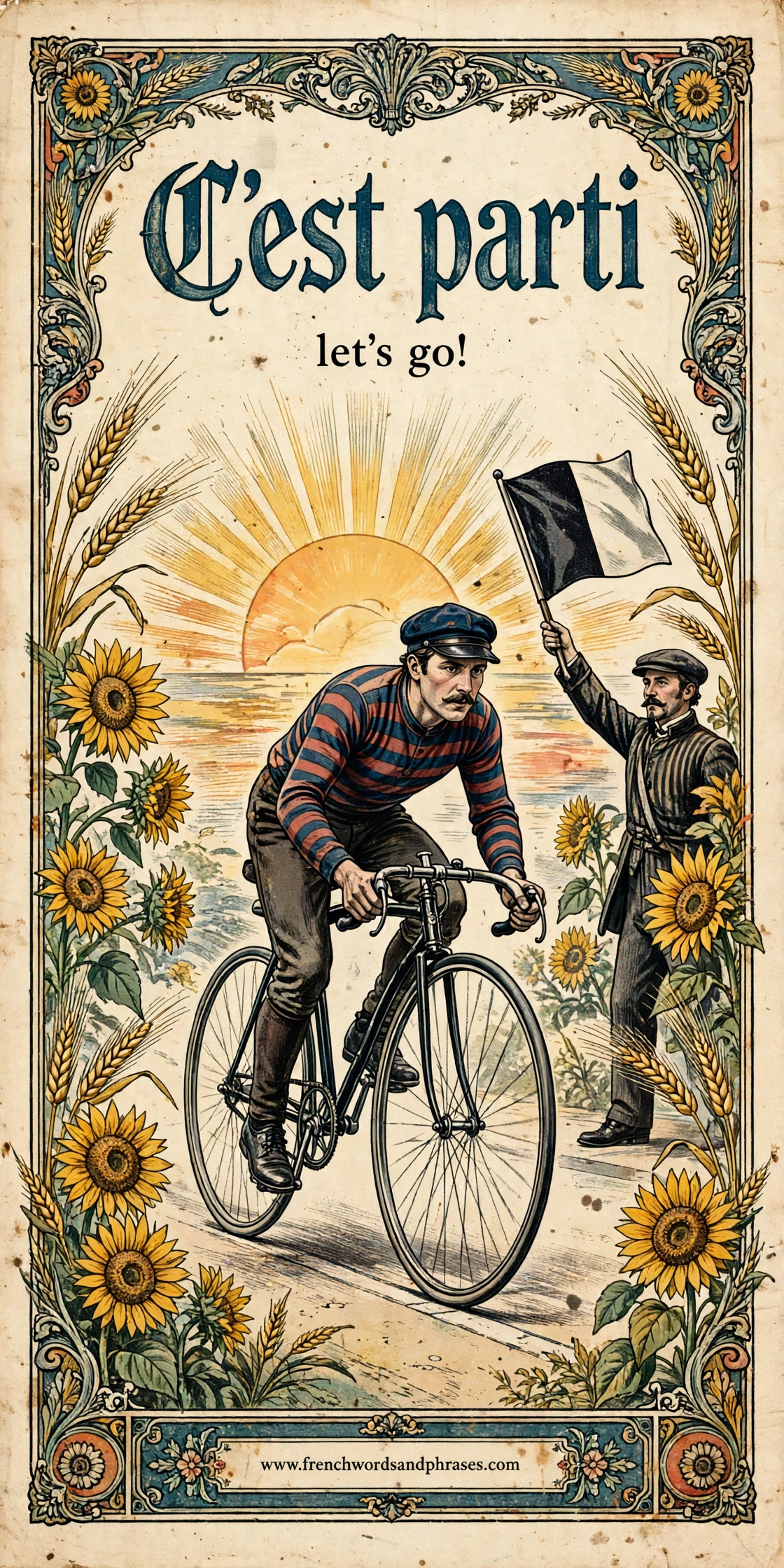
C’est parti means let’s go — off we go, here we go, it’s started.
The car is loaded, the dog is in, the playlist is ready, and the driver turns the key with ceremony. As the engine catches, everyone in the car says it together, like a crew launching a ship: « C’est parti ! »
Let’s explore how c’est parti works in French, beginning with the whole phrase on one card.
Understanding the French Phrase C’est parti
C’est parti is a French everyday expression built from c’est (it is) and parti, the past participle of partir (to leave, to set off). Word for word it says ‘it has set off’ — the thing, the trip, the race is no longer waiting: it has left the start line.
It is the French launch cry: let’s go, off we go, here we go. Drivers say it turning the key, cooks say it putting the cake in the oven, teams say it opening the first file of a big project. It announces that the waiting is over and the movement has begun — cheerfully, and usually with energy.
Type: Everyday expression — starting and launching (c’est + past participle)
Answers the need: Announcing that something has started, or launching it yourself
Register: Neutral to cheerful — everyday speech, safe everywhere
Strength: Bright and brisk — pure departure energy, no hesitation
One important usage detail: the phrase is frozen in the masculine singular — c’est parti — whatever is starting, because the subject is the neutral ce, the event itself. A playful extended version exists: c’est parti, mon kiki ! — an old-fashioned, jokey launch cry among friends. And when the same thing starts all over again, French says c’est reparti.
Experience the Word
C’est parti is the green light of French conversation — two words, and the whole room moves.
Imagine the village fête at the moment the band is ready, the lights are strung, the first dancers are hovering — and the mayor, or the accordionist, or simply the bravest teenager, calls it out. Nothing has happened yet, and yet everything has: the evening has officially begun. The phrase works because it speaks in the past tense about the future — as if the departure were already a fact.
French starts its journeys, recipes and revolutions with the same small ceremony. C’est parti is the sound of the handbrake coming off.
How to Use C’est parti in French: Complete Guide
Let’s explore how c’est parti works in French, beginning with the whole phrase on one card.
C’est parti at a Glance
The Whole Phrase on One Card
Real meaning, literal picture, English twin and register — c’est parti in five lines.
| Point | C’est parti |
|---|---|
| What it really means | let’s go, off we go — it has started, we are on our way |
| Word for word | it has set off — parti is the past participle of partir, to leave |
| English equivalent | let’s go! / here we go! / and we’re off! |
| Register | neutral to cheerful — everyday speech |
| Use it for | trips, races, recipes, projects — anything with a start moment |
Example
Les valises sont dans le coffre, c’est parti !
The bags are in the boot, let’s go!
Word by Word: Building the Launch
Two pieces — a neutral pointer and a departure already completed.
| Word | Literal meaning | Its job in the phrase |
|---|---|---|
| c’est | it is | points at the whole event — the trip, the race, the project — as one thing |
| parti | left, set off | the past participle of partir: the departure is presented as already done |
Example
Le compte à rebours est fini : c’est parti.
The countdown is over: here we go.
Quick Quiz 1
From which verb does parti come?
Reveal the answer
Partir — to leave, to set off. C’est parti says the leaving has already happened.
Le train est parti à l’heure.
The train left on time.
When You Say It: The Starting Moments
C’est parti fires at moments like these — a hand on the key, a finger on the button, a foot on the start line.
| Situation | Example |
|---|---|
| Setting off on a trip | tout le monde est là ? c’est parti ! — everyone here? let’s go! |
| Starting a race | trois, deux, un… c’est parti ! — three, two, one… they’re off! |
| In the kitchen | le four est chaud, c’est parti pour le gâteau — the oven is hot, the cake is on its way |
| A big project | le client a signé, c’est parti ! — the client has signed, we’re off! |
| A show begins | les lumières s’éteignent, c’est parti — the lights go down, here we go |
Example
Le départ est donné, c’est parti pour dix kilomètres.
The start is given, off we go for ten kilometres.
Make It Yours: The Launch in Every Tense of Life
The phrase is a fixed block, but it stretches with pour, reparti and a smile.
| Form | French | In English |
|---|---|---|
| The launch | c’est parti ! | let’s go! |
| With a duration | c’est parti pour deux heures de route | off we go for two hours on the road |
| Here we go again | c’est reparti ! | here we go again! |
| Playful, among friends | c’est parti, mon kiki ! | off we go! (jokey, old-fashioned) |
| Reporting | à neuf heures, c’était parti | at nine o’clock, it was under way |
| Question | c’est parti ? | are we off? / has it started? |
Example
La pluie s’arrête et c’est reparti pour la randonnée.
The rain stops and the hike is on again.
Quick Quiz 2
The meeting ends and the same problem comes back on Monday. Which form fits — c’est parti or c’est reparti?
Reveal the answer
C’est reparti — the re- says it is starting again, for better or worse.
Lundi matin, c’est reparti pour les réunions.
Monday morning, here we go again with the meetings.
Everyday Expressions: Building on the Launch
C’est parti slots into these everyday frames — each one ready to use as it stands.
| Frame | In English |
|---|---|
| c’est parti ! | let’s go! / we’re off! |
| c’est parti pour + duration | off we go for… |
| c’est reparti | here we go again |
| c’est parti, mon kiki ! | off we go! (playful, among friends) |
| et c’est parti | and off it goes |
Example
Et c’est parti pour une journée de jardinage.
And off we go for a day of gardening.
Close Cousins: The Other Ways to Start
French launches things in several voices — c’est parti announces; its cousins invite, command or count down.
| Expression | The difference |
|---|---|
| c’est parti | it has started — an announcement, the movement is under way |
| allons-y ! | let’s go! — an invitation, the group is invited to move together |
| on y va ! | let’s go! — everyday and warm, almost the same energy |
| en route ! | on the road! — for journeys, with a whiff of adventure |
| à vos marques, prêts, partez ! | on your marks, get set, go! — the official race start |
Example
Allons-y, on y va, c’est parti !
Let’s go, off we go, we’re on our way!
Quick Quiz 3
Which cousin is an invitation to the group rather than an announcement — c’est parti or allons-y?
Reveal the answer
Allons-y — it is the imperative of aller with y: ‘let us go there’. C’est parti reports that the start has happened.
Allons-y, le marché ferme à midi.
Let’s go, the market closes at noon.
C’est parti and Its Neighbours
The departure shelf around the phrase — starts, keys and countdowns.
| French | In English |
|---|---|
| le départ | the departure, the start |
| démarrer | to start (a car, a project) |
| le coup d’envoi | the kick-off, the starting signal |
| un compte à rebours | a countdown |
| prendre la route | to take to the road, to set off |
| en avant ! | forward! onwards! |
Example
Au coup d’envoi, toute l’équipe crie : c’est parti !
At the starting signal, the whole team shouts: let’s go!
Watch Out: The Traps Around C’est parti
The traps: a party that is not a party, and a participle that never agrees.
| Trap | The truth |
|---|---|
| parti is not ‘party’ | un parti is a political party; la fête is a party — c’est parti has nothing to do with either: it is partir, to leave |
| no agreement, ever | the phrase stays c’est parti even for a feminine event: la course ? c’est parti ! — the subject is the neutral ce |
| a person is different | for a person leaving, conjugate partir properly: elle est partie, ils sont partis — c’est parti is only the event cry |
| word for word in English | ‘it is left’ is not English — say let’s go, here we go, we’re off |
Example
Elle est partie tôt, mais pour le spectacle, c’est parti à vingt heures.
She left early, but for the show, it’s on at eight o’clock.
Quick Quiz 4
True or false: for a swimming race (la course), you should say c’est partie because course is feminine.
Reveal the answer
False — the phrase is frozen: c’est parti, always. The ce is neutral and the block never changes.
La course commence, c’est parti !
The race is starting, here we go!
C’est parti in Everyday French: Real-Life Examples
Now that you know the word, let’s see how c’est parti appears in everyday French.
Example 1 — On the road
Ceinture attachée ? C’est parti !
Seatbelt on? Let’s go!
Example 2 — In the kitchen
Le four est prêt, c’est parti pour la tarte.
The oven is ready, the tart is on its way.
Example 3 — A race
Le drapeau tombe : c’est parti !
The flag drops: they’re off!
Example 4 — At work
Le budget est validé, c’est parti pour le projet.
The budget is approved, the project is under way.
Example 5 — Again on Monday
Le week-end est fini, c’est reparti.
The weekend is over, here we go again.
Example 6 — The fête
La musique commence, c’est parti pour la danse.
The music starts, the dancing is on.
Beyond Translation: The Meaning of C’est parti
English says let’s go — a suggestion, still warm from the decision. French says c’est parti — it has already left. The French launch cry speaks of the start as a completed fact, as if the trip had voted with its wheels before the passengers finished deciding.
To say c’est parti is to lend the future a little certainty: the thing is spoken of as done, so it gets done.
That is why the phrase is shouted at start lines and whispered at oven doors with the same confidence. In French, beginnings are announced in the past tense, and somehow it works.
How to Remember the French Phrase C’est parti
Remember it this way: C’est parti is the driver turning the key with the whole car watching — the trip is spoken of as already gone, so off it goes.
- You hear the engine inside — parti is partir finished: the leaving has, grammatically, already happened.
- You never make it agree — c’est parti is a frozen block, feminine events included.
- You keep the encore ready — c’est reparti is ‘here we go again’, same phrase, second lap.
The key idea is c’est parti means let’s go — the launch cry that announces the start as already done.
Test Your Knowledge of C’est parti
Let’s see how much you’ve learned. Try answering these questions before revealing the answers.
Question 1
What does c’est parti mean?
Reveal the answer
Let’s go, off we go, here we go — the cry that announces something has started.
Question 2
Which verb is hiding inside parti?
Reveal the answer
Partir — to leave, to set off. The phrase says ‘it has set off’.
Question 3
What does c’est reparti add?
Reveal the answer
The idea of again — here we go again, the same thing starting over.
Question 4
Does the phrase change for a feminine event, like la course?
Reveal the answer
No — c’est parti is frozen in the masculine singular, because the subject is the neutral ce.
Question 5
Complete the sentence:
Tout est prêt, c’est ______ ! (Everything is ready, let’s go!)
Reveal the answer
parti
Tout est prêt, c’est parti !
Everything is ready, let’s go!
Your Final Challenge
Can You Use It?
How would you say this in French?
“The bags are packed, let’s go!”
Reveal the answer
Les valises sont faites, c’est parti !
The bags are packed, let’s go!
A little French. A little curiosity. A richer everyday life.
LEARN FRENCH ONE WORD AT A TIME