A French Word to Live By
Translate C’est enfantin to English
/sɛ.t‿ɑ̃.fɑ̃.tɛ̃/
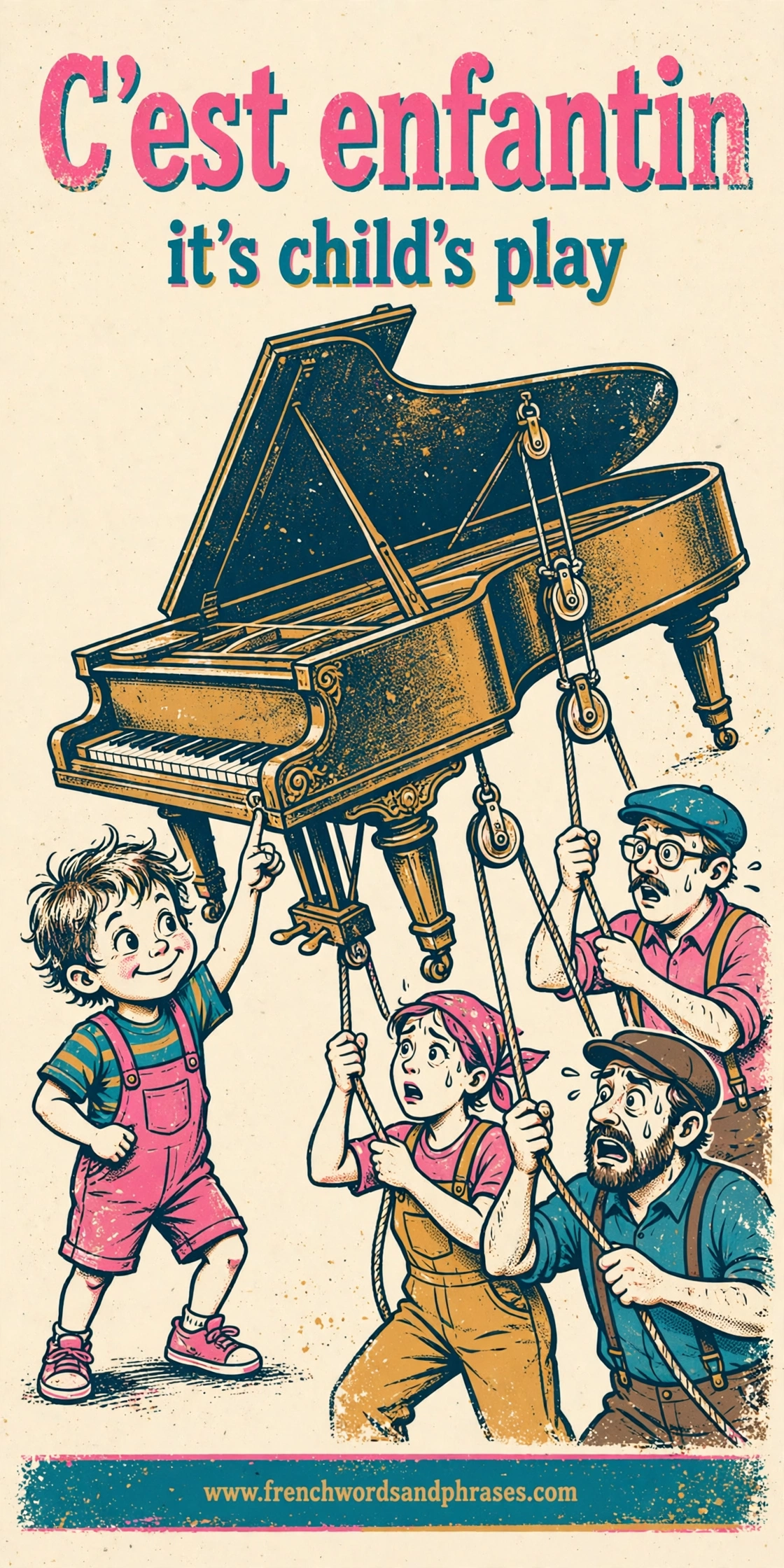
C’est enfantin means it’s child’s play — extremely easy, simple enough for a child.
Your neighbour stares at the flat-pack wardrobe instructions like they are written in ancient Greek. You take the page, glance at the diagram, pick up the screwdriver and shrug the most reassuring sentence in French DIY: « C’est enfantin, regarde. » Ten minutes later, the wardrobe is standing.
Let’s explore how c’est enfantin works in French, beginning with the whole phrase on one card.
Understanding the French Phrase C’est enfantin
C’est enfantin is a French idiomatic expression built from c’est (it is) and enfantin (childish, childlike — from enfant, a child). Said of a task, it is the highest praise French easiness can give: a child could do it.
It means it’s child’s play — a task so easy that no skill, strength or thought is required. Nobody is insulting the task: the child in the phrase is a measuring unit of simplicity. The same adjective, pointed at a grown-up’s behaviour, turns critical — enfantin can mean childish — but aimed at a task, it is pure reassurance.
Type: Idiomatic expression — easiness (c’est + adjective)
Answers the need: Saying a task is extremely easy — nothing to worry about
Register: Neutral — safe everywhere; a favourite of teachers, instructors and helpful neighbours
Strength: Maximum ease — not just easy, but child-level easy
One important usage detail: c’est enfantin is a verdict on a task, usually delivered before or during it, to encourage: tu verras, c’est enfantin. The near-relative un jeu d’enfant — a child’s game — works the same way as a noun phrase: ce montage, c’est un jeu d’enfant.
Experience the Word
C’est enfantin is the sentence that lowers shoulders — the expert’s way of saying the mountain is a molehill, and you are already standing on it.
Imagine the driving instructor on the first lesson, the swimming teacher at the shallow end, the grandmother rolling pastry with a six-year-old beside her. Each of them reaches for the same word, because it does two jobs at once: it measures the task, and it protects the learner’s pride. Nothing you are about to do, it promises, can defeat you.
French trusts children as the unit of simplicity. If a child can do it, the phrase says, fear is officially unnecessary.
How to Use C’est enfantin in French: Complete Guide
Let’s explore how c’est enfantin works in French, beginning with the whole phrase on one card.
C’est enfantin at a Glance
The Whole Phrase on One Card
Real meaning, literal picture, English twin and register — c’est enfantin in five lines.
| Point | C’est enfantin |
|---|---|
| What it really means | it’s child’s play — extremely easy, nothing to it |
| Word for word | it is childish — in the sense of ‘fit for a child’ |
| English equivalent | it’s child’s play / it’s dead easy / it’s a piece of cake |
| Register | neutral — teachers, instructors and reassuring friends |
| Use it for | instructions, recipes, exercises — any task you want to make sound small |
Example
Ce montage ? C’est enfantin, dix minutes au plus.
This assembly? It’s child’s play, ten minutes at most.
Word by Word: Building the Easiness
Two small pieces — take them one by one and the task shrinks to child size.
| Word | Literal meaning | Its job in the phrase |
|---|---|---|
| c’est | it is | the verdict frame — ce + est, pointing at the task |
| enfantin | childish, childlike | from enfant, a child — of a task: so simple a child could do it |
Example
Un exercice enfantin pour commencer la leçon.
A child’s-play exercise to start the lesson.
Quick Quiz 1
In c’est enfantin, is the task being insulted as childish?
Reveal the answer
No — aimed at a task, enfantin is praise for its simplicity: a child could do it. The insult exists only when the word is aimed at a person’s behaviour.
Cette recette est enfantine, même pour un débutant.
This recipe is child’s play, even for a beginner.
When You Say It: The Reassuring Moments
C’est enfantin fires at moments like these — a task looks big, and someone shrinks it kindly.
| Situation | Example |
|---|---|
| Before a DIY job | c’est enfantin, je te montre — it’s child’s play, I’ll show you |
| About a recipe | cette recette est enfantine — this recipe is child’s play |
| In a lesson | le premier exercice est enfantin — the first exercise is child’s play |
| About a form | le formulaire ? c’est enfantin — the form? it’s child’s play |
| Encouraging a child | tu vas voir, c’est enfantin — you’ll see, it’s child’s play |
Example
Ne t’inquiète pas pour l’inscription, c’est enfantin.
Don’t worry about the registration, it’s child’s play.
Make It Yours: The Verdict for Every Task
Enfantin agrees with its noun — enfantine for a feminine task — while c’est keeps the phrase general.
| Form | French | In English |
|---|---|---|
| The verdict | c’est enfantin | it’s child’s play |
| Feminine noun | une recette enfantine | a child’s-play recipe |
| Past verdict | c’était enfantin | it was child’s play |
| With reassurance | tu verras, c’est enfantin | you’ll see, it’s child’s play |
| As a noun phrase | c’est un jeu d’enfant | it’s a child’s game — the twin verdict |
| Question | c’est enfantin, tu crois ? | it’s child’s play, you think? |
Example
Tu verras, changer une roue, c’est enfantin.
You’ll see, changing a wheel is child’s play.
Quick Quiz 2
A recipe is feminine — une recette enfantin or une recette enfantine?
Reveal the answer
Enfantine — the adjective agrees with its noun. Only the frozen c’est enfantin keeps the masculine form.
Une recette enfantine, parfaite pour débuter.
A child’s-play recipe, perfect for starting out.
Everyday Expressions: Building on the Easiness
C’est enfantin slots into these everyday frames — each one ready to use as it stands.
| Frame | In English |
|---|---|
| c’est enfantin | it’s child’s play |
| c’est un jeu d’enfant | it’s a child’s game — the noun-phrase twin |
| tu verras, c’est enfantin | you’ll see, it’s child’s play |
| un exercice enfantin | a child’s-play exercise |
| simple et enfantin | simple and child’s play |
Example
Ce branchement, c’est un jeu d’enfant, vraiment enfantin.
This connection is a child’s game, truly child’s play.
Close Cousins: The Other Ways to Say Easy
French has a whole shelf of easiness phrases — enfantin is the child-measured one; its cousins use cake, greetings and simplicity itself.
| Expression | The difference |
|---|---|
| c’est enfantin | it’s child’s play — the child is the measuring unit |
| c’est un jeu d’enfant | it’s a child’s game — the noun-phrase twin, equally common |
| c’est du gâteau | it’s a piece of cake — the edible twin, a touch more familiar |
| c’est simple comme bonjour | it’s as easy as saying hello — the picturesque cousin |
| c’est facile | it’s easy — the plain word, no picture, no promise |
| c’est bête comme chou | it’s dead simple — literally ‘stupid like a cabbage’, humorous and familiar |
Example
Simple comme bonjour, un vrai jeu d’enfant : c’est enfantin.
Easy as hello, a real child’s game: it’s child’s play.
Quick Quiz 3
Which cousin compares the task to food — enfantin or du gâteau?
Reveal the answer
Du gâteau — c’est du gâteau is ‘it’s a piece of cake’. Enfantin measures by the child instead.
Cet examen, c’était du gâteau.
That exam was a piece of cake.
C’est enfantin and Its Neighbours
The easiness shelf around the phrase — from the child to the cake.
| French | In English |
|---|---|
| un enfant | a child |
| facile | easy |
| un jeu d’enfant | a child’s game |
| c’est enfantin | it’s child’s play |
| c’est du gâteau | it’s a piece of cake |
| simple comme bonjour | as easy as saying hello |
Example
Facile, simple, enfantin : ce devoir est un jeu d’enfant.
Easy, simple, child’s play: this homework is a child’s game.
Watch Out: The Traps Around C’est enfantin
The traps: a childish adult, an agreement that follows the noun, and confidence that must stay kind.
| Trap | The truth |
|---|---|
| the childish adult | aimed at behaviour, enfantin is a criticism — ne sois pas si enfantin, don’t be so childish; the praise only works on tasks |
| agreement follows the noun | une recette enfantine, un exercice enfantin — outside the frozen c’est, the adjective dresses for its noun |
| kind, not mocking | said of someone’s hard work, c’est enfantin can sound dismissive — the phrase reassures learners, it does not grade experts |
| not for children themselves | the phrase never describes an actual child — un enfant enfantin would be a child who is childish, a different and rather sad sentence |
Example
Pour un adulte, être enfantin est un défaut ; pour une recette, c’est un compliment.
For an adult, being childish is a flaw; for a recipe, it is a compliment.
Quick Quiz 4
True or false: c’est enfantin can describe a very young child.
Reveal the answer
False — the phrase is a verdict on tasks, never a description of a child. It measures easiness, not age.
Ce puzzle est enfantin, même pour les petits.
This puzzle is child’s play, even for the little ones.
C’est enfantin in Everyday French: Real-Life Examples
Now that you know the word, let’s see how c’est enfantin appears in everyday French.
Example 1 — The flat-pack
Ce meuble ? C’est enfantin, regarde le dessin.
This piece of furniture? It’s child’s play, look at the diagram.
Example 2 — The recipe
Cette recette est enfantine, tu vas réussir.
This recipe is child’s play, you will manage it.
Example 3 — The first lesson
Le premier exercice est enfantin, promis.
The first exercise is child’s play, I promise.
Example 4 — The form
Le formulaire en ligne, c’est enfantin.
The online form is child’s play.
Example 5 — Encouraging
Tu verras, changer une ampoule, c’est enfantin.
You’ll see, changing a light bulb is child’s play.
Example 6 — After the fact
Finalement, c’était enfantin.
In the end, it was child’s play.
Beyond Translation: The Meaning of C’est enfantin
English and French measure easiness with the same two units — the child and the cake — as if the languages had agreed in advance. But enfantin carries a shadow its English twin lacks: the word can turn, mid-sentence, from praise of a task to criticism of a person. Child’s play is never an insult in English; enfantin keeps one foot in each camp.
C’est enfantin is reassurance with a warning label — the simplest tasks and the silliest adults share one adjective.
Context, as so often in French, is the referee: point it at work and it comforts; point it at behaviour and it stings.
How to Remember the French Phrase C’est enfantin
Remember it this way: C’est enfantin is the expert’s lullaby — the task is measured against a child, and found smaller.
- You picture the measuring unit — a child could do it; that is the whole scale of the phrase.
- You agree the adjective — une recette enfantine; only the frozen c’est enfantin never changes.
- You aim it at tasks — at behaviour, enfantin turns into ‘childish’, a criticism.
The key idea is c’est enfantin means it’s child’s play — so easy a child could do it.
Test Your Knowledge of C’est enfantin
Let’s see how much you’ve learned. Try answering these questions before revealing the answers.
Question 1
What does c’est enfantin mean?
Reveal the answer
It’s child’s play — extremely easy, simple enough for a child.
Question 2
Where does enfantin come from?
Reveal the answer
From enfant, a child — the child is the measuring unit of simplicity.
Question 3
How do you say ‘this recipe is child’s play’?
Reveal the answer
Cette recette est enfantine — the adjective agrees with the feminine recette.
Question 4
What is the noun-phrase twin of the phrase?
Reveal the answer
C’est un jeu d’enfant — it’s a child’s game, the same verdict in noun form.
Question 5
Complete the sentence:
Ce montage, c’est ______, dix minutes au plus. (This assembly is child’s play, ten minutes at most.)
Reveal the answer
enfantin
Ce montage, c’est enfantin, dix minutes au plus.
This assembly is child’s play, ten minutes at most.
Your Final Challenge
Can You Use It?
How would you say this in French?
“With this recipe, the cake is child’s play.”
Reveal the answer
Avec cette recette, le gâteau, c’est enfantin.
With this recipe, the cake is child’s play.
A little French. A little curiosity. A richer everyday life.
LEARN FRENCH ONE WORD AT A TIME