A French Word to Live By
How to Conjugate Cesser in French
/se.se/
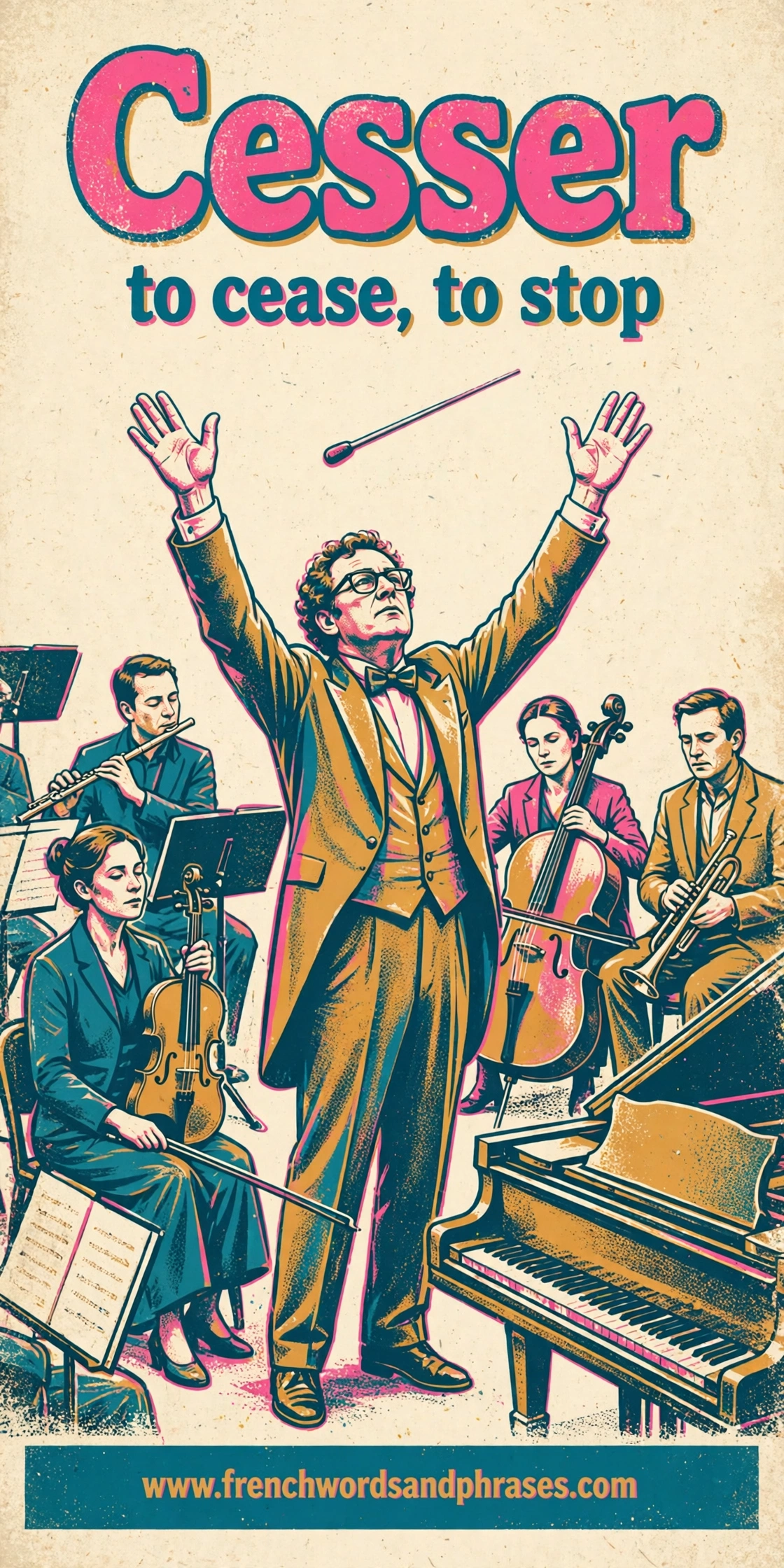
Cesser means to cease, to stop — to bring something to an end, or for rain, noise and pain to stop on their own.
Rain stopping at last over a flooded street, a factory whistle falling silent, a pain that finally lets go — cesser is the verb of the ending everyone was waiting for: what was going on, goes on no longer.
In this guide, you’ll learn how to conjugate cesser in all the major French tenses and moods. Explore complete conjugation tables, French examples, English translations, and practice quizzes.
Understanding the French Verb Cesser
Cesser is a regular French verb belonging to the first group of verbs, those ending in-er.
It means to cease, to stop. It covers both deliberate endings — cesser le travail, cesser les paiements — and natural ones: la pluie cesse, le vent cesse, la douleur cesse. Its noun is la cessation, and its adverbial shadow sans cesse (without ceasing) appears everywhere, from sans cesse répéter to travailler sans cesse.
Verb classification: First group (-er)
Auxiliary verb: Avoir
Past participle: cessé
Present participle: cessant
English equivalents: To cease, to stop; cesser de + infinitive — to stop doing something: cesser de fumer, to stop smoking; cesser le travail — to stop work, to down tools; faire cesser — to put a stop to something; ne pas cesser de — to keep on doing, to never stop; sans cesse — ceaselessly.
One important detail: cesser is built around de — cesser de fumer, cesser de pleuvoir, cesser d’attendre — and the same de serves in the great paradox of ne pas cesser de, which means the opposite of stopping: il ne cesse de pleuvoir, it keeps on raining. To make someone else stop, French causative steps in: faire cesser le bruit, to put a stop to the noise — faire cesser les travaux, to halt the works. The verb itself is perfectly regular: je cesse, nous cessons.
Experience the Word
Cesser is the verb of the longed-for silence — the moment the rain, the noise or the pain finally gives up.
Imagine a village street after three days of rain. Shutters closed, gutters roaring, nobody outside. Then, towards evening, the drumming on the roofs thins, slows, and stops — la pluie cesse, and one by one the doors open onto the shining street.
Nobody ordered it to stop. The rain ceased — a cessé — and the village came back to life.
How to Conjugate Cesser: Complete French Conjugation Guide
Let’s explore every major conjugation of cesser, beginning with the indicative mood.
How to Conjugate Cesser in the Indicative Mood
The indicative mood is used to express facts, observations, actions, and events.
How to Conjugate Cesser in the Present Tense (Présent)
Used for actions happening now, habitual actions, and general truths.
| Subject | Conjugation |
|---|---|
| je | cesse |
| tu | cesses |
| il / elle | cesse |
| nous | cessons |
| vous | cessez |
| ils / elles | cessent |
Example
La pluie cesse enfin après trois jours.
The rain is finally stopping after three days.
Quick Quiz 1
Complete the sentence:
Nous ______ le travail à midi pile.
Reveal the answer
cessons
Nous cessons le travail à midi pile.
We stop work at noon sharp.
How to Conjugate Cesser in the Passé Composé
Used for completed actions in the past. Cesser takes the auxiliary verb avoir.
| Subject | Conjugation |
|---|---|
| j’ | ai cessé |
| tu | as cessé |
| il / elle | a cessé |
| nous | avons cessé |
| vous | avez cessé |
| ils / elles | ont cessé |
Example
Les ouvriers ont cessé le travail à midi.
The workers stopped work at noon.
How to Conjugate Cesser in the Imparfait (Imperfect Tense)
Used for habitual past actions, descriptions, and ongoing situations in the past.
| Subject | Conjugation |
|---|---|
| je | cessais |
| tu | cessais |
| il / elle | cessait |
| nous | cessions |
| vous | cessiez |
| ils / elles | cessaient |
Example
Le bruit ne cessait jamais dans cette usine.
The noise never stopped in that factory.
Quick Quiz 2
Choose the correct form:
The music stopped suddenly.
La musique ______ soudain. (a cessé / est cessée)
Reveal the answer
a cessé
La musique a cessé soudain.
Cesser takes avoir.
How to Conjugate Cesser in the Plus-que-parfait
Used to describe an action that had already been completed before another past event.
| Subject | Conjugation |
|---|---|
| j’ | avais cessé |
| tu | avais cessé |
| il / elle | avait cessé |
| nous | avions cessé |
| vous | aviez cessé |
| ils / elles | avaient cessé |
Example
Elle avait cessé de fumer depuis des mois.
She had stopped smoking months before.
How to Conjugate Cesser in the Passé Simple
Primarily used in formal writing, literature, and historical narratives. It is rarely used in everyday conversation.
| Subject | Conjugation |
|---|---|
| je | cessai |
| tu | cessas |
| il / elle | cessa |
| nous | cessâmes |
| vous | cessâtes |
| ils / elles | cessèrent |
Example
Soudain, la musique cessa et tout le monde se tut.
Suddenly, the music stopped and everyone fell silent.
How to Conjugate Cesser in the Passé Antérieur
A literary tense used to express an action completed immediately before another past action, generally in the passé simple.
| Subject | Conjugation |
|---|---|
| j’ | eus cessé |
| tu | eus cessé |
| il / elle | eut cessé |
| nous | eûmes cessé |
| vous | eûtes cessé |
| ils / elles | eurent cessé |
Example
Quand la pluie eut cessé, les enfants sortirent dans la cour.
When the rain had stopped, the children went out into the yard.
How to Conjugate Cesser in the Future Tense (Futur Simple)
Used to describe actions that will take place in the future.
| Subject | Conjugation |
|---|---|
| je | cesserai |
| tu | cesseras |
| il / elle | cessera |
| nous | cesserons |
| vous | cesserez |
| ils / elles | cesseront |
Example
Le vent cessera demain matin, dit la météo.
The wind will drop tomorrow morning, says the forecast.
How to Conjugate Cesser in the Futur Antérieur (Future Perfect)
Used for an action that will have been completed before a particular point in the future.
| Subject | Conjugation |
|---|---|
| j’ | aurai cessé |
| tu | auras cessé |
| il / elle | aura cessé |
| nous | aurons cessé |
| vous | aurez cessé |
| ils / elles | auront cessé |
Example
À minuit, la fête aura cessé depuis longtemps.
By midnight, the party will have been over for a long time.
How to Conjugate Cesser in the Near Future (Futur Proche)
Used to describe something that is going to happen soon. Formed with aller + infinitive.
| Subject | Conjugation |
|---|---|
| je | vais cesser |
| tu | vas cesser |
| il / elle | va cesser |
| nous | allons cesser |
| vous | allez cesser |
| ils / elles | vont cesser |
Example
Regarde le ciel : la pluie va cesser.
Look at the sky: the rain is going to stop.
How to Conjugate Cesser in the Conditional Mood
The conditional mood expresses what would happen under certain circumstances. It is also frequently used to make polite requests or express wishes.
How to Conjugate Cesser in the Present Conditional
| Subject | Conjugation |
|---|---|
| je | cesserais |
| tu | cesserais |
| il / elle | cesserait |
| nous | cesserions |
| vous | cesseriez |
| ils / elles | cesseraient |
Example
Sans ce mur, le bruit ne cesserait jamais.
Without this wall, the noise would never stop.
How to Conjugate Cesser in the Past Conditional
| Subject | Conjugation |
|---|---|
| j’ | aurais cessé |
| tu | aurais cessé |
| il / elle | aurait cessé |
| nous | aurions cessé |
| vous | auriez cessé |
| ils / elles | auraient cessé |
Example
Le maire aurait fait cesser les travaux si le bruit avait dépassé les limites.
The mayor would have put a stop to the works if the noise had exceeded the limits.
Cesser in the Literary Past Conditional Form
This less common literary form uses the imperfect subjunctive of avoir.
| Subject | Conjugation |
|---|---|
| j’ | eusse cessé |
| tu | eusses cessé |
| il / elle | eût cessé |
| nous | eussions cessé |
| vous | eussiez cessé |
| ils / elles | eussent cessé |
Example
Elle eût cessé ses plaintes si on l’avait écoutée dès le début.
She would have stopped her complaints if she had been listened to from the start.
How to Conjugate Cesser in the Subjunctive Mood
The subjunctive is used to express wishes, emotions, doubts, necessity, and uncertainty. It frequently follows expressions such as il faut que (it is necessary that) or bien que (although).
How to Conjugate Cesser in the Present Subjunctive
| Subject | Conjugation |
|---|---|
| que je | cesse |
| que tu | cesses |
| qu’il / qu’elle | cesse |
| que nous | cessions |
| que vous | cessiez |
| qu’ils / qu’elles | cessent |
Example
Il est temps que le bruit cesse dans la cour.
It is time the noise stopped in the yard.
Quick Quiz 3
Complete the sentence using the subjunctive:
On attend que la pluie ______ pour partir.
Reveal the answer
cesse
On attend que la pluie cesse pour partir.
We are waiting for the rain to stop before leaving.
How to Conjugate Cesser in the Imperfect Subjunctive
A literary tense, rarely encountered in modern spoken French.
| Subject | Conjugation |
|---|---|
| que je | cessasse |
| que tu | cessasses |
| qu’il / qu’elle | cessât |
| que nous | cessassions |
| que vous | cessassiez |
| qu’ils / qu’elles | cessassent |
Example
On attendait que la pluie cessât pour partir.
We were waiting for the rain to stop before leaving.
How to Conjugate Cesser in the Pluperfect Subjunctive
A literary construction used to express an action completed before another past action.
| Subject | Conjugation |
|---|---|
| que j’ | eusse cessé |
| que tu | eusses cessé |
| qu’il / qu’elle | eût cessé |
| que nous | eussions cessé |
| que vous | eussiez cessé |
| qu’ils / qu’elles | eussent cessé |
Example
Je ne croyais pas qu’il eût cessé de fumer si vite.
I did not think he had stopped smoking so quickly.
How to Conjugate Cesser in the Past Subjunctive
| Subject | Conjugation |
|---|---|
| que j’ | aie cessé |
| que tu | aies cessé |
| qu’il / qu’elle | ait cessé |
| que nous | ayons cessé |
| que vous | ayez cessé |
| qu’ils / qu’elles | aient cessé |
Example
Je suis ravi qu’elle ait cessé de s’inquiéter.
I am delighted she has stopped worrying.
How to Conjugate Cesser in the Imperative
The imperative is used to give commands, instructions, invitations, or suggestions. Subject pronouns are omitted.
How to Conjugate Cesser in the Present Imperative
| Person | Conjugation |
|---|---|
| (tu) | cesse |
| (nous) | cessons |
| (vous) | cessez |
Example
Cessez ce bruit, les enfants dorment !
Stop that noise, the children are asleep!
Quick Quiz 4
How would you say Stop crying (tu form)?
Reveal the answer
Cesse de pleurer !
French Participles of Cesser
Participles are verb forms that can be used in compound tenses and other grammatical constructions.
Present Participle of Cesser
cessant
En cessant de fumer, il a retrouvé le souffle.
By stopping smoking, he got his breath back.
Past Participle of Cesser
cessé
À peine cessée, la pluie recommença de plus belle.
Hardly had the rain stopped than it started again harder than ever.
Cesser in Everyday French: Real-Life Examples
Now that you know the conjugations, let’s see how cesser appears in everyday French.
Example 1 — Present
La pluie cesse enfin.
The rain is finally stopping.
Example 2 — Passé composé
Les ouvriers ont cessé le travail à midi.
The workers stopped work at noon.
Example 3 — Imparfait
Le bruit ne cessait jamais dans cette usine.
The noise never stopped in that factory.
Example 4 — Future
Le vent cessera demain matin.
The wind will drop tomorrow morning.
Example 5 — Conditional
Sans ce mur, le bruit ne cesserait jamais.
Without this wall, the noise would never stop.
Example 6 — Imperative
Cesse de pleurer, tout va bien !
Stop crying, everything is fine!
Beyond Translation: The Meaning of Cesser
Latin cessare means to delay, to idle, to leave off — the root of English cease and cessation, and of the French legal phrase cessation de paiements, the suspension of payments that announces a bankruptcy.
Its finest trick is the negative.
Ne pas cesser de turns the verb of stopping into the verb of never stopping: elle ne cesse de travailler — she never stops working. The ending that means its own opposite.
How to Remember the French Verb Cesser
Remember it this way: Cesser is about the rain stopping at last — and ne pas cesser de, never stopping.
- Cesser takes de: cesser de fumer, cesser de pleuvoir — and faire cesser puts a stop to someone else’s noise.
- The paradox: ne pas cesser de means to keep on — il ne cesse de pleuvoir, it keeps raining.
- Regular -er: je cesse, nous cessons, past participle cessé.
The key idea is the rain stopping at last — and ne pas cesser de, never stopping.
Test Your Knowledge of Cesser
Let’s see how much you’ve learned. Try answering these questions before revealing the answers.
Question 1
How do you say to put a stop to the noise in French?
Reveal the answer
Faire cesser le bruit — the causative faire cesser means to put a stop to something: le maire a fait cesser les travaux.
Question 2
How do you say The workers stopped work at noon in French?
Reveal the answer
Les ouvriers ont cessé le travail à midi.
Question 3
Translate: It keeps on raining.
Reveal the answer
Il ne cesse de pleuvoir.
Question 4
What is the past participle of cesser?
Reveal the answer
Cessé.
Question 5
Complete the sentence:
Il est temps que le bruit ______ dans la cour.
Reveal the answer
cesse
Il est temps que le bruit cesse dans la cour.
It is time the noise stopped in the yard.
Your Final Challenge
Can You Use It?
How would you say this in French?
The rain stops, the roofs steam in the sun, and the village breathes again.
Reveal the answer
La pluie cesse, les toits fument au soleil, et le village respire.
The rain stops, the roofs steam in the sun, and the village breathes again.
A little French. A little curiosity. A richer everyday life.
LEARN FRENCH ONE WORD AT A TIME