A French Word to Live By
How to Conjugate Cémenter in French
/se.mɑ̃.te/
Cémenter means to cement — in the workshop sense: to harden the skin of steel by heating it packed in carbon.
A steelworks furnace glowing at dawn, gears and blades packed in carbon powder, a smith drawing out a part whose surface has turned harder than its heart — cémenter is the metallurgist’s verb: to case-harden steel so that tools, gears and blades can survive a working life.
In this guide, you’ll learn how to conjugate cémenter in all the major French tenses and moods. Explore complete conjugation tables, French examples, English translations, and practice quizzes.
Understanding the French Verb Cémenter
Cémenter is a regular French verb belonging to the first group of verbs, those ending in-er.
It means to cement. It is a technical verb of metallurgy and materials science: watch parts, gears, pinions and blades are cémentés to resist wear. Outside the workshop you will meet it almost only in its noun, la cémentation — the process itself, in steelmaking and in geology alike.
Verb classification: First group (-er)
Auxiliary verb: Avoir
Past participle: cémenté
Present participle: cémentant
English equivalents: To cement, to case-harden; cémenter l’acier — to case-harden steel; cémenter une lame — to cement a blade; cémenter des engrenages — to case-harden gears; la cémentation — case-hardening, carburizing; le cément — the carburizing compound.
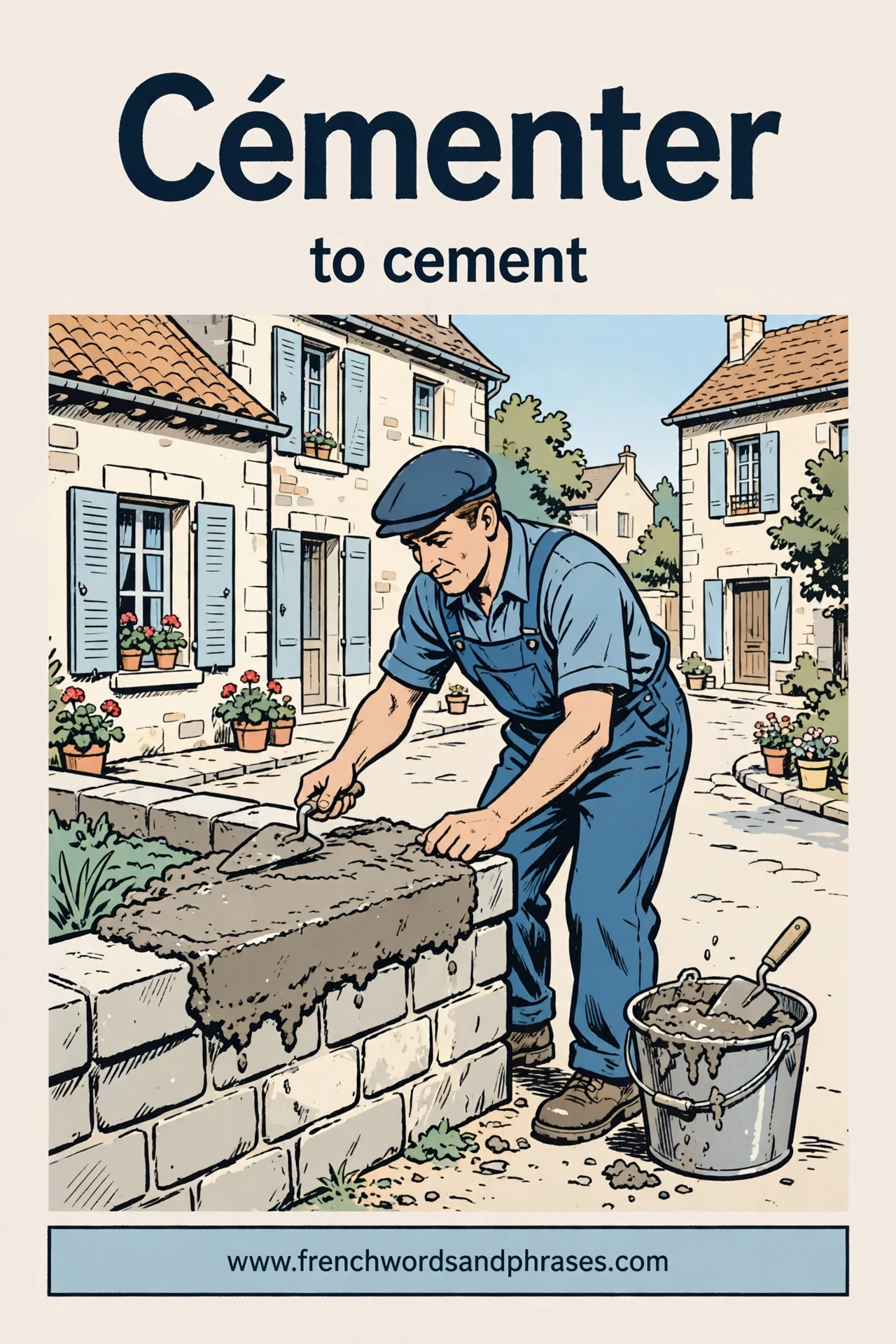
One important detail: cémenter is NOT cimenter. Cimenter is the builder’s verb — to cement a wall, and figuratively to cement a friendship. Cémenter is the metallurgist’s: to case-harden steel by heating it in a carbon-rich cément so the surface absorbs carbon and turns hard while the core stays tough. The verb itself is perfectly regular (je cémente, nous cémentons, participle cémenté) and lives in forges, factories and engineering manuals; geologists also use la cémentation for the natural cementing of sediments into rock.
Experience the Word
Cémenter is the verb of the hard skin — soft steel goes into the furnace and comes out armoured.
Imagine the night shift at the forge. The gears are packed in boxes of glowing carbon, the furnace roars for six hours, and the smith watches the clock: on cémente lentement, because a gear that is hard all through would shatter, and a gear that is soft would wear away — only the skin must turn to armour.
The gear looks unchanged. It has been cemented — cémenté — and it will outlive the machine it serves.
How to Conjugate Cémenter: Complete French Conjugation Guide
Let’s explore every major conjugation of cémenter, beginning with the indicative mood.
How to Conjugate Cémenter in the Indicative Mood
The indicative mood is used to express facts, observations, actions, and events.
How to Conjugate Cémenter in the Present Tense (Présent)
Used for actions happening now, habitual actions, and general truths.
| Subject | Conjugation |
|---|---|
| je | cémente |
| tu | cémentes |
| il / elle | cémente |
| nous | cémentons |
| vous | cémentez |
| ils / elles | cémentent |
Example
L’atelier cémente les engrenages avant le montage.
The workshop case-hardens the gears before assembly.
Quick Quiz 1
Complete the sentence:
Nous ______ les pignons ce matin.
Reveal the answer
cémentons
Nous cémentons les pignons ce matin.
We are case-hardening the pinions this morning.
How to Conjugate Cémenter in the Passé Composé
Used for completed actions in the past. Cémenter takes the auxiliary verb avoir.
| Subject | Conjugation |
|---|---|
| j’ | ai cémenté |
| tu | as cémenté |
| il / elle | a cémenté |
| nous | avons cémenté |
| vous | avez cémenté |
| ils / elles | ont cémenté |
Example
Ils ont cémenté les pièces d’acier pendant six heures.
They cemented the steel parts for six hours.
How to Conjugate Cémenter in the Imparfait (Imperfect Tense)
Used for habitual past actions, descriptions, and ongoing situations in the past.
| Subject | Conjugation |
|---|---|
| je | cémentais |
| tu | cémentais |
| il / elle | cémentait |
| nous | cémentions |
| vous | cémentiez |
| ils / elles | cémentaient |
Example
Autrefois, on cémentait l’acier dans des caisses de charbon.
In the old days, steel was case-hardened in boxes of charcoal.
Quick Quiz 2
Choose the correct form:
The smith case-hardened the blade.
Le forgeron ______ la lame. (a cémenté / est cémenté)
Reveal the answer
a cémenté
Le forgeron a cémenté la lame.
Cémenter takes avoir.
How to Conjugate Cémenter in the Plus-que-parfait
Used to describe an action that had already been completed before another past event.
| Subject | Conjugation |
|---|---|
| j’ | avais cémenté |
| tu | avais cémenté |
| il / elle | avait cémenté |
| nous | avions cémenté |
| vous | aviez cémenté |
| ils / elles | avaient cémenté |
Example
Le forgeron avait cémenté la lame avant de la tremper.
The smith had case-hardened the blade before quenching it.
How to Conjugate Cémenter in the Passé Simple
Primarily used in formal writing, literature, and historical narratives. It is rarely used in everyday conversation.
| Subject | Conjugation |
|---|---|
| je | cémentai |
| tu | cémentas |
| il / elle | cémenta |
| nous | cémentâmes |
| vous | cémentâtes |
| ils / elles | cémentèrent |
Example
L’usine cémenta mille pièces en une semaine.
The factory case-hardened a thousand parts in one week.
How to Conjugate Cémenter in the Passé Antérieur
A literary tense used to express an action completed immediately before another past action, generally in the passé simple.
| Subject | Conjugation |
|---|---|
| j’ | eus cémenté |
| tu | eus cémenté |
| il / elle | eut cémenté |
| nous | eûmes cémenté |
| vous | eûtes cémenté |
| ils / elles | eurent cémenté |
Example
Quand il eut cémenté l’outil, il le plongea dans l’huile.
When he had cemented the tool, he plunged it into oil.
How to Conjugate Cémenter in the Future Tense (Futur Simple)
Used to describe actions that will take place in the future.
| Subject | Conjugation |
|---|---|
| je | cémenterai |
| tu | cémenteras |
| il / elle | cémentera |
| nous | cémenterons |
| vous | cémenterez |
| ils / elles | cémenteront |
Example
Demain, nous cémenterons la nouvelle série de pignons.
Tomorrow, we will case-harden the new batch of pinions.
How to Conjugate Cémenter in the Futur Antérieur (Future Perfect)
Used for an action that will have been completed before a particular point in the future.
| Subject | Conjugation |
|---|---|
| j’ | aurai cémenté |
| tu | auras cémenté |
| il / elle | aura cémenté |
| nous | aurons cémenté |
| vous | aurez cémenté |
| ils / elles | auront cémenté |
Example
À midi, ils auront cémenté toutes les pièces du moteur.
By noon, they will have case-hardened all the engine parts.
How to Conjugate Cémenter in the Near Future (Futur Proche)
Used to describe something that is going to happen soon. Formed with aller + infinitive.
| Subject | Conjugation |
|---|---|
| je | vais cémenter |
| tu | vas cémenter |
| il / elle | va cémenter |
| nous | allons cémenter |
| vous | allez cémenter |
| ils / elles | vont cémenter |
Example
Attention, on va cémenter l’acier, fermez le four !
Careful, we are going to cement the steel, close the furnace!
How to Conjugate Cémenter in the Conditional Mood
The conditional mood expresses what would happen under certain circumstances. It is also frequently used to make polite requests or express wishes.
How to Conjugate Cémenter in the Present Conditional
| Subject | Conjugation |
|---|---|
| je | cémenterais |
| tu | cémenterais |
| il / elle | cémenterait |
| nous | cémenterions |
| vous | cémenteriez |
| ils / elles | cémenteraient |
Example
Un four plus chaud cémenterait l’acier plus vite.
A hotter furnace would case-harden the steel faster.
How to Conjugate Cémenter in the Past Conditional
| Subject | Conjugation |
|---|---|
| j’ | aurais cémenté |
| tu | aurais cémenté |
| il / elle | aurait cémenté |
| nous | aurions cémenté |
| vous | auriez cémenté |
| ils / elles | auraient cémenté |
Example
Sans le charbon actif, ils n’auraient pas cémenté la pièce correctement.
Without the activated carbon, they would not have cemented the part properly.
Cémenter in the Literary Past Conditional Form
This less common literary form uses the imperfect subjunctive of avoir.
| Subject | Conjugation |
|---|---|
| j’ | eusse cémenté |
| tu | eusses cémenté |
| il / elle | eût cémenté |
| nous | eussions cémenté |
| vous | eussiez cémenté |
| ils / elles | eussent cémenté |
Example
L’artisan eût cémenté la lame selon l’ancienne méthode.
The craftsman would have case-hardened the blade by the old method.
How to Conjugate Cémenter in the Subjunctive Mood
The subjunctive is used to express wishes, emotions, doubts, necessity, and uncertainty. It frequently follows expressions such as il faut que (it is necessary that) or bien que (although).
How to Conjugate Cémenter in the Present Subjunctive
| Subject | Conjugation |
|---|---|
| que je | cémente |
| que tu | cémentes |
| qu’il / qu’elle | cémente |
| que nous | cémentions |
| que vous | cémentiez |
| qu’ils / qu’elles | cémentent |
Example
Il faut que l’ouvrier cémente la pièce à la bonne température.
The worker must cement the part at the right temperature.
Quick Quiz 3
Complete the sentence using the subjunctive:
Il faut que tu ______ l’acier avant midi.
Reveal the answer
cémentes
Il faut que tu cémentes l’acier avant midi.
You must case-harden the steel before noon.
How to Conjugate Cémenter in the Imperfect Subjunctive
A literary tense, rarely encountered in modern spoken French.
| Subject | Conjugation |
|---|---|
| que je | cémentasse |
| que tu | cémentasses |
| qu’il / qu’elle | cémentât |
| que nous | cémentassions |
| que vous | cémentassiez |
| qu’ils / qu’elles | cémentassent |
Example
On exigeait que l’atelier cémentât chaque engrenage.
It was required that the workshop case-harden every gear.
How to Conjugate Cémenter in the Pluperfect Subjunctive
A literary construction used to express an action completed before another past action.
| Subject | Conjugation |
|---|---|
| que j’ | eusse cémenté |
| que tu | eusses cémenté |
| qu’il / qu’elle | eût cémenté |
| que nous | eussions cémenté |
| que vous | eussiez cémenté |
| qu’ils / qu’elles | eussent cémenté |
Example
On vérifia que la machine eût cémenté la série entière.
They checked that the machine had cemented the whole batch.
How to Conjugate Cémenter in the Past Subjunctive
| Subject | Conjugation |
|---|---|
| que j’ | aie cémenté |
| que tu | aies cémenté |
| qu’il / qu’elle | ait cémenté |
| que nous | ayons cémenté |
| que vous | ayez cémenté |
| qu’ils / qu’elles | aient cémenté |
Example
Je suis content que vous ayez cémenté les pièces à temps.
I am glad you case-hardened the parts in time.
How to Conjugate Cémenter in the Imperative
The imperative is used to give commands, instructions, invitations, or suggestions. Subject pronouns are omitted.
How to Conjugate Cémenter in the Present Imperative
| Person | Conjugation |
|---|---|
| (tu) | cémente |
| (nous) | cémentons |
| (vous) | cémentez |
Example
Cémentez les pignons avant demain matin !
Case-harden the pinions before tomorrow morning!
Quick Quiz 4
How would you say Case-harden the blade (tu form)?
Reveal the answer
Cémente la lame !
French Participles of Cémenter
Participles are verb forms that can be used in compound tenses and other grammatical constructions.
Present Participle of Cémenter
cémentant
En cémentant l’acier, on rend sa surface presque inusable.
By case-hardening steel, you make its surface almost wear-proof.
Past Participle of Cémenter
cémenté
Cémentée pendant six heures, la pièce résiste à tous les chocs.
Cemented for six hours, the part withstands every impact.
Cémenter in Everyday French: Real-Life Examples
Now that you know the conjugations, let’s see how cémenter appears in everyday French.
Example 1 — Present
L’atelier cémente les engrenages.
The workshop case-hardens the gears.
Example 2 — Passé composé
Ils ont cémenté les pièces d’acier.
They case-hardened the steel parts.
Example 3 — Imparfait
On cémentait l’acier au charbon.
Steel was case-hardened with charcoal.
Example 4 — Future
Nous cémenterons les pignons demain.
We will case-harden the pinions tomorrow.
Example 5 — Conditional
Un four plus chaud cémenterait plus vite.
A hotter furnace would cement faster.
Example 6 — Imperative
Cémente la lame avant de la tremper !
Case-harden the blade before quenching it!
Beyond Translation: The Meaning of Cémenter
English cement and French cément both descend from Latin caementum, broken stone — but the two languages sent the word to different workshops.
In French, the forge kept cémenter and the building site took cimenter.
The steelworker’s cément was the carbon powder packed round the glowing part, and the name of the powder became the name of the process: cémenter, la cémentation — a hard skin for steel, earned in the fire.
How to Remember the French Verb Cémenter
Remember it this way: Cémenter is about glowing gears packed in carbon inside the furnace.
- Not cimenter: cémenter hardens steel in a furnace; cimenter builds walls and cements friendships.
- Its world is the forge: cémenter une lame, un engrenage, une pièce d’acier.
- Regular -er: je cémente, nous cémentons, past participle cémenté.
The key idea is glowing gears packed in carbon inside the furnace.
Test Your Knowledge of Cémenter
Let’s see how much you’ve learned. Try answering these questions before revealing the answers.
Question 1
What is the difference between cémenter and cimenter?
Reveal the answer
Cémenter case-hardens steel; cimenter is the builder’s verb, to cement with mortar.
Question 2
How do you say The workshop case-hardens the gears in French?
Reveal the answer
L’atelier cémente les engrenages.
Question 3
Translate: They case-hardened the steel parts.
Reveal the answer
Ils ont cémenté les pièces d’acier.
Question 4
What is the past participle of cémenter?
Reveal the answer
Cémenté.
Question 5
Complete the sentence:
Il faut que l’ouvrier ______ la pièce à la bonne température.
Reveal the answer
cémente
Il faut que l’ouvrier cémente la pièce à la bonne température.
The worker must cement the part at the right temperature.
Your Final Challenge
Can You Use It?
How would you say this in French?
The workshop case-hardens the gears one by one, and each comes out hard as a diamond.
Reveal the answer
L’atelier cémente les engrenages un à un, et chacun ressort dur comme un diamant.
The workshop case-hardens the gears one by one, and each comes out hard as a diamond.
A little French. A little curiosity. A richer everyday life.
LEARN FRENCH ONE WORD AT A TIME