A French Word to Live By
Translate Cause to English
/koz/
La cause means the cause.
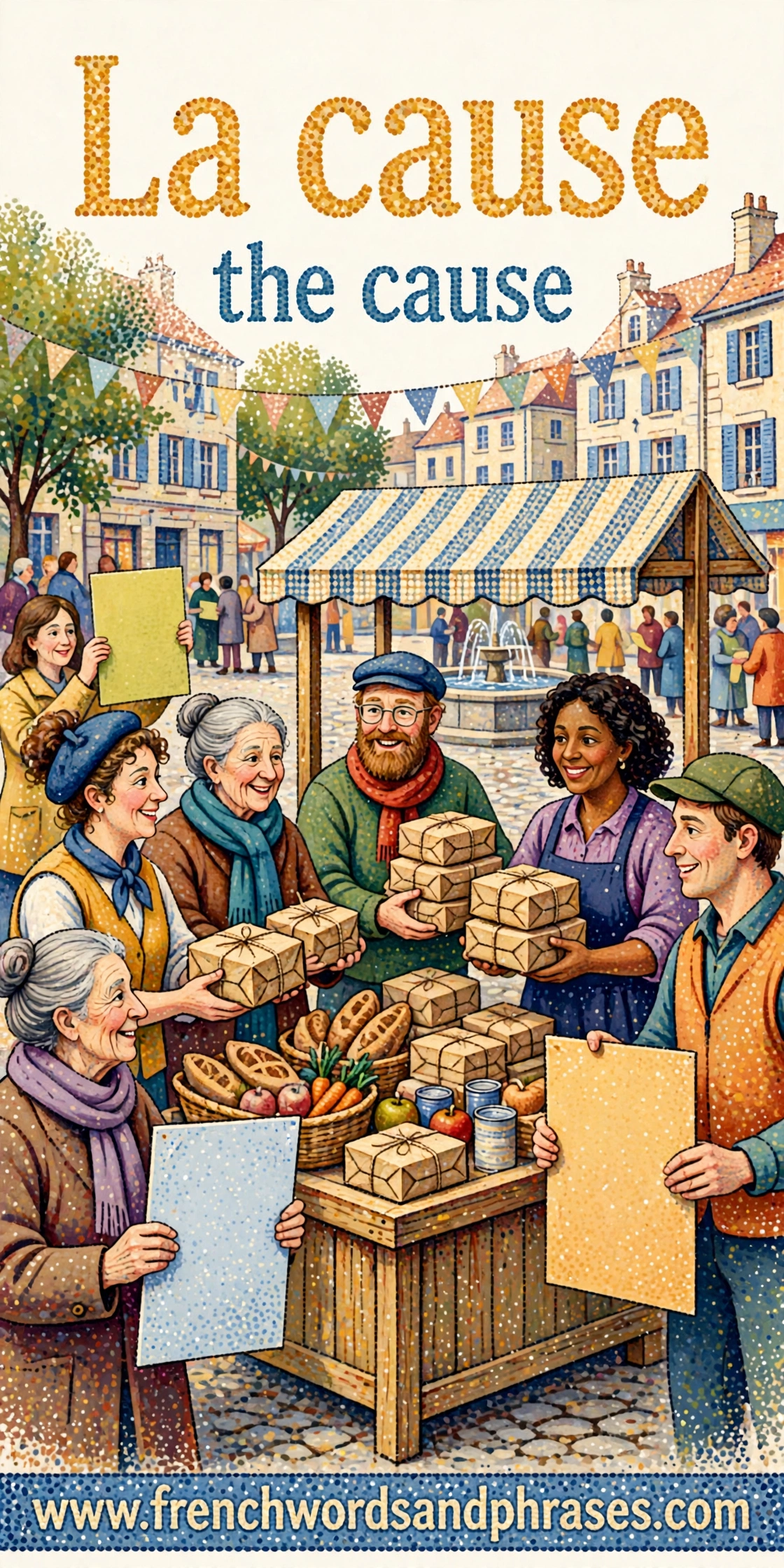
A doctor asking where the pain began; a detective at a quiet scene, notebook open; a crowd marching behind a banner for the climate. « Quelle est la cause ? » — what is the cause? La cause is the reason behind the event, and the great purpose people gather behind: two lives, one word.
In this guide, you’ll learn what cause means in English, how to use it with its articles, how to form its plural, and how it appears in everyday French. Explore French examples, English translations, and practice quizzes.
Understanding the French Noun Cause
Cause is a feminine French noun, learned with its article: la cause, une cause. It names what produces an effect — la cause de l’accident, the cause of the accident — and, with the heart, the purpose worth serving: une cause juste, a just cause; défendre une cause, to defend a cause. In law it is also the case itself: plaider une cause, to plead a case.
It means a cause. In the world of facts it answers pourquoi: chercher la cause, to look for the cause; la cause et l’effet, cause and effect. In the world of values it rallies: se battre pour une cause, to fight for a cause; une cause perdue, a lost cause. Its great everyday frame is the preposition built from it: à cause de, because of — the reason, usually unwelcome: en retard à cause de la pluie, late because of the rain.
Gender: Feminine — la cause
Definite article: la — la cause (the cause)
Indefinite article: une — une cause (a cause)
Plural: les causes — regular, with a simple -s
The reason frame: à cause de + noun — because of (usually a negative reason)
Key phrase: une cause juste — a just cause; une cause perdue — a lost cause
English equivalents: The cause; a case (in law).
One important usage detail: à cause de blames — it gives the reason for something unwelcome (à cause de la grève, because of the strike). For a welcome reason, French thanks with grâce à: grâce à toi, thanks to you. Mixing them is the classic compliment that lands as an insult.
Experience the Word
Cause is the noun of the why — the root under the event, and the banner over the crowd.
Imagine the young doctor in a village surgery, listening to an old man’s cough, asking the question her whole profession is built on: quelle est la cause ? Find the cause, and the cure has somewhere to begin.
You have not just said ‘reason’. You have named what sets the world in motion — in the body, in the courtroom, in the street.
How to Use Cause in French: Complete Guide
Let’s explore how cause works in French, beginning with its articles — la cause, une cause, à cause de la pluie.
Cause with the Definite Article (La, Les)
Used for the specific cause — the one being hunted or defended.
| Form | French |
|---|---|
| Feminine singular | la cause |
| Plural | les causes |
Example
La cause de l’incendie est inconnue.
The cause of the fire is unknown.
Cause with the Indefinite Article (Une, Des)
Used for a cause in general — one reason, one banner among many.
| Form | French |
|---|---|
| Feminine singular | une cause |
| Plural | des causes |
Example
Il se bat pour une cause juste.
He is fighting for a just cause.
Cause in Its Lives (Reason, Banner, Case)
Cause works in the laboratory, in the street and in the courtroom.
| Sense | French |
|---|---|
| a reason, an origin | la cause de la panne — the cause of the breakdown |
| a purpose | défendre une cause — to defend a cause |
| a legal case | plaider une cause — to plead a case |
| the blame frame | à cause de la pluie — because of the rain |
Example
L’avocat plaide la cause des fermiers.
The lawyer is pleading the farmers’ cause.
Quick Quiz 1
Complete the sentence:
______ cause de l’accident est claire. (the)
Reveal the answer
La
La cause de l’accident est claire.
The cause of the accident is clear.
The Plural of Cause
Cause takes a regular plural in -s.
| Number | French |
|---|---|
| Singular | la cause |
| Plural | les causes |
Example
Les causes du problème sont nombreuses.
The causes of the problem are numerous.
Cause with Possessive Adjectives (Ma, Ta, Sa…)
Cause is feminine, so the singular possessives are ma, ta, sa.
| Owner | French |
|---|---|
| my | ma cause |
| your (tu) | ta cause |
| his / her | sa cause |
| our | notre cause |
| your (vous) | votre cause |
| their | leur cause |
Example
Elle défend sa cause avec passion.
She defends her cause with passion.
Quick Quiz 2
Complete the sentence:
Il a donné sa vie pour ______ cause. (his)
Reveal the answer
sa
Il a donné sa vie pour sa cause.
He gave his life for his cause.
Cause with Demonstrative Adjectives (Cette, Ces)
Used to point: cette cause, this cause — the one on the banner.
| Form | French |
|---|---|
| Feminine singular | cette cause |
| Plural | ces causes |
Example
Cette cause rassemble tout le village.
This cause brings the whole village together.
Cause with Adjectives
Adjectives agree with cause — feminine singular.
| Adjective | With Cause |
|---|---|
| juste (just) | une cause juste |
| perdue (lost) | une cause perdue |
| principale (main) | la cause principale |
| inconnue (unknown) | une cause inconnue |
| noble (noble) | une noble cause |
Example
La cause principale de la panne est électrique.
The main cause of the breakdown is electrical.
Quick Quiz 3
Complete the sentence:
C’est une cause ______. (lost)
Reveal the answer
perdue
C’est une cause perdue.
It is a lost cause — feminine, to agree with cause.
Everyday Expressions with Cause
Blame, thanks and banners — the cause phrases of daily life.
| Expression | In English |
|---|---|
| à cause de | because of (a negative reason) |
| la cause et l’effet | cause and effect |
| une cause perdue | a lost cause |
| défendre une cause | to defend a cause |
| pour la bonne cause | for a good cause |
| en connaissance de cause | knowingly, with full knowledge |
Example
Le match est annulé à cause de la neige.
The match is cancelled because of the snow.
Words from the Same Family as Cause
The reason family — whys, becauses and thank-yous.
| French | In English |
|---|---|
| causer | to cause; also to chat (familiar) |
| une raison | a reason |
| un effet | an effect |
| grâce à | thanks to — the welcome reason |
| parce que | because (before a clause) |
Example
Grâce à la pluie, le jardin revit.
Thanks to the rain, the garden comes back to life.
Quick Quiz 4
What does à cause de mean?
Reveal the answer
Because of — for an unwelcome reason.
En retard à cause des travaux.
Late because of the roadworks.
Cause in Everyday French: Real-Life Examples
Now that you know the word, let’s see how cause appears in everyday French.
Example 1 — A breakdown
Quelle est la cause de cette panne ?
What is the cause of this breakdown?
Example 2 — Weather blame
Le train est en retard à cause de la neige.
The train is late because of the snow.
Example 3 — A march
Ils marchent pour une cause juste.
They are marching for a just cause.
Example 4 — Science
La cause et l’effet sont liés.
Cause and effect are linked.
Example 5 — A lost cause
Ne perds pas ton temps, c’est une cause perdue.
Don’t waste your time, it’s a lost cause.
Example 6 — Thanks
Grâce à ton aide, tout est fini.
Thanks to your help, everything is finished.
Beyond Translation: The Meaning of Cause
Cause is the word where French keeps its logic and its passion in one drawer: the scientist hunts la cause, the lawyer pleads la cause, the crowd marches pour la cause. Even its blame is grammatical — à cause de for the strike and the snow, grâce à for the friend and the rain that saves the garden: French sorts reasons into curses and blessings.
Every cause is a why that learned to walk.
And the same word, turned verb in familiar speech — causer — softens into chatter: causer is to talk, as if conversation were just causes exchanged gently.
How to Remember the French Noun Cause
Remember it this way: Cause is the cause — feminine: la cause, and its blame frame is à cause de.
- Always feminine — la cause, une cause, ma cause.
- The blame frame — à cause de la pluie, because of the rain.
- The banner sense — une cause juste, a just cause; une cause perdue, a lost cause.
The key idea is la cause — the cause, feminine; à cause de = because of (negative); grâce à = thanks to.
Test Your Knowledge of Cause
Let’s see how much you’ve learned. Try answering these questions before revealing the answers.
Question 1
Is cause masculine or feminine?
Reveal the answer
Feminine — la cause, une cause.
Question 2
How do you say because of the rain?
Reveal the answer
À cause de la pluie.
Question 3
Translate: He fights for a just cause.
Reveal the answer
Il se bat pour une cause juste.
Question 4
What is the difference between à cause de and grâce à?
Reveal the answer
À cause de blames (an unwelcome reason); grâce à thanks (a welcome one).
Question 5
Complete the sentence:
______ causes de la maladie sont connues. (the)
Reveal the answer
Les
Les causes de la maladie sont connues.
The causes of the illness are known.
Your Final Challenge
Can You Use It?
How would you say this in French?
“The train is late because of the snow.”
Reveal the answer
Le train est en retard à cause de la neige.
The train is late because of the snow.
A little French. A little curiosity. A richer everyday life.
LEARN FRENCH ONE WORD AT A TIME